Carma's 13-slide deck addresses a specific pain point in the emerging markets solar sector: the lack of profitability due to high operating costs and credit risk. The company positions itself as a specialized SaaS layer for PAYGO companies, offering underwriting, payment processing, and collection tools. The deck is notable for its granular unit economics, comparing margins with and without their software, and a clear roadmap for fundraising across Seed, Pre-Series A, and Series A rounds. While the visual design is minimal, the data-heavy approach provides a clear argument for how their inter…
Key takeaways
- The deck identifies a critical industry problem: PAYGO solar companies have high gross margins but are struggling to reach EBITDA positivity due to high operating costs (Slide 3).
- Carma claims its underwriting software can nearly double contribution margins from 7% to 13% by reducing default rates and collection costs (Slide 7).
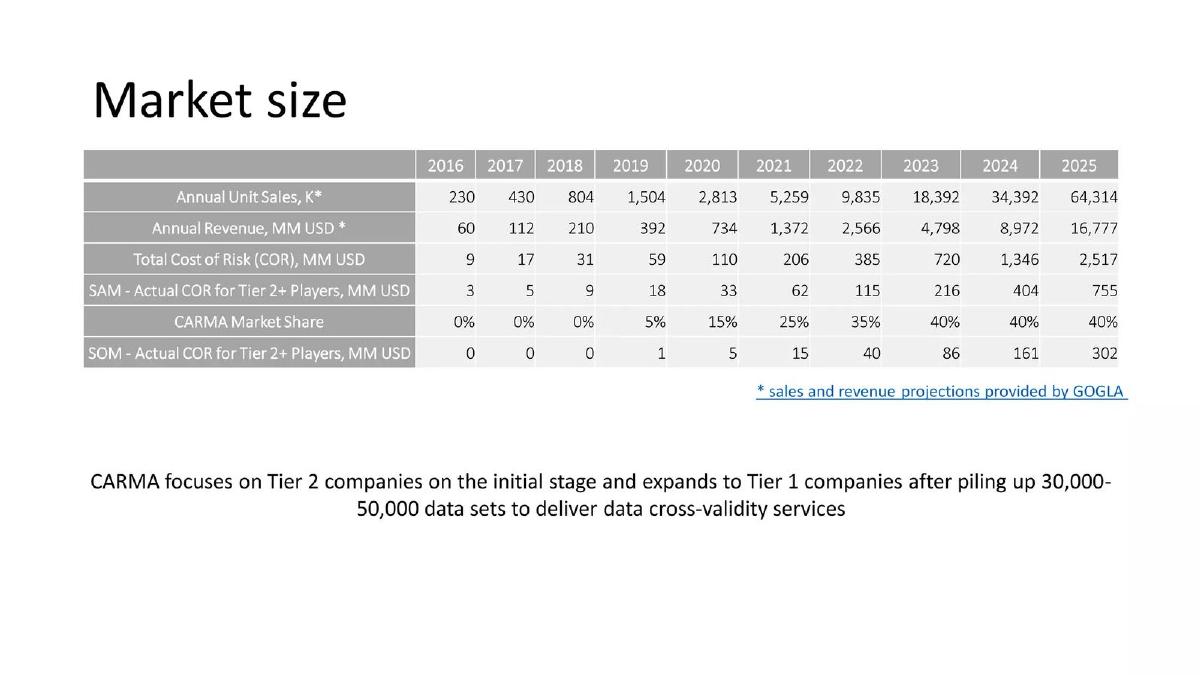
- The market size projections are aggressive, forecasting annual unit sales growing from 230k in 2016 to over 64 million by 2025 (Slide 6).
- The business model uses a granular pay-per-use structure, charging $0.25 for underwriting and $0.50 for credit scores per customer (Slide 10).
- Founder Ted Martynov leverages his background as the former CEO of SolarHome, which raised $16M in equity and debt, to prove domain expertise (Slide 11).
- The financial roadmap explicitly outlines three funding stages: a $136k Seed, a $536k Pre-Series A, and a $413k Series A (Slide 12).
- The competitive analysis admits that while no direct credit risk competitors exist, BPM platforms like Angaza are potential threats (Slide 8).
- The product suite extends beyond software into physical infrastructure, offering call-center facilities for unit repossession (Slide 9).
Executive Summary: The Infrastructure Layer for Emerging Market Energy
Carma's pitch deck is a focused, data-driven proposal for a B2B SaaS platform targeting the Pay-As-You-Go (PAYGO) solar industry. The deck foregoes flashy design in favor of dense tables and industry-specific metrics. It positions the company not just as a software provider, but as a critical financial intermediary that enables solar providers to become profitable by managing the high risks associated with lending to unbanked populations in emerging markets.
Slide 1: Title and Identity
The cover slide introduces the company name, Carma, with the subtitle "credit risk management agency." The logo features a black cat silhouette, which is a play on the phonetic similarity to "karma," though the subtitle immediately grounds the company in the financial services sector. There is no tagline or mission statement here, keeping the focus entirely on the functional category of the business.
Slide 2: Purpose
Slide 2 provides a one-sentence elevator pitch: "CARMA provides credit risk management and payment software as a service for PAYGO companies." This is a textbook example of a clear purpose statement. It identifies the product (software), the delivery model (SaaS), the primary function (credit risk/payments), and the target audience (PAYGO companies).
Slide 3: The Profitability Problem
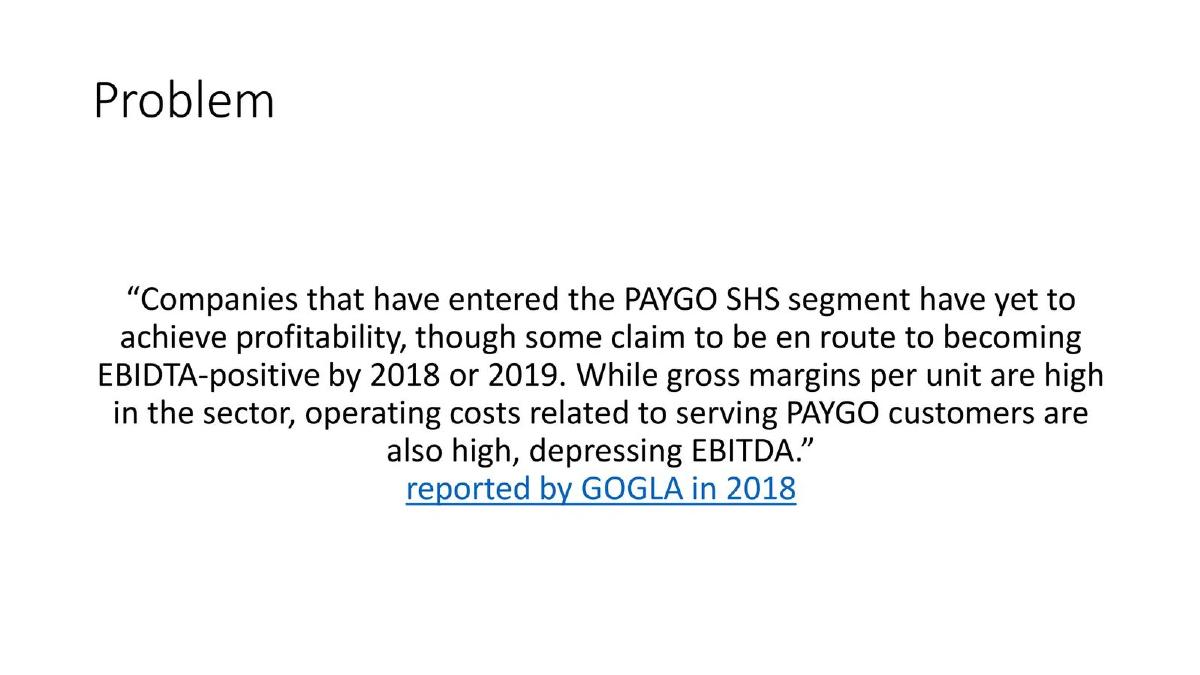
The problem slide uses an external citation from GOGLA (Global Off-Grid Lighting Association) from 2018 to establish credibility. The core issue is that PAYGO Solar Home System (SHS) companies are not yet profitable. While gross margins are high, the "operating costs related to serving PAYGO customers are also high, depressing EBITDA." This sets the stage for a solution that specifically targets operational efficiency and risk reduction rather than sales growth.
Slide 4: The Solution Suite
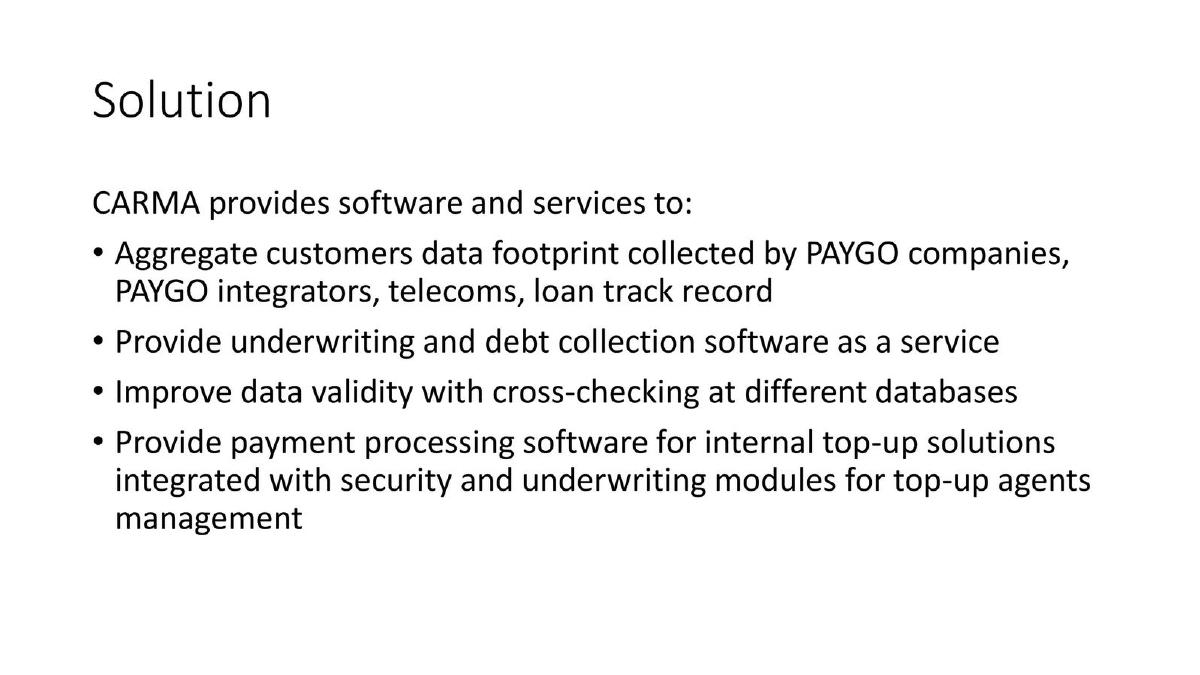
The solution is broken down into four functional pillars: data aggregation (collecting footprints from telecoms and loan records), underwriting/debt collection SaaS, data validity through cross-checking databases, and payment processing for top-up agents. This slide clarifies that Carma is a multi-module platform intended to handle the entire lifecycle of a PAYGO loan, from initial credit check to final collection.
Slide 5: Why Now - Market Momentum
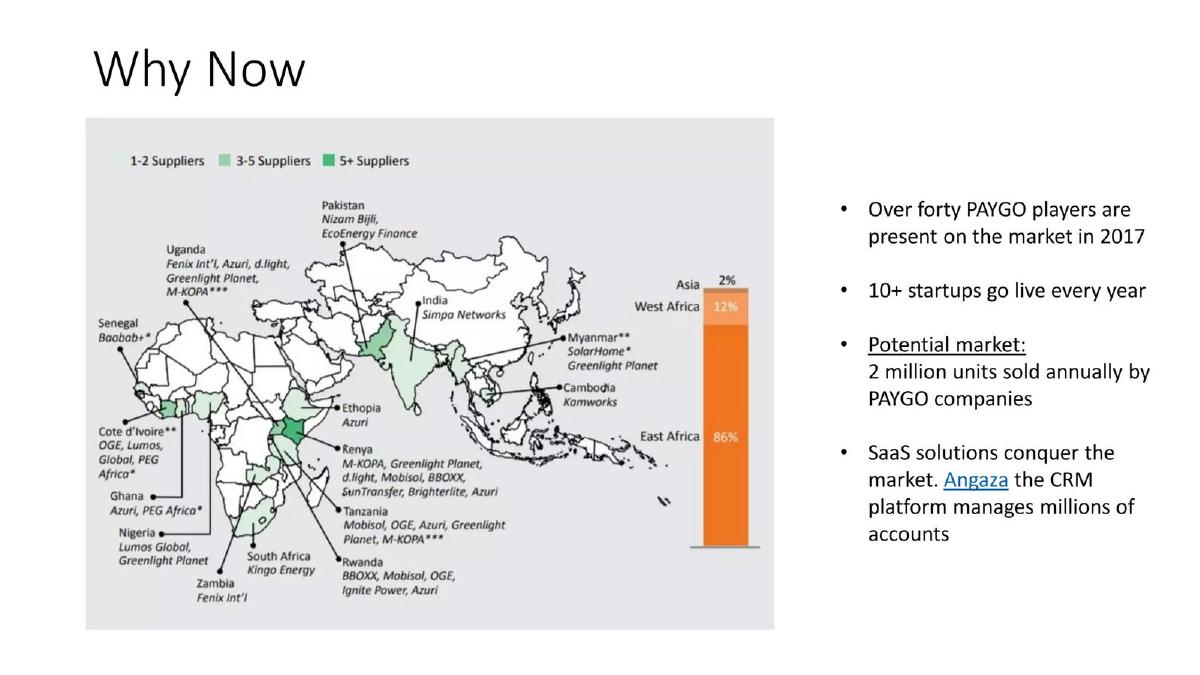
This slide uses a map to show the concentration of PAYGO suppliers in Africa and Asia. Key data points include that over 40 players were present in 2017, with 10+ new startups going live every year. It notes a potential market of 2 million units sold annually. Crucially, it mentions Angaza as a successful CRM platform in the space to prove that SaaS solutions are already "conquering the market," suggesting a validated path for specialized tools like Carma.
Slide 6: Market Size Projections
Slide 6 presents a detailed table of market projections from 2016 to 2025. It forecasts the "Total Cost of Risk (COR)" growing from $9M to over $2.5B. Carma defines its Serviceable Addressable Market (SAM) as the COR for Tier 2+ players. The company aims for a 40% market share by 2023, which would represent a Serviceable Obtainable Market (SOM) of $302M by 2025. The slide notes a strategy of starting with Tier 2 companies and moving to Tier 1 after aggregating 30,000-50,000 data sets.
Slide 7: The Value Proposition (Unit Economics)
This is arguably the most important slide in the deck. It provides a side-by-side comparison of unit economics "No UW" (Underwriting) vs. "CARMA UW." By applying Carma's tools, the default rate is projected to drop from 5% to 3%, and the asset utilization rate rises from 75% to 85%. The result is a jump in contribution margin from 7% ($9) to 13% ($16). This 2x improvement in margin is the primary selling point for potential B2B customers.
Slide 8: Competition and Advantages
Carma claims there is "no direct competition for End-customer Credit Risk Management." It lists potential competitors like Angaza Design and Solaris Offgrid but categorizes them as BPM (Business Process Management) platforms. Carma argues its advantage is being "non-contradictory" to these platforms, meaning it can sit on top of existing CRMs. It also highlights its built-in call center and payment processing infrastructure as unique differentiators.
Slide 9: Product Deep-Dive
The product slide lists specific features: blacklists, credit scoring, digital routing for unit repossession, and a mobile app for top-up agents. By including "units repossession" and "call-center facilities," Carma signals that its solution includes an operational component, acknowledging that software alone cannot solve credit risk in markets where physical assets must be recovered.
Slide 10: Business Model and Revenue Mix
The business model is a granular fee structure. Revenue is split between Underwriting (33%), Payments (37%), Routing (20%), and Call-center (10%). The fees are small—$0.25 to $0.50 per customer—but the slide illustrates how these add up to $90,500 in revenue across a sample base of 30,000 customers. This demonstrates a clear path to scaling revenue alongside the customer's growth.
Slide 11: The Team and Track Record
The deck focuses entirely on founder Ted Martynov. His pedigree is strong: co-founder and former CEO of SolarHome. The slide lists SolarHome's achievements—430 employees, 30,000 customers, and $16M raised—to prove that the founder has already successfully built a company in the exact sector Carma is now serving. This reduces the "execution risk" in the eyes of an investor.
Slide 12: Financial Roadmap
The financial slide outlines three distinct phases. The Seed round ($136k) covers months 1-6 to build the MVP. The Pre-Series A ($536k) covers months 7-18 for the payment solution. The Series A ($413k) targets months 19-36. By month 36, the company projects $4.34M in revenue and $756k in EBITDA. The relatively small size of the Series A ($413k) compared to the Pre-Series A ($536k) is unusual and may suggest a typo or a very specific capital efficiency plan.
Slide 13: Contact Information
The final slide provides direct contact details for Ted Martynov, including a WhatsApp number and LinkedIn profile. It is a standard, functional closing slide.
What Works Well in This Deck
Specific Industry Insight: The deck identifies a very specific, high-value problem (EBITDA depression in PAYGO) that only an industry insider would fully appreciate. · Comparative Unit Economics: Slide 7 is a masterclass in showing value. By showing exactly how the product changes the bottom line for a customer, they move the conversation from "cost" to "ROI." · Founder-Market Fit: The founder's history with SolarHome is the strongest piece of evidence in the deck. It proves he understands the customer's pain points because he lived them as a CEO. · Granular Pricing: The business model slide shows that the founders have thought through every touchpoint where they can extract value without becoming a burden to the customer's cash flow.
What Is Missing or Could Be Improved
Visual Design: The deck is visually very plain, using standard fonts and basic tables. While the data is good, a more professional design could help convey the "tech" nature of the SaaS platform. · Team Depth: The team slide only mentions the founder. Investors usually want to see a CTO or a head of operations, especially for a product that involves complex data cross-validation and physical call centers. · Technology Detail: For a company claiming to use "non-proprietary data for cross-validation," there is very little detail on how the data is actually accessed or secured. In the fintech space, data privacy and API integrations are major hurdles. · Series A Logic: The fundraising table on Slide 12 shows a Series A round that is smaller than the Pre-Series A. This is counter-intuitive in venture capital and requires a clear explanation of why capital needs would decrease as the company scales.
Founder Lessons: What to Copy
Use the 'Side-by-Side' Value Prop: If your software saves money or increases efficiency, do not just say it—show the math. The table on Slide 7 is the most persuasive element of the entire deck. · Leverage External Reports: Using a GOGLA report to define the problem (Slide 3) makes the problem feel like an industry-wide truth rather than just the founder's opinion. · Define Your 'Why Now' with Market Saturation: Instead of just saying the market is big, Slide 5 shows that the market is maturing with 40+ players, creating a secondary market for infrastructure tools like Carma.
Frequently asked questions
- What is the specific problem Carma is solving?
- Carma addresses the 'profitability gap' in the Pay-As-You-Go (PAYGO) Solar Home System (SHS) market. According to Slide 3, while these companies have high gross margins, their operating costs related to serving customers are so high that most were not EBITDA positive as of 2018. Carma provides the credit risk and payment infrastructure to lower these costs.
- How does Carma make money?
- The company uses a pay-as-you-go SaaS model. As detailed on Slide 10, they charge per-transaction fees such as $0.25 for underwriting data cross-validation, $0.50 for credit scores, and $0.05 for agent app transactions. They also charge license fees for call center agents ($900) and dispatchers ($1,000).
- What are the projected unit economics for a customer using Carma?
- Slide 7 provides a side-by-side comparison. Without Carma, a unit has a contribution margin of $9 (7%). With Carma's underwriting (UW), the default rate drops from 5% to 3%, and collection costs drop from $4 to $2, resulting in a contribution margin of $16 (13%).
- Who is the founder and what is their track record?
- The company was founded by Ted Martynov. Slide 11 highlights his experience as the co-founder and former CEO of SolarHome, a PAYGO leader in Southeast Asia that raised $6 million in equity and $10 million in debt. This background suggests deep operational knowledge of the exact customers Carma targets.
- What is the fundraising ask in this deck?
- Slide 12 outlines a multi-stage fundraising plan. It lists a Seed round of $136k to build the MVP (Underwriting + Call Center), followed by a Pre-Series A of $536k for payment solutions and routing, and finally a Series A of $413k to reach a projected $4.3M in revenue by month 36.