Casai’s Series A deck is a masterclass in brand-led storytelling, leveraging high-quality photography to sell a lifestyle rather than just a real estate play. By positioning themselves at the intersection of boutique hotels, Airbnb, and smart homes, they successfully carved out a premium niche in the Latin American market. The deck focuses heavily on the 'nomadic generation' and the lack of consistency in existing short-term rentals. While it lacks granular financial data or unit economics, it compensates with a powerful 'social proof' slide featuring Andreessen Horowitz, Monashees, and Kasze…
Key takeaways
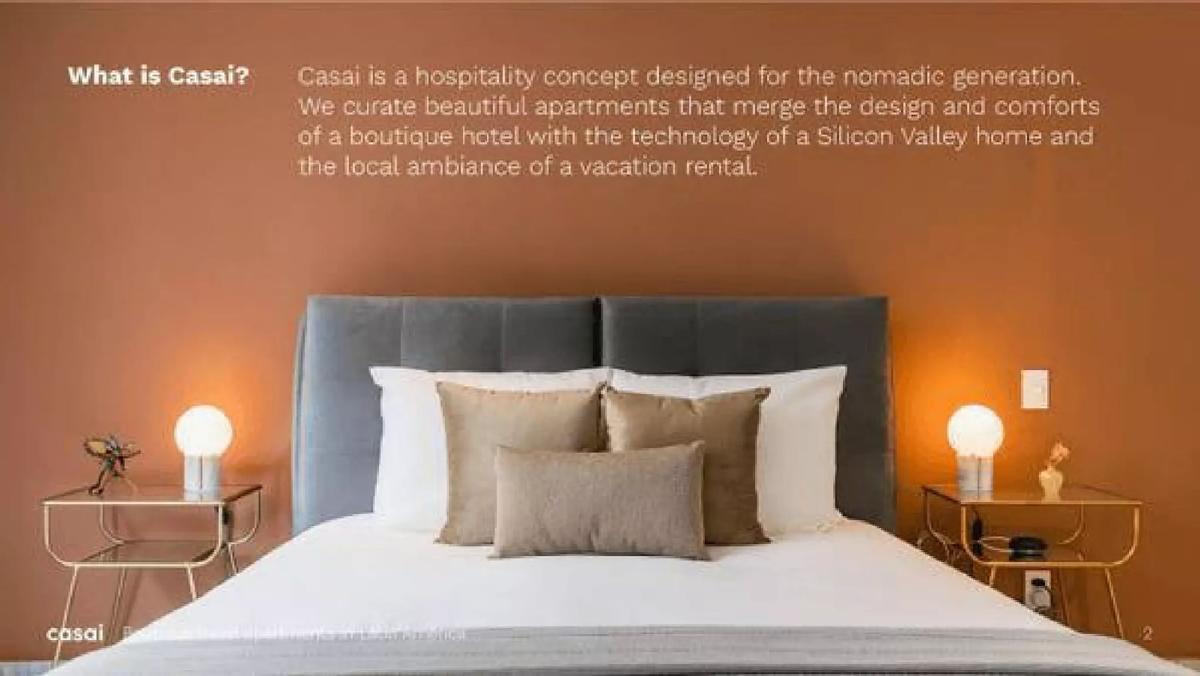
- The deck defines Casai as a 'hospitality concept designed for the nomadic generation' on slide 2.
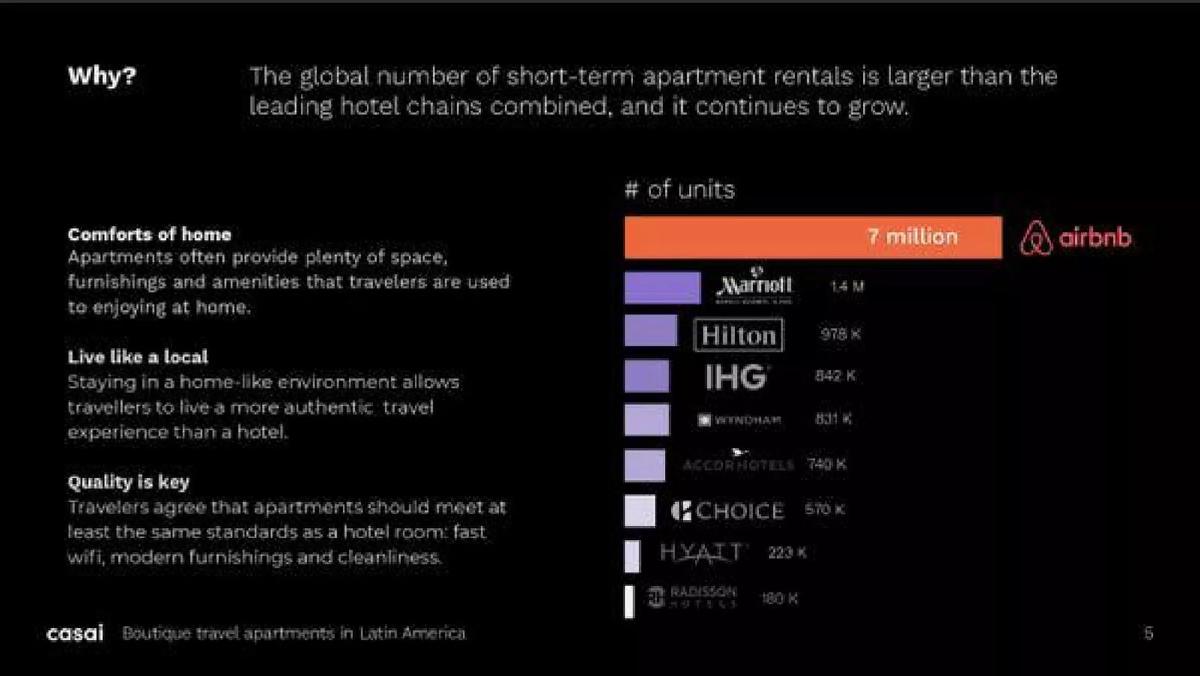
- Market size is framed by comparing Airbnb's 7 million units against major hotel chains like Marriott (1.4M) and Hilton (978K) on slide 5.
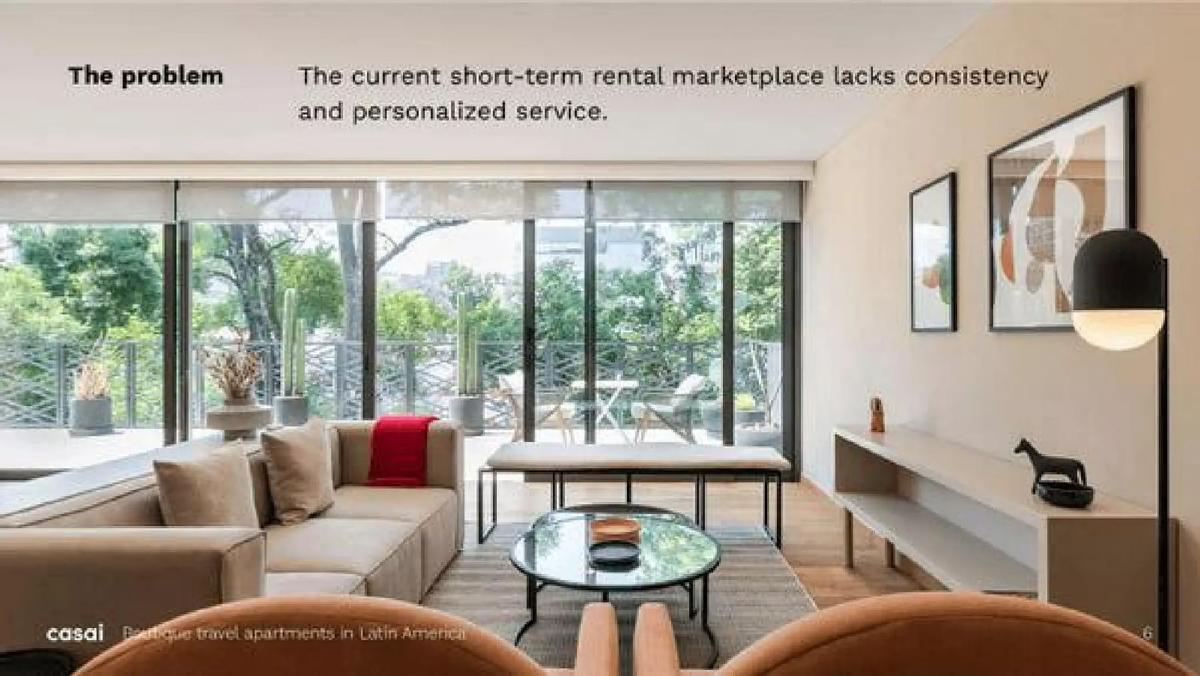
- The core problem identified is that the current short-term rental marketplace 'lacks consistency and personalized service' (slide 6).
- A detailed competitive matrix on slide 9 claims Casai is the only provider offering high-speed wifi, smart home tech, and 24/7 concierge simultaneously.
- The team slide (14) highlights a massive scale-up, noting '+130 Casaiers' and founders with backgrounds from BCG and Yale.
- Investment social proof is a primary driver, showcasing a total of $53M raised from Andreessen Horowitz, Monashees, and Kaszek on slide 15.
- The product is heavily tech-enabled, featuring keyless check-in and smart home controls via a proprietary app (slides 17-18).
- Cultural sustainability is emphasized on slide 20, noting that 90% of design assets are made in Mexico.
The Brand-First Approach to Series A
Casai’s 2019 Series A deck is a visual-heavy document that prioritizes brand identity and market positioning over raw data. In a sector like hospitality, where the 'vibe' is a product feature, this approach makes sense. The company successfully raised $53 million by convincing investors that Latin America was ready for a 'Sonder-style' professionalized rental brand. The deck uses a dark, sophisticated color palette and high-end photography to mirror the premium nature of their apartments.
The Hook: Defining the Nomadic Generation
Slides 1-3 serve as the introduction. Slide 1 is a simple, illustrated cover, while Slide 2 immediately defines the company: "Casai is a hospitality concept designed for the nomadic generation." This is a critical framing. They aren't just renting apartments; they are serving a specific demographic. They describe their product as a merger of three distinct worlds: the design of a boutique hotel, the technology of a Silicon Valley home, and the local ambiance of a vacation rental. Slide 3 reinforces this with a high-quality lifestyle image of a couple in a modern apartment, setting the aspirational tone for the rest of the deck.
Market Opportunity and Problem Statement
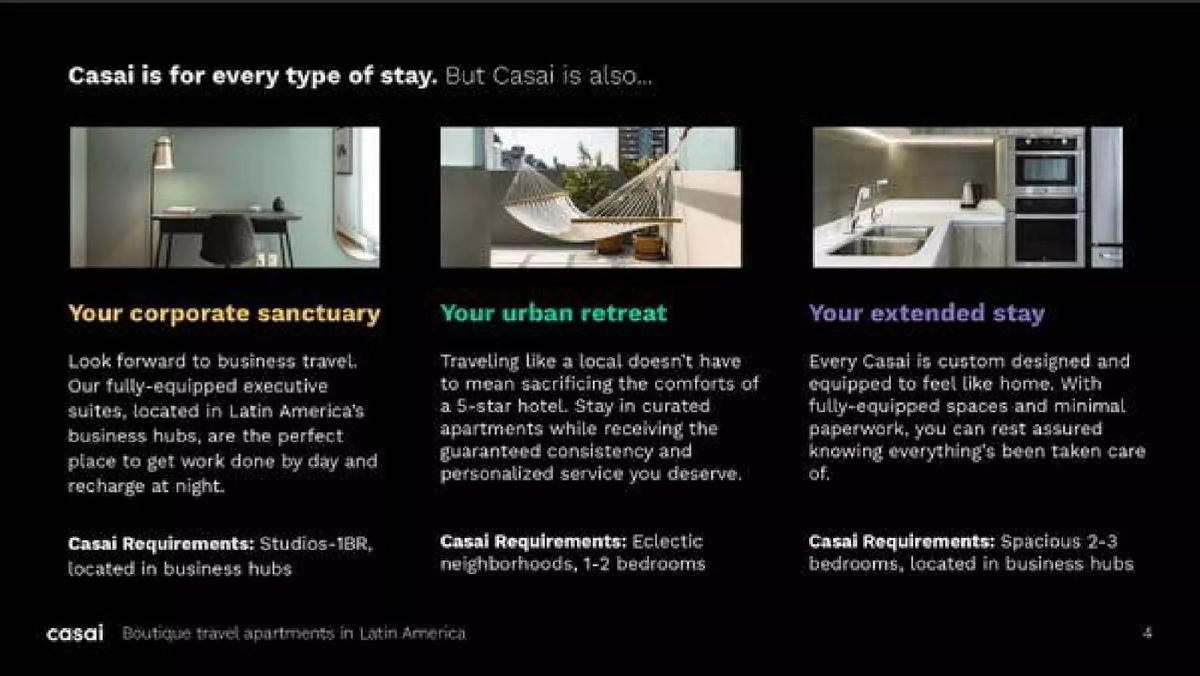
Slides 4-6 move into the 'Why now?' and the 'What's wrong?'. Slide 4 categorizes their offerings into three buckets: Corporate Sanctuary (Studios-1BR), Urban Retreat (1-2 bedrooms in eclectic neighborhoods), and Extended Stay (Spacious 2-3 bedrooms). This shows a clear understanding of their customer segments. Slide 5 provides the market context, noting that the number of short-term rentals is larger than the leading hotel chains combined. They use a bar chart to show Airbnb's 7 million units dwarfing Marriott's 1.4 million. This validates the category. Slide 6 identifies the gap: the current marketplace "lacks consistency and personalized service." This is the classic professionalized-rental pitch: Airbnb has the scale, but it doesn't have the quality control.
The Solution and Competitive Edge
Slides 7-9 present the Casai solution. Slide 7 and 8 are almost entirely visual, showing minimalist, high-design interiors. This is 'show, don't tell' at its best. Slide 9 is the most data-dense slide in the first half of the deck. It’s a competitive matrix comparing Casai against Hotel Chains, Boutique Hotels, Airbnb, and Apartment Rentals. Casai is the only one with 'green lights' across all categories, specifically highlighting 'High-speed wifi guaranteed,' 'Smart home technology,' and 'Sense of community' as their unique differentiators. By checking every box, they position themselves as the 'best of all worlds' solution.
Vision and Macro Trends
Slides 10-12 expand the scope. Slide 10 outlines the vision: "To redefine the way the world travels." It breaks down the value proposition into Design, Technology, and Local Ambiance. Slide 12 is particularly interesting as it addresses the COVID-19 crisis (suggesting this deck was updated during or shortly after the initial 2020 lockdowns). It maps behavioral shifts like "Work from anywhere" and "Safety & privacy" to Casai’s specific answers: strong wifi, professional cleaning, and contactless service via the app. This slide was likely crucial for maintaining investor confidence during a period of global travel restrictions.
The Team and The Social Proof
Slides 13-16 focus on the people and the progress. Slide 14 shows a robust team of over 130 'Casaiers.' The pedigree is high: Yale, BCG, Oxford, Amazon, Google, and WeWork. Highlighting a large headcount can be a double-edged sword, but here it suggests a company that has already moved past the 'two founders in a garage' stage. Slide 15 is the 'Power Slide.' It lists $53M in total investment from Andreessen Horowitz, Monashees, and Kaszek. By listing other successful investments from these VCs (Airbnb, Facebook, Rappi, Kavak), Casai is using the 'halo effect' to suggest they are the next regional unicorn. Slide 16 focuses on community impact, noting that 90% of design assets are made in Mexico, which adds a layer of 'ESG' (Environmental, Social, and Governance) appeal to the investment.
Deep Dive into the Tech Stack
Slides 17-19 highlight the 'Tech' in 'PropTech.' Slide 17 shows the app interface, emphasizing 'Tech Enabled' features like QR check-in codes and Spanish audio recordings for building guards—a very practical solution for international travelers in Mexico. Slide 18 focuses on 'Smart Home Controls,' allowing guests to control lights and speakers from their phones. Slide 19 introduces the 'Live Concierge Chat,' positioning the app as a digital companion that provides curated city guides. This section is vital because it justifies the 'Silicon Valley' part of their initial pitch; without this, they are just a property management company.
Design and Local Integration
Slides 20-22 close the deck with a focus on aesthetics and local culture. Slide 20 discusses 'Cultural Sustainability' and their in-house design team. Slide 21 introduces the 'Casai Gallery,' a project that allows guests to buy art from the apartments via QR codes. This is a clever way to deepen the 'local ambiance' while potentially creating a small secondary revenue stream or at least a unique marketing hook. Slide 22 is a final collage of lifestyle imagery, ending the deck on the same high-design note it started with.
What Works in This Deck
Visual Storytelling: The use of high-quality, consistent photography does more to sell the 'premium' nature of the product than any bullet point could. · Clear Positioning: They don't try to be everything to everyone. They are for the 'nomadic generation' and 'business hubs.' · Social Proof: Slide 15 is incredibly strong. Listing Andreessen Horowitz alongside local giants like Kaszek tells a story of both global potential and local expertise. · Practical Tech: The inclusion of the 'audio recording for guards' shows they have thought through the actual friction points of traveling in Latin America.
What Is Missing
Unit Economics: There is no mention of RevPAR (Revenue Per Available Room), occupancy rates, or CAC (Customer Acquisition Cost). For a Series A, these are usually expected. · Financial Projections: The deck lacks a 'Forward Looking' slide showing where the $53M will take them in terms of unit count or revenue. · The 'Ask': While the catalogue says they raised $53M, the deck itself doesn't explicitly state what they are looking for in the current round or how the funds will be allocated. · Regulatory Landscape: Short-term rentals often face legal hurdles in major cities. The deck doesn't address how Casai navigates local zoning laws or hotel taxes in Mexico and beyond.
What a Founder Should Copy
The Competitive Matrix (Slide 9): Instead of just listing competitors, Casai lists features and shows how they are the only ones providing the full stack. This is a very effective way to visualize a 'Blue Ocean' strategy. · The 'Halo Effect' (Slide 15): If you have great investors, don't just list their names. List their best other investments to show the caliber of the 'club' you are in. · Addressing Macro Trends (Slide 12): Showing how your business model is a direct answer to a global shift (like remote work) makes the investment feel timely and urgent. · Segmented Offerings (Slide 4): Breaking down your product into specific use cases (Corporate vs. Urban vs. Extended) helps investors visualize the actual customer journey.
Frequently asked questions
- How much did Casai raise with this deck?
- According to the catalogue listing and slide 15, Casai raised a total of $53,000,000. This was a Series A round in 2019, led by prominent investors including Andreessen Horowitz, which is highlighted as having $12 billion under management at the time.
- What is Casai's core business model?
- Casai operates as a premium real estate and hospitality platform. They curate and design high-end apartments in Latin American business hubs (like Mexico City), equip them with smart home technology, and offer hotel-like services such as 24/7 concierge and professional cleaning for the 'nomadic generation' (slides 2 and 4).
- Who are the founders and what is their background?
- The founders are Nico Barawid (CEO) and Maricarmen Herrerias (COO). Nico's background includes Yale, BCG, and Oxford, while Maricarmen has experience in the hospitality sector. The team also includes former employees from Amazon, Google, and WeWork (slide 14).
- How does Casai differentiate itself from Airbnb?
- Casai differentiates through 'consistency.' While Airbnb offers local experiences, it often lacks professional standards. Slide 9 highlights that Casai guarantees high-speed wifi, professional cleaning, and 24/7 local concierge—features that are hit-or-miss on standard rental marketplaces.
- What specific technology does Casai use?
- Casai uses a proprietary app for the entire guest journey. This includes 'Keyless check-in,' smart home controls for lights and speakers, and a 24/7 live concierge chat. They also provide a 'Spanish audio recording' for building guards to assist non-local guests (slides 17-18).