LawnGuru’s 2014 seed deck is a masterclass in brevity, utilizing only eight slides to communicate a complete investment thesis. The deck follows a classic marketplace narrative: identifying friction for both consumers and providers, presenting a mobile-first solution, and proving early product-market fit through rapid geographic expansion. With just $30k in initial revenue from 12 zip codes, the founders showed a path to over $300k across 200 zip codes, providing the necessary momentum to justify a $1,000,000 raise. While it lacks traditional deep dives into unit economics or a formal 'ask' s…
Key takeaways
- The deck identifies five specific consumer pain points including annual contracts and rigid schedules on slide 2.
- It addresses the provider side of the marketplace by highlighting the difficulty of running an outdoor service company on slide 3.
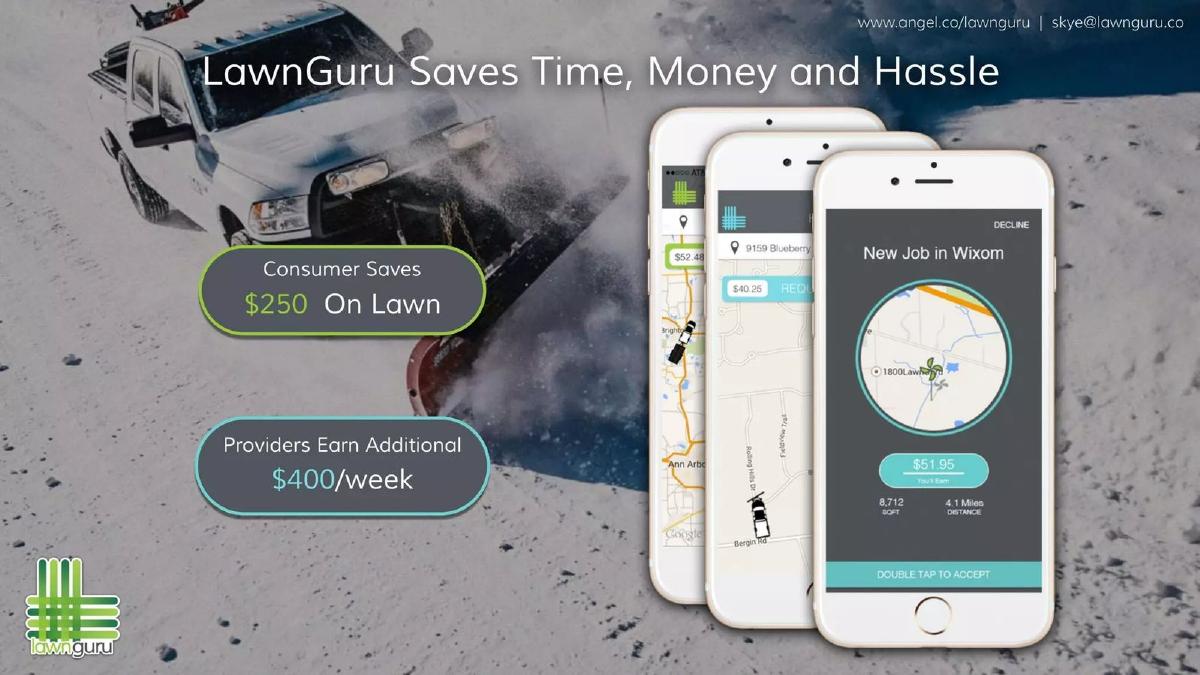
- LawnGuru claims a specific value proposition of saving consumers $250 on lawn care while adding $400/week in provider earnings on slide 4.
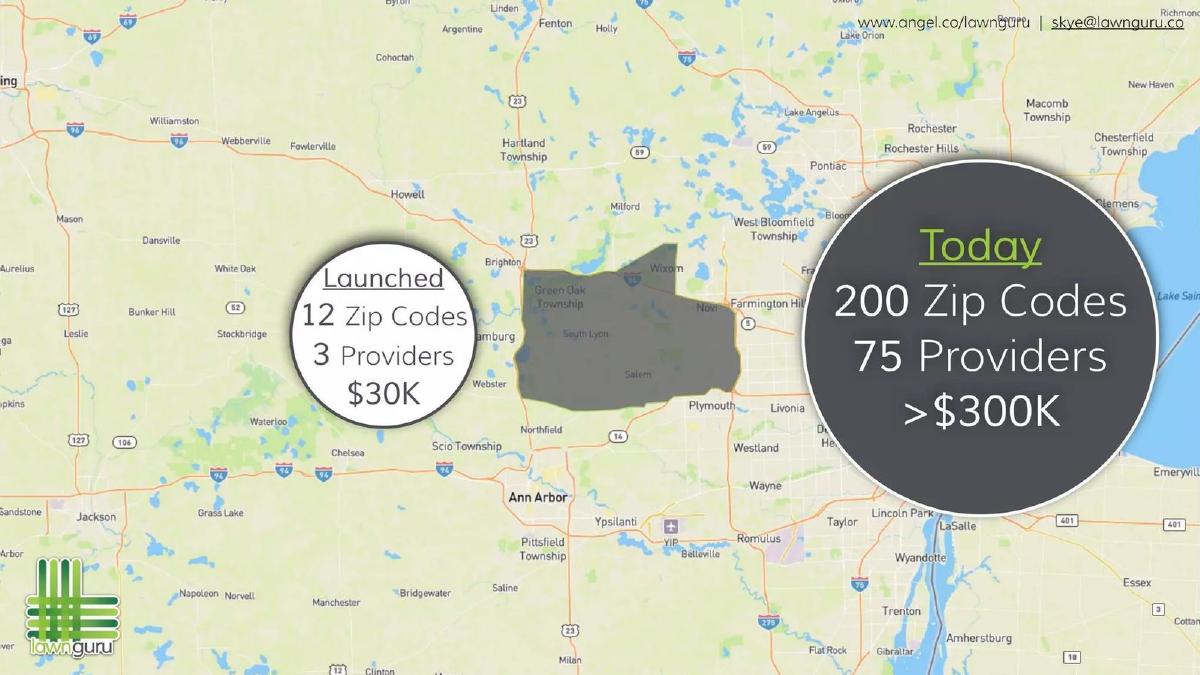
- Traction is visualized through a geographic map showing growth from 12 zip codes to 200 zip codes on slide 5.
- The company reports a revenue jump from $30k at launch to over $300k 'today' on slide 5.
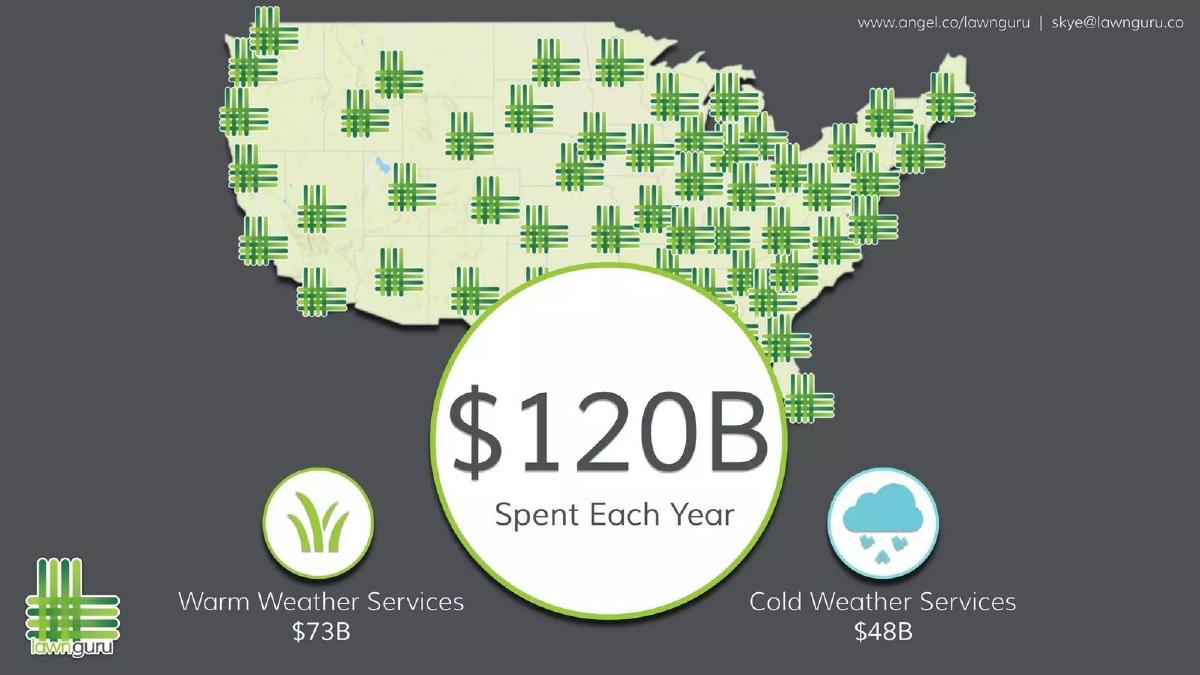
- The total addressable market is cited as $120B, split between $73B for warm weather and $48B for cold weather services on slide 6.
- The founders leverage their background of building a 'multi-million dollar outdoor service company' to establish industry authority on slide 7.
- The deck completely omits a slide detailing the specific use of funds or the investment terms for the $1M round.
The 8-Slide Seed Strategy
LawnGuru’s pitch deck is an exercise in extreme minimalism. In an era where decks often stretch to 20 or 30 slides with complex data visualizations, this 2014 seed deck relies on eight high-impact slides to tell a story of industry frustration and marketplace efficiency. The company, headquartered in Ann Arbor, Michigan, successfully raised $1,000,000 using this narrative. The deck is built on the 'Uber-for-X' framework, which was the dominant venture capital thesis at the time, but it grounds that hype in the founders' previous success in the traditional version of the industry.
Slide 1: Title and Vision
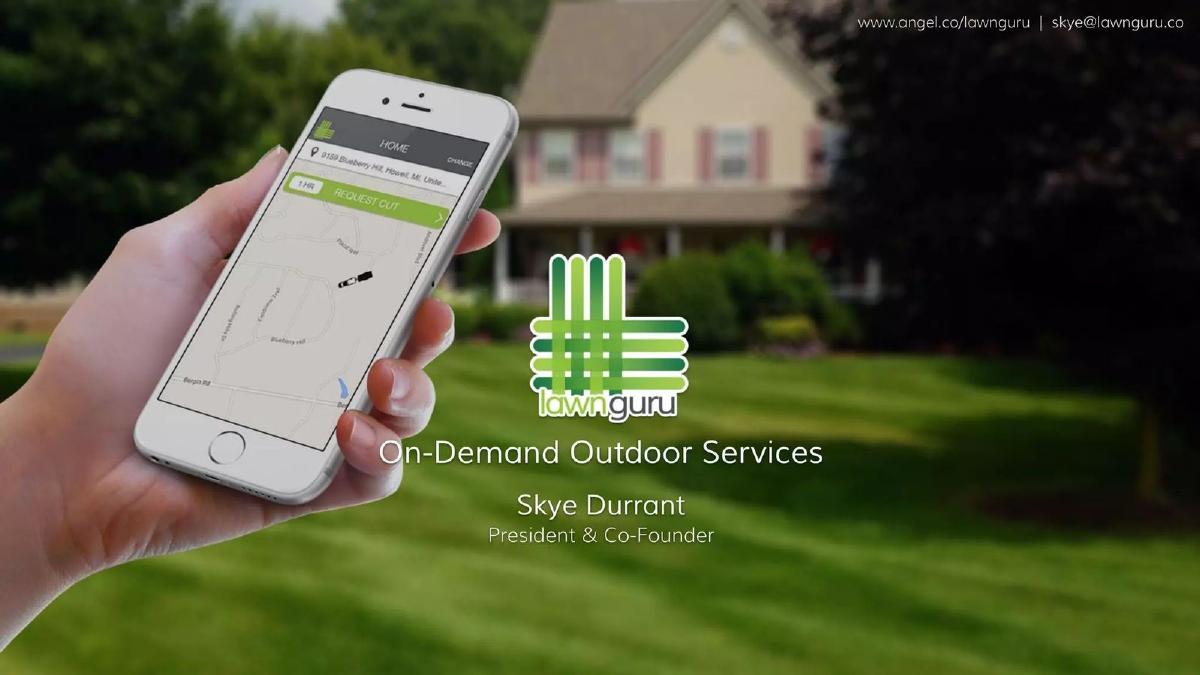
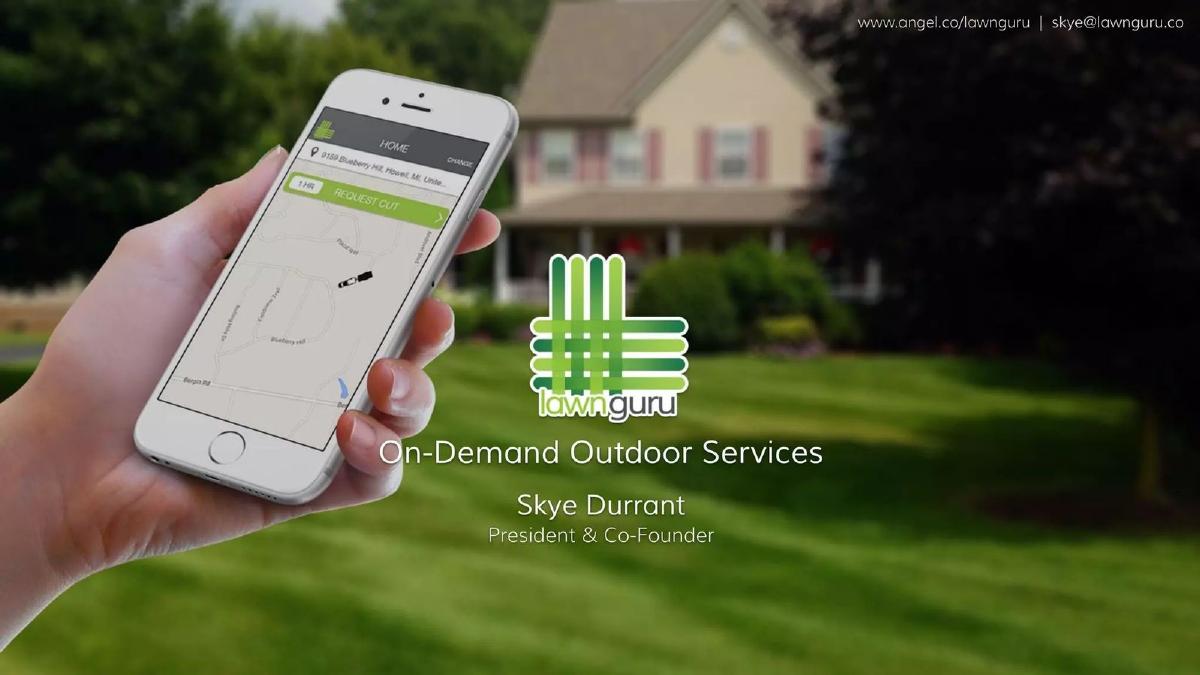
The cover slide introduces LawnGuru as 'On-Demand Outdoor Services.' The background image features a well-manicured suburban home, immediately identifying the target demographic. A mobile phone in the foreground displays the app interface, signaling a tech-first approach to a traditionally analog industry. Skye Durrant is listed as President and Co-Founder. The inclusion of an AngelList URL and a direct email address in the header indicates this was a working deck used for active outreach.
Slide 2: The Consumer Pain Point
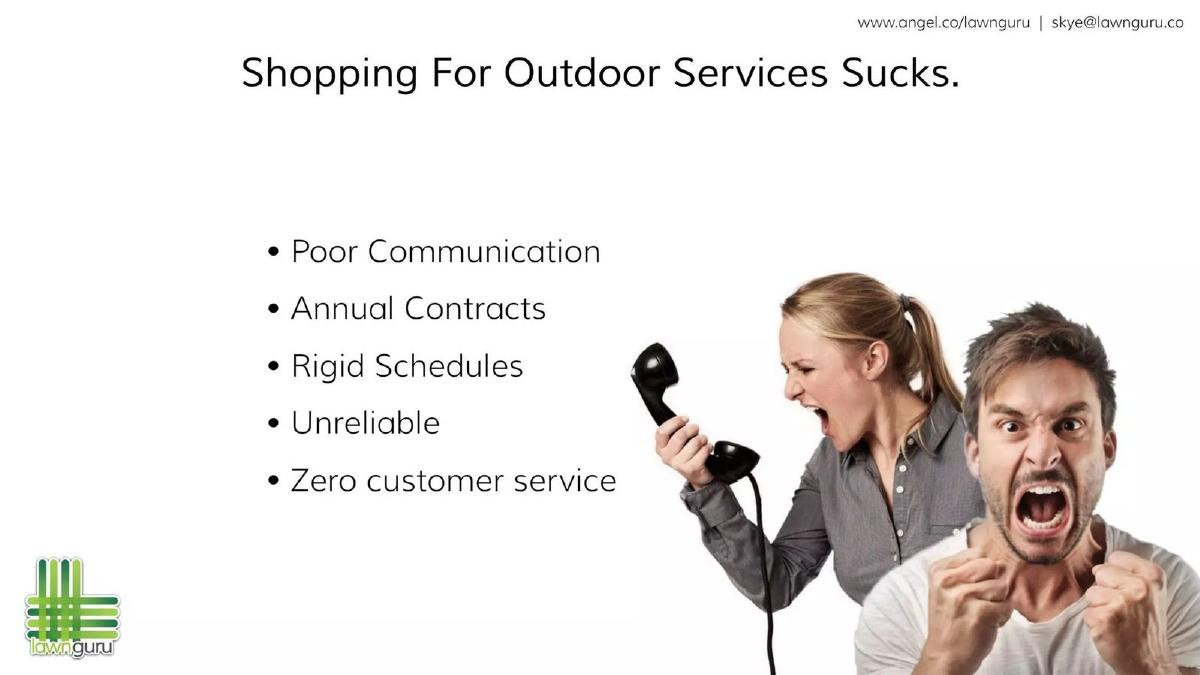
Slide 2 uses the headline 'Shopping For Outdoor Services Sucks.' It lists five specific grievances: Poor Communication, Annual Contracts, Rigid Schedules, Unreliable, and Zero customer service. The imagery—a man and woman screaming into a telephone—is visceral and perhaps a bit hyperbolic, but it effectively communicates the emotional frustration of the current status quo. By highlighting 'Annual Contracts' and 'Rigid Schedules,' LawnGuru sets the stage for its 'on-demand' solution, which aims to break the traditional subscription model of lawn care.
Slide 3: The Provider Pain Point
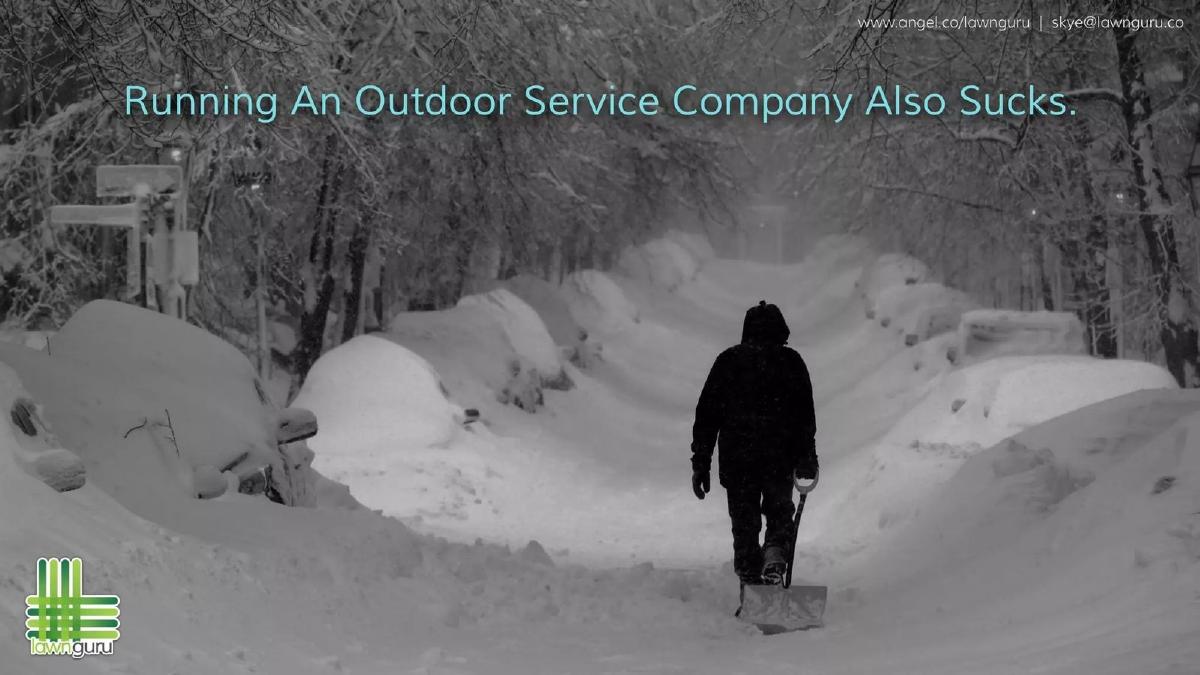
Rarely do marketplace decks spend equal time on the supply side, but LawnGuru does so on slide 3. 'Running An Outdoor Service Company Also Sucks' is paired with an image of a lone worker shoveling a massive snow-covered street. This slide acknowledges the operational difficulties for providers, such as finding new customers and managing logistics in harsh weather. This dual-sided empathy is crucial for a marketplace; if the providers don't find value in the platform, the consumer side will eventually fail due to lack of supply.
Slide 4: The Value Proposition
Slide 4 presents the solution: 'LawnGuru Saves Time, Money and Hassle.' It provides two specific financial claims. First, that the 'Consumer Saves $250 On Lawn.' Second, that 'Providers Earn Additional $400/week.' The slide also shows three screenshots of the app. The most important detail here is the provider-facing screen, which shows a 'New Job in Wixom' with a payout of $51.95, the square footage of the lawn (8,712 SQFT), and the distance (4.1 Miles). This demonstrates that the platform is doing the heavy lifting of job estimation and routing.
Slide 5: Traction and Geographic Proof
Slide 5 is the 'money slide' for this deck. It uses a map of the Michigan area to show growth. The 'Launched' bubble shows 12 Zip Codes, 3 Providers, and $30K in revenue. The 'Today' bubble shows a significant jump to 200 Zip Codes, 75 Providers, and >$300K in revenue. This 10x growth in revenue and zip code coverage provides the necessary proof of concept. It shows that the model isn't just a theory; it is actively scaling in a specific geographic cluster.
Slide 6: Market Size
Slide 6 addresses the Total Addressable Market (TAM). It claims a '$120B Spent Each Year' figure. It further segments this into 'Warm Weather Services' ($73B) and 'Cold Weather Services' ($48B). The map of the United States is littered with LawnGuru logos, suggesting a future state of national dominance. By splitting the market into seasons, the deck addresses the potential seasonality risk of a lawn-only business, showing that snow removal provides a significant hedge during winter months.
Slide 7: The Team
The team slide uses a 'Designer, Hustler, Hacker' framework. Skye Durrant (Designer) and Brandon Bertrang (Hustler) are the co-founders, with Jacob Torrence (Hacker) as the Lead Developer. The most important text on this slide is at the bottom: 'Together we’ve already built a multi-million dollar outdoor service company.' This single sentence provides more credibility than any list of degrees or past employers could. It tells investors that the founders have deep domain expertise and have successfully scaled a business in this exact vertical before.
Slide 8: Contact and Closing
The final slide returns to the imagery of the first, showing the app in action with a notification: 'Your property is being serviced.' It includes a photo of the provider (C.J.) and his 5-star rating, reinforcing the trust and transparency aspects of the platform. Contact information is repeated, including the AngelList link.
What Works in This Deck
Clarity of Purpose: Within three slides, the investor knows exactly what the problem is, who suffers from it, and how LawnGuru fixes it. There is no jargon or 'platform-as-a-service' fluff. It is a straightforward marketplace pitch.
Supply-Side Focus: By explicitly stating how much extra money a provider can make ($400/week), LawnGuru addresses the hardest part of any service marketplace: retention of quality labor. This shows they understand the economics of their contractors.
Domain Expertise: The mention of a previous multi-million dollar service company is the ultimate 'de-risker.' It suggests the founders aren't guessing about the pain points on slides 2 and 3; they lived them.
What is Missing
The Ask: The deck never specifies how much capital is being raised or what the milestones for that capital are. While we know from the catalogue that they raised $1M, a founder using this deck today would need to add a slide detailing the use of proceeds.
Competition: There is no mention of existing competitors like TaskRabbit or other niche lawn care startups. Investors always want to know why a specific team will win against incumbents or other well-funded newcomers.
Unit Economics: While the deck mentions total revenue, it doesn't touch on Customer Acquisition Cost (CAC) or the Lifetime Value (LTV) of a customer. In a marketplace, understanding the 'take rate' and the cost to acquire both sides of the market is essential for long-term viability.
What a Founder Should Copy
The Traction Visualization: Slide 5 is an excellent way to show growth. Instead of a standard line graph, using a map to show geographic density and expansion helps investors visualize the 'land and expand' strategy.
The 'Sucks' Framework: Starting with a very blunt assessment of why the current industry is failing is a great way to build tension that the solution then resolves. It creates an immediate 'aha' moment.
Seasonal Balancing: If your business is seasonal, copy slide 6’s approach of showing how the 'off-season' is actually a massive market in its own right. This turns a potential weakness into a diversified strength.
Final Verdict: LawnGuru's deck is a high-conviction, low-friction pitch. It relies heavily on the team's past success and early Michigan traction to bridge the gap left by missing financial depth. For a seed round in 2014, this was a potent combination.
Frequently asked questions
- How did LawnGuru justify its $120B market size?
- On slide 6, the deck breaks down the $120B annual spend into two seasonal categories: $73B for warm weather services (lawn care) and $48B for cold weather services (snow removal). This dual-season approach is critical for a service marketplace in regions like Michigan, ensuring year-round utility for both the platform and the service providers.
- What was the primary traction metric used in the pitch?
- LawnGuru focused on geographic density and revenue growth. Slide 5 shows they expanded from 3 providers in 12 zip codes to 75 providers in 200 zip codes. During this period, they grew revenue from $30,000 to over $300,000, demonstrating a scalable model within their initial target market of Ann Arbor and surrounding areas.
- Does the deck explain the technology behind the platform?
- Only superficially. Slide 4 shows mobile interface mockups that include GPS tracking of service vehicles and job details like square footage and distance. The 'Hacker' role on the team slide (slide 7) is assigned to Jacob Torrence, the Lead Developer, implying the tech is built in-house, but there is no technical architecture slide.
- What is the 'Founder-Market Fit' story here?
- The team slide (slide 7) is the strongest evidence of founder-market fit. It explicitly states that the founders 'already built a multi-million dollar outdoor service company.' This suggests they aren't just tech enthusiasts, but industry veterans who understand the operational 'suck' described on slides 2 and 3 from first-hand experience.
- What are the most significant omissions in this deck?
- The deck lacks a Competitor slide, a Unit Economics slide (CAC/LTV), and a formal 'The Ask' slide. While the catalogue facts state they raised $1M, the deck itself does not specify how much they were seeking or how they intended to spend the capital to reach the next milestone.