The Latch pitch deck is a masterclass in enterprise-grade storytelling for the PropTech sector. Rather than focusing on individual consumer gadgets, Latch positions itself as a critical infrastructure partner for the world's largest real estate operators. The presentation relies heavily on financial momentum, citing a 135-140% YoY revenue growth projection for Q1'21 and a clear strategy to expand Average Revenue Per Home Unit (ARPHU) by over 150% through ecosystem lock-in. By showcasing partnerships with industry giants like AvalonBay and Tishman Speyer, Latch shifts the narrative from hardwa…
Key takeaways
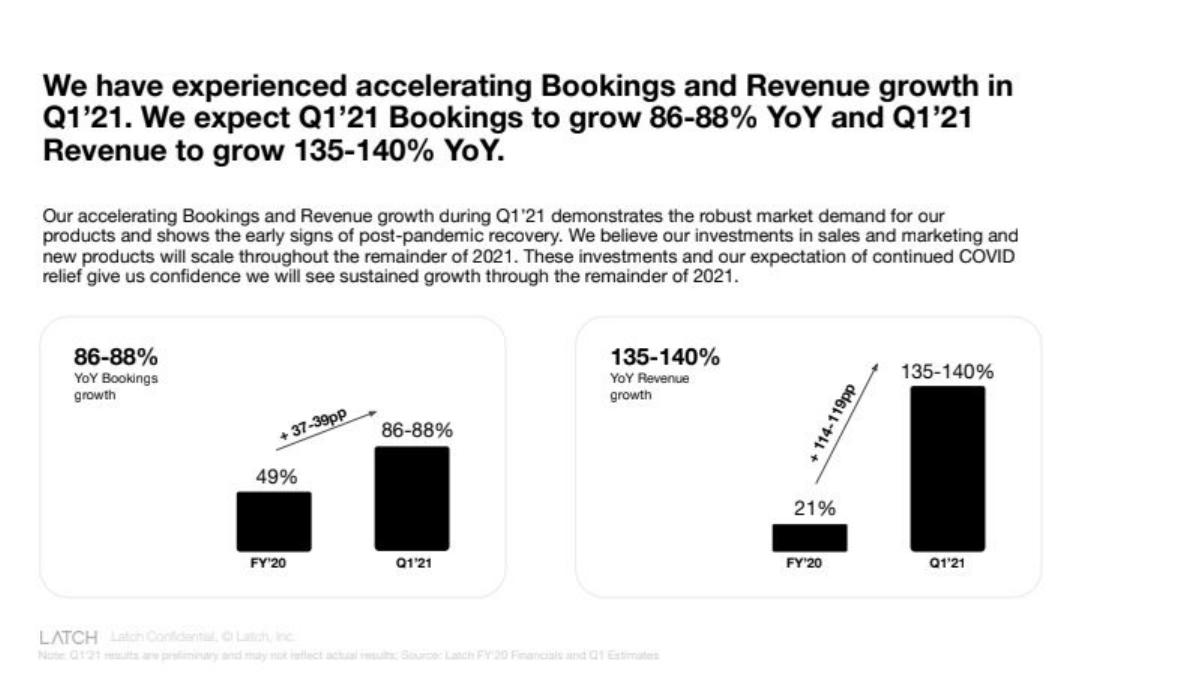
- Latch projected Q1'21 revenue growth of 135-140% YoY to demonstrate post-pandemic recovery (Slide 2).
- The company leverages deep enterprise partnerships, such as the retrofit initiative with AvalonBay, to ensure scale (Slide 3).
- Tishman Speyer is presented as a strategic anchor with $56.8 billion in global assets and 80 million square feet under management (Slide 17).
- The product strategy focuses on meeting rigorous regulatory standards like UL, FCC, and ANSI to satisfy multi-family infrastructure requirements (Slide 30).
- Latch positions its LatchOS as a 'Unified Management' solution to replace fragmented legacy vendors (Slide 38).
- The company claims visibility into 150% growth in ARPHU by upselling intercoms and smart home modules (Slide 50).
- Historical financials show a rapid shift in Booked ARR from $4M in 2018 to $31M in 2020 (Slide 71).
- Long-term projections estimate Total Bookings reaching $1.78B by 2025, driven by a 65% 5-year CAGR (Slide 75).
The Strategic Pivot from Hardware to LatchOS
The Latch pitch deck, used for its 2021 SPAC merger, is a comprehensive 79-slide document that meticulously builds a case for Latch as the dominant operating system for modern real estate. At this stage, the company was moving beyond its identity as a smart-lock manufacturer and into a full-scale PropTech ecosystem provider. The deck is structured to satisfy the rigorous demands of public market investors, blending high-level vision with granular financial modeling.
Slides 1-4: Momentum and Market Validation
The presentation opens with immediate proof of growth. Slide 2 highlights accelerating bookings and revenue, specifically projecting Q1'21 revenue growth of 135-140% YoY . This is a classic 'traction first' approach, designed to show that the company has moved past the uncertainty of the 2020 pandemic. Slide 3 introduces the AvalonBay partnership, quoting Karen Hollinger, SVP of Strategic Initiatives, who states that technology provides 'real estate alpha.' This slide is crucial because it validates Latch's utility in both new developments and 'retrofit' initiatives, proving the product's versatility. Slide 4 serves as a formal bridge to the SEC-filed Analyst Day presentation, signaling the transition to a public-grade financial discussion.
Slide 17: The Tishman Speyer Anchor
One of the most powerful slides in the deck is Slide 17 , which details the scale of Tishman Speyer. By listing $56.8 billion in global assets and 80 million square feet of managed property, Latch isn't just showing an investor; they are showing a massive, built-in customer base. This slide implies a symbiotic relationship where the sponsor’s portfolio acts as a laboratory and a primary market for Latch’s expansion. The mention of 1,200+ employees across a vertically integrated organization further reinforces the institutional backing behind the deal.
Slides 26-30: Solving Enterprise Pain Points
Slide 26 establishes the core philosophy: building 'hand in hand with the largest real estate operators.' This is a direct shot at consumer-focused IoT companies. Latch positions itself as a partner to the landlord, not just a gadget for the tenant. Slide 30 reinforces this by highlighting compliance with UL, FCC, and ANSI standards. In the world of multi-family real estate, these certifications are non-negotiable. By emphasizing 'Internet Independence' and 'Hardwired Power,' Latch addresses the two biggest fears of building managers: security breaches and device failure during power outages.
Slides 38-46: The Platform Play (LatchOS)
Slide 38 is the 'competitive landscape' slide, but it focuses on complexity rather than specific brand names. It contrasts 'Traditional Vendors' (8+ vendors, multiple contracts, fragmented management) with the 'LatchOS' model (One vendor, one contract, unified management). This is the 'Apple of Real Estate' argument—vertical integration leads to a better user experience and lower operational overhead for the owner. Slide 42 and Slide 46 act as narrative transitions, asserting that while 'access' (locks) was the foundation, the company is now 'widening our access moat' with a broader product universe.
Slide 50: The ARPHU Growth Engine
For investors looking for the 'SaaS' in this PropTech story, Slide 50 is the most important page in the deck. It introduces ARPHU (Average Revenue Per Home Unit) . Latch claims visibility into 150% growth in this metric. The chart shows a progression: starting with Smart Access, adding Intercom and Smart Home modules (+57%), and finally layering on additional 'Products & Services' from the roadmap (+73%). This slide transforms Latch from a one-time hardware seller into a recurring revenue powerhouse that extracts more value from every apartment unit over time.
Slides 54-63: Ecosystem Expansion and Direct Sales
Slide 54 and Slide 58 emphasize that Latch is 'just getting started' with its direct account-based selling motion. By owning the 'long-term software relationship,' Latch ensures it cannot be easily displaced by a cheaper hardware competitor. Slide 63 visualizes the 'Latch Product Universe,' showing integrations with third-party services like UPS, RealPage, and Sonos . This ecosystem strategy creates high switching costs; once a building is wired into LatchOS for its intercom, cameras, and resident payments, replacing the system becomes a massive capital and operational burden.
Slides 71-75: The Financial Roadmap
The deck concludes with heavy financial data. Slide 71 shows the historical climb: Total Bookings grew from $29M in 2018 to $165M in 2020 . However, it also shows significant losses, with an EBITDA of $(61)M in 2020. To counter this, Slide 75 provides a five-year projection. Latch forecasts Total Bookings of $1.78B by 2025 and a shift to positive Free Cash Flow by 2023. The 65% 5-year CAGR is the 'north star' metric for the SPAC valuation, predicated on the belief that Latch will penetrate more of the North American and European rental markets.
What Latch Does Well
Enterprise Credibility: By featuring AvalonBay and Tishman Speyer prominently, Latch removes the 'startup risk' from the conversation. They are presented as an industry standard, not an experiment. · Metric Innovation: The creation of 'ARPHU' is a brilliant way to translate real estate units into SaaS-style growth metrics that tech investors understand. · Regulatory Focus: Highlighting UL and ANSI certifications (Slide 30) shows a deep understanding of the 'unsexy' side of PropTech that actually wins enterprise contracts. · Clear Upsell Path: The deck clearly explains how a simple lock sale leads to a comprehensive software subscription, justifying the initial hardware acquisition cost.
What is Missing from the Latch Deck
Churn Data: While the deck focuses on 'Booked ARR,' it provides very little data on actual churn or retention rates for buildings that have been live for 3+ years. · Hardware Margins: Slide 71 shows that 'Cost of Goods Sold' was 112% of Net Revenue in 2020. The deck assumes these margins will improve drastically through 'scale efficiencies,' but provides few specifics on how manufacturing costs will be slashed. · Competitive Specifics: The deck avoids naming competitors like ButterflyMX or August Home, opting instead to fight against 'fragmentation.' This leaves a gap in understanding how Latch wins in a head-to-head RFP. · Unit Economics: There is no explicit breakdown of Customer Acquisition Cost (CAC) vs. Lifetime Value (LTV), which is a standard requirement for high-growth tech companies.
What Founders Should Copy
The 'Unified vs. Fragmented' Slide: Use Slide 38 as a template for showing how your platform simplifies a complex vendor landscape. · The Roadmap to Expansion: Slide 50 is a perfect example of how to show investors that your current revenue is just the 'wedge' and that you have a clear plan to increase revenue per customer. · Third-Party Validation: Don't just list logos; use quotes from high-level executives at your biggest customers to explain why your product provides 'alpha' (Slide 3). · Financial Transparency: If you are raising a late-stage round, provide the 5-year outlook (Slide 75) to show the 'end game' of your current burn rate.
Frequently asked questions
- What was the primary goal of this pitch deck?
- The primary goal was to facilitate a SPAC merger with Tishman Speyer Innovation Corp (TSIA), raising $1.5B. The deck needed to convince institutional investors that Latch was not just a hardware company making smart locks, but a software-driven 'Building Operating System' with high recurring revenue potential and a massive moat within the multi-family real estate market.
- How does Latch justify its valuation despite historical losses?
- Latch justifies its valuation through aggressive growth projections and the concept of 'Booked ARR.' While Slide 71 shows an EBITDA loss of $61M in 2020, Slide 75 projects a flip to positive EBITDA of $104M by 2025. They argue that their high hardware-to-software attachment rate and long-term contracts with enterprise owners create a predictable, high-margin future revenue stream.
- What is the significance of the AvalonBay partnership in the deck?
- The AvalonBay partnership (Slide 3 and Slide 34) serves as a critical proof of concept for Latch's enterprise strategy. By showing that a major REIT is retrofitting existing buildings with Latch technology, the company demonstrates that its market is not limited to new construction, significantly expanding its Total Addressable Market (TAM).
- How does Latch differentiate itself from other smart home competitors?
- Latch differentiates itself by focusing on the 'Building Owner' rather than the 'Renter.' Slide 38 highlights that traditional vendors are fragmented and complex. Latch offers a 'Simple Sale' and 'Unified Management' through LatchOS. They also emphasize 'Internet Independence' and 'Hardwired Power,' which are critical for enterprise-grade reliability that consumer-grade devices lack.
- What are the key financial metrics investors focused on?
- Investors focused on Bookings, Booked ARR, and ARPHU (Average Revenue Per Home Unit). Slide 50 is particularly important, as it shows how Latch plans to grow revenue from a single unit by 150% over time by layering on services like intercoms and resident software, moving beyond the initial smart access sale.