Laoshi's 15-slide angel deck presents a focused solution for the Mandarin Chinese learning market, specifically targeting the difficulty of vocabulary acquisition. The company employs a B2B2C strategy, providing tools for teachers to reduce churn and preparation time, which in turn drives student acquisition. With a reported 13,000 MAU and a 40% teacher retention rate at month five, the deck highlights early product-market fit. The founders seek $600,000 to reach profitability and scale their teacher network to 10,000. While the deck is visually minimalist, it effectively uses cohort data and…
Key takeaways
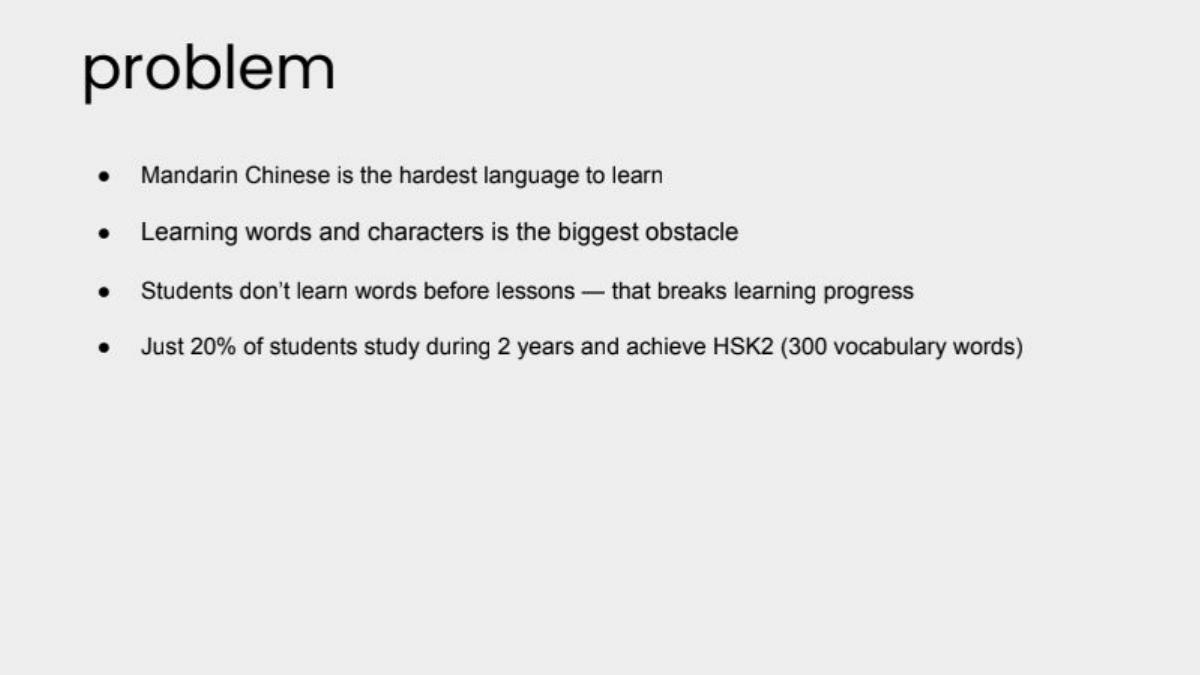
- The problem slide identifies that only 20% of students achieve HSK2 (300 words) after two years of study (Slide 2).
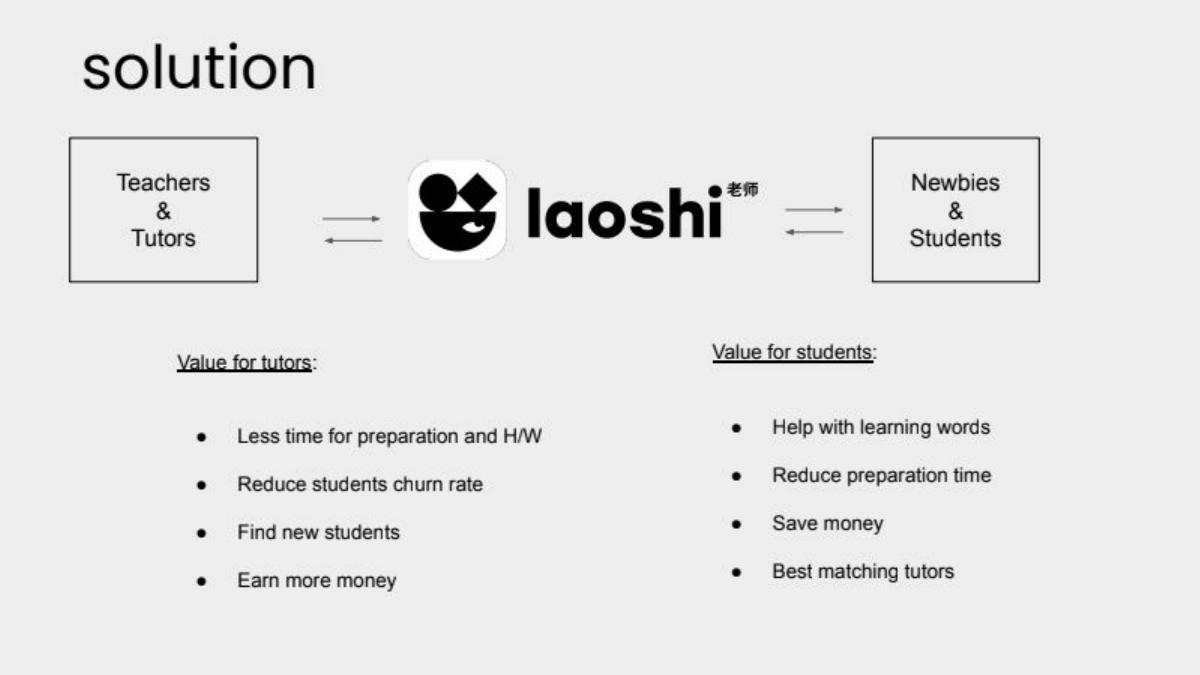
- Laoshi positions itself as a dual-sided platform providing value to both teachers (reduced prep time) and students (vocabulary help) (Slide 4).
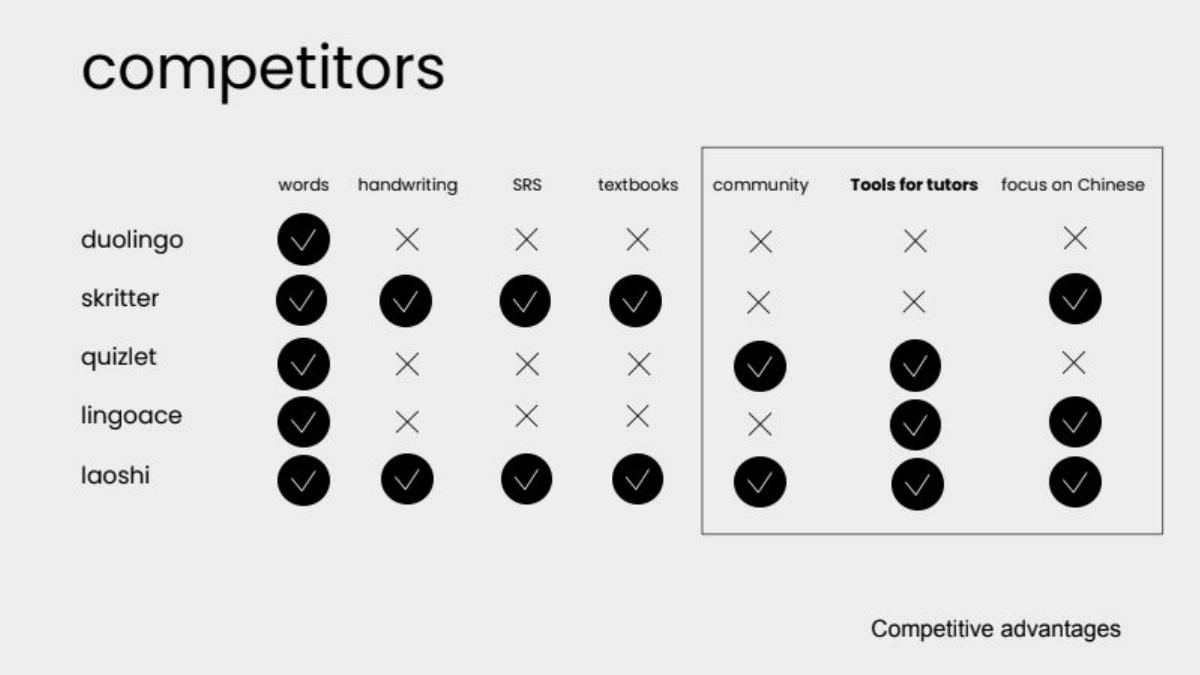
- The competitive matrix claims Laoshi is the only player combining SRS, handwriting, teacher tools, and a focus on Chinese (Slide 5).
- The team has relevant domain experience, having previously sold 4,000+ Mandarin study books and managed 8 offline schools (Slide 7).
- Teacher retention is a core metric, showing a plateau at approximately 40% after five months (Slide 9).
- Engagement metrics show paying users spend an average of 6.5 days a week in the app (Slide 10).
- The business model relies on a $50 teacher acquisition cost to unlock at least five students per teacher (Slide 13).
- The $600,000 ask is primarily allocated to product development (60%) and marketing/sales (20%) (Slide 14).
Executive Summary: The Niche Specialist
Laoshi's pitch deck is a study in minimalist, data-driven storytelling. Operating in the EdTech sector with a specific focus on Mandarin Chinese, the company seeks to bridge the gap between formal instruction and individual study. By targeting the "hardest language to learn," Laoshi attempts to solve the high churn rate associated with vocabulary acquisition. The deck focuses heavily on teacher-led growth, suggesting a strategic pivot away from the high-CAC world of direct-to-consumer app marketing.
Slide 1: Title and Positioning
The cover slide is clean, featuring the Laoshi logo and a clear value proposition: "Tools for learning and teaching Mandarin Chinese." It includes links to their website and mentions of Product Hunt and another platform logo, establishing early web presence. The tagline immediately identifies the dual-audience strategy (teachers and students).
Slide 2: The Problem of Retention
The problem slide focuses on the friction of Mandarin acquisition. It states that learning characters is the "biggest obstacle" and that a lack of pre-lesson study "breaks learning progress." The most compelling data point here is that only 20% of students achieve HSK2 (a basic proficiency level of 300 words) after two years of study. This frames the problem not just as a difficulty in learning, but as a systemic failure in current methodology.
Slide 3: Market Opportunity
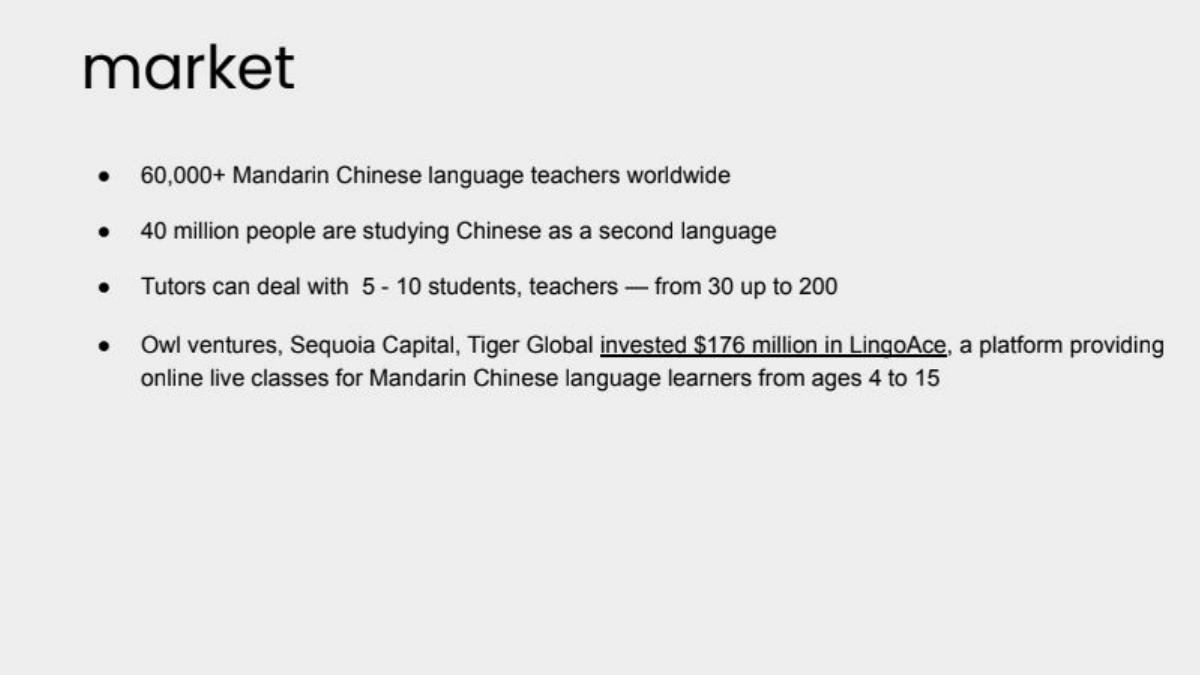
Laoshi quantifies the market with four bullet points: 60,000+ Mandarin teachers worldwide and 40 million people studying Chinese as a second language. They also highlight the scalability of teachers, noting they can handle between 30 and 200 students. To validate the sector's venture potential, they cite LingoAce's $176 million raise from Owl Ventures, Sequoia, and Tiger Global, though LingoAce focuses on a younger demographic (ages 4 to 15).
Slide 4: The B2B2C Solution
The solution is presented as a flow chart where Laoshi sits between teachers/tutors and newbies/students. The value for tutors includes reduced preparation time, lower student churn, and lead generation. For students, the benefits are vocabulary assistance, saved money, and tutor matching. This slide establishes the platform as a marketplace and a utility tool simultaneously.
Slide 5: Competitive Landscape
The competitive matrix compares Laoshi against Duolingo, Skritter, Quizlet, and LingoAce. Laoshi claims to be the only platform that offers the full suite of: words, handwriting, SRS (Spaced Repetition System), textbooks, community, and specific tools for tutors, all while maintaining a dedicated focus on Chinese. This is a classic "check-all-boxes" slide designed to show a gap in the current market offerings.
Slide 6: Product Roadmap
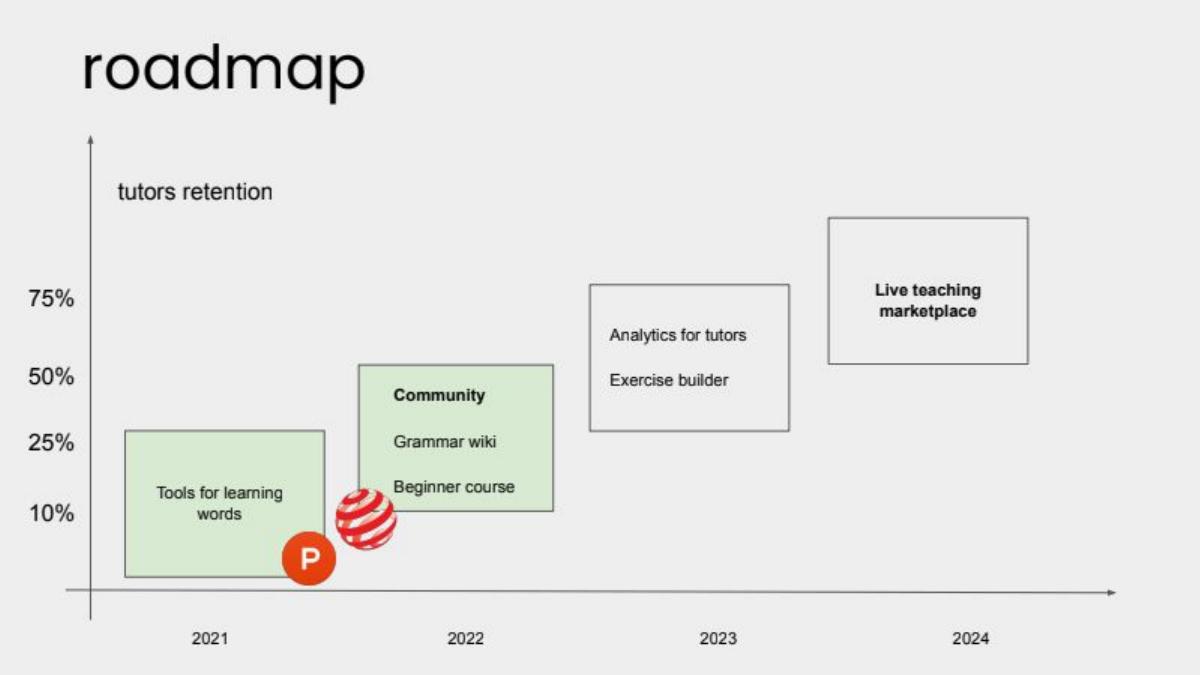
The roadmap spans from 2021 to 2024. It shows a progression from basic vocabulary tools (2021) to community and grammar wikis (2022), followed by analytics and exercise builders for tutors (2023). The final goal for 2024 is a "Live teaching marketplace." The Y-axis tracks "tutors retention," suggesting that product features are directly tied to keeping teachers on the platform.
Slide 7: Team and Domain Expertise
The team slide features five members: Sergei Kondrashov (CEO), Danil Khasanshin (BDM), Natalia Sinitsyna (Content Director), Kostya Zakharenko (Product Designer), and Zaur Sundukov (CTO). The most important part of this slide is the bottom box, which details their prior experience: selling 4,000+ copies of a Mandarin study book and managing 8 offline schools with 2,000+ students. This provides significant credibility to their "domain expert" claims.
Slide 8 & 9: Growth and Retention Data
Slide 8 shows a line graph of "teacher growth" from October 2021 to October 2022, showing a steady climb with a sharp spike toward the end of the period, reaching approximately 250 unique teachers. Slide 9 displays a "teacher retention" cohort curve. It shows a steep drop-off in the first month but stabilizes significantly, maintaining over 40% retention through month five. The slide explicitly labels this as "A sign of product-market fit."
Slide 10: Traction Summary
This slide consolidates their current metrics: 1,200 DAU, 13,000 MAU (all organic), 3,700+ students, and 290+ teachers. It also notes they have 200+ paying subscribers. The engagement data is particularly strong, claiming active users spend 6 hours per week in the app, with paying users active 6.5 days per week.
Slide 11 & 12: Contact and Virality
Slide 11 provides contact info and app store links. Slide 12, titled "Viral effect," shows a Google Analytics screenshot of new user spikes, reinforcing the claim that their growth is organic and driven by word of mouth rather than heavy ad spend.
Slide 13: The Business Model
The business model slide is text-heavy and uses a light grey font that is somewhat difficult to read. It outlines a $50 Tutor Acquisition Cost (TAC). It assumes each tutor brings 5 students, each paying a $40 annual subscription, resulting in $200 revenue per tutor. They project that 10,000 tutors would lead to $2,000,000 ARR from tools alone, with commissions on live lessons potentially pushing that to $10,000,000 ARR.
Slide 14: The Ask
Laoshi is seeking $600,000. A pie chart breaks down the use of funds: 60% for Product Development, 20% for Marketing and Sales, 10% for Localizations, and 10% for SaaS/other. The goal is to "release a stable version, become profitable, and be ready to grow."
What Works in This Deck
Specific Domain Experience: The founders aren't just building an app; they have a track record of selling physical books and running physical schools in this exact niche. This de-risks the execution significantly. Retention Focus: By showing a retention curve for teachers (Slide 9), they demonstrate an understanding that their platform's health depends on the supply side of their B2B2C model. Organic Growth: The emphasis on word-of-mouth growth (Slide 12) suggests a product that users actually find valuable, which is a strong signal for angel investors.
What Is Missing
Unit Economics Detail: While they provide a $50 TAC for tutors, they don't detail the CAC for students who join independently of a tutor, nor do they discuss churn rates for the student subscription. Competitive Moat: The deck relies on a feature-comparison matrix. In EdTech, features are easily copied. There is no mention of proprietary algorithms, unique data sets, or IP that would prevent a larger player like Duolingo from simply adding a handwriting feature. Financial Projections: Beyond a high-level ARR goal, there is no P&L forecast or timeline for when the $10M ARR milestone might be reached.
Founder's Playbook: What to Copy
The B2B2C Angle: If you are building a consumer app in a crowded space, look for the "gatekeepers" (like teachers) who can act as a low-cost acquisition channel. Laoshi's focus on making the teacher's life easier is a smart way to bypass expensive Facebook/Google ads. Minimalist Design: The deck uses a very limited color palette and plenty of white space. This makes the data points that are present stand out more clearly. Direct Traction Screenshots: Using actual screenshots from analytics tools (Slide 12) is often more convincing than a custom-drawn chart, as it feels more authentic and less "massaged."
Frequently asked questions
- What is Laoshi's primary acquisition strategy?
- Laoshi utilizes a B2B2C model where they acquire teachers first. According to Slide 13, their target is to acquire 10,000 tutors at a cost of $50 each. Each tutor is expected to bring at least five students onto the platform, creating an organic growth loop that lowers the overall student acquisition cost.
- How does Laoshi differentiate itself from Duolingo or Quizlet?
- Per Slide 5, Laoshi differentiates through specialization and feature set. Unlike Duolingo, it includes handwriting and Spaced Repetition Systems (SRS). Unlike Quizlet, it is specifically focused on the Chinese language and includes textbook-aligned content, positioning it as a specialized tool rather than a general flashcard app.
- What are the key engagement metrics for the app?
- Slide 10 reports high engagement levels: 1,200 Daily Active Users (DAU) and 13,000 Monthly Active Users (MAU). Active users spend an average of 6 hours per week in the app. Notably, paying subscribers use the app 6.5 days per week on average, compared to 5 days for the general user base.
- What is the team's background in the Mandarin market?
- The team has significant offline experience. Slide 7 notes that before Laoshi, they created a Mandarin study book for beginners that sold over 4,000 copies and managed a network of 8 offline schools with more than 2,000 students. The CEO, Sergei Kondrashov, is labeled as a domain expert.
- What is the intended use of the $600,000 investment?
- As shown on Slide 14, the majority of the funds (60%) are earmarked for Product Development. The remaining 40% is split between Marketing and Sales (20%), Localizations (10%), and SaaS/other operational costs (10%). The stated goal is to reach profitability and release a stable version of the platform.