Lattice Biologics positions itself as a mature player in the regenerative medicine space, anchored by a leadership team that previously scaled Bacterin International to a $400 million market cap. The deck emphasizes a dual-track strategy: commercializing immediate revenue-generating products like DBM Putty and Dermis through a Key Opinion Leader (KOL) model, while developing high-upside technologies in Extracellular Matrix (ECM) and cancer diagnostics. With a stated goal of $2-3M in annual revenue per KOL and a projected 53% 4-year CAGR, the company focuses on operational execution and market…
Key takeaways
- CEO Guy Cook previously led Bacterin International (AMEX:BONE) from a startup to a $400 million market cap company (Slide 4).
- Management has demonstrated significant skin in the game with $2.4 million personally invested in the company (Slide 4).
- The commercial strategy relies heavily on Key Opinion Leaders (KOLs), targeting 20 KOLs each for DBM Putty and Dermis products (Slide 10).
- The company estimates that each contracted KOL can generate between $2 million and $3 million in revenue per year (Slide 10).
- Lattice Biologics is expanding into cancer diagnostics by replicating the natural microenvironment tumor cells experience in the body (Slide 22).
- The deck projects a 53% 4-year CAGR, moving from $6 million to $36 million in revenue (Slide 25).
- A 'Huge market' of $3 billion is cited as the primary opportunity for their regenerative tissue solutions (Slide 25).
- The sales cycle is clearly defined, ranging from 1-3 months for recruitment to 1-12 months for hospital approval (Slide 10).
Executive Summary and Management Credibility
Slide 1: Title Slide
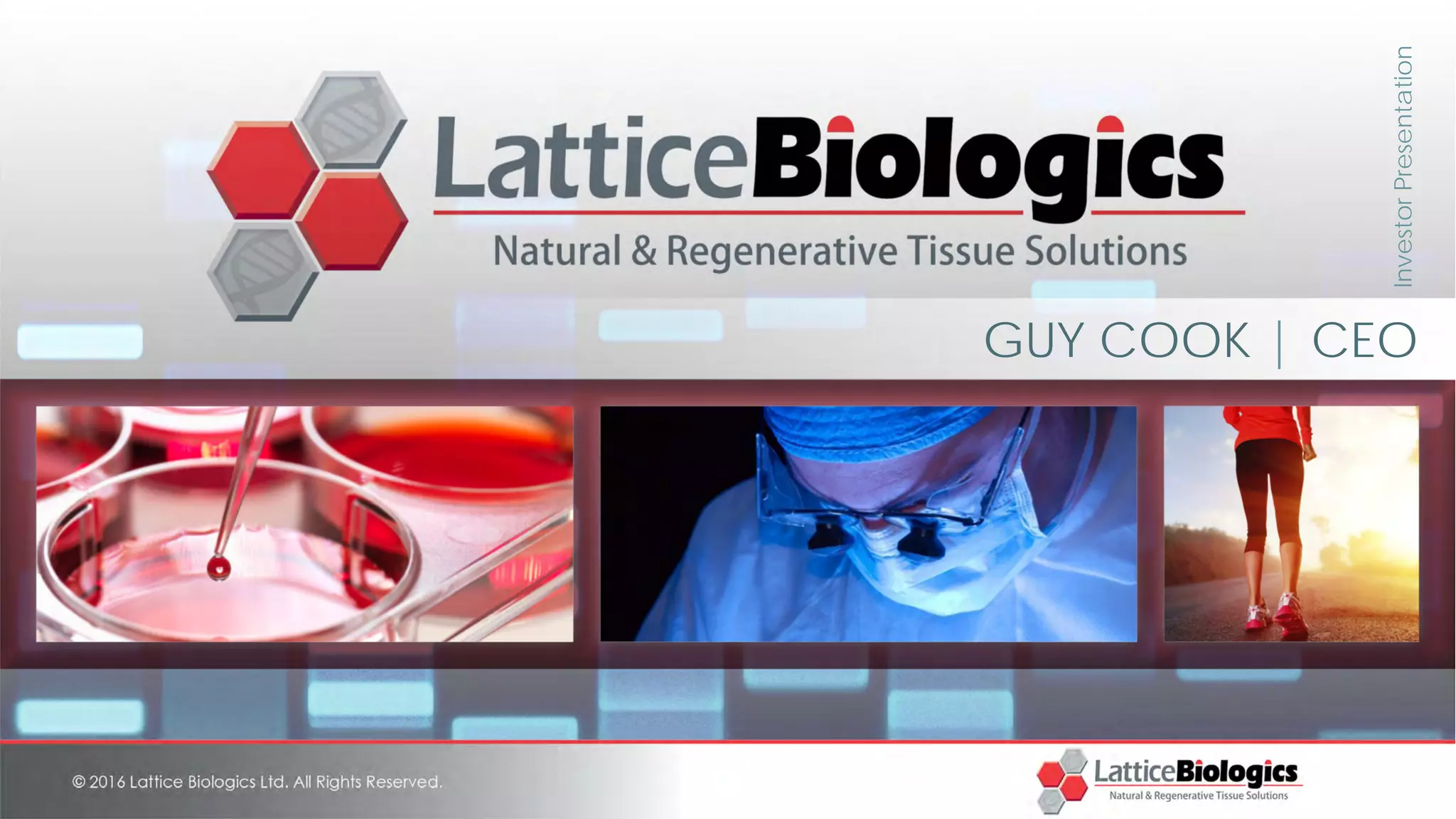
The presentation opens with a professional, clinical aesthetic. The company name, Lattice Biologics, is paired with the tagline 'Natural & Regenerative Tissue Solutions.' The slide identifies Guy Cook as the CEO and marks the presentation as an 'Investor Presentation.' The imagery includes lab-based cellular work and an athlete, suggesting a bridge between biotechnology and physical recovery.
Slide 4: Management Team and Track Record
This slide is titled 'NOT OUR FIRST RODEO...' and serves as the primary credibility builder for the deck. It highlights that CEO Guy Cook led Bacterin International (AMEX:BONE) from a startup to a publicly traded company with a $400 million market cap. It specifically notes a revenue increase from $7.8MM in 2009 to $30.1MM in 2012. The slide also introduces COO Gregory Davis and Product Development Director Christopher Bradley, Ph.D. A critical piece of data at the bottom states that $2.4 million has been invested by management, signaling high alignment with potential investors.
Product Portfolio and Commercial Strategy
Slide 7: New Products for 2016
Lattice Biologics details its 100% Human Demineralized Cortical Bone, scheduled for Q2 2016. The slide lists technical advantages including a 5-year shelf life, room temperature storage, and 'excellent malleable handling characteristics.' The product uses a proprietary 'Matrix-assisted Regeneration (MAR)' process. This slide is designed to show immediate, marketable inventory that solves logistical issues for hospitals (storage and shelf life).
Slide 10: Executing Our Strategy
This slide outlines the 'KOL Model' for sales. The company targets two main products: DBM Putty (tissue grafting) and Dermis (breast reconstruction). The goal for Q2 2016 was to have 20 KOLs (Key Opinion Leaders) for each, with 2 and 12 already contracted respectively at the time of the deck's creation. The financial impact is quantified: $2-3M in revenue per KOL per year. It also visualizes the sales cycle, showing a 1-12 month window for hospital approval, which manages investor expectations regarding revenue timing.
Technology and Scientific Foundation
Slide 13: Age-Related Functional Decline
This is a conceptual slide explaining the 'Why' behind their regenerative focus. It compares 15-year-old stem cells (mostly active) to 65-year-old stem cells (mostly dormant). This sets the stage for why external biological solutions are necessary for an aging population, providing a biological rationale for the market demand.
Slide 16: Extracellular Matrix (ECM) Technology
The deck moves into the technical specifics of Mesenchymal Stem Cells (MSCs). It explains how MSCs can differentiate into bone, fat, or cartilage tissue depending on the culture conditions and the matrix used. This slide establishes the company's scientific depth, citing Deans RJ and Mosely AB (2000) to ground their technology in peer-reviewed research.
Slide 19: Modern Cancer Diagnostics
Lattice Biologics signals a move beyond just tissue grafting into diagnostics. This slide explains the current state of cancer diagnostics (identifying primary tumors and staging) and how DNA sequencing and biomarkers are becoming routine. It serves as a transition to how Lattice's technology applies to this high-value sector.
Slide 22: Building the Microenvironment
This slide connects the tissue engineering expertise to cancer diagnostics. By 'replicating the natural microenvironment tumor cells experience in the body,' Lattice claims they can achieve more accurate results when testing drugs in a laboratory setting. The slide uses the phrase 'Imitation is the highest form of innovation,' suggesting their competitive advantage is the ability to mimic human biology more closely than competitors.
Market Opportunity and Summary
Slide 25: Exciting and Doable Opportunity
The final slide in the sequence summarizes the investment thesis into six pillars: a licensed facility, a pipeline moving from '200 to 2' new products, a $3B huge market, the KOL access model, a 53% 4-year CAGR (growing from $6M to $36M), and differentiated, scalable products. This slide acts as the 'closer,' framing the company as a de-risked opportunity with significant growth potential.
What Lattice Biologics Does Well
The deck excels at establishing founder-market fit . By leading with the 'Not our first rodeo' slide, the company immediately addresses the biggest risk in biotech: management's ability to navigate regulatory hurdles and achieve an exit. The inclusion of the $2.4 million management investment is a powerful signal of confidence that few early-stage decks can match.
Furthermore, the commercial clarity on Slide 10 is exemplary. Instead of vague 'market penetration' percentages, the company provides a specific unit of growth: the Key Opinion Leader. By assigning a dollar value to each KOL ($2-3M), they make the path to $36M in revenue feel like a matter of execution rather than a mystery. This makes the business model feel 'doable,' as the slide title suggests.
What is Missing from the Lattice Biologics Deck
The most glaring omission in the provided slides is a specific funding Ask . While the deck builds a strong case for the company's value, it does not state how much capital is being raised, the terms of the round, or the specific milestones that the new capital will unlock. Without this, the deck feels more like a general capabilities briefing than a fundraising tool.
Additionally, there is a lack of competitive analysis . The deck mentions a $3B market and proprietary processes, but it does not name competitors or provide a 'feature check' matrix. In the crowded space of regenerative medicine and allografts, investors need to know why a surgeon would choose Lattice's DBM Putty over established incumbents. The deck also lacks detailed unit economics ; while we see revenue per KOL, we do not see the cost of goods sold (COGS) or the margin profile for these biological products.
Lessons for Founders
Leverage your history: If you have had a previous exit or successful scale-up, put it at the front of the deck. Lattice uses their AMEX:BONE success to frame the entire presentation as a sequel to a hit, rather than a risky new venture. · Quantify your sales engine: Don't just say you will sell to hospitals. Define the mechanism (KOLs), the timeline (1-12 months for approval), and the expected value of a single 'win' ($2-3M). This allows investors to build their own mental models of your growth. · Bridge the gap between science and business: Lattice does a good job of explaining complex biological concepts (like ECM and MSC differentiation) and immediately tying them to market opportunities like cancer diagnostics and orthopedic surgery. · Show skin in the game: If the management team has invested their own capital, highlight it. It is one of the strongest indicators of a team's belief in their own success and significantly de-risks the 'intent' of the founders for an investor.
Frequently asked questions
- What is the primary product focus of Lattice Biologics according to the deck?
- The company focuses on 'Natural & Regenerative Tissue Solutions.' Specifically, Slide 7 highlights 100% Human Demineralized Cortical Bone, while Slide 10 details DBM Putty for tissue grafting and Dermis for breast reconstruction. They are also developing Extracellular Matrix (ECM) technology to prompt stem cell migration and healing (Slide 22).
- How does the company plan to acquire customers?
- Lattice Biologics utilizes a Key Opinion Leader (KOL) model. As shown on Slide 10, they aim to recruit and contract 20 KOLs for each major product line. These KOLs act as 'incentivized market access partners' (Slide 25) to drive adoption within hospitals, following a sales cycle that includes physician recruitment and hospital approval.
- What is the track record of the leadership team?
- The leadership team emphasizes prior success in the public markets. CEO Guy Cook led Bacterin International to a $400M market cap and grew revenues from $7.8M to $30.1M in three years. COO Gregory Davis has experience in organ procurement and tissue banks, while Dr. Christopher Bradley brings 13 years of combined academic and industrial chemistry experience (Slide 4).
- What are the projected growth metrics?
- Slide 25 outlines an 'Exciting and Doable Opportunity' featuring a 53% 4-year Compound Annual Growth Rate (CAGR). This trajectory shows the company scaling from $6 million to $36 million in revenue. This growth is supported by a target of $2-3M revenue per KOL per year as stated on Slide 10.
- Is there a specific investment ask in this deck?
- No. The provided slides do not include a specific funding request, valuation, or use of proceeds slide. While it is labeled as an 'Investor Presentation' (Slide 1), it functions more as a corporate overview and strategic roadmap rather than a direct solicitation for a specific round of capital.