LawTrades presents a masterclass in the 'less is more' philosophy of pitch deck design. The 16-slide deck is characterized by large-format typography, sparse text, and a heavy reliance on traction metrics to tell the story. Rather than getting bogged down in the complexities of legal regulations, the deck focuses on the inefficiency of the status quo—citing $1,500 hourly rates at top firms—and the simplicity of their message-based solution. The deck successfully highlights a 37% month-over-month growth rate and a $960,000 ARR run rate, providing immediate proof of market fit. While it lacks t…
Key takeaways
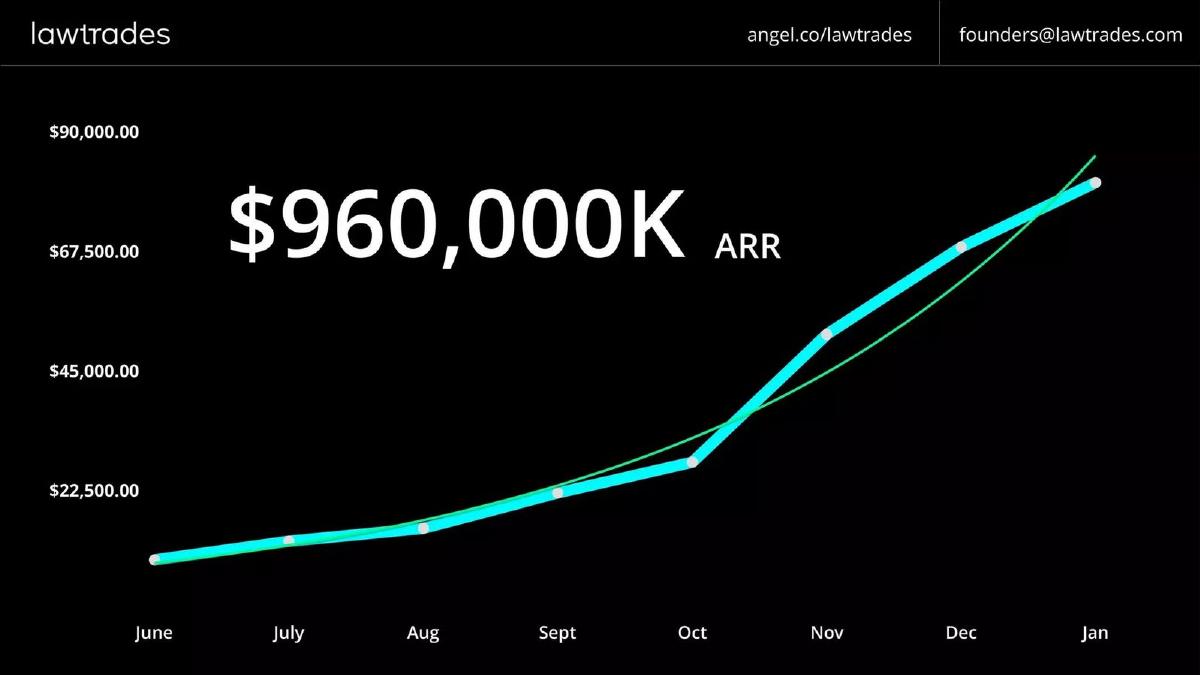
- The deck leads with a high-impact traction slide showing a $960,000 ARR run rate as of January (Slide 2).
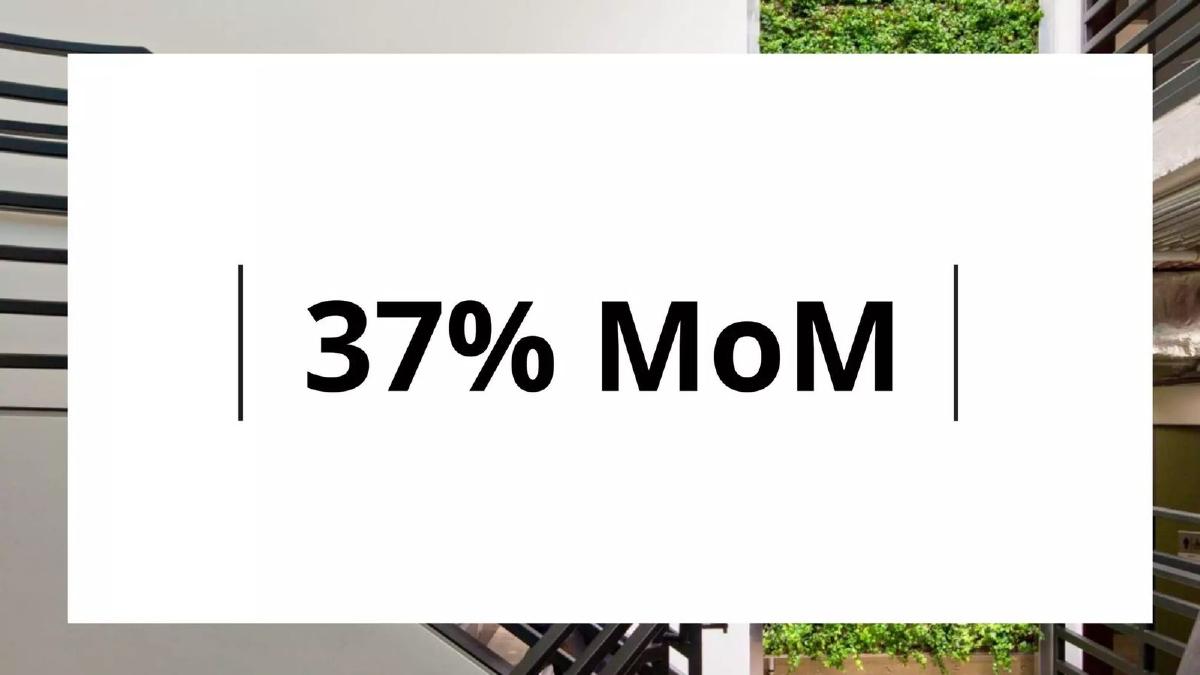
- Growth is emphasized early with a dedicated slide highlighting 37% month-over-month (MoM) growth (Slide 3).
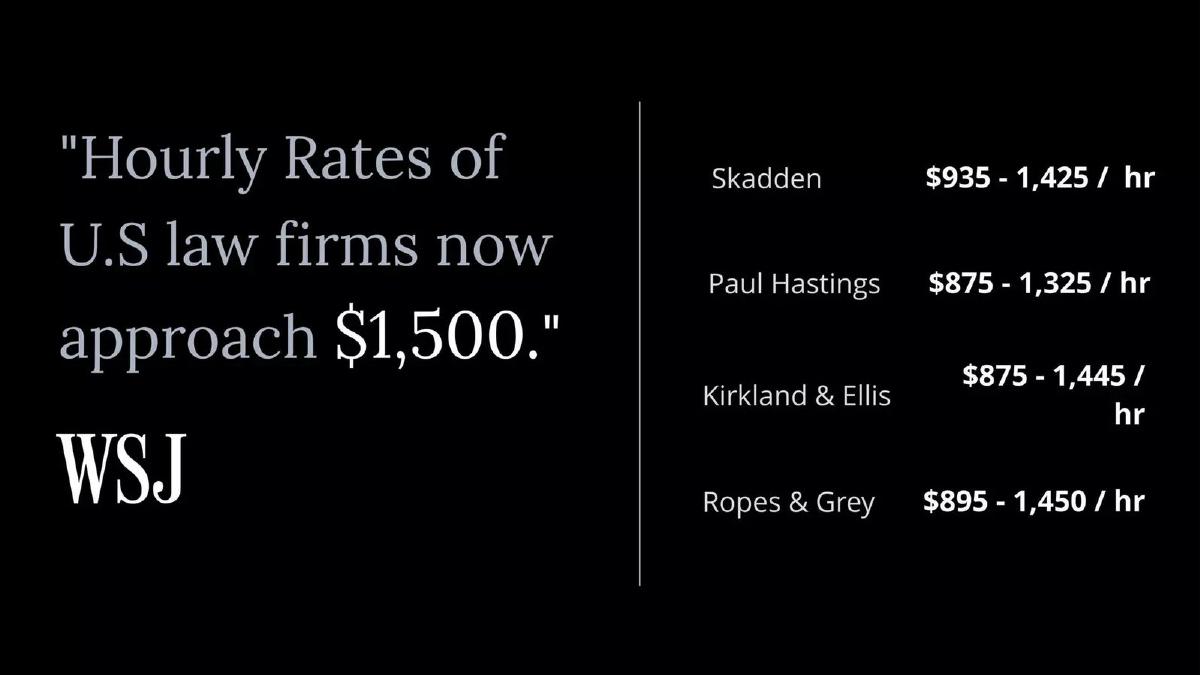
- The problem is framed through extreme pricing, citing Wall Street Journal data that U.S. law firm rates approach $1,500 per hour (Slide 5).
- The product is positioned as a message-based interface integrating with Slack, SMS, and Messenger (Slide 7).
- Supply-side health is demonstrated by showing top attorneys earning between $16K and $21K per month on the platform (Slide 13).
- The deck utilizes a minimalist aesthetic with single-metric slides to maintain investor focus (Slides 4, 11, 12).
- The team slide highlights a mix of legal background (Buffalo Law, Touro Law) and design/tech expertise (Slide 15).
- The final slide summarizes the core investment thesis: $80K+ GMV, 37% MoM growth, and a $100B market (Slide 16).
The LawTrades Pitch Deck: A Study in Minimalist Traction
The LawTrades deck is an outlier in the legal tech space. Traditionally, legal startups feel the need to over-explain regulatory compliance, attorney-client privilege, and complex workflows. LawTrades does the opposite. Founded in 2014, the company used this 16-slide deck to secure a significant Series A. The deck is characterized by a 'traction-first' narrative, where the numbers do the heavy lifting, and the product is presented as an elegant, almost invisible layer between the client and the attorney.
The Hook: Immediate Traction (Slides 1-4)
Slide 1 sets a professional, modern tone with the tagline: "Building the world's tech-enabled legal workforce." It avoids the word "marketplace," opting for "workforce," which implies a more managed and reliable service.
Slide 2 is the most important slide in the deck. It shows a revenue graph from June to January, ending at a $960,000 ARR . The line is not just growing; it is accelerating. By putting this second, LawTrades answers the "does anyone want this?" question before it is even asked. Note the exactness of the figures on the Y-axis, ranging from $22,500.00 to $90,000.00 in monthly increments.
Slide 3 and Slide 4 are minimalist 'stat' slides. Slide 3 highlights 37% MoM (Month-over-Month) growth, and Slide 4 simply states $100B . This is a classic venture capital play: show that the business is growing fast and that the ceiling is incredibly high. There is no text explaining how the $100B was calculated, which forces the investor to engage with the founder to learn more.
The Problem: Inefficiency and Risk (Slides 5-6)
Slide 5 uses a Wall Street Journal quote to anchor the problem in reality: "Hourly Rates of U.S law firms now approach $1,500." It lists specific firms like Skadden ($935 - 1,425 / hr) and Kirkland & Ellis ($875 - 1,445 / hr). This creates a clear 'enemy'—the high-priced, traditional law firm.
Slide 6 addresses the other end of the spectrum: "DIY services are risky." By using a trash can icon and this simple sentence, LawTrades dismisses competitors like LegalZoom without naming them. The implication is that LawTrades is the 'Goldilocks' solution: more professional than DIY, but significantly cheaper than Big Law.
The Solution: Frictionless Communication (Slides 7-9)
Slide 7 introduces the product interface. It shows the LawTrades logo surrounded by Slack, SMS, and Facebook Messenger icons. This communicates that LawTrades is not just another app to download; it lives where the user already spends their time.
Slide 8 and Slide 9 provide a visual walkthrough of a transaction. A user messages: "I need a 20 Page Sales Agreement reviewed." The system responds with an attorney (Jonathan Hood, 4.9 stars) and a flat price of $299 . Slide 9 shows the final step: "Your document is awaiting signature." This three-slide sequence reduces a complex legal process to a few text bubbles, emphasizing speed and price transparency.
The Business Model and Supply Side (Slides 10-13)
Slide 10 is a bold claim: $0/mo Practice Management . This is directed at the supply side (the lawyers). Most legal software charges lawyers a monthly subscription. LawTrades offers the tools for free, likely taking a percentage of the transaction instead.
Slide 11 and Slide 12 continue the minimalist trend with 60% and 4X . Without context on the slides, these likely refer to gross margins or efficiency gains for the lawyers, but their primary purpose is to serve as talking points during a live pitch.
Slide 13 is a 'Proof of Supply' slide. It shows three real attorneys and their monthly earnings on the platform: Jonathan Hood ($21K / month) , Jared Stark ($19K / month) , and Trippe Fried ($16K / month) . For a marketplace to succeed, the supply side must be able to make a living. These figures prove that LawTrades is a high-volume, high-value channel for legal professionals.
The Team and The Ask (Slides 14-16)
Slide 14 shows $2m in a circle. As noted in the FAQ, this is likely the target raise or a milestone. Slide 15 introduces the team. It is a balanced group: Raad (CEO) and Ashish (COO) bring legal credentials from Buffalo Law and Touro Law, while Amit (Design) and Jaime (CTO) provide the technical and aesthetic foundation. The slide is clean, focusing on faces and core backgrounds.
Slide 16 acts as a summary slide, repeating the core metrics: $80K+ GMV , 37% MoM , and $100B Market . It leaves the investor with the three most compelling reasons to write a check.
What Works in This Deck
Traction First: By leading with ARR and MoM growth, the deck creates a sense of inevitability. It is much harder to say 'no' to a business that is already working. · Extreme Simplicity: The design is uncluttered. By putting only one idea on each slide, the founders control the pace of the presentation and ensure the investor isn't distracted by reading small text. · Supply-Side Proof: Showing that lawyers are making $20k/month is a powerful way to debunk the myth that 'good lawyers won't use marketplaces.' · Price Anchoring: Comparing a $299 flat fee to a $1,500 hourly rate makes the value proposition feel like a 'no-brainer' for small businesses.
What is Missing
Unit Economics: While the deck shows revenue and growth, it does not explicitly state the Customer Acquisition Cost (CAC) or Lifetime Value (LTV). For a Series A, investors usually want to see the 'money in, money out' formula. · Competitive Landscape: The deck ignores other startups in the space. While this keeps the focus on LawTrades, it leaves the door open for questions about how they differ from UpCounsel or Priori Legal. · Regulatory Strategy: The legal industry is heavily regulated (e.g., fee-splitting rules). The deck omits how they navigate these hurdles, which is a common concern for legal tech investors.
What a Founder Should Copy
The 'Stat Slide' Format: Use slides with a single, massive number (like the 37% MoM slide) to punctuate your pitch. It forces the audience to look at you for the explanation. · Visual Product Walkthroughs: Instead of showing a complex dashboard, show a simple 'User Story' through chat bubbles or a 3-step process. · Supply-Side Success Stories: If you are building a marketplace, show the faces and earnings of your top providers. It humanizes the platform and proves the economic engine is running.
Frequently asked questions
- What is the primary value proposition of LawTrades according to the deck?
- LawTrades positions itself as a 'tech-enabled legal workforce' that simplifies the process of finding and hiring lawyers through a message-based interface. By integrating with common communication tools like Slack and SMS, it removes the friction and high costs associated with traditional law firms, which the deck notes can charge up to $1,500 per hour.
- How does LawTrades demonstrate market traction?
- Traction is the centerpiece of this deck. Slide 2 shows a clear upward trend in revenue from June to January, culminating in a $960,000 ARR. Slide 3 reinforces this with a 37% month-over-month growth figure. By placing these metrics at the very beginning, the founders establish immediate credibility before explaining the product mechanics.
- What is the significance of the attorney earnings slide?
- Slide 13 is crucial for a marketplace business. It proves the 'supply side' of the platform is viable. By showing that individual attorneys like Jonathan Hood are earning $21,000 per month, LawTrades demonstrates that the platform can provide a primary income for high-quality professionals, which is essential for long-term retention and service quality.
- Why does the deck omit a traditional competitor slide?
- The deck chooses to frame the 'competitor' as the status quo rather than other startups. Slide 5 targets high-priced traditional firms (Skadden, Kirkland & Ellis), and Slide 6 dismisses 'DIY services' as risky. This positioning suggests LawTrades is carving out a new category of 'managed marketplace' rather than fighting for scraps in the existing DIY legal document space.
- Is the $2 million figure on Slide 14 the funding ask?
- While the slide simply says '$2m' inside a circle, in the context of a Series A deck from 2014, this likely represented either the target raise amount or a specific milestone achieved. Given that the company eventually raised $8.7 million, this slide may have been a placeholder for a specific round tranche or a previous seed milestone.