Leapcure’s 10-slide deck is an exercise in restraint, designed for a high-speed verbal pitch rather than a standalone read. It identifies a critical bottleneck in the $2.6 billion drug development process: the three-year recruitment phase that contributes to $200 billion in annual patent revenue losses for pharma companies. While the deck is almost entirely devoid of product screenshots, technical architecture, or financial projections, it compensates with high-signal social proof. The team claims over 35 years of health tech experience and lists partnerships with major health organizations l…
Key takeaways
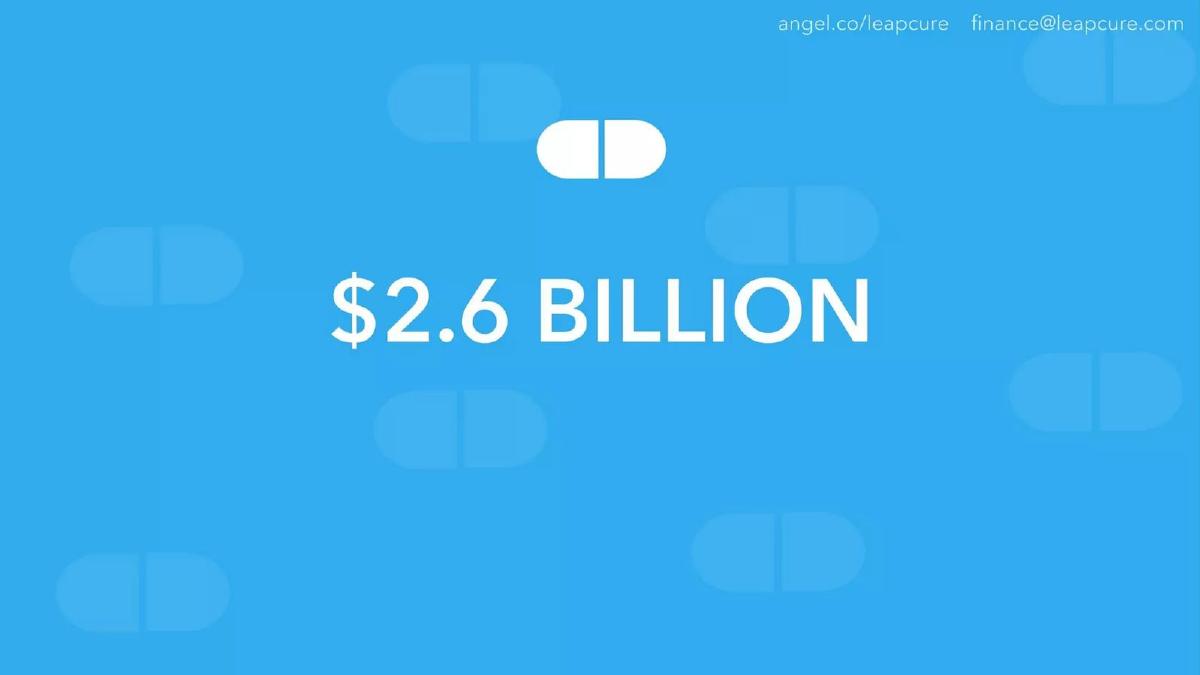
- The deck frames the market opportunity through a single massive figure: $2.6 billion on slide 2.
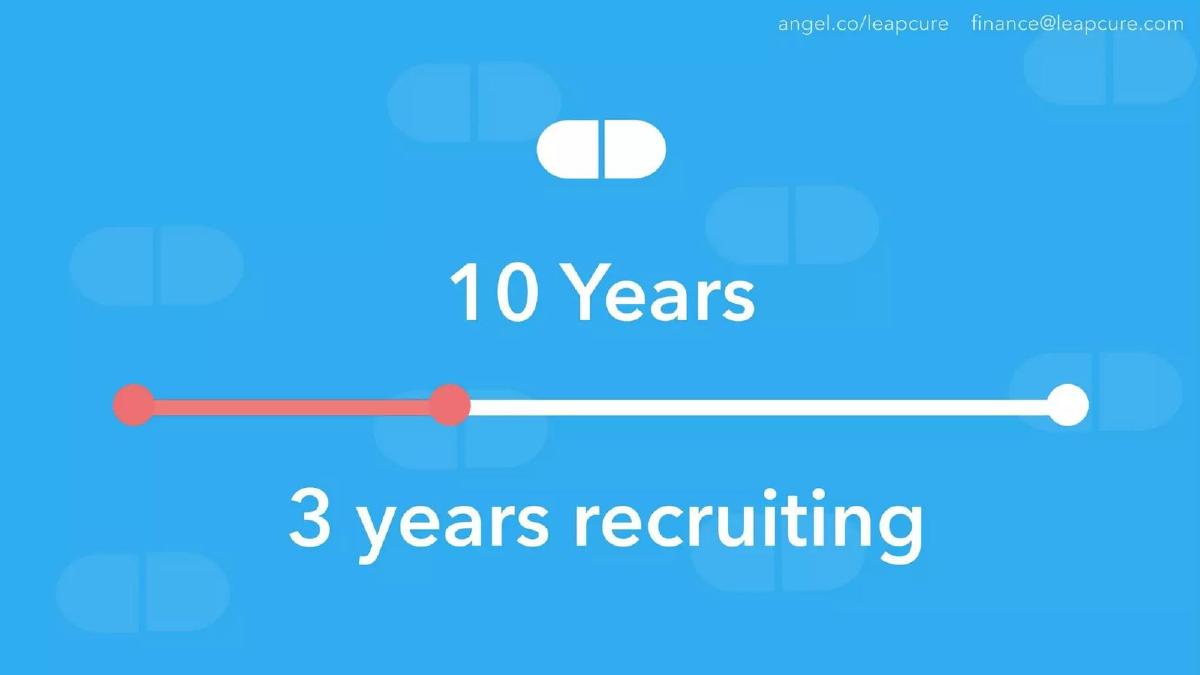
- It identifies a specific timeline bottleneck, noting that 3 out of 10 years in drug development are spent on recruitment (slide 3).
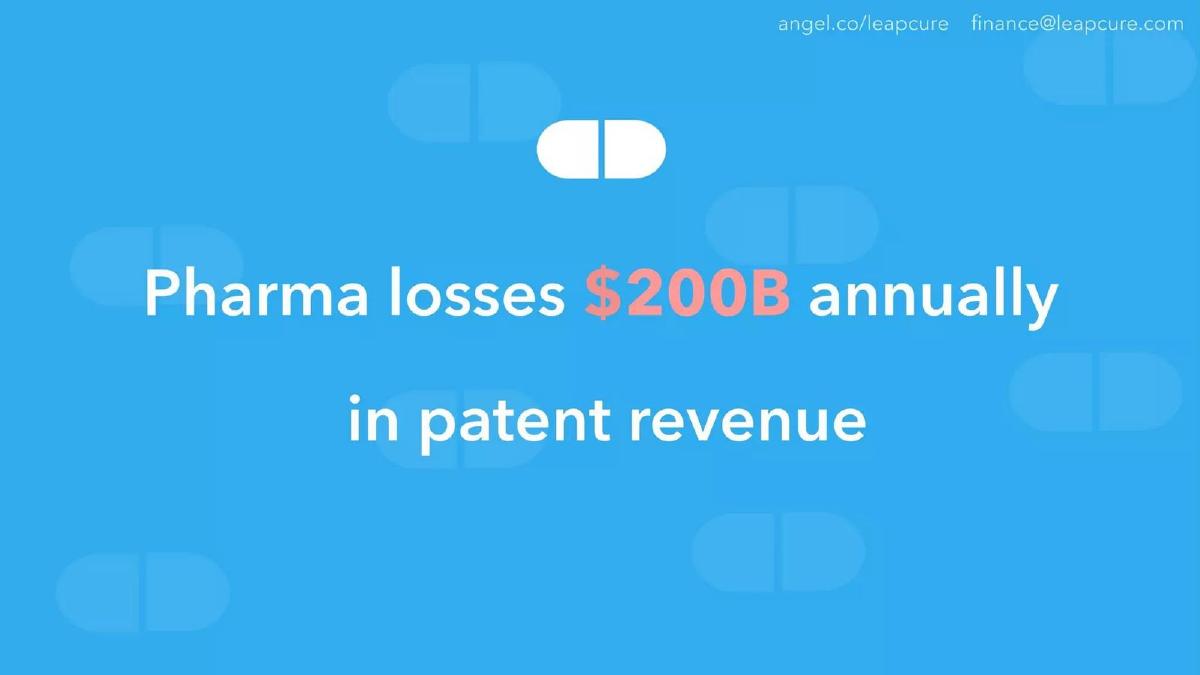
- The 'cost of inaction' is quantified as $200 billion in annual lost patent revenue for pharma (slide 4).
- The team slide emphasizes collective experience (35+ years) rather than individual resumes (slide 6).
- Strategic partnerships with the American Liver Foundation, American Diabetes Association, and American Lung Association are used as trust signals (slide 7).
- Early commercial traction is proven by revenue from 4 of the top 20 global pharma companies (slide 8).
- A specific performance metric claims the ability to recruit 75 patients in 60 days (slide 9).
- The deck uses a 1/5 and 1/10 ratio to imply significant time and cost savings compared to industry standards (slide 9).
The Minimalism of High-Stakes Problem Solving
The Leapcure pitch deck from 2015 is a fascinating artifact of seed-stage fundraising. It contains only 10 slides, very few words, and zero charts. In an era where decks often bloat to 20+ slides of dense data, Leapcure takes the opposite approach: it identifies a massive, expensive problem and asserts that they are the team already solving it for the world's largest companies. This is a 'teaser' deck designed to be presented live, where the speaker provides the substance while the slides provide the emotional and statistical punctuation.
Slides 1-5: Framing the Multi-Billion Dollar Bottleneck
Slide 1: Title The deck opens with a simple logo on a blue background. No tagline is provided on the slide itself, though the contact information (angel.co/leapcure and a finance email) is tucked into the top right corner.
Slide 2: The Market Size The company leads with a single figure: $2.6 BILLION . There is no context on the slide, but in the pharmaceutical world, this is the widely cited average cost to develop a single new drug. By starting here, Leapcure establishes that they are operating in a high-stakes environment where even marginal improvements in efficiency result in massive savings.
Slide 3: The Recruitment Problem This slide introduces a timeline. It notes that drug development takes 10 Years , and a red segment of that timeline represents 3 years recruiting . This identifies the specific bottleneck Leapcure intends to fix. It tells the investor that 30% of a drug's time-to-market is wasted on the logistics of finding patients.
Slide 4: The Financial Impact Leapcure connects the timeline delay to a specific loss: Pharma losses $200B annually in patent revenue . This is a classic 'hair on fire' problem. Because drug patents have a fixed expiration date, every day spent in recruitment is a day of lost sales once the drug is approved. The $200B figure transforms a logistical problem (recruitment) into a top-line revenue problem for the C-suite.
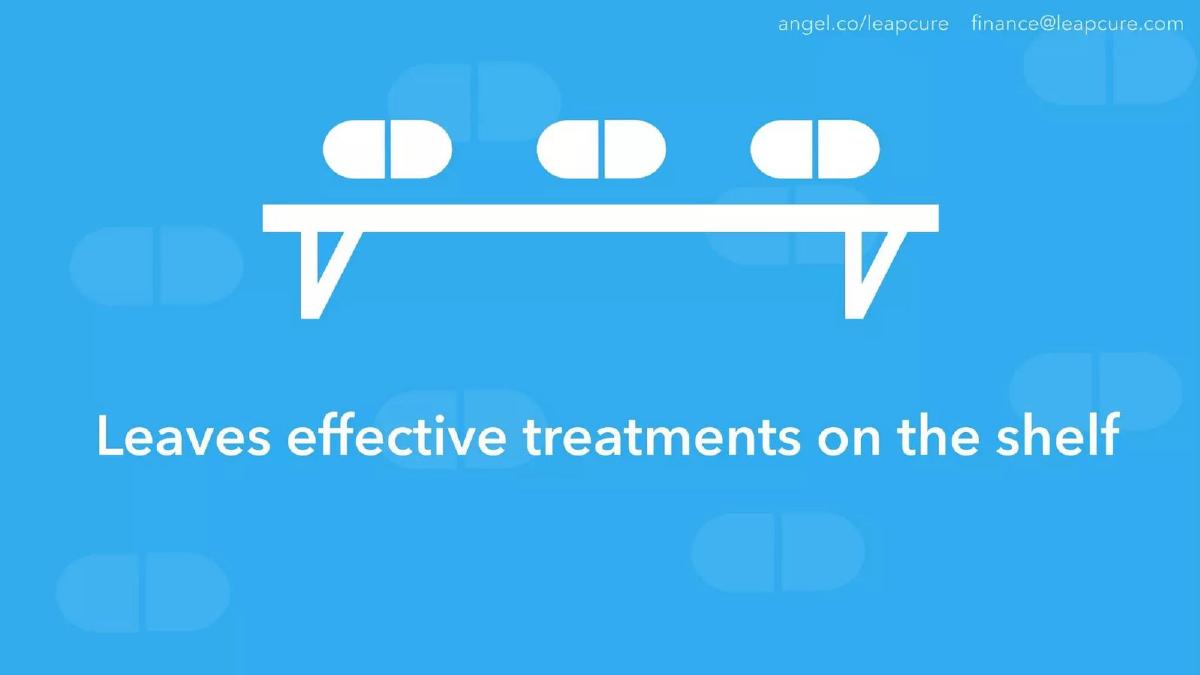
Slide 5: The Human Cost The final slide in the problem sequence states that the current system Leaves effective treatments on the shelf . This adds a moral dimension to the business case, suggesting that inefficiency isn't just costing money—it's costing lives by delaying access to medicine.
Slides 6-8: Team, Trust, and Traction
Slide 6: The Team The deck moves to the solution by highlighting the people behind it. It claims 35+ years of health tech experience and shows headshots for eight team members. Notably, it does not list previous companies (like Google, Merck, or Stanford), which is a common omission in minimalist decks. It relies on the aggregate '35+ years' to establish authority.
Slide 7: Strategic Partnerships To prove they can actually find patients, Leapcure displays the logos of three major organizations: the American Liver Foundation , the American Diabetes Association , and the American Lung Association . For a recruitment startup, these aren't just customers; they are the gatekeepers to the patient data required to solve the problem identified on slide 3.
Slide 8: Commercial Validation This is the 'money slide.' It states the company is Generating revenue from 4 of the top 20 pharma companies. For a seed-stage company in 2015, having 20% of the top global players as paying customers is an extraordinary level of validation. It moves the conversation from 'Can you do this?' to 'How fast can you scale this?'
Slides 9-10: The Performance Metric and Conclusion
Slide 9: The Case Study Leapcure provides a specific proof point: 75 Patients in 60 Days . Below this, they use two icons—a stopwatch and a money bag—with the fractions 1/5 and 1/10 . While the slide doesn't explicitly label these, the implication is that they can recruit patients in one-fifth the time and at one-tenth the cost of traditional methods. This is the only slide that hints at the 'how' of their business model.
Slide 10: Closing The deck ends as it began, with the Leapcure logo and contact information. There is no 'Ask' slide, no financial projection, and no roadmap.
What Works in This Deck
Extreme Clarity on the Problem: By the fourth slide, any investor understands that recruitment is a $200 billion bottleneck. The deck doesn't hide the lead. · High-Signal Traction: Claiming revenue from 4 of the top 20 pharma companies (Slide 8) is a massive de-risking event for a seed investor. It proves product-market fit has already been established with the hardest-to-close customers in the world. · The 1/5 and 1/10 Ratios: These are 'sticky' numbers. Even if an investor forgets the rest of the deck, they will remember that Leapcure claims to be 5x faster and 10x cheaper than the status quo.
What is Missing
The Product: There is not a single screenshot or description of the 'Adaptive screening platform' mentioned in the company's self-description. We don't know if this is a manual service, an AI-driven database, or a patient-facing app. · The Business Model: While they mention 'generating revenue,' they don't explain how they charge. Is it per patient recruited? A SaaS subscription for the pharma company? A percentage of the trial budget? · The Competition: The deck acts as if Leapcure is the only company attempting to modernize clinical trials. There is no mention of CROs (Contract Research Organizations) or other digital health competitors. · The Ask: This is the most glaring omission. A fundraising deck usually concludes with how much money is being raised and what milestones that money will buy. This deck is purely a narrative of the problem and the company's early success.
What a Founder Should Copy
The 'Problem-to-Loss' Pipeline: Leapcure doesn't just say 'recruitment is slow.' They say 'recruitment is slow (Slide 3), which causes patent loss (Slide 4), which equals $200B (Slide 4).' Founders should always connect their technical problem to a specific financial pain point for the customer. · Using Logos for Credibility: If you have partnerships with major non-profits or industry leaders, give them their own slide (Slide 7). In healthcare, trust is a currency that is often more valuable than the code itself. · Minimalist Design: The consistent blue background and simple white text make the deck feel professional and easy to digest. It prevents 'cognitive overload' during a pitch.
Frequently asked questions
- How much did Leapcure raise with this deck?
- According to the catalogue facts, Leapcure raised $125,000 in 2015 during its Seed stage. This relatively small amount suggests the deck may have been used for an accelerator demo day or an initial angel round where the primary goal was to secure follow-up meetings rather than close a multi-million dollar Series A.
- Is the lack of product screenshots a weakness?
- In this specific context, it appears intentional. Leapcure is selling a solution to a massive logistical and financial headache for pharma companies. By focusing on the outcome—75 patients in 60 days—rather than the software interface, they prioritize the value proposition over the tool. However, for a technical investor, the lack of information on how the 'adaptive screening platform' actually works would be a significant gap.
- What is the significance of the '3 years recruiting' metric?
- Slide 3 highlights that 30% of the 10-year drug development cycle is spent just finding patients. This is the 'Aha!' moment of the deck. It tells investors exactly where the inefficiency lies. By shortening this specific window, Leapcure directly impacts the $200 billion patent revenue problem mentioned on the following slide.
- Who is the target customer based on this deck?
- The deck clearly targets large pharmaceutical companies ('Top 20 pharma') and major health foundations. Slide 8 confirms they are already generating revenue from four of the top 20 pharma firms, which is an incredibly high bar for a seed-stage company and serves as the deck's strongest validation point.
- Why are the health foundation logos included?
- Clinical trial recruitment relies heavily on trust and access to patient pools. By showing logos for the American Lung Association and others on slide 7, Leapcure demonstrates they have the necessary 'pipes' or relationships to reach patients that pharma companies struggle to find independently.