Normative’s 2021 Series A deck is a lean, 19-slide presentation that successfully raised $31M by focusing on the massive gap between corporate net-zero promises and actual data capabilities. The deck avoids the common pitfall of over-explaining climate science, instead framing carbon accounting as a mandatory financial-grade requirement driven by the Corporate Sustainability Reporting Directive (CSRD). By highlighting a database of 100 million companies and a 'hybrid model' for Scope 3 accuracy, Normative moved the conversation from environmental altruism to operational necessity. While the d…
Key takeaways
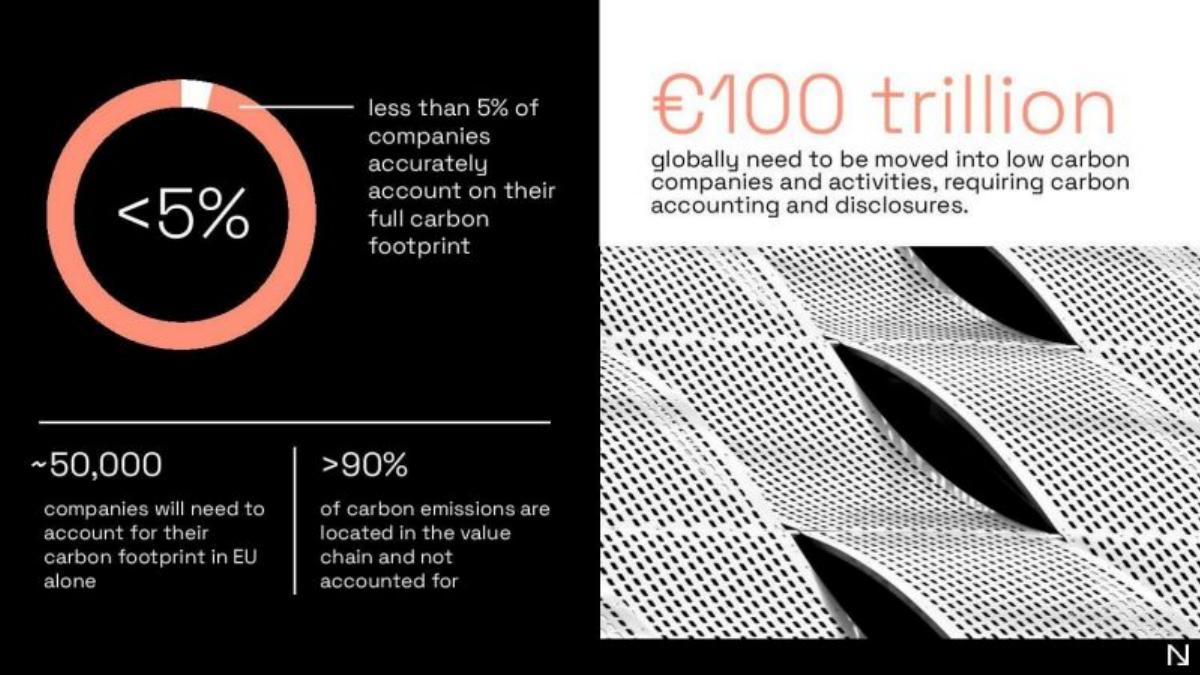
- The deck identifies a massive market gap where less than 5% of companies accurately account for their full carbon footprint (Slide 3).
- Regulatory tailwinds are central to the pitch, specifically citing the 50,000 organizations required to report under the EU CSRD (Slide 9).
- The product uses a hybrid model that combines spend-based data with supplier-specific activity data to increase accuracy (Slide 12).
- Normative emphasizes speed, claiming they can measure full Scope 3 emissions in 2-3 weeks rather than months (Slide 16).
- The 'Carbon Accounting Engine' is presented as a mathematical formula: the sum of Business Activity multiplied by Emission Factors (Slide 15).
- The deck features significant enterprise social proof, including logos from BNP Paribas, Flying Tiger Copenhagen, and SEB (Slide 17).
- There is a notable omission of a dedicated team slide, which is unusual for a Series A deck (Slide 1-19).
- The presentation lacks a specific 'Ask' slide detailing how the $31M would be allocated across headcount or R&D (Slide 1-19).
Introduction: The Infrastructure of the Net Zero Economy
Normative’s 2021 Series A deck arrived at a pivotal moment for the ESG (Environmental, Social, and Governance) software market. With $31M raised, the company successfully argued that carbon accounting is no longer a 'nice-to-have' marketing tool but a 'foundational infrastructure' requirement for the global economy. The deck is characterized by a minimalist aesthetic, high-contrast visuals, and a heavy reliance on regulatory pressure as a market catalyst.
Slides 1-5: The Macro Thesis and Vision
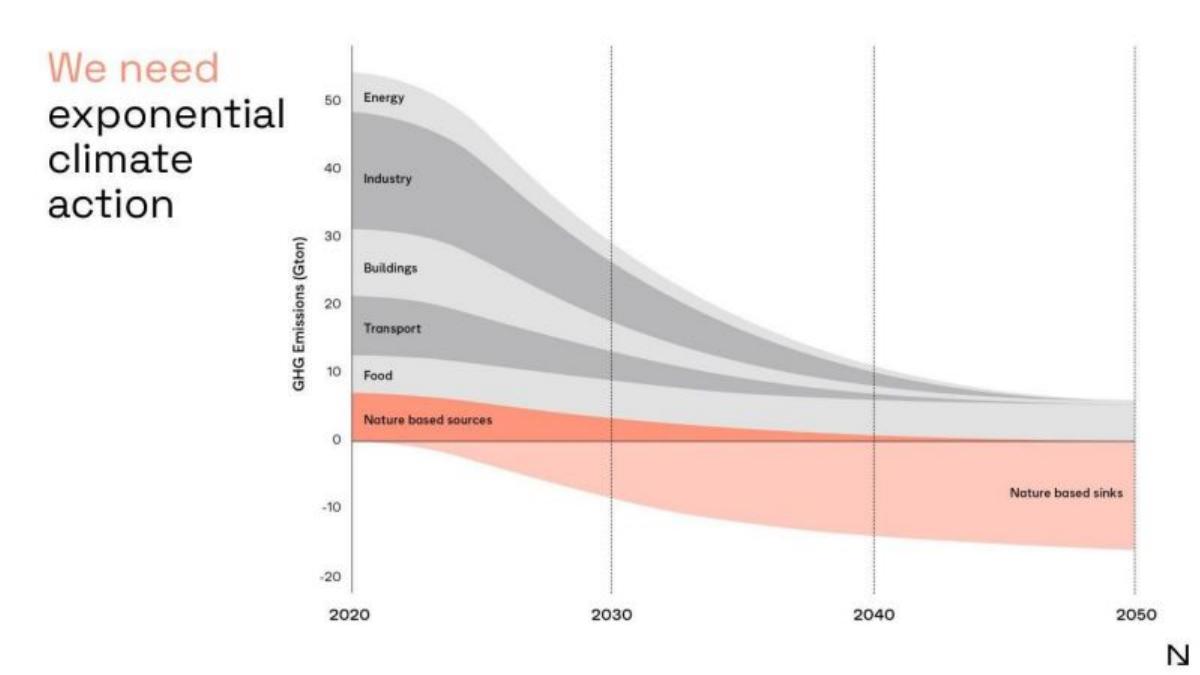
Slide 1 sets a somber, professional tone with the title 'The Path to Net Zero emissions.' It establishes the brand identity immediately: clean, authoritative, and focused on the outcome rather than just the tool. Slide 2 provides the scientific 'Why,' showing a chart of GHG emissions across sectors (Energy, Industry, Buildings, etc.) and the exponential reduction required by 2050. This slide serves to validate the urgency of the problem space.
Slide 3 is the 'Problem' slide, and it is highly effective. It presents three staggering statistics: less than 5% of companies accurately account for their full footprint, ~50,000 companies in the EU alone will soon be required to do so, and over 90% of emissions are hidden in the value chain (Scope 3). By framing the problem this way, Normative isn't just selling software; they are selling a solution to a massive compliance and data gap. Slide 4 and Slide 5 transition into the vision, calling for a 'new norm' and stating their goal to 'make known the sustainability impact of all economic activities on the planet.'
Slides 6-9: The Value Proposition and Market Drivers
Slide 6 defines 'What we do' in a single sentence: 'We deliver actionable sustainability intelligence to reduce companies’ emissions.' This is a crucial distinction; they aren't just reporting data, they are providing 'intelligence' for reduction. Slide 7 breaks this down into three pillars: Full climate footprint (Scope 1, 2, and 3), Emissions reporting, and the Path to net zero. It explicitly mentions adherence to the Greenhouse Gas Protocol (GHGP), which is the gold standard for carbon accounting.
Slide 8 and Slide 9 focus on the 'Why Now.' Slide 8 lists Capital, Compliance, and Consumers as the three drivers. Slide 9 backs this up with hard numbers: 76% of investment managers following UN principles, 50,000 organizations hit by CSRD, and 77% of consumers demanding sustainable brands. This section is designed to convince investors that the market is being forced into existence by regulators and financiers, regardless of individual corporate will.
Slides 10-13: Product Workflow and Accuracy
Slide 10 and Slide 11 introduce the 'How it works' section. The workflow is simplified into three steps: Input data (financial transactions), Calculate emissions (via their engine), and Take climate action (suggesting initiatives). This simplicity is intentional, as it contrasts with the traditionally manual and expensive process of hiring sustainability consultants.
Slide 12 addresses the biggest technical hurdle in carbon accounting: accuracy vs. effort. Normative explains their 'hybrid model.' They start with a 'spend-based approach' (easy but less accurate) and then move to an 'activity-based approach' for high-impact areas. This demonstrates a pragmatic understanding of enterprise data challenges. Slide 13 provides a clean UI mockup of the 'Acme Corp' dashboard, showing a clear breakdown of Scope 1, 2, and 3 emissions and a progress bar toward a net-zero target. The UI looks more like a modern fintech app than a clunky compliance tool, which is a significant selling point for modern enterprises.
Slides 14-16: The Technical Moat
Slide 14 and Slide 15 dive into the 'Carbon Accounting Engine.' Slide 15 is particularly interesting as it shows the actual mathematical logic: the sum of Business Activity multiplied by Emission Factors. This transparency builds trust with technical auditors and investors. Slide 16 highlights the scale of their data: 200 million data points, a database of 100 million companies, and a reduction in measurement time from months to 2-3 weeks. This is the 'Moat' slide—it suggests that a new competitor cannot easily replicate Normative's accuracy because they lack the historical data and company database.
Slides 17-19: Social Proof and Conclusion
Slide 17 is a classic logo wall featuring heavy hitters like BNP Paribas, Flying Tiger Copenhagen, and SEB. For a Series A company, this level of enterprise adoption is impressive and serves as the primary validation of the product-market fit. Slide 18 doubles down on this with a testimonial from the Head of Sustainability at Flying Tiger Copenhagen, emphasizing 'honest and dependable calculations.' Slide 19 concludes with a simple 'Thank you.'
What Normative Does Well
Regulatory Alignment: The deck leans heavily on the CSRD. By tying their success to a mandatory EU directive, they de-risk the investment. Investors aren't betting on whether companies want to buy this; they are betting on the fact that companies have to buy it. · Scope 3 Focus: Most early carbon trackers focused on Scope 1 and 2 (direct emissions). Normative identifies that 90% of the problem is in Scope 3 (supply chain) and positions their 100M company database as the only way to solve it. · Clarity of Process: The three-step workflow (Input, Calculate, Act) demystifies a complex scientific process, making it accessible to generalist investors. · Visual Consistency: The deck uses a limited color palette (black, white, and a soft coral) and high-quality typography. This professional 'fintech' look helps move carbon accounting away from 'greenwashing' and toward 'financial-grade data.'
What is Missing from the Deck
Team Slide: There is no mention of the founders, their backgrounds, or the scientific advisors. In a Series A, the 'Who' is usually as important as the 'What.' · Financials and Metrics: The deck is completely devoid of ARR, NRR, CAC, or LTV. While the catalogue listing confirms a $31M raise, the deck itself doesn't show the growth trajectory that justified that valuation. · The Ask: There is no slide detailing how much they are raising or how they plan to spend the capital. This suggests this version of the deck may have been a 'teaser' or a high-level vision deck used in conjunction with a more detailed data room. · Competitive Landscape: The deck assumes a vacuum. It doesn't address how Normative competes with other players like Watershed, Persefoni, or the 'Big Four' consulting firms who are also moving into this space.
Founder Lessons: How to Copy Normative's Success
Sell the 'Must-Have,' not the 'Nice-to-Have': If your industry is facing new regulations, make those regulations the star of your deck. Normative didn't sell 'saving the planet'; they sold 'compliance with the CSRD.' · Quantify the Data Moat: If you are a data company, give investors a number to latch onto. '200M data points' and '100M companies' are much more compelling than 'we have a lot of data.' · Simplify the Complex: Carbon accounting is incredibly dense. Normative used a simple summation formula (Slide 15) to explain their entire backend. Find the 'formula' for your business and put it on a slide. · Focus on the Hardest Part: In carbon accounting, Scope 3 is the hardest part. By focusing their pitch on the most difficult aspect of the problem, Normative made their solution seem more valuable than simpler competitors.
Frequently asked questions
- What is the core value proposition of Normative according to the deck?
- Normative positions itself as 'foundational infrastructure for carbon accounting.' The deck argues that for the world to move €100 trillion into low-carbon activities, companies need a standardized, science-based way to measure their full footprint, including the notoriously difficult Scope 3 emissions which account for over 90% of total emissions.
- How does Normative differentiate its technology from other carbon trackers?
- The deck highlights two main technical advantages: a database of 100 million companies and a 'hybrid' accounting model. By starting with spend-based data and then layering in supplier-specific activity data for high-impact areas, they claim to provide higher accuracy without the time burden of traditional manual consulting.
- Which regulatory factors are driving Normative's growth?
- The deck explicitly mentions the Corporate Sustainability Reporting Directive (CSRD) in the EU, which mandates that 50,000 organizations report on ESG issues. It also notes that 76% of large investment managers have signed the UN Principles of Responsible Investment, creating a top-down demand for accurate carbon data.
- Who are the target customers for this software?
- Based on the logos on Slide 17, Normative targets large enterprises and financial institutions. Examples include banks like BNP Paribas and SEB, retailers like Flying Tiger Copenhagen and Happy Socks, and industrial firms like Bonava and Elekta. The focus is on companies with complex supply chains.
- What is missing from this pitch deck that investors usually expect?
- This deck is surprisingly light on internal metrics. It lacks a team slide, a detailed roadmap, financial projections (ARR, growth rates), and a specific breakdown of the funding ask. It functions more as a high-level vision and product overview rather than a granular business plan.