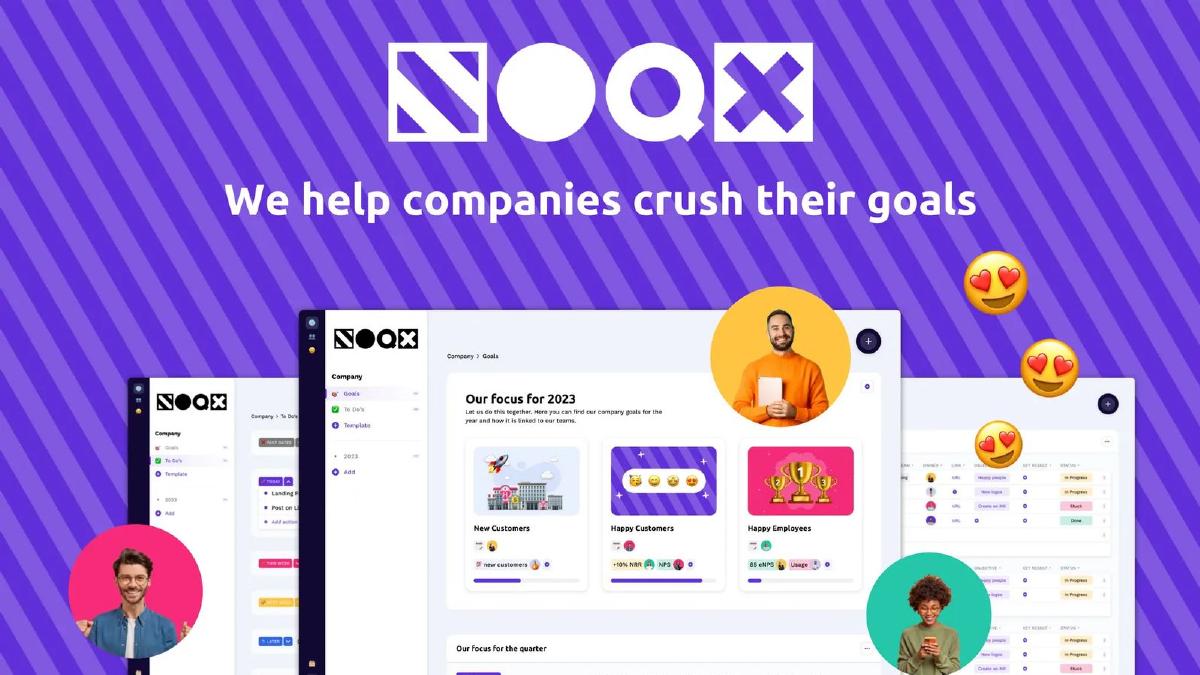
NOQX is a goal-setting and collaboration platform designed to bridge the gap between high-level corporate strategy and daily employee tasks. The deck highlights a significant market pain point: 90% of organizations fail to execute their strategies, and 51% of top management cannot name their company's top three priorities. NOQX proposes a 'one-stop-shop' that merges OKRs with daily to-do lists, emphasizing a user experience that prioritizes simplicity over the complexity of traditional HR performance tools. While the deck excels at defining the problem and the ideal customer persona—targeting…
Key takeaways
- The deck identifies a massive execution gap, citing that 70% of companies fail to achieve their goals (Slide 2).
- Product differentiation is built on the 'marriage' of a goal tool and a collaboration tool to reduce cognitive overload (Slide 6).
- The roadmap outlines a transition from an OKR framework in Q4 2023 to an AI-assisted platform by Q1 2024 (Slide 11).
- Traction is presented as a timeline, projecting a milestone of 70 paying customers by late 2024 (Slide 12).
- The go-to-market strategy targets mid-sized businesses with 50-500 employees, starting in the Nordics (Slide 15).
- Pricing is transparently set at $100 per user/year for 'Core' and $150 for 'Professional' tiers (Slide 14).
- The team slide highlights deep domain expertise, including a CEO with a decade in B2B SaaS and a CTO from Klarna (Slide 17).
- The deck omits a formal 'Ask' slide and does not provide financial projections or current revenue figures (Omitted).
NOQX Pitch Deck Teardown
NOQX entered the crowded OKR (Objectives and Key Results) software market with a focus on radical simplicity and employee engagement. This $200k pre-seed deck is a study in problem-centric storytelling, though it leaves several critical investor questions unanswered regarding the business's financial health and the specific terms of the raise.
The Problem: Execution Failure and Cognitive Overload
Slides 2-4 establish the 'why' behind the company. The deck leads with a heavy-hitting statistic: 70% of companies fail to achieve their goals. Slide 2 attributes this to disconnected initiatives and a lack of ownership. The visual of a pyramid with 'Information gets lost...' written along the side effectively illustrates the breakdown between company leadership and individual contributors.
Slide 3 introduces the concept of 'Information chaos,' noting that goals are often buried in spreadsheets and slide decks. It cites a Deloitte 2023 survey stating that 33% of companies struggle with digital infrastructure. Slide 4 provides the most damning evidence for the status quo, citing MIT Sloan research that shows goal awareness drops precipitously down the corporate ladder, with only 13% of frontline employees able to name top priorities.
The Solution: A Marriage of Goals and Collaboration
Slides 5-7 present the NOQX platform. The solution is framed around three pillars: Simplify Goals, Blend Governance and Inclusivity, and Embrace Digital Transformation. Slide 6 explicitly defines the product as 'A goal tool marrying a collaboration tool.' This is a strategic positioning move intended to distance the product from 'set it and forget it' HR software.
Slide 7 uses screenshots to show the UI, emphasizing 'Clarity,' 'Transparency,' and 'Impact everyday.' The UI appears clean, utilizing a dashboard that links individual 'Me' goals to 'Team' and 'Company' goals. The mention of 'a UX the World never experienced before' is high-level marketing speak, but the visual evidence suggests a focus on modern, consumer-grade design for enterprise software.
Onboarding and Market Landscape
Slides 8-9 address the practicalities of adoption and competition. Slide 8 outlines a 'Timeline to success,' a 9-month onboarding journey from the initial startup meeting to renewal. It includes specific touchpoints like a 'Satisfaction Survey' at month 3 and a 'Business Review' at month 6. Interestingly, it quotes Harvard Business Review stats like '125% Lower Burnout' as potential outcomes of better goal alignment.
Slide 9 is the standard competitive matrix. NOQX places itself in the 'Simplicity' quadrant, contrasting itself against 'Goal platforms' (high complexity) and 'Collaboration platforms' (which they claim lack strategic alignment). The text acknowledges that HR-procured tools often suffer from 'sporadic logins,' whereas NOQX aims for daily engagement.
The 'Unique' Factor and Roadmap
Slides 10-11 focus on the future. Slide 10 lists six unique selling points, including being 'Catapulted into the future by AI.' They claim AI will allow users to grasp goal progress and access executive summaries with one click. This is a standard inclusion for decks in the current cycle, though the specific technical implementation isn't detailed.
Slide 11 provides a quarterly roadmap for 2024. It shows a logical progression: building the core OKR framework first, then adding AI and note-taking, followed by integrations (Slack and Microsoft Teams icons are shown), and finally expanding into a broader 'Strategy Space' with Kanban and timeline views. This suggests the founders view OKRs as an entry point into a larger project management ecosystem.
Traction and Go-To-Market
Slides 12-16 cover the business side. Slide 12 is a 'Traction' timeline that is actually more of a milestone projection. It starts in May 2023 and ends in December 2024 with a goal of '70 Paying Customers.' It mentions '100 Target Customer Interviews' and 'First Paid Customer' as achieved milestones, but does not list current revenue or user numbers.
Slide 13, 'Our commercial engine,' is a flow chart showing how Sales, Marketing, and Product interact. It lists standard tactics like cold calling, SEO, and digital onboarding. Slide 14 is refreshingly transparent about pricing: $100/user/year for Core and $150/user/year for Professional. This high-price point suggests they are targeting higher-value enterprise seats rather than a low-cost volume play.
Slide 15 defines the persona 'CEO Cecile' at a 150-employee company. This level of detail—naming influencers like the Chief Strategy Officer and the 'Champion' as the employee—shows a sophisticated understanding of the B2B sales cycle. Slide 16 reinforces the 'Why Now?' by highlighting the shift to hybrid work and inclusive leadership styles.
The Team and The Mission
Slides 17-18 introduce the builders. The team is small but appears balanced. CEO Sophie Hedestad brings the commercial and growth experience, CTO Robert Zetterqvist provides the technical backbone (with Klarna pedigree), and Matilda Lundsten focuses on the UX, which the deck repeatedly claims is their primary differentiator. The deck ends on slide 18 with a mission statement: 'To Create Clarity and Enable Execution for Employees Around the World.'
What Works
Strong Problem Validation: The use of third-party data from Deloitte and MIT Sloan gives the 'problem' slides significant weight and creates a sense of urgency. · Clear ICP: The deck doesn't try to be everything to everyone. It specifically targets mid-sized companies (50-500 employees) and identifies the Nordics as the starting point. · Transparent Pricing: Including the $100-$150/user/year pricing helps investors immediately model the potential revenue scale based on the target customer size. · UX Focus: In a category (HR/OKR software) known for being clunky, emphasizing UX as a core feature is a smart way to appeal to modern workplaces.
What is Missing
The Ask: The most significant omission is a slide detailing how much they are raising, at what valuation, and how the funds will be spent. While the source listing mentions $200k, the deck itself is silent on the terms. · Current Metrics: The traction slide is largely aspirational. There is no mention of current MRR (Monthly Recurring Revenue), churn rates, or the number of active pilots. · Unit Economics: With a clear pricing model, investors would want to see Customer Acquisition Cost (CAC) and Lifetime Value (LTV) projections, even if they are early estimates. · Competitive Names: While they categorize competitors, they don't name them. In the OKR space, investors will want to know how they specifically beat Lattice, WorkBoard, or Gtmhub.
Founder Takeaways
Lead with Pain: NOQX does an excellent job of making the 'status quo' look painful. If you are entering a crowded market, your first three slides must make the current way of doing things look like a disaster. · Visualizing the Roadmap: The quarterly breakdown on slide 11 is a great way to show that you have a long-term vision beyond just a single feature set. · Define the Buying Committee: Slide 15 is a masterclass in persona mapping. Don't just list a target company; list the CEO, the influencers, and the champion. It shows you know how to sell. · Don't Forget the Ask: Even if you are sending a 'teaser' deck, you should generally include a slide that outlines what you need from the investor to reach the next set of milestones.
Frequently asked questions
- What is the primary problem NOQX is trying to solve?
- NOQX targets 'information chaos' and the failure of strategy execution. According to slide 2, 90% of organizations fail to execute their strategies because goals are disconnected from daily work. They cite MIT Sloan research on slide 4 showing that only 51% of top management can list their company's top three priorities, suggesting a massive lack of alignment.
- How does NOQX differentiate itself from existing OKR tools?
- On slide 9, NOQX positions itself on a 2x2 matrix as high simplicity compared to traditional 'Goal platforms' which are often complex and procured by HR. They claim to bridge the gap between goal setting and collaboration, making the process 'fun' and 'effortless' rather than a sporadic, manager-driven chore.
- What is the company's target market and initial expansion plan?
- Slide 15 defines their Ideal Customer Profile (ICP) as medium-sized businesses with 50 to 500 employees. Geographically, they are launching in the Nordics but state they have their 'sight set on the US from the get-go.' They specifically target companies undergoing significant change or digital transformation.
- What are the key features on the product roadmap?
- The roadmap on slide 11 shows a progression from basic OKR frameworks and goal visualization in Q4 2023 to more advanced features in 2024. These include an AI-assistant, document uploading, and billing tools in Q1, followed by Slack integrations in Q2, and a 'Strategy Space' with Kanban views in Q3.
- Who are the founders and what is their background?
- The team consists of CEO Sophie Hedestad, who has 10 years of B2B SaaS experience; CTO Robert Zetterqvist, a senior developer with four years at Klarna; and Matilda Lundsten, Head of UX. Sophie specifically notes on slide 17 that she was inspired to build NOQX after struggling to find a simple OKR tool in her previous role.