Nomadisation’s pitch deck, dated February 2018, outlines a four-week program designed for students to develop startup ideas while traveling across multiple countries. The business model relies on student fees starting at £2,400, targeting a demographic with 'strong academics' and an interest in tech, business, or finance. While the deck successfully communicates the program's structure—including a pitch competition for seed capital—it lacks critical financial projections, a clear breakdown of the 'seed capital' source, and a competitive analysis of the crowded ed-tech and travel-study market.…
Key takeaways
- The program is defined as a 'premium summer travel experience' and 'startup bootcamp' for students (Slide 2).
- Operational scale is set at 90 students across 7 destinations and 3 countries, involving 30 startups (Slide 2).
- Revenue is driven by student fees starting from £2,400 plus flights for a 4-week session (Slide 3).
- The curriculum involves teams of 2-4 students identifying industry problems and pitching for seed capital (Slide 4).
- Candidate requirements include an interest in tech/business, travel ability, a startup idea, and strong academics (Slide 5).
- Partnerships are established with recruitment firm Wells Tobias and student societies at Imperial, UCL, LSE, and King's College (Slide 6).
- The mentor roster includes high-level professionals from Harris Williams & Co, UBS, and J.P. Morgan (Slide 7).
- The deck omits a traditional 'Ask' slide, financial forecasts, and a competitive landscape analysis within the provided 7 slides.
Nomadisation: The Intersection of Ed-Tech and Experiential Travel
The Nomadisation pitch deck, titled "The Startup Game," represents a niche in the 2018 startup ecosystem: the experiential bootcamp. By positioning itself as both a "premium summer travel experience" and a "startup bootcamp," the company attempts to capture the growing market of ambitious students looking for alternatives to traditional internships. The deck is visually clean but functions more as a program brochure than a comprehensive investment vehicle. Below is a slide-by-slide breakdown of the provided materials.
Slide 1: Title Slide
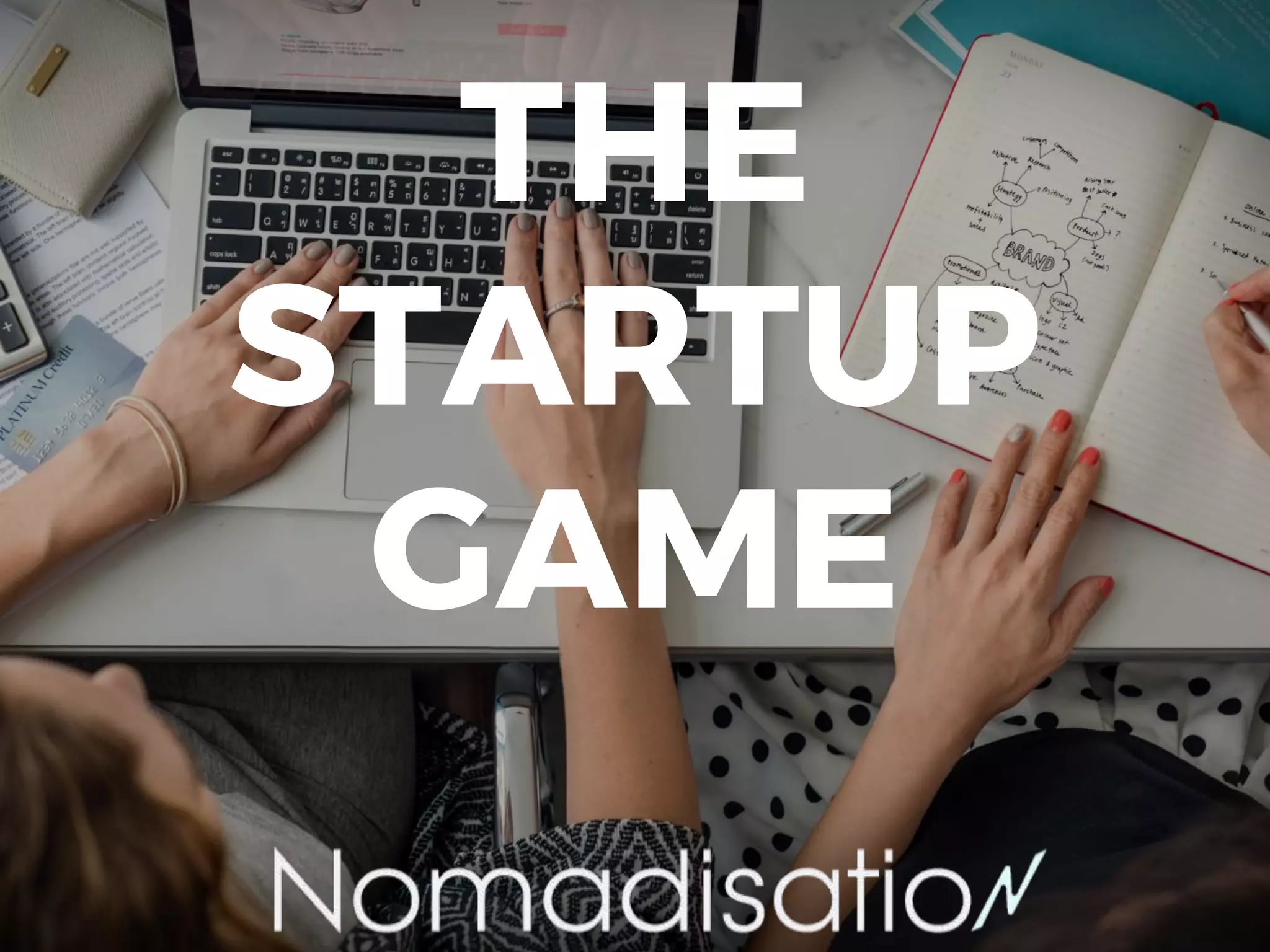
The cover slide introduces the brand "Nomadisation" and the program name "The Startup Game." The background imagery features a collaborative workspace with a laptop, a credit card, and a notebook filled with brand strategy diagrams. This immediately signals the target audience: young, aspiring entrepreneurs who are comfortable in a digital-nomad environment. The branding is consistent, though the title "The Startup Game" suggests a gamified approach to education that isn't fully detailed in the subsequent slides.
Slide 2: The Value Proposition and Scale
Slide 2 defines the product: "A premium summer travel experience and 'startup bootcamp' for students." This is a clear, one-sentence elevator pitch. The slide uses four icons to present the program's scope: 90 students , 7 destinations , 3 countries , and 30 start-ups . This slide is effective because it quantifies the operation. However, it leaves the reader wondering if these are historical figures or goals for the upcoming season. The inclusion of "30 start-ups" suggests a partnership model where students might interact with existing companies, though Slide 4 later suggests students develop their own ideas.
Slide 3: Program Logistics and Pricing
This slide covers the "how" and "how much." Each program runs for 4 weeks between June and September. The breakdown of time includes work with startups, mentoring, and "wellbeing." Crucially, this slide contains the only financial data in the deck: "Fees from £2,400 + flights." For an investor, this establishes the top-line revenue per head. At 90 students, the gross revenue for a season would be approximately £216,000. The mention of "wellbeing" alongside a bicycle icon suggests a holistic lifestyle approach, which aligns with the "premium" branding.
Slide 4: The Curriculum and Outcome
Slide 4 explains the student journey. Participants work in teams of 2-4 , grouped by industry. Their task is to identify and solve a problem within that industry. The climax of the program is a pitch to a "panel of experts" where seed capital is awarded . This is a significant claim. The deck does not specify the amount of seed capital or whether Nomadisation takes equity in these new ventures. For a fundraising analyst, this is a red flag; the mechanics of the "seed capital" (is it a prize or an investment?) are vital to understanding the business model.
Slide 5: The Target Persona
The "Applications are Open" slide serves as a filter for the funnel. They are looking for students with an interest in tech, business, or finance, the ability to travel, an existing startup idea, and "strong academics." By emphasizing academic excellence, Nomadisation is positioning itself as an elite tier above standard travel programs. This slide is less about the investment opportunity and more about the recruitment criteria, which is common in decks for service-based or education-based startups.
Slide 6: The Partner Network
This slide focuses on traction and credibility. It lists a recruitment partner, Wells Tobias , and four prestigious London-based student societies: Imperial Entrepreneurs, UCL Entrepreneurs, LSE SU Entrepreneurs Society, and King's Entrepreneurs . This is a strong "moat" slide. Access to these specific student bodies provides a low-cost acquisition channel for high-quality leads. It demonstrates that the founders have successfully navigated the gatekeepers of top-tier UK universities.
Slide 7: The Mentor Roster
The final provided slide showcases the "Team of Mentors." This is a high-pedigree list designed to build trust. Edward Arkus (Managing Director at Harris Williams & Co) brings M&A expertise. Photis Kassianides brings 25 years of global portfolio trading experience from firms like UBS, Merrill Lynch, and J.P. Morgan . Jay Dickieson is labeled a "Start-up Expert" with ties to The Summerhill Group and Prince's Trust . The presence of these individuals suggests the program has high-level industry buy-in, which is essential for a program promising "expert" panels and seed capital.
What Works in This Deck
Clarity of Product: Within the first three slides, the reader knows exactly what is being sold, how long it lasts, and what it costs. Many decks fail to be this explicit about the core offering.
Credibility by Association: The mentor slide and the university partner slide do the heavy lifting. By showing logos like UBS, J.P. Morgan, LSE, and Imperial, the company borrows the prestige of established institutions to validate a relatively new concept.
Quantified Scope: Slide 2 provides hard numbers (90 students, 30 startups) that give a sense of the operational complexity and potential revenue ceiling for a single season.
What Is Missing
The Raise (The Ask): The provided slides do not mention how much money the company is looking for or what the funds will be used for (e.g., marketing, hiring, or the seed capital fund itself).
Unit Economics: While we see the price point (£2,400), we do not see the cost of delivery. Travel, accommodation for 90 students across 7 destinations, and venue rentals are high-margin killers. Without a slide on margins, an investor cannot judge the scalability.
Competitive Landscape: The travel-study and bootcamp markets are crowded. The deck does not explain how Nomadisation differs from competitors like Remote Year, Hacker Paradise, or traditional university exchange programs.
The 'Seed Capital' Source: If the program awards seed capital, where does it come from? If it comes from the student fees, it's a prize. If it comes from a separate fund, that fund's structure needs to be explained.
Founder's Takeaway
Nomadisation has built a deck that is excellent for recruiting students and partners , but it is incomplete for recruiting investors . A founder should copy the clean layout and the clear use of logos to build institutional trust. However, to turn this into a successful fundraising deck, one would need to add a slide on the Total Addressable Market (TAM) , a detailed Financial Forecast , and a clear Exit Strategy . The current deck sells a program; an investment deck needs to sell a profitable, scalable machine.
Frequently asked questions
- What is the primary product offered by Nomadisation?
- Nomadisation offers a four-week summer program called 'The Startup Game.' It combines travel across three countries and seven destinations with a bootcamp environment where students work in teams of 2-4 to develop and pitch startup ideas to a panel of experts for potential seed capital.
- How does the company generate revenue according to the deck?
- The deck specifies a B2C revenue model where students pay fees starting from £2,400. Notably, this fee does not include flights, which are an additional cost for the participant. There is no mention of B2B revenue from the 30 startups involved in the program.
- What kind of students is Nomadisation targeting?
- The company targets 'exceptional talent' with strong academic backgrounds and a specific interest in tech, business, or finance. They focus their recruitment efforts on top-tier London universities, specifically mentioning societies at UCL, LSE, King's College, and Imperial College.
- Who are the key mentors involved in the program?
- The deck highlights three primary mentors: Edward Arkus (Managing Director at Harris Williams & Co), Photis Kassianides (an investment banker with experience at UBS and J.P. Morgan), and Jay Dickieson (Managing Partner at The Summerhill Group).
- What is missing from this pitch deck for a professional investor?
- The deck lacks a clear 'Ask' (how much capital they are raising), a slide on unit economics (CAC vs. LTV), a competitive analysis, and a roadmap for scaling beyond the initial 90-student cohort. It also fails to explain the source or amount of the 'seed capital' awarded to students.