Nominal’s 22-slide Series A deck is a masterclass in narrative-driven fundraising, positioning their AI accounting platform as a 'Digital Workforce' rather than just another SaaS tool. By anchoring the problem in the 'Aging Baby Boomer Crisis'—where 75% of public accountants are expected to retire in 15 years (Slide 6)—Nominal creates immediate urgency for enterprise CFOs. The deck highlights a significant drop in CPA exam candidates (Slide 7) and uses this talent scarcity to pitch their 'Agentic General Ledger' (Slide 14). While the version of the deck reviewed uses placeholders for specific…
Key takeaways
- The deck uses a specific macro-economic 'ticking clock' by citing that 75% of public accountants will retire in 15 years (Slide 6).
- Nominal positions its product as a 'novel system of record' that requires 'no migration,' lowering the perceived barrier to entry (Slide 4).
- Technical credibility is established by referencing modern AI frameworks like LangGraph and Bedrock for 'scalable digital labor' (Slide 13).
- The product is framed as 'Agentic,' moving the user role from 'Doers to Reviewers' (Slide 17).
- A 'Consolidation Example' visualizes the 'Excel Chaos' that currently plagues enterprise finance teams (Slide 8).
- The deck claims a 90% reduction in manual work for current users, though specific case study names are omitted in this version (Slide 11).
- Nominal aligns its value proposition with CFO priorities, noting that 71% of CFOs view automation as the most promising use of GenAI (Slide 10).
- The 'Founding Team' is introduced early (Slide 2), emphasizing the importance of pedigree in the enterprise accounting space.
The Narrative: From Labor Crisis to Digital Workforce
Nominal’s pitch deck for their $20M Series A is a textbook example of how to sell a 'solution' by first selling a 'crisis.' Instead of starting with features, the deck spends its first third establishing that the accounting profession is in a state of terminal decline. By the time the product is introduced, the investor is primed to believe that automation isn't just a 'nice to have'—it is the only way for enterprises to remain functional.
Slides 1-2: The Hook and the Pedigree
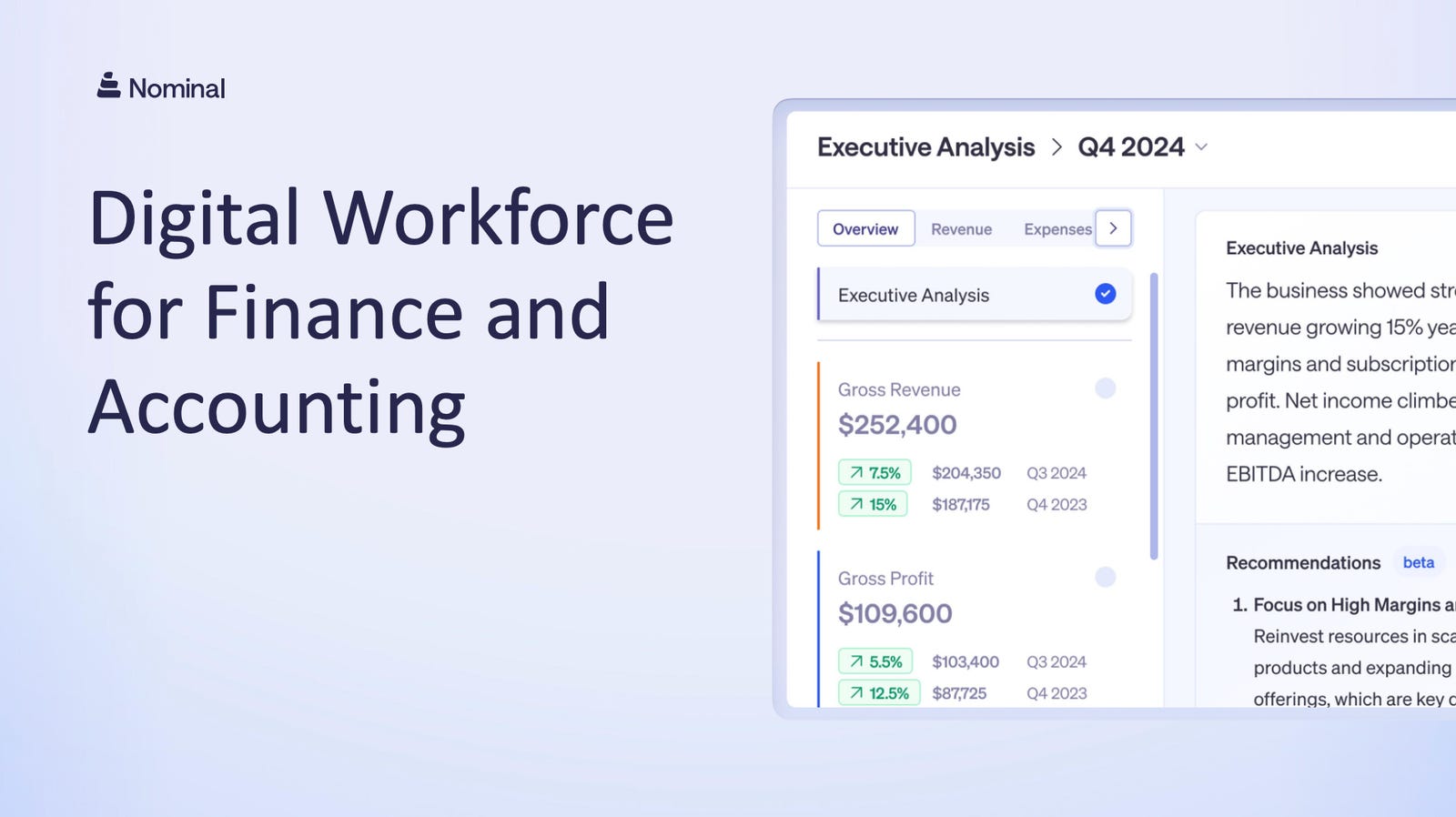
Slide 1 sets the stage with the title 'Digital Workforce for Finance and Accounting.' The use of the term 'Workforce' instead of 'Software' is a deliberate positioning move. It suggests that Nominal isn't just a tool for accountants; it is a replacement for the labor that firms can no longer find. The visual shows a dashboard with 'Executive Analysis' for Q4 2024, displaying metrics like Gross Revenue ($252,400) and Gross Profit ($109,600) with growth indicators. This immediately grounds the AI hype in the reality of financial reporting.
Slide 2 introduces the Founding Team. In enterprise fintech, where trust and domain expertise are paramount, placing the team slide at the front is a standard move to establish credibility before diving into the problem space.
Slides 3-5: The ERP Evolution
Slide 3 and Slide 4 frame the current moment as a historical shift. Slide 3 claims 'Every Technology Wave Changes the ERP Landscape,' and Slide 4 asserts that the 'Digital Workforce is the Future.' A key selling point is introduced here: 'No migration is required.' This addresses the biggest objection in enterprise sales—the fear of a multi-year, multi-million dollar implementation process. Nominal positions itself as a 'novel system of record' that enables AI agents without the pain of a traditional ERP overhaul.
Slides 6-10: The Macro Crisis (The 'Why Now')
This section is the strongest part of the deck's narrative. Slide 6 highlights the 'Aging Baby Boomer Crisis,' stating that 75% of public accountants will retire in the next 15 years. Slide 7 follows up with a chart showing that the number of candidates taking the CPA exam has fallen to its lowest level in at least 17 years (citing AICPA and FT as sources). The chart shows a clear downward trend from a peak in 2010 to a trough in 2022.
Slide 8 visualizes 'Excel Chaos' through a consolidation example, and Slide 9 hammers home the point: 'Scarce Talent Cannot Be Wasted on Manual Work.' Finally, Slide 10 uses a Deloitte CFO Signals report to show that 71% of CFOs are already looking for exactly what Nominal provides: automation, efficiency, and insights.
Slides 11-17: The Solution and the 'Agentic' Ledger
Slide 11 makes a bold claim: Nominal reduces manual work by 90%, allowing humans to focus on strategy with 'no engineering required.' This is the 'aha' moment of the deck, promising a massive ROI.
Slide 13 , titled 'From Science Fiction to Fiction to Science,' explains the technical 'how.' It cites three pillars: Coding Assistants (CoPilots), Complex Reasoning (larger context windows), and Agentic Frameworks (specifically naming LangGraph and Bedrock). This slide is crucial for a Series A deck as it demonstrates that the company is building on a modern, defensible technical stack.
Slide 14 introduces the 'Agentic General Ledger,' and Slide 16 shows the product interface. The UI demonstrates how 'Agents Take Plain-English Instructions' to perform tasks like inter-company eliminations. The workflow is broken down into four logical steps, from searching journal entries to validating accuracy. Slide 17 summarizes the user experience shift: moving humans from 'Doers to Reviewers.'
Slides 18-22: Traction and Future
Slide 19 covers 'Customers / Revenue.' While the version provided uses 'XXX' and '$XX' placeholders, the chart shows a steep hockey-stick growth curve starting in Q3 2023 and accelerating through Q4 2024. The text notes 'In only 10 months in the market,' which suggests rapid product-market fit. The deck concludes on Slide 22 with a 'So, What's Next?' prompt in a chat interface, reinforcing the conversational, AI-driven nature of the platform.
What Works in the Nominal Deck
The 'Ticking Clock' Problem: By using the 15-year retirement window and the 17-year low in CPA candidates, Nominal makes the problem feel urgent and inevitable. · Positioning as 'Labor': Framing the software as a 'Digital Workforce' allows Nominal to tap into headcount budgets rather than just software budgets, which are often larger and less scrutinized. · The 'No Migration' Promise: This is the single most important line for an enterprise accounting startup. It removes the primary reason a CFO would say 'no.' · Technical Specificity: Mentioning LangGraph and Bedrock (Slide 13) shows that the team understands the current state of the art in AI orchestration, which builds investor confidence in their ability to execute.
What is Missing from the Nominal Deck
Unit Economics: There is no mention of LTV, CAC, or churn. While this is a Series A deck, investors usually want to see the underlying math of the sales engine. · Competitive Landscape: The deck assumes the only competition is 'Excel Chaos.' It ignores other AI accounting incumbents or legacy players like BlackLine or Workiva who are also adding AI features. · Specific Case Studies: While Slide 11 claims a 90% reduction in work, the deck lacks a specific, named customer success story to prove this isn't just a theoretical lab result. · The 'Ask': The version of the deck reviewed does not include a slide detailing how much capital is being raised or how it will be deployed (though we know from publisher reports it was $20M).
Founder Takeaways: What to Copy
Use Macro Trends to Create Urgency: If your industry is facing a labor shortage, regulatory shift, or demographic collapse, lead with it. It makes your solution a necessity rather than a luxury. · Visualize the 'Chaos': Slide 8’s 'Excel Chaos' is a great way to make a boring problem feel visceral. Show the messy reality your customers live in. · Explain the 'How' Without Getting Lost: Slide 13 is a perfect 'Technical Architecture' slide. It uses recognizable names (Bedrock, LangGraph) to signal competence without needing a 20-minute deep dive into the code. · Focus on the User's New Role: The 'Doers to Reviewers' (Slide 17) framework is a powerful way to sell AI. It reassures the buyer that humans are still in the loop, but their jobs are becoming easier and more 'strategic.'
Frequently asked questions
- What is the primary problem Nominal is solving?
- Nominal targets the acute labor shortage in the accounting profession. They cite that CPA exam participation is at its lowest in 17 years and that 75% of the current workforce is nearing retirement. They argue that manual work in Excel is no longer sustainable given the shrinking talent pool, necessitating a 'digital workforce' to handle routine tasks.
- How does Nominal differentiate itself from traditional ERPs?
- Slide 14 introduces the concept of an 'Agentic General Ledger.' Unlike traditional ERPs that act as passive databases, Nominal claims to have built a system of record where AI agents actively perform tasks based on plain-English instructions, essentially acting as an automated layer that sits on top of or alongside existing data without requiring a full migration.
- What metrics did Nominal share in this deck?
- In the version analyzed, Slide 19 contains placeholders (XXX) for customer count, ARR, and QoQ growth. However, Slide 11 claims that the platform currently reduces manual work by 90%. The publisher reports that this deck successfully raised $20M in a Series A round in 2024, suggesting the actual figures shown to investors were compelling.
- What technical stack does Nominal mention?
- Nominal explicitly mentions using LangGraph and Bedrock on Slide 13. They position these as the 'Agentic Frameworks' that enable 'scalable digital labor.' This signals to investors that they are leveraging the latest in LLM orchestration and cloud-based AI infrastructure rather than building basic wrappers.
- Who is the target buyer for Nominal?
- The deck is clearly aimed at the Enterprise CFO. Slide 10 uses Deloitte data to show that 71% of CFOs are looking for automation and efficiency. The product features, such as inter-company eliminations and consolidation, are specific to mid-to-large enterprise finance departments rather than small businesses.