Papaya Global’s 17-slide deck serves as a high-level overview of a company that has already achieved significant market fit and is now focused on dominance. Raising $250M in 2021, the presentation emphasizes their ability to manage employees in over 140 jurisdictions and highlights a 300% YoY growth rate. The deck is notably light on traditional 'problem' slides, opting instead to lead with 'Global Footprint' and 'Our Customers'—a strategy typical of late-stage rounds where the business model is proven. It focuses heavily on technical integrations, compliance, and security, signaling to inves…
Key takeaways
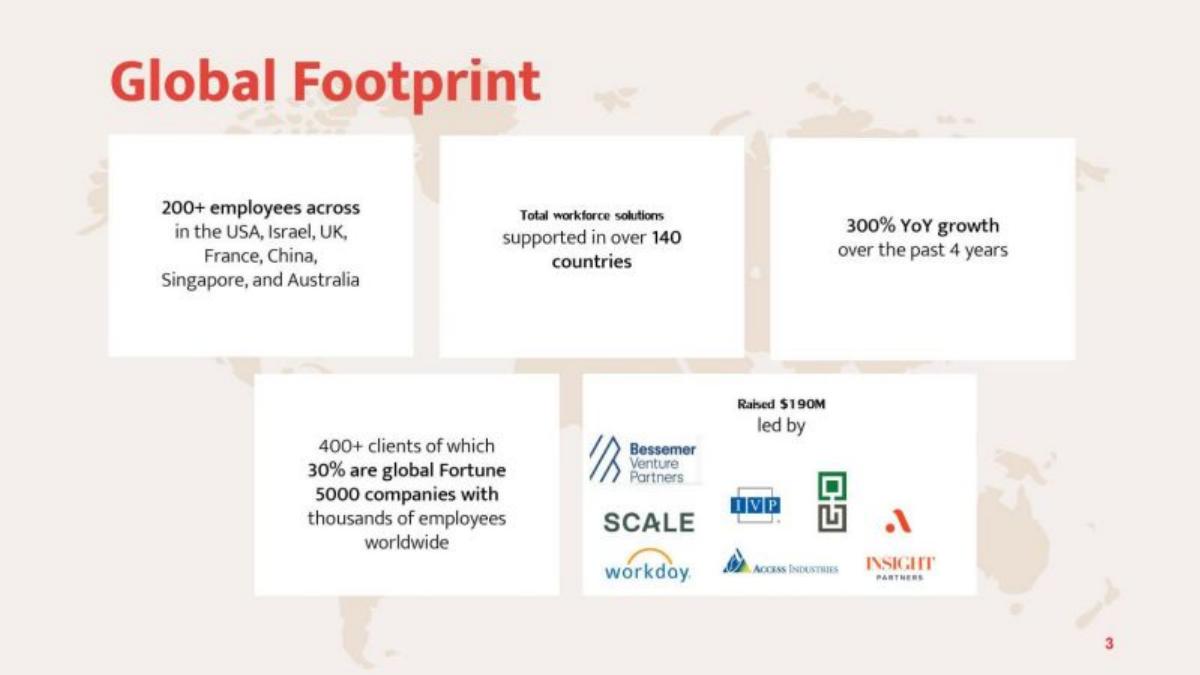
- The company supports workforce solutions in over 140 countries as stated on Slide 3.
- Papaya Global reported a 300% YoY growth rate over the four years leading up to the deck (Slide 3).
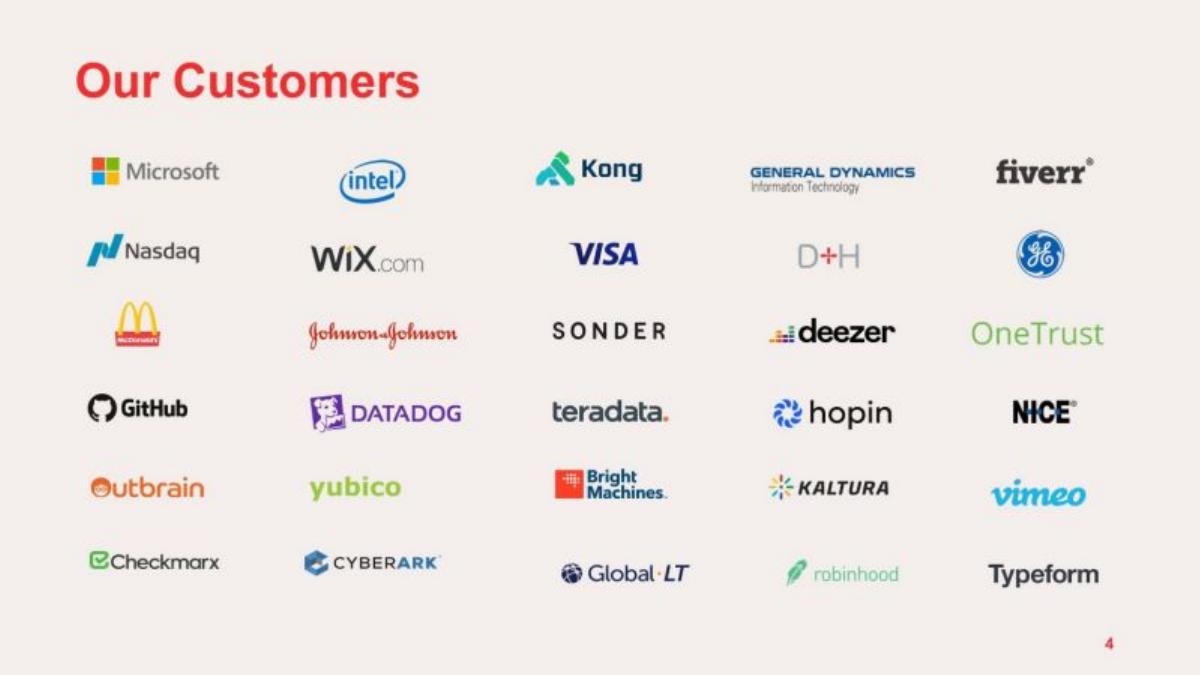
- The customer slide features high-profile enterprise logos including Microsoft, Intel, Visa, and McDonald's (Slide 4).
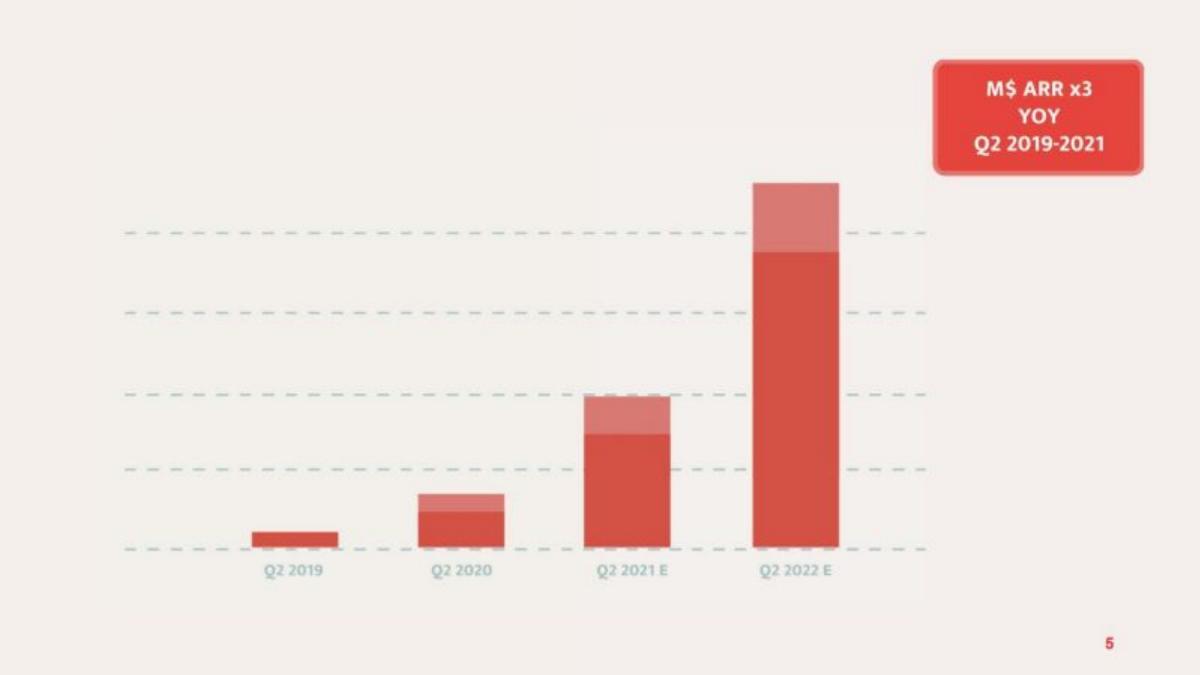
- The ARR chart on Slide 5 shows a consistent tripling of revenue year-over-year from Q2 2019 to Q2 2021.
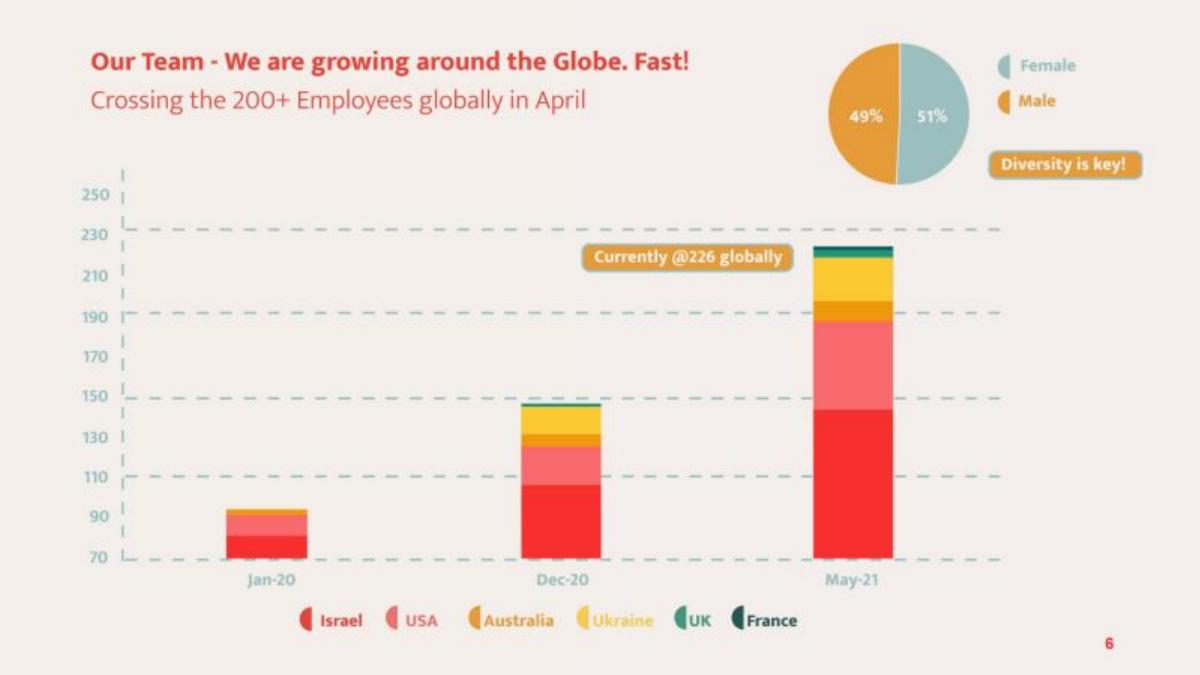
- The team has grown to over 226 employees globally as of May 2021, with a 51/49 female-to-male gender split (Slide 6).
- The platform integrates with major enterprise software including Workday, NetSuite, SAP, and BambooHR (Slide 9).
- Security is a primary focus, with certifications for ISO/27001, GDPR, and SOC compliance highlighted on Slide 10.
- The deck introduces 'Papaya Personal,' an employee self-service portal for onboarding and document management (Slide 12).
The Series D Narrative: From Tool to Infrastructure
Papaya Global’s Series D deck is a document of a company that has moved past the 'visionary' stage and into the 'execution' stage. At 17 slides, the deck is concise but dense with social proof and growth metrics. It does not waste time explaining why global payroll is hard; it assumes the investor already knows the pain point and focuses entirely on why Papaya Global is the winning solution. The visual language is clean, professional, and corporate, reflecting its target audience of Fortune 5000 companies.
Slides 1-3: The Hook and Global Scale
Slide 1 is a standard title slide featuring the company logo and high-quality lifestyle photography. It establishes a modern, tech-forward brand identity immediately.
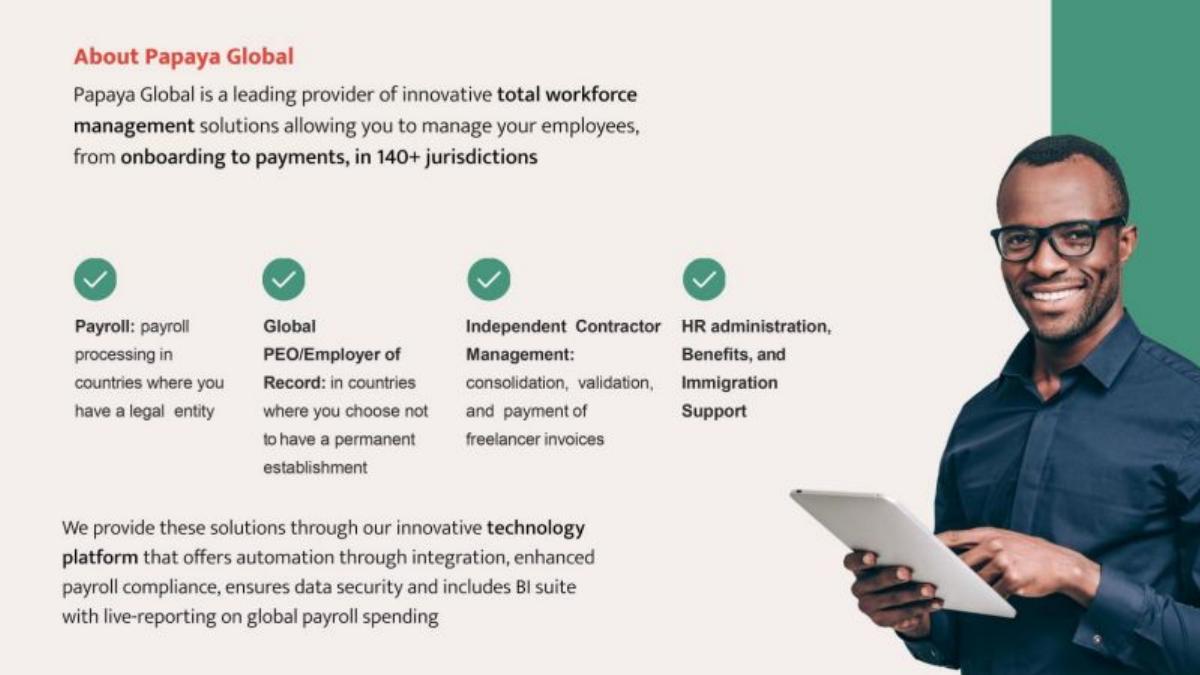
Slide 2 , titled 'About Papaya Global,' serves as the executive summary. It defines the company as a 'total workforce management solution' covering onboarding to payments in 140+ jurisdictions. It breaks down the service into four pillars: Payroll, Global PEO/Employer of Record, Independent Contractor Management, and HR administration. This slide is critical because it moves the company beyond just 'payroll software' into a full-service workforce platform.
Slide 3 is the 'Global Footprint' slide, and it is the most important slide in the first half of the deck. It lists five key achievements: 200+ employees in 7 countries, support in 140+ countries, 300% YoY growth over 4 years, 400+ clients (30% of which are Global Fortune 5000), and $190M previously raised. By putting the investor logos (Bessemer, IVP, Insight Partners) right here, they establish massive credibility before the reader even sees the product.
Slides 4-6: Traction and Team
Slide 4 is a 'Logo Slide' titled 'Our Customers.' It is a 'who's who' of tech and traditional enterprise, featuring Microsoft, Intel, Visa, McDonald’s, and GitHub. For a Series D round, this slide proves that the product can scale to the highest levels of security and complexity required by global giants.
Slide 5 provides the financial 'up and to the right' chart. While the Y-axis lacks specific dollar amounts (labeled as M$ ARR), the annotation 'M$ ARR x3 YOY Q2 2019-2021' tells the story. It shows actuals for 2019 and 2020, with estimates (E) for 2021 and 2022. The tripling of revenue annually is the primary driver for the $250M raise mentioned in the catalogue facts.
Slide 6 focuses on the team, but in an unconventional way. Instead of headshots of the founders, it shows a bar chart of headcount growth and a diversity pie chart. As of May 2021, they were at 226 employees. The 51% female and 49% male split is highlighted with the phrase 'Diversity is key!', signaling the company's commitment to ESG (Environmental, Social, and Governance) standards, which are increasingly important to late-stage investors.
Slides 7-10: The Technology Backbone
Slide 8 dives into 'Automation & Compliance.' It highlights a 'Compliance-intelligence engine,' 'Automated smart data validation,' and 'Zero mistakes on the payroll processes.' The mention of 'Machine-Learning' and 'RPA based processing' (Robotic Process Automation) positions Papaya as a high-margin tech company rather than a low-margin service bureau.
Slide 9 , the 'Papaya Integration Kit,' is a masterclass in ecosystem positioning. It shows Papaya Global at the center of a web connecting HRIS (Workday, Oracle), ERP (NetSuite, SAP), VMS (Beeline), Expense Management (Concur), and Time and Attendance (FinancialForce). This slide addresses a major enterprise concern: 'Will this work with our existing tools?' The answer provided is a definitive yes.
Slide 10 focuses on 'Security & Privacy.' For a company handling sensitive employee bank details and personal data, this is a 'must-have' slide. It lists ISO/27001, 2FA, SSO (Okta, Auth0), GDPR, and SOC compliance. This is about de-risking the investment by showing the company meets global enterprise standards.
Slides 11-12: Product Interface and Worker Experience
Slide 11 shows a screenshot of the 'Real-time Reporting' dashboard on an iMac. It emphasizes the ability to see total employer costs and payroll spending by location. This is the 'manager' view of the product.
Slide 12 introduces 'Papaya Personal,' the employee-facing side of the platform. It covers onboarding, worker reporting, payslips, and worker profiles. By showing both the employer and employee experience, Papaya demonstrates that they own the entire lifecycle of the employment relationship.
Slides 13-15: The Service Model and Specialized Solutions
Slide 14 explains the 'Global Support Model.' It balances the 'Technology' claims from earlier by acknowledging that global workforce management still requires human expertise. It highlights a 'Customer Success Manager,' an 'In-House Center of Excellence' for legal and tax expertise, and 'Trusted Local Partnerships.' This slide is meant to reassure investors that the company can handle the 'edge cases' of local labor laws that software alone cannot solve.
Slide 15 introduces a 'Global Equity Management Solution.' This is a strategic addition, showing that Papaya is expanding its product line into adjacent markets like ESOP, RSUs, and ESPP management. This increases the Total Addressable Market (TAM) and the potential Lifetime Value (LTV) of each customer.
Slides 16-17: Conclusion
Slide 16 is a 'Thank You' slide with contact information and social media handles. It features a photo of two women working at a laptop, maintaining the professional aesthetic.
Slide 17 is a promotional slide for the source of the deck, bestpitchdeck.com, and is not part of the original Papaya Global presentation.
What Works in This Deck
Momentum as a Narrative: The deck leads with growth and scale. By Slide 3, the investor knows the company is growing 300% YoY and has 400+ clients. This creates a 'fear of missing out' (FOMO) that carries through the rest of the presentation. · Ecosystem Integration: Slide 9 is exceptionally strong. It visualizes Papaya as the 'connective tissue' of an enterprise's HR stack. This makes the product 'sticky' and harder to churn. · Compliance as a Feature: In the world of global payroll, compliance is the product. Papaya leans heavily into its automated compliance engine and security certifications, which are the primary buying triggers for their target customers. · Visual Consistency: The deck uses a consistent color palette and high-quality imagery. It looks like a deck from a billion-dollar company, which helps justify a Series D valuation.
What Is Missing from This Deck
The 'Ask' Slide: The deck does not explicitly state how much they are raising or what the funds will be used for. While the catalogue facts state $250M, a standard pitch deck usually includes a slide detailing the use of proceeds (e.g., 40% R&D, 40% Sales/Marketing, 20% Expansion). · Unit Economics: There is no mention of Customer Acquisition Cost (CAC), Lifetime Value (LTV), or Net Revenue Retention (NRR). For a Series D company, these metrics are usually scrutinized heavily. Their omission suggests this deck might be a 'teaser' or a high-level overview used for initial meetings rather than the full due-diligence data room. · Competitive Landscape: The deck never mentions competitors. While Papaya's growth is impressive, investors would want to know how they differentiate from other players in the space like Deel or Remote. · Financial Projections: Beyond the ARR bar chart, there are no detailed P&L projections or a path to profitability.
What a Founder Should Copy
The 'Global Footprint' Summary: If you have traction, put it on Slide 3. Don't bury your best metrics at the end of the deck. Papaya’s 'Slide 3' is a perfect example of how to validate a business model in 30 seconds. · The Integration Map: If your software needs to work with other tools, create a visual map like Slide 9. It is much more effective than a bulleted list of 'Integrations.' · Highlighting Diversity: Including gender diversity metrics (Slide 6) is a smart move for modern fundraising. It shows the company is built on sustainable, professional values. · Focus on Security: If you are selling to Enterprise, you must have a slide like Slide 10. Listing your ISO and SOC certifications early builds the trust necessary to close large-scale deals.
Frequently asked questions
- What is Papaya Global's core value proposition?
- According to Slide 2, Papaya Global provides a total workforce management solution that handles employees from onboarding to payments across 140+ jurisdictions. This includes payroll processing, Global PEO/Employer of Record services, independent contractor management, and HR administration. The platform emphasizes automation, compliance, and data security to simplify complex global operations for enterprise clients.
- How fast is Papaya Global growing?
- The deck claims a 300% YoY growth rate over a four-year period on Slide 3. This is further supported by the bar chart on Slide 5, which indicates that Annual Recurring Revenue (ARR) tripled every year between Q2 2019 and the estimated figures for Q2 2021 and Q2 2022. This aggressive growth trajectory is a hallmark of their Series D narrative.
- What does the integration ecosystem look like?
- Slide 9 illustrates the 'Papaya Integration Kit,' showing that the platform acts as a central hub. It connects with HRIS (Workday, BambooHR), ERP systems (NetSuite, SAP), Expense Management (Expensify, Concur), and Time and Attendance tools. This positioning suggests that Papaya is designed to fit into existing enterprise tech stacks rather than replacing them entirely.
- How does Papaya Global handle local compliance?
- The company uses a 'Global Support Model' detailed on Slide 14. This involves a three-pronged approach: Centralized Service Coordination via a Customer Success Manager, an In-House Center of Excellence with experts in local labor laws and tax, and 'Trusted Local Partnerships' in over 140 countries to ensure compliance with regional rules and regulations.
- Who are Papaya Global's investors?
- Slide 3 lists several prominent venture capital firms that participated in their previous $190M funding rounds. These include Bessemer Venture Partners, Scale Venture Partners, Workday Ventures, IVP, Access Industries, and Insight Partners. The presence of Workday Ventures is particularly notable given the integration capabilities mentioned later in the deck.