Palisade Bio (NASDAQ: PALI) presents a clinical-stage biotech case focused on postoperative gastrointestinal (GI) recovery. The deck centers on LB1148, a drug candidate that has demonstrated a 1.3-day reduction in hospital length of stay (LOS) in GI surgery trials. By targeting a $2,400 per inpatient day expense, the company builds a strong economic argument alongside its clinical data. The presentation effectively uses competitive benchmarking against Entereg, the only currently approved drug for this indication, highlighting LB1148's superior safety profile and lack of a 'Black Box' warning…
Key takeaways
- LB1148 demonstrated a 1.3-day reduction in hospital length of stay for GI surgery patients (Slide 9).
- National average hospital expenses are cited at $2,400 per inpatient day, providing a clear ROI for the drug (Slide 9).
- Phase 2 cardiovascular surgery data showed a 30% improvement in return of bowel function with a p-value of <0.001 (Slide 17).
- The company positions itself against Merck’s Entereg, noting that LB1148 has a different mechanism of action and lacks the competitor's Black Box warning (Slide 13).
- Clinical results for GI surgery showed a 20% reduction in length of stay compared to expected GMLOS (Slide 25).
- Unexpected secondary findings in GI surgery showed zero adhesions in three follow-up patients (Slide 29).
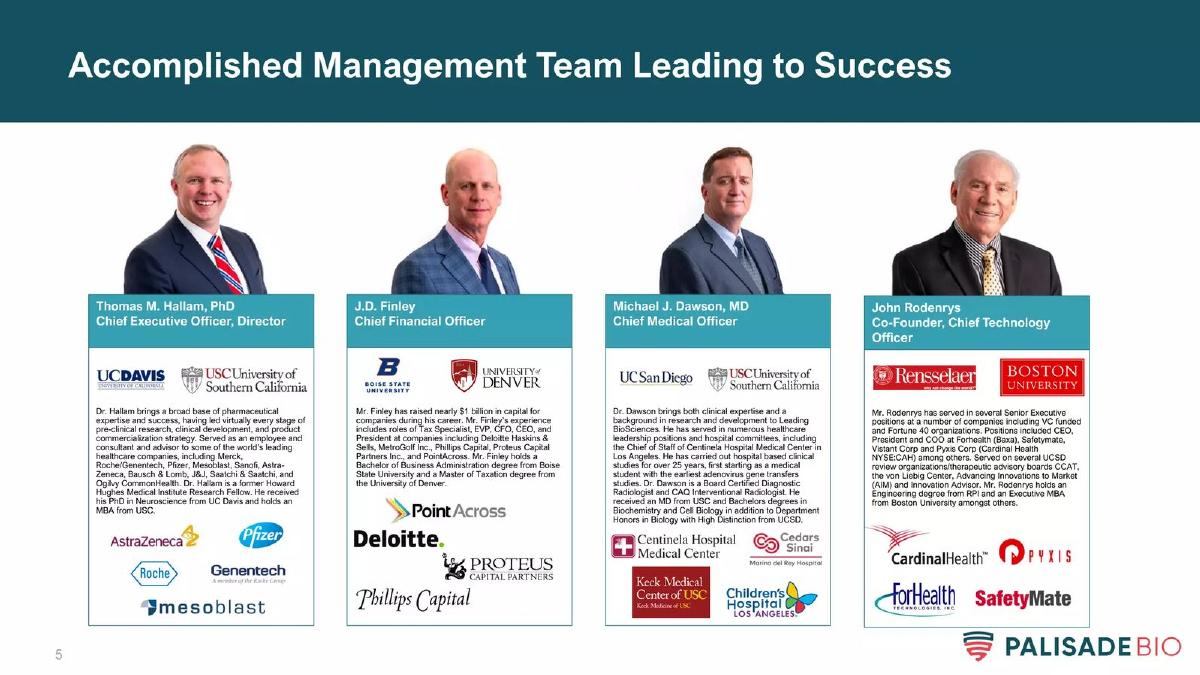
- The management team includes leaders with experience at Pfizer, AstraZeneca, Genentech, and Deloitte (Slide 5).
- A planned Phase 2/3 study for neonatal cardiovascular surgery was scheduled to begin in mid-2021 (Slide 21).
Palisade Bio: A Deep Dive into Postoperative GI Recovery
Palisade Bio’s April 2021 investor presentation is a classic example of a clinical-stage biotech deck that successfully bridges the gap between complex science and economic reality. The company, traded on NASDAQ under the ticker PALI, focuses on a specific but high-impact problem: the failure of the intestinal barrier after major surgery. This teardown examines how the company uses data to prove efficacy and market necessity.
Slide 1: Title and Core Mission
The deck opens with a clear value proposition: "Restoring Intestinal Barrier Health." It immediately identifies the company as a public entity (NASDAQ: PALI) and sets the date as April 2021. The visual of the human torso with the GI tract highlighted in red reinforces the therapeutic focus without unnecessary clutter.
Slide 5: The Management Team
Biotech investing is often a bet on the people. Palisade Bio presents a team with deep institutional pedigree. Thomas M. Hallam, PhD (CEO) , is credited with experience at Merck, Pfizer, and Genentech. J.D. Finley (CFO) is noted for raising nearly $1 billion in capital. Michael J. Dawson, MD (CMO) , and John Rodenrys (CTO) round out the leadership with clinical and technical expertise from institutions like UCSD and Boston University. The inclusion of logos from major pharma and consulting firms (Deloitte, AstraZeneca, Roche) serves as a shorthand for professional credibility.
Slide 9: The Unmet Need and Economic Impact
This is arguably the most important slide for a non-scientific investor. It defines the "Unmet Need" as postoperative GI recovery. The slide lists four major surgery types (Cardiovascular, GI, Abdominal, Gynecological) and explains that bowel function is the "limiting determinant of hospital discharge." Crucially, it attaches a dollar value to the problem: $2,400 per inpatient day. By citing a 1.3-day reduction in stay, Palisade Bio isn't just selling a drug; they are selling hospital margin improvement.
Slide 13: Competitive Landscape (Entereg)
Palisade Bio performs a direct comparison with Entereg, the only FDA-approved drug for this indication. The slide is a masterclass in "competitive de-positioning." While acknowledging Entereg's approval provides a regulatory roadmap, Palisade highlights its competitor's Black-box warning for myocardial infarction and its restricted REMS program. By stating LB1148 has a "completely different MOA" (Mechanism of Action), they position their candidate as a safer, more accessible alternative.
Slide 17: Cardiovascular Surgery Phase 2 Data
The deck moves into hard clinical evidence. Slide 17 shows a Kaplan-Meier plot for the return of bowel function. The data is compelling: a 30% improvement with a median recovery time of 31.7 hours for LB1148 versus 45.0 hours for placebo. The p-value of <0.001 indicates high statistical significance. The slide also notes a 1.1-day reduction in hospital length of stay, though it marks this as "ns" (not significant), demonstrating a level of transparency often missing in early-stage decks.
Slide 21: Neonatal CV Surgery Study Design
This slide outlines the expansion of LB1148 into the neonatal space. It details a planned Phase 2/3 study for infants undergoing heart surgery. The scope includes 10 U.S. sites and ~100 subjects. This demonstrates the company's pipeline depth and its strategy to address high-risk pediatric populations where GI complications like NEC (Necrotizing Enterocolitis) are life-threatening.
Slide 25: GI Surgery Study Results
Shifting from cardiovascular to GI surgery, Slide 25 compares actual length of stay (LOS) against expected LOS (GMLOS). The result is a 1.3-day improvement or a 20% reduction in stay (p = 0.03). This slide reinforces the economic argument made earlier in the deck by showing that the drug consistently beats hospital billing code expectations.
Slide 29: Unexpected Clinical Success - Adhesions
Slide 29 presents a "bonus" clinical finding. In three patients who required a second surgery for unrelated reasons, surgeons found zero adhesions and no evidence of inflammation. The slide includes a quote from a surgeon describing the absence of adhesions as "entirely unexpected." While the sample size is tiny (n=3), it suggests a secondary, high-value therapeutic application for LB1148 beyond just bowel function.
Slide 33: The Value Proposition Summary
This slide synthesizes the clinical and economic arguments. It highlights four pillars: Oral administration (no impact on surgical procedure), Safety profile , Reduced healthcare costs , and Improved patient outcomes . It serves as a summary slide to ensure the investor remembers the "why" behind the data.
Slide 37: Contact Information
The deck concludes with standard contact details for the Carlsbad, CA-based company. It lacks a specific "Ask" slide (e.g., "We are seeking $50M for Phase 3"), which is typical for a public company presentation intended for general investor relations rather than a specific private funding round.
What Palisade Bio Does Well
Economic Anchoring: Palisade Bio does an excellent job of translating clinical days into hospital dollars. By citing the $2,400 per day cost, they make the 1.3-day reduction in stay feel like a tangible financial product for hospital administrators.
Statistical Rigor: The inclusion of p-values and the honest labeling of non-significant (ns) secondary endpoints builds trust with sophisticated biotech investors who are wary of "cherry-picked" data.
Competitive Differentiation: The strategy of using a competitor's FDA approval as a "roadmap" while simultaneously attacking that competitor's safety profile is a very effective way to lower perceived regulatory risk while highlighting market opportunity.
What is Missing from the Deck
Detailed Financials: As this is a corporate presentation for a public company, it lacks the detailed burn rate, cash-on-hand, and specific use-of-funds breakdown that a private startup would need to include. An investor would need to look at their SEC filings to understand their runway.
Market Size (TAM): While the deck mentions surgery types, it doesn't provide a total addressable market (TAM) in terms of annual surgical volumes or potential peak sales. It assumes the investor can extrapolate the market size from the surgery categories listed.
Manufacturing and Scale: There is no mention of the manufacturing process, supply chain, or the cost of goods sold (COGS) for LB1148. For an oral drug, this is usually less of a concern than for biologics, but it remains a missing piece of the commercialization puzzle.
What Other Founders Should Copy
The 'Unmet Need' Slide: Founders should copy the way Slide 9 links a clinical problem to a specific, cited financial cost. Don't just say your product saves time; say what that time is worth to the person paying the bill.
Clear Study Design: Slide 21 is a perfect template for explaining a clinical trial. It breaks down the timeline, population, design, and objectives into four clear boxes that anyone can understand, regardless of their medical background.
Visualizing Data: The use of Kaplan-Meier curves (Slide 17) and simple bar charts with error bars (Slide 25) is the standard for biotech. Founders should avoid over-designed infographics and stick to these industry-standard ways of presenting evidence.
Frequently asked questions
- What is the primary clinical indication for Palisade Bio's lead candidate?
- The lead candidate, LB1148, is designed to restore intestinal barrier health and accelerate the return of bowel function after major surgeries, including cardiovascular, gastrointestinal, abdominal, and gynecological procedures. The deck emphasizes that patients typically cannot be discharged until bowel function returns, making this a critical bottleneck in hospital efficiency.
- How does LB1148 compare to the current market leader, Entereg?
- Palisade Bio highlights that Entereg (owned by Merck) is the only approved drug for this indication but carries significant limitations. These include a 'Black Box' warning for myocardial infarction and a restricted REMS program. Palisade claims LB1148 has a completely different mechanism of action (MOA) and a well-characterized safety profile without these risks.
- What are the economic benefits for hospitals using LB1148?
- The deck cites a national average hospital expense of $2,400 per inpatient day. Because LB1148 demonstrated a 1.3-day reduction in length of stay in GI surgery trials, the implied savings per patient are significant. A quote from a Chair of Surgery suggests that saving just one day of stay could realize $20M more in annual profits for a large hospital system.
- What clinical evidence is presented for cardiovascular surgery?
- Slide 17 shows Phase 2 data where LB1148 achieved a 30% improvement in the return of bowel function. The median time to recovery was 31.7 hours for the LB1148 group (n=58) compared to 45.0 hours for the placebo group (n=52). This result was highly statistically significant with a p-value of <0.001.
- What is the status of the neonatal clinical program?
- As of the April 2021 deck, Palisade Bio was planning a Phase 2/3 study for neonatal infants undergoing elective on-pump open-heart surgery. The trial was planned to begin in mid-2021 across 10 U.S. sites, with final data expected in 2022. The primary objectives included time to recovery of GI function and prevention of Necrotizing Enterocolitis (NEC).