The Palau Project pitch deck presents a B2C app designed to help consumers reduce their environmental impact, particularly related to food choices. The deck effectively highlights the problem of corporate greenwashing and consumer confusion regarding sustainable products, proposing a solution that includes product scanning, impact calculation, and tailored recommendations. It outlines a commission-based business model and presents early traction metrics like organic downloads, scans, and engagement time. The team slide introduces both an advisory team and a founding team, with varied experien…
Key takeaways
- The problem is clearly articulated, focusing on the food industry's environmental impact (Slide 02) and the confusion faced by consumers due to corporate 'sustainability as a marketing tool' (Slide 03).
- The solution is presented as a multi-faceted app offering product scanning, diet footprint calculation, and tailored recommendations, aiming to reduce consumer impact by 'up to 70%' (Slides 04-07).
- The business model is based on a 'comission of 3-5%' for every product sold through the app (Slide 10), indicating a marketplace or affiliate revenue stream.
- Early traction metrics are provided, including '25-30 organic downloads a day', '10000 scans', '1h 45min engagement time', and growth from '0 TO 700 WAU in Portugal' (Slide 13).
- The market size for Europe is stated as '57M' potential users, with '67%' remaining market share to capture (Slide 11).
- The team includes a founding duo (Hustler/CEO and Hacker/CTO) and an advisory team with diverse backgrounds, including a 'Senior McKinsey Consultant' (Slides 16-17).
- The deck explicitly asks for a 'SEED ROUND AMOUNT: 500K' and provides a percentage breakdown for its allocation across Team, Marketing, Platform, and Operations (Slide 20).
- A clear financial forecast, including projections for revenue, user growth, and profitability, is not present in the deck.
Palau Project Pitch Deck Teardown: Demystifying ESG for Consumers
This teardown analyzes the pitch deck used by Palau Project, a B2C sustainability app, to raise a pre-seed round of $125K in 2022. The deck comprises 23 slides and focuses on empowering consumers to make more sustainable food choices. We will examine each slide in order, noting its content, strengths, and any omissions.
Slide-by-Slide Breakdown
Slide 01: Cover
The first slide is a simple cover slide featuring the company name, 'PALAU', in large white text, centered. Above the name is a stylized blue and green turtle logo. Below the name, two hand-drawn style phrases read 'BUY WELL. LIVE BETTER.' and 'PITCH DECK'. The bottom left corner indicates 'Palau Pitch Deck' and the bottom right corner shows '01'. The background is a dark grey.
Slide 02: Current Situation
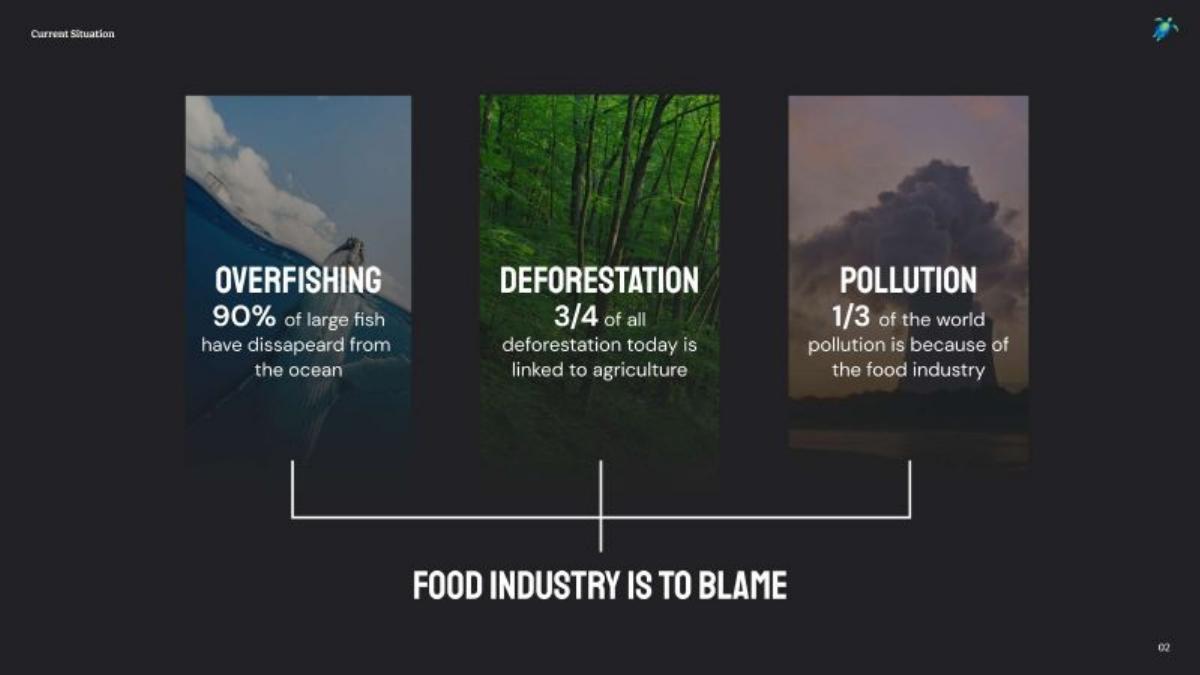
Titled 'Current Situation', this slide presents three vertical image panels with accompanying text, linked by lines to a central statement at the bottom. The first panel, featuring an underwater scene, states 'OVERFISHING 90% of large fish have dissapeard from the ocean'. The second panel, showing a forest, reads 'DEFORESTATION 3/4 of all deforestation today is linked to agriculture'. The third panel, depicting a smoky, polluted sky, says 'POLLUTION 1/3 of the world pollution is because of the food industry'. The unifying statement at the bottom, in large white text, is 'FOOD INDUSTRY IS TO BLAME'. This slide effectively sets the stage by highlighting the environmental problems the company aims to address, specifically linking them to the food industry.
Slide 03: Problem
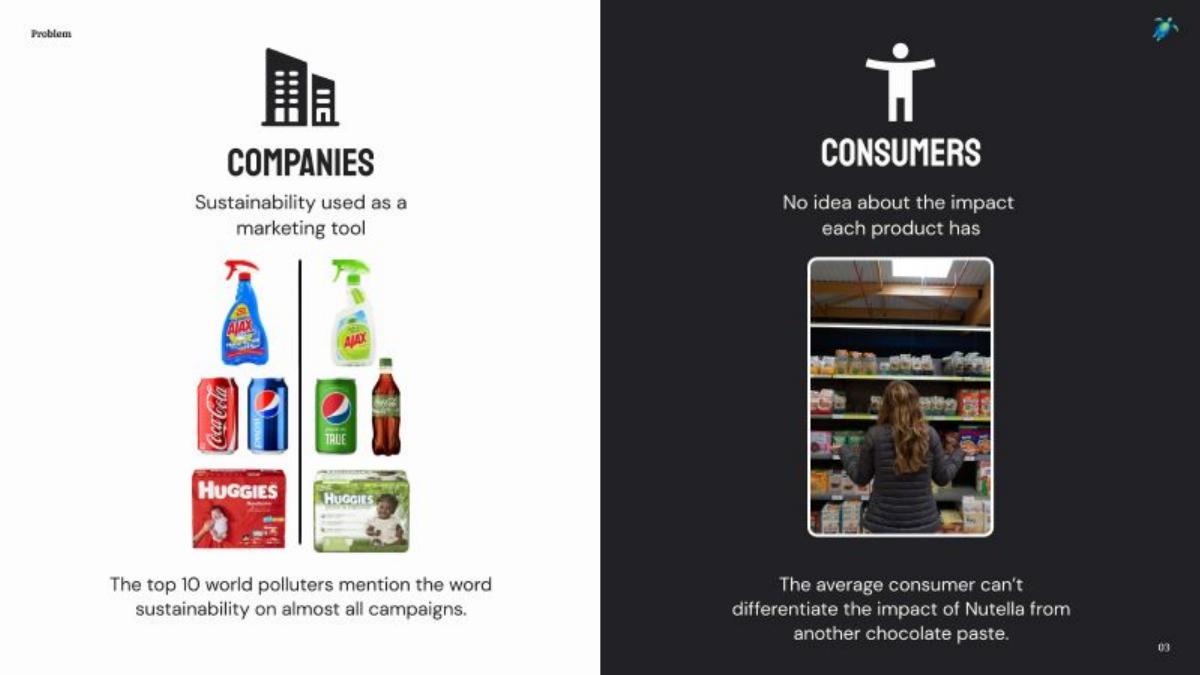
Labeled 'Problem', this slide is divided into two vertical sections. The left section, under the heading 'COMPANIES', features an icon of a building and the statement 'Sustainability used as a marketing tool'. Below this, images of various consumer products (cleaning supplies, soft drinks, diapers) are displayed, followed by the text 'The top 10 world polluters mention the word sustainability on almost all campaigns.' The right section, under 'CONSUMERS', has a human icon and the statement 'No idea about the impact each product has'. An image of a person looking at a supermarket shelf is shown, with the text 'The average consumer can't differentiate the impact of Nutella from another chocolate paste.' This slide clearly articulates the dual problem: corporate greenwashing and consumer confusion, establishing the need for a solution that provides clarity.
Slide 04: Solution
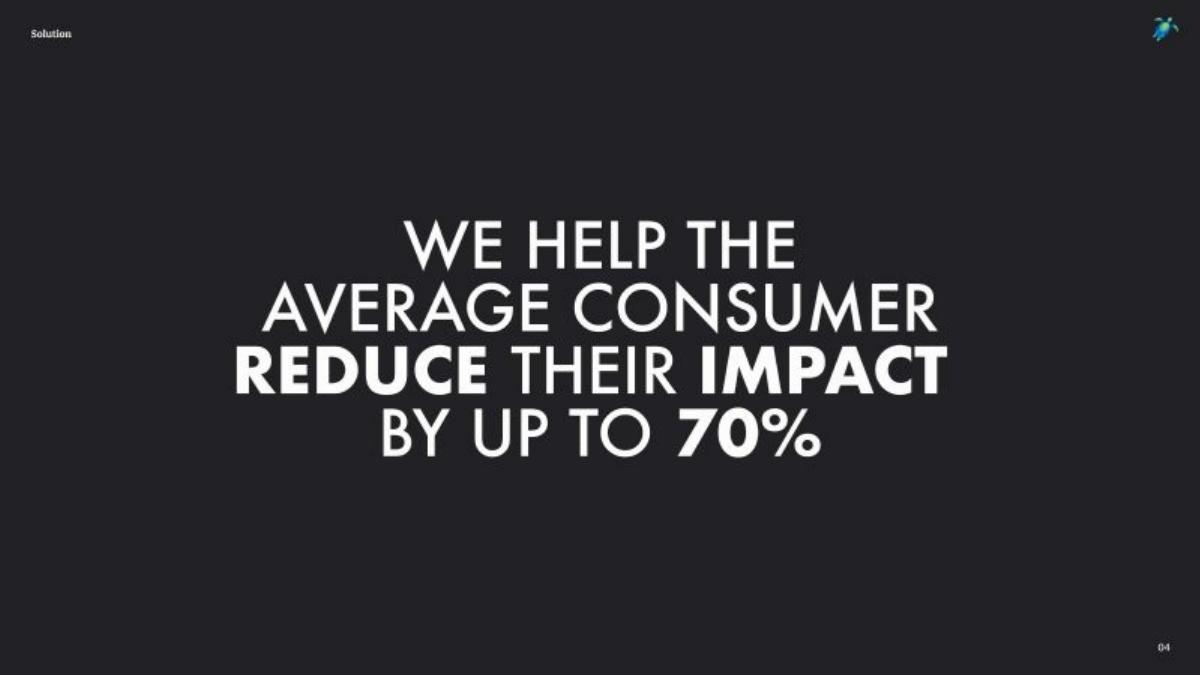
This slide, simply titled 'Solution', features a single, bold statement in large white text against a dark grey background: 'WE HELP THE AVERAGE CONSUMER REDUCE THEIR IMPACT BY UP TO 70%'. This slide serves as a direct and impactful declaration of the company's value proposition and the scale of the potential impact for users.
Slide 05: Scanning Tool
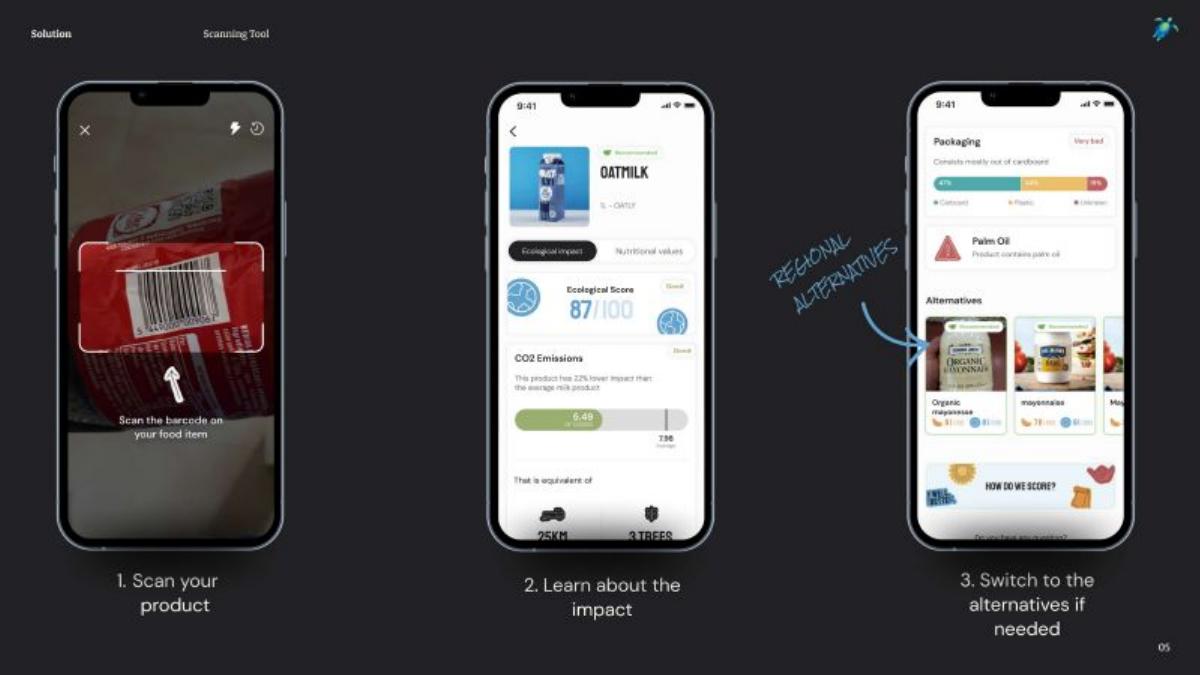
Titled 'Solution' and subtitled 'Scanning Tool', this slide visually explains a core feature of the app using three iPhone screen mockups. The first screen, labeled '1. Scan your product', shows a phone scanning a barcode on a packaged item. The second screen, labeled '2. Learn about the impact', displays an app interface with an 'Ecological Score' of '87/100' for 'OATMILK' and 'CO2 Emissions' data. The third screen, labeled '3. Switch to the alternatives if needed', shows the app presenting 'REGIONAL ALTERNATIVES' for a product, with options like 'Organic mayonnaise' and 'Oat Milk'. This slide provides a clear, step-by-step demonstration of how the app functions for product evaluation.
Slide 06: Diet Footprint
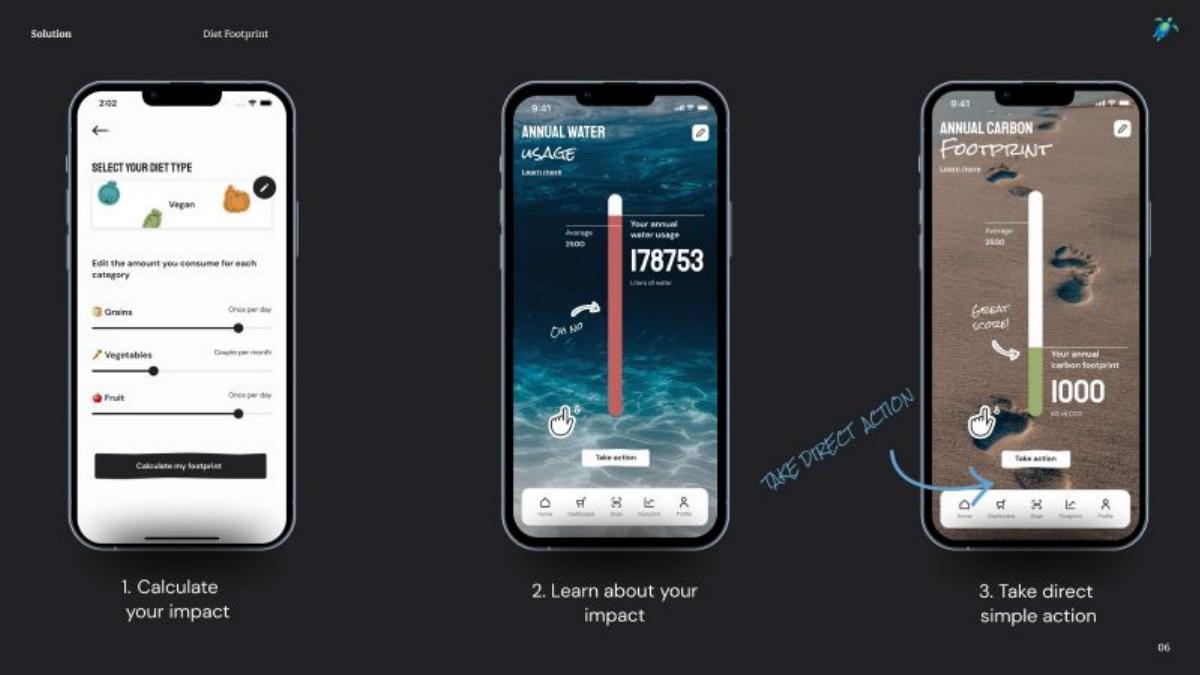
This slide, also under 'Solution' and subtitled 'Diet Footprint', illustrates another key app feature with three more iPhone screen mockups. The first screen, labeled '1. Calculate your impact', shows an interface for selecting diet type (e.g., Vegan) and editing consumption amounts for categories like Grains, Vegetables, and Fruit. The second screen, labeled '2. Learn about your impact', displays 'ANNUAL WATER USAGE' with a visual representation of water levels and a total of '178753' liters. The third screen, labeled '3. Take direct simple action', shows 'ANNUAL CARBON FOOTPRINT' with a visual of a footprint and a number '1000' kg, with a call to 'TAKE DIRECT ACTION'. This slide demonstrates the app's ability to personalize impact tracking and suggest actions.
Slide 07: Academy
Under the 'Solution' heading, subtitled 'Academy', this slide presents two iPhone screen mockups held by hands. The left screen shows a 'Highlights' section with a message 'LET'S SAVE THE CORALS TOGETHER'. To the right of the phones, four numbered points are listed: '1. COMMUNITY', '2. GAMIFICATION', '3. CONVENIENCE', '4. IMPACT'. The right screen mockup displays a recipe for 'OATMEAL BOWL' with ingredients and 'CO2 emissions' data. This slide highlights additional features and the core principles driving the app's user experience.
Slide 08: (Untitled)
This slide has no specific title, but features a large, two-line statement in white text against a dark grey background: 'EVERYONE WANTS TO BE GOOD FOR THE PLANET BUT CONVENIENCE GOES FIRST'. This slide serves as a powerful insight into consumer behavior, emphasizing the importance of ease of use for adoption of sustainable practices.
Slide 09: Marketplace
Titled 'Business Model' and subtitled 'Marketplace', this slide shows an iPhone screen mockup held by a hand on the left. The screen displays 'Nutritional Score' (71/100) and 'Ecological Score' (97/100) for products, with recommendations. To the right, two numbered points state: '1. Users can reduce their weekly impact with almost no effort. ' and '2. No more worries about taste & health preferrences. ' An arrow points from the phone screen to the text 'TAILORED FOOD BASKET'. This slide introduces the marketplace aspect of the business model, emphasizing personalized, low-effort solutions for consumers.
Slide 10: Why?
Under 'Business Model', subtitled 'Why?', this slide features two arrows pointing upwards from the words 'CONSUMER' and 'EUROPEAN UNION' to the central phrase 'THE TIME HAS COME'. Below this, a star icon is followed by the text 'For every product sold through the app => comission of 3-5%'. This slide briefly explains the market readiness from both consumer demand and regulatory perspectives, and explicitly states the core revenue generation mechanism.
Slide 11: Size
Titled 'Market' and subtitled 'Size', this slide presents a visual breakdown of the European market. A map of Europe is shown with 'Europe 57M' indicating the total market. This is followed by a visual equation: a phone representing 'COMPETITORS' with '17.5M' users, subtracted from the total, resulting in another phone representing Palau Project with '67%' 'REMAINING MARKET SHARE TO CAPTURE'. Below the visuals, two data points are listed: 'Following the COVID19 pandemic, 13% of consumers choose to buy more environmental friendly food brands while shopping.' and '37 percent of European consumers deeply care about sustainability'. The source is cited as 'Source: McKinsey&Company'. This slide quantifies the market opportunity and consumer interest.
Slide 12: Positioning
Under 'Market', subtitled 'Positioning', this slide uses a Venn diagram to illustrate Palau Project's unique position. The diagram shows two overlapping circles. The left circle is labeled 'EFFICIENT TECH TOOL' and contains logos of apps like 'Yuka', 'OPEN FOOD FACTS', 'myrealfood', and 'eugène'. The text describes it as 'Solution that provides the opportunity for consumers to make decisions in full transparency'. The right circle is labeled 'EMOTIONAL SATISFACTION' and contains logos of organizations like 'Earth Hero', 'Greenpeace', 'klima', and '4ocean'. The text describes it as 'Solution that triggers an emotional state in consumers once they know they are helping the environment'. The intersection of the two circles contains the Palau Project turtle logo, with the overarching statement: 'Palau combines the efficient tools for analysing food products with the emotional state of knowing you are saving our oceans/planet'. This slide effectively communicates the company's competitive advantage by blending technology with emotional appeal.
Slide 13: App
Titled 'Traction' and subtitled 'App', this slide presents three circular images of people using phones, each with a metric: '25-30 organic downloads a day', '10000 scans', and '1h 45min engagement time'. Below these, two upward-pointing arrows indicate further traction: 'Last month we went from O TO 700 WAU in Portugal' and 'We have a tiktok about our app that has 430k views' with a small screenshot of a TikTok video. This slide provides concrete, early-stage metrics demonstrating user engagement and growth.
Slide 14: (Untitled)
This slide, still under 'Traction', features the bold statement 'OUR PRODUCT IS ALREADY SCALABLE'. Below this, two graphs are displayed. The left graph is a world map showing 'Users = by Country', with a bar chart listing countries and user counts (e.g., 'Portugal 832', 'Belgium 685', 'United Kingdom 344', 'United States 242'). The right graph is a line chart showing 'Retaining users' over time, with a peak around 40-45 users. This slide aims to demonstrate the product's global reach and retention capabilities.
Slide 15: (Untitled)
This slide, also under 'Traction', highlights partnerships and achievements. It features three circular logos with descriptions below. The first is 'Food 4 Future BILBAO' with an image of a stage presentation, stating 'Top 10 finalist out of 3000 startups'. The second is 'BNEW BARCELONA' with an image of a panel discussion, stating 'Invited as part of the Top 8 startups to the Bnew E-commerce hub'. The third is 'Vlaanderen & ondernemen' with a logo and the text 'Received a 50k subsidy to support our innovation'. This slide showcases external validation and early financial support.
Slide 16: Team
Titled 'Team', this slide introduces five individuals with their photos, names, roles, and past experience. From left to right: 'HOLLY ENVIRONMENTAL JOURNALIST' ('Content writer for multiple magazines'), 'JADE COO & ADVISOR' ('Senior McKinsey Consultant'), 'EMILIO MARKETING' ('Head of content at Moonroi'), 'TOBY PRODUCT MANAGER' ('Technical account manager at Qualtrics'), and 'NINA USER RESEARCH INTERN' ('Content creation for DuoTone'). A horizontal line separates roles from past experience. This slide presents a diverse advisory and operational team.
Slide 17: Founding Team
Titled 'Founding Team', this slide introduces the two founders. The top section features 'JEROME HUSTLER/CEO' with his photo. Text describes him as having 'Studied at EAE Business school', 'While traveling +60 countries thanks to marketing campaings', 'Marketing Major', 'Content creator. World Champion. 2 documentaries on Amazon Prime. Obsessed with the ocean.' The bottom section features 'SIMON HACKER/CTO' with his photo. Text describes him as having 'Studied at School 19', 'Interned at DPG-Media as Fullstack developer for VTM.be', 'Passionate and perfectionist in what he does. Makes music in his free time. Loves nature.' This slide provides personal and professional background for the core leadership.
Slide 18: Seed Round
This slide is a simple transition slide, featuring the bold text 'SEED ROUND' in large white letters against a dark grey background. The bottom right corner shows '18'.
Slide 19: Seed Round
This slide, also titled 'Seed Round', features a large image of two dolphins swimming underwater. Overlaid in white text, centered, is the statement: 'THERE WILL BE TIMES WHERE WE WILL PUT NATURE BEFORE YOUR MONEY'. This slide serves as a mission statement or a declaration of values for potential investors.
Slide 20: What we need
Titled 'Seed Round' and subtitled 'What we need', this slide explicitly states the funding ask: 'SEED ROUND AMOUNT: 500K'. Below this, a pie chart breaks down the allocation of funds. The largest slice, 'TEAM' (47%), includes bullet points: 'Key hires in Growth, Data architecture', 'continue building up tech team with roles front end, back end and R&D'. 'MARKETING' (23%) includes 'Growth campaings', 'Paid performance', 'Climate partnerships and influencers'. 'PLATFORM' (20%) includes 'Scaling infrastructure', 'Scaling analytics capabilities', 'Outsourcing trivial development tasks'. 'OPERATIONS' (10%) includes 'Office space & equipment', 'Team activities', 'Team necessities'. This slide clearly communicates the funding target and how the money will be used.
Slide 21: Momentum
This slide, titled 'Momentum', presents three circular logos with descriptions. The first is 'noise' (Noise Studios), stating 'Joins forces with Palau'. The second is 'WEFUNDER', stating 'Expands into Europe starting their campaign with 10 startups'. The third is 'web summit LISBON', stating 'Invited to Websummit where will pitch to the big players of the industry'. This slide highlights recent achievements and partnerships that indicate positive forward movement for the company.
Slide 22: (Untitled)
This slide has no title. It features a large image of a surfer riding a wave filled with debris, with the bold white text 'EQUITY FOR THRIFTHERS' overlaid. This slide appears to be a concluding statement or a call to action, though 'THRIFTHERS' is an unusual spelling and its specific meaning in this context is not explicitly defined within the deck.
Slide 23: (Untitled)
This is a standard bestpitchdeck.com outro slide, not part of the original pitch deck content. It features social media icons, the text 'Browse the best pitch deck examples. Brought to you by bestpitchdeck.com — the world's largest library of pitch decks: hundreds of winning presentations from leading startups, updated every week.' with a 'Read more' button, and an image of various pitch deck covers (Uber, Airbnb).
What Works Well
The Palau Project pitch deck excels at clearly defining the problem and presenting a tangible solution. Slides 02 and 03 effectively use statistics and relatable examples to highlight the environmental impact of the food industry and the confusion consumers face. The dual problem of corporate greenwashing and consumer lack of information is well-articulated, creating a strong case for the app's necessity. The solution, detailed across slides 04-07, is visually demonstrated with clear iPhone mockups, showing how the app functions for product scanning, diet footprint calculation, and personalized recommendations. The claim of helping consumers 'reduce their impact by up to 70%' (Slide 04) is a bold and memorable value proposition. The inclusion of 'COMMUNITY, GAMIFICATION, CONVENIENCE, IMPACT' (Slide 07) as core principles helps to illustrate the user experience and engagement strategy. The insight on Slide 08, 'EVERYONE WANTS TO BE GOOD FOR THE PLANET BUT CONVENIENCE GOES FIRST', shows a nuanced understanding of consumer behavior, which is crucial for a B2C product. The business model is straightforward, with a clear 'comission of 3-5%' (Slide 10) on products sold through the app. Early traction metrics on Slide 13, such as '25-30 organic downloads a day', '10000 scans', and '700 WAU in Portugal', provide concrete evidence of early adoption and engagement. The 'OUR PRODUCT IS ALREADY SCALABLE' statement on Slide 14, supported by a global user map, suggests potential for expansion. External validation through awards and subsidies (Slide 15) adds credibility. The team slides (16-17) introduce a mix of operational, advisory, and founding talent, showcasing relevant experience. Finally, the explicit ask for '500K' with a detailed allocation breakdown (Slide 20) provides transparency for investors regarding fund utilization.
What Is Missing
Despite its strengths, the Palau Project pitch deck has several notable omissions. A crucial missing element is a detailed financial forecast. While the business model states a commission rate (Slide 10), there are no projections for revenue, user growth over time, or pathways to profitability. This makes it difficult for investors to assess the long-term financial viability and potential returns. Similarly, a clear competitive analysis beyond the Venn diagram on Slide 12 would be beneficial. While the Venn diagram positions Palau Project, it doesn't delve into the specific strengths, weaknesses, or market share of direct competitors in the B2C sustainability app space. There is no mention of the $125K previously raised, as stated in the catalogue listing, which is a significant piece of information for investors to understand the company's prior funding and valuation. The 'SEED ROUND' slides (18-20) state the ask but do not include a specific valuation or the equity being offered for the 500K. There is also no mention of a timeline for achieving milestones with the requested funds. While the team slide (16) lists an 'INTERN', it's unusual to highlight an intern in a core team presentation for a seed round, especially without clear justification for their prominence. The term 'THRIFTHERS' on Slide 22 is unclear and not defined, potentially causing confusion for investors. Finally, the deck lacks a dedicated 'ask' slide that clearly outlines what the company is seeking beyond just the amount, such as specific investor profiles or strategic partnerships.
What a Founder Should Copy
Founders can learn several valuable lessons from the Palau Project pitch deck. Firstly, the clear and concise problem statement (Slides 02-03) is excellent. Using statistics and relatable examples to frame the issue of environmental impact and consumer confusion is highly effective. The direct and bold solution statement on Slide 04 ('WE HELP THE AVERAGE CONSUMER REDUCE THEIR IMPACT BY UP TO 70%') is a strong example of a memorable value proposition. The visual demonstration of the app's functionality through iPhone mockups (Slides 05-07) is crucial for a product-centric pitch, making the solution easy to understand. The inclusion of a key consumer insight ('CONVENIENCE GOES FIRST' on Slide 08) demonstrates a deep understanding of the target market. Presenting early traction metrics (Slide 13) with specific numbers like 'organic downloads', 'scans', and 'WAU' provides concrete evidence of early product-market fit. Showcasing external validation through awards, hubs, and subsidies (Slide 15) builds significant credibility. The transparent breakdown of fund allocation (Slide 20) is essential for investors to understand how their money will be utilized. Lastly, the 'Positioning' slide (12) using a Venn diagram to illustrate how the company differentiates itself by combining 'Efficient Tech Tool' with 'Emotional Satisfaction' is a creative and effective way to communicate competitive advantage.
Frequently asked questions
- What problem does Palau Project aim to solve?
- Palau Project aims to solve the problem of the food industry's significant environmental impact, including overfishing, deforestation, and pollution (Slide 02). It also addresses consumer confusion caused by companies using 'sustainability as a marketing tool' without providing clear product impact information (Slide 03).
- How does Palau Project's solution work?
- The solution is an app that allows users to scan product barcodes to learn about their environmental impact and see regional alternatives (Slide 05). It also helps users calculate their diet's water and carbon footprint and offers 'direct simple action' to reduce it (Slide 06). The app incorporates community, gamification, convenience, and impact features (Slide 07).
- What is Palau Project's business model?
- Palau Project's business model is based on earning a 'comission of 3-5%' for every product sold through the app (Slide 10). This suggests a marketplace or affiliate model where the app facilitates environmentally conscious purchases.
- What traction has Palau Project achieved?
- Palau Project reports '25-30 organic downloads a day', '10000 scans', and '1h 45min engagement time' (Slide 13). They also grew from '0 TO 700 WAU in Portugal' and have a TikTok video with '430k views'. Additionally, they were a 'Top 10 finalist out of 3000 startups' at Food 4 Future Bilbao and received a '50k subsidy' (Slide 14).
- What is Palau Project asking for in this seed round?
- Palau Project is seeking a 'SEED ROUND AMOUNT: 500K' (Slide 20). The funds are planned to be allocated primarily to the team (47%), followed by marketing (23%), platform development (20%), and operations (10%).