Palate Mkt’s deck features a brilliant, data-backed analysis of the CAC ceiling for single-product brands, yet buries this insight behind 600 words of CV and a messy cover slide. While the founders show deep industry expertise and honest market mapping, the pitch suffers from repetitive segmentation and implausible financial projections.
Key takeaways
- Lead with the business vision on slide one instead of burying it behind hundreds of words of founder biographies.
- Quantify your core insight with data, like Palate’s CAC ceiling analysis, to prove the economic necessity of your platform.
- Avoid repetitive 'word cloud' slides; group customer segments by specific needs and pain points rather than generic synonyms.
- Map the competitive landscape honestly by naming giants like Amazon or Swiggy and clearly stating your unique wedge against them.
- Ensure financial projections like LTV:CAC ratios are grounded in reality and don't contradict your own data on rising acquisition costs.
What this deck is
Palate Mkt is a Delhi-based marketplace-and-enablement platform for single-product food brands, pitched by co-founders Aditi Kapoor and Ruchi Sibal on the back of their existing business, Palate Fest. The deck is dated December 2020 — nine months into India's pandemic, when every food business in the country was rebuilding around online sales — and asks for INR 3.5 crore, roughly $475,000 at the time, split into two tranches.
It is 29 slides. It is also one of the most instructive decks in this series, because its two halves belong to different documents. The middle of the deck — the CAC ceiling analysis, the three-route market landscape, the unmet-needs overlay — is genuinely good original thinking, better than most seed decks produce. The outside of the deck — the opening, the founder slides, the traction slide, the ask — undoes a large part of it.
Start with the first thing an investor sees. Slide 1, above the company name, carries this line in plain text: "Go to - use the hex code e46525 for the colour to be the same." A note-to-self about matching illustration colours, left on the cover of an investment deck. It is a small thing and it is not a small thing: the first signal the reader gets is that nobody read the file end to end before sending it.
Slide-by-slide walkthrough
Slide 1 — Cover: "Palate Mkt — Investment Deck"
Company name, document type, and the stray Freepik instruction. No positioning line, no tagline, no date, no stage, no city. "Investment Deck" is not information; the reader already knows what they opened.
A cover has one job: to make the next 20 minutes make sense before they begin. "Palate — the sales and marketing platform for India's single-product food brands" would have done it in eleven words. Instead the deck spends its highest-attention slide on a filename and a colour reminder.
Slides 2–3 — Founders: Aditi Kapoor and Ruchi Sibal
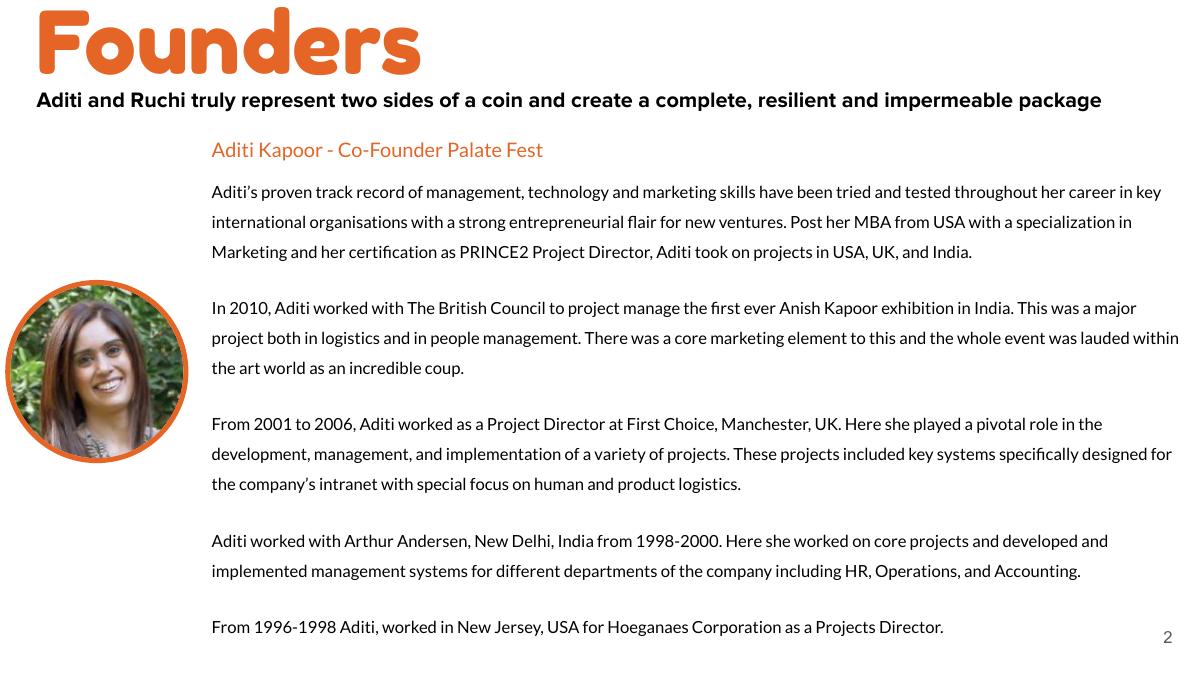
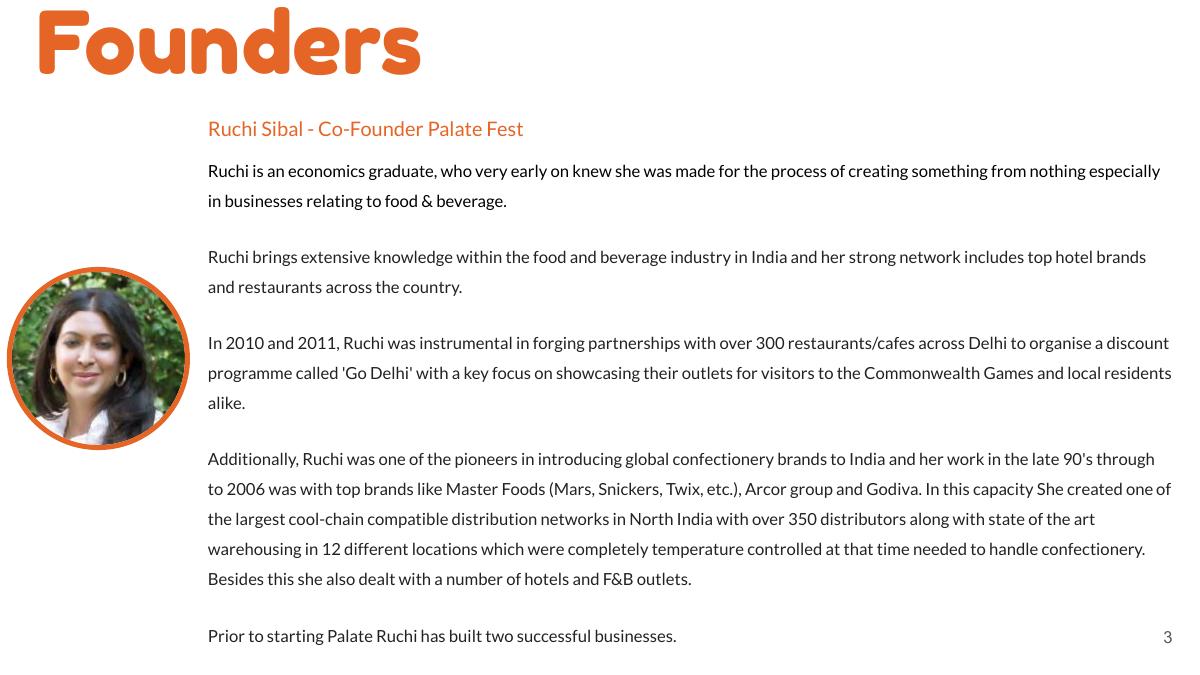
Two full slides of founder biography, each several hundred words. Aditi: MBA in the USA, PRINCE2 certification, project work across the USA, UK and India, project-managed the first Anish Kapoor exhibition in India for the British Council in 2010, Project Director at First Choice in Manchester from 2001 to 2006. Ruchi: economics graduate, deep F&B network across Indian hotels and restaurants, forged partnerships with over 300 restaurants and cafés for the 'Go Delhi' discount programme around the 2010 Commonwealth Games, and earlier built a 350-distributor cool-chain network across North India for Mars, Arcor and Godiva.
First, the substance is strong and under-recognised. Ruchi's 350-distributor temperature-controlled distribution network and 300-restaurant partnership programme are exactly the "unfair advantage" a food marketplace needs: she has already done supply-side aggregation in this city, in this category, at scale. That is the single most investable fact in the entire deck.
Second, the presentation buries it. It is two slides of dense paragraphs, positioned before the reader knows what the company does, with a header ("Aditi and Ruchi truly represent two sides of a coin and create a complete, resilient and impermeable package") that asserts the conclusion rather than earning it. Nobody reads several hundred words of CV on slide 2. The 350 distributors and the 300 restaurants should be two bullet lines on a team slide near the end, in bold, next to the sentence that says why they matter for this business.
There is also a chronology problem. The strongest cited achievements are from 2001–2011, and the deck is dated 2020. Nothing in either bio covers the last five years, which invites the question the founders least want asked.
Slide 4 — Vision: "Tech enablement platform for food vendors"
Six words, one slide, and the first time the reader learns what the company is — on slide 4, after roughly six hundred words about the founders. Move this to slide 1 and the whole deck reads differently.
The phrase itself is also softer than it needs to be. "Tech enablement platform" is category vocabulary; it does not say whether Palate sells software, takes a commission, runs marketing campaigns, or all three. That ambiguity persists for another eighteen slides.
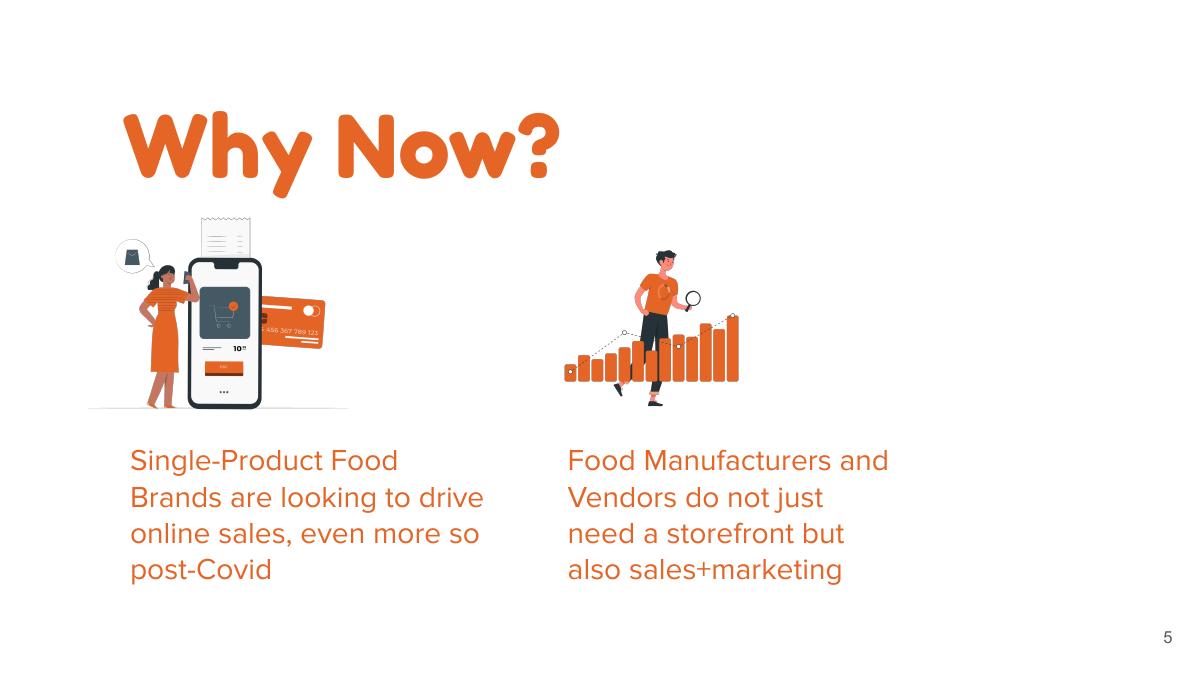
Slide 5 — "Why Now?"
Two statements: single-product food brands are pushing online sales, more so post-Covid; and manufacturers and vendors need not just a storefront but sales and marketing.
The second half is the actual insight of the business — the wedge is that a storefront alone does not sell anything — and it is stated correctly here. What is missing is evidence. In December 2020 there was abundant public data on Indian online grocery and D2C food growth. One sourced number ("online grocery in India grew X% in 2020") would have converted an assertion into a market fact. As written, the strongest timing argument in the deck rests on the reader's own assumptions.
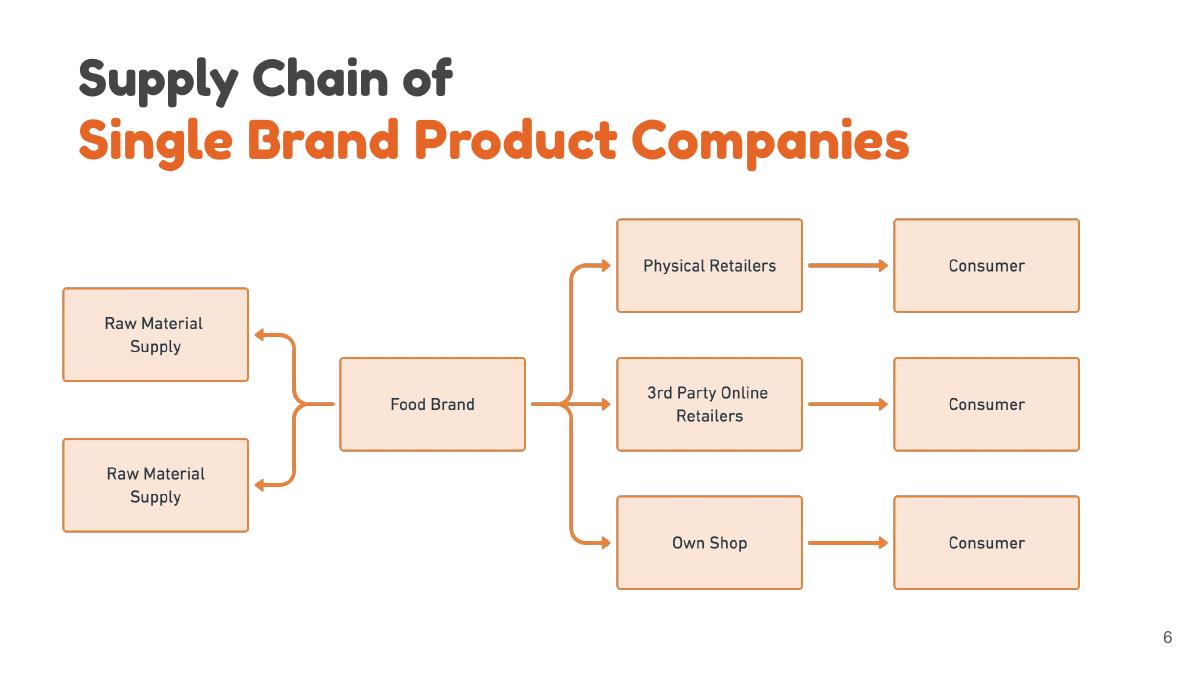
Slide 6 — Supply chain diagram
A three-path flow: raw material supply into a food brand, then out through physical retailers, third-party online retailers, and the brand's own shop, each ending at the consumer.
This is accurate and it is context, not argument. It shows the world as it is without yet showing what is broken or where Palate inserts itself. As a setup slide before the problem, it works — provided the next slide lands hard, which is where things get uneven.
Slide 7 — "The problem of scaling up single-brand products"
A diagram labelled with nothing but "Good Money" and "Bad Money," twice each.
This is the weakest slide in the deck and it is sitting in the most important position. The problem slide is where an investor decides whether to keep reading properly or start skimming, and this one offers four words with no definition of either term, no numbers, and no named customer. The idea underneath it — that marketing spend on a single-product brand stops converting past a certain point, so incremental spend is "bad money" — is a real and interesting one. It arrives on the next slide instead, which means the problem slide is doing zero work.
Slide 8 — "Single-product companies hit a CAC ceiling quickly"
The best slide in the deck, by a distance. Two tables side by side.
A single-product brand: at ₹37,000 of spend, CAC is ₹550 and average CPC ₹15; at ₹1.2M, CAC rises to ₹950 with CPC at ₹25; at ₹1.9M, CAC is ₹920 and CPC still ₹25. A multi-brand horizontal platform, simulated for Palate: at ₹100,000 of spend, CAC ₹180 with CPC ₹4.51; at ₹1M, CAC ₹460 with CPC ₹11; at ₹5M, CAC ₹850 with CPC ₹21.
This is a real argument, made with real arithmetic, and it is the reason the company should exist: a single brand's acquisition cost nearly doubles between ₹37K and ₹1.2M of spend, while a portfolio of brands on one platform absorbs 50× more spend before reaching the same CAC. It even links out to the underlying analysis rather than asking for trust.
Two fixes. The tables should be one chart — spend on the x-axis, CAC on the y-axis, two curves — because the crossover is the entire point and a reader has to do the comparison mentally in the current format. And the headline should state the conclusion: "A single brand hits ₹950 CAC at ₹1.2M spend. A platform holds ₹460 at the same spend." The finding is buried inside a table when it deserves to be the largest text on the page.
Slide 9 — CAC analysis continued
Screenshots of ad-platform estimates: ₹4.7K budget with ₹100 max CPC producing a 3.7% rate; ₹40K producing 4.0%; ₹1.2M producing 4.7%.
Raw evidence, unannotated, in a font size that requires zooming. The instinct — show the receipts — is right and rare. The execution puts the burden of interpretation entirely on the reader. One sentence of caption per screenshot would have kept the credibility and removed the work.
Slides 10–11 — Market entry approach and "Why this?"
Slide 10: "an enablement platform for existing and upcoming food and gourmet brands." Slide 11: two words, "High Relevance" and "High Differentiation."
Slide 11 is a claim with nothing behind it. Relevant to whom, differentiated from what? The comparison that would substantiate both arrives seven slides later on the market landscape, disconnected from the assertion it is supposed to support.
Slides 12–15 — Target audience and three segment slides
Three customer types are named: local gourmet stores, new F&B startups, existing food vendors. Each then gets a full slide consisting of a list of needs — revenue, leads, sales, commission, marketing, identity, branding, reach, growth, expansion, enablement, platform, business development.
Compare the three lists closely and the problem appears: they are nearly identical. The local gourmet store adds "commission" and "identity"; the new startup adds "investment" and "capital"; the existing vendor gets the same list minus a couple of items. Three slides, one list, twelve near-synonyms.
Word clouds of business nouns are not segmentation. Segmentation is: this customer has this specific problem, pays this much today, and is reached this way. Palate's segments almost certainly differ in a way that matters — a new F&B startup needs demand and capital, an established vendor needs incremental channel without cannibalising retail — and the deck has three whole slides to say that and says none of it. These four slides should be one.
Slide 16 — Target audience needs
The same vocabulary again, arranged as a two-column layout of needs against the audience. Fourth consecutive slide on the same idea. By this point a reader who started at the CAC analysis has lost the thread.
Slides 17–20 — Market landscape in three routes
The second-best sequence in the deck. Palate maps the competitive field into three routes with named companies and funding.
Route 1, enablement and capital: Amazon Launchpad, Sodexo Accelerator, BigBasket's BB Accelerator ($1.02B raised by the parent), Ghost Kitchen India (bootstrapped). Route 2, non-curated retail marketplaces: Amazon, BigBasket ($819M), Swiggy ($1.62B), Flipkart (Walmart, ~$20B valuation), Dunzo ($84.7M). Route 3, curated marketplaces: Nature's Basket (acquired at ₹300 Cr), Scootsy (acquired by Swiggy at ₹50 Cr), Healthy Buddha, Foodhall, LBB ($8.3M), Modern Bazaar, Q Trove ($51.6M), ISayOrganic.
This is honest market work. It names 17 competitors including the largest companies in Indian commerce, cites funding for each, and includes two acquisition comparables that give an investor a reference for what exits look like in this category. Most seed decks either omit the giants or claim no competition; this one lists Amazon, Flipkart, Swiggy and BigBasket on consecutive slides.
What it never does is take a position. Three routes are described and Palate is not placed on any of them, no axis of comparison is drawn, and no reason is given why a curated enablement platform survives between a $1.62B delivery company above it and eight funded curated marketplaces beside it. The honesty is admirable and incomplete: naming your competitors without stating why you win reads as a market briefing, not a pitch. It also, read cynically, spends three slides proving that eight companies already do route 3.
Slide 21 — "Unmet needs"
The needs list from slide 16 re-presented as gaps the market fails to fill: online storefront, revenue, business development, online sales, marketing, branding, reach, growth, enablement platform.
The intent is the right one — bridge from the competitive landscape to the whitespace — and this is the fifth appearance of the same word list. What would carry the argument is a simple matrix: those nine needs as rows, the three routes as columns, ticks and crosses showing that no existing player covers more than half. The deck has all the raw material for that table on the previous four slides and never builds it.
Slides 22–23 — Operating model, "Go Gourmet Live"
A section divider followed by a diagram of the operating model under the "Go Gourmet Live" banner. This is the how-it-actually-works slide: onboarding, storefront, fulfilment, marketing. Presented as a graphic with almost no text, it will read clearly in a live presentation and poorly over email — and in December 2020, over email was how most decks were being read.
Slides 24–25 — Business model and projections, LTV:CAC of 30.22
A section divider, then a single headline figure: an LTV-to-CAC ratio of 30.22 for the enablement model.
First, it is presented alone. No revenue model, no take rate, no pricing, no assumptions, no time horizon, no churn — the deck section is titled "Business Model & Projections" and contains neither a business model nor projections, just an output.
Second, 30.22 is implausible for a pre-product company. The benchmark investors use is 3:1, with 5:1 considered strong. Thirty is not a strong number; it is a number that tells an experienced reader the LTV assumption is wrong — usually because lifetime was modelled without churn, or gross margin was omitted, or CAC counted only ad spend and not the sales effort to onboard a vendor.
Third, and most damaging in context: the deck just spent two excellent slides establishing that CAC rises with spend. The 30.22 figure implicitly assumes it does not. The strongest analysis in the deck and the headline financial claim contradict each other, and nothing on the slide reconciles them.
Two decimal places on a pre-revenue projection add precision, not credibility.
Slides 26–27 — Pre-product traction and milestones achieved
Slide 26 shows four logos — Fat Lulu's Gourmet Pizza, Whole Foods, Mrs Kaur's, The Leela Palaces Hotels Resorts — under the heading "Pre-Product Traction," with no caption. Slide 27 lists milestones achieved: existing brand recall, idea validation via DREK analysis, financial projections, pre-product traction (waitlist).
The logo wall is the classic ambiguity trap. Four marks, no relationship stated. Are these signed vendors, waitlist signups, letters of intent, prior clients of Palate Fest, or aspirational targets? An investor cannot tell, and the ones who care will ask in a way that is uncomfortable if the answer is "waitlist." Slide 27 does eventually clarify that the traction is a waitlist — one slide too late, and phrased as a milestone rather than a number.
The fix is a single line of text: "12 brands on the waitlist, including Fat Lulu's and Mrs Kaur's; 2 signed LOIs." Whatever the true numbers are, stating them converts an ambiguous logo wall into verifiable pre-product traction, which for a December 2020 marketplace was a perfectly respectable thing to have.
Slide 28 — The ask: INR 3.5 crore in two tranches
Total INR 3.5 crore. First tranche of ₹50 lakh for go-to-market, initial traction and product-market fit. Second tranche of ₹3 crore for scaling, adding food brands, team and traction.
The tranching is a genuinely thoughtful structure — it de-risks the investor by tying the larger cheque to evidence from the smaller one, and it shows the founders think in milestones. But the slide leaves out everything that makes an ask actionable: no instrument (equity, SAFE, CCPS), no valuation or cap, no runway in months, no percentage split of the use of funds, and no definition of what "product-market fit" means as a trigger for the second tranche. A tranche gated on an undefined condition is not a gate.
Slide 29 — Next milestones
Digital product go-live, full product launch, traction. Three activities with no dates and no numbers. This is where the deck closes, so it is the last thing the reader retains: three unquantified intentions. There is no call to action, no contact detail, and no ask restated.
What Palate does better than most seed decks
An original insight, quantified. The CAC ceiling argument on slide 8 is a real economic thesis with real numbers behind it and a link to the working. Most seed decks contain no proprietary analysis at all. · Honest competitive mapping. Seventeen named competitors across three structural routes, with funding figures and two acquisition comparables, including the four largest players in Indian commerce. Very few founders name Amazon, Flipkart and Swiggy voluntarily. · Real supply-side credibility. A co-founder who has already built a 350-distributor cold-chain network and aggregated 300 restaurants in the target city. That is a moat, buried on slide 3. · A milestone-gated ask. Splitting ₹3.5 Cr into a ₹50L proof tranche and a ₹3 Cr scale tranche is investor-friendly thinking that most first-time founders never consider. · Timing awareness. A December 2020 deck built around the post-Covid shift to online food sales was pointed at a genuinely open window.
Where this deck would lose the room
A production note on the cover. A Freepik URL and a hex code, on slide 1 of an investment deck. · The company is explained on slide 4. Roughly 600 words of founder biography come first. · A problem slide that says "Good Money / Bad Money." Four words in the position that decides whether the deck gets read. · Five slides of the same word list. Slides 12 to 16 and 21 restate the same twelve business nouns as segmentation, needs and gaps. · A competitive landscape with no verdict. Seventeen competitors named, no axis drawn, no reason given why Palate wins. · A 30.22 LTV:CAC with no model. A ratio ten times the accepted benchmark, presented alone, contradicting the deck's own CAC analysis. · An unexplained logo wall. Four brand marks under "Pre-Product Traction" with no stated relationship. · No numbers in the ask. No instrument, no valuation, no runway, no PMF definition gating tranche two. · No close. The last slide is three undated activities; there is no contact detail anywhere.
What the deck says vs. what an investor needs
Cover "Palate Mkt — Investment Deck" plus a Freepik note Company name and a one-line description of the business
Problem "Good Money / Bad Money" One brand, its ad spend, and the rupee cost of the CAC ceiling
Insight Two CAC tables, conclusion left implicit One chart, two curves, the crossover called out in the headline
Segments Four slides of near-identical need words One slide: three segments, one distinct pain and price point each
Competition 17 companies across three routes, no position taken The same map with Palate placed on it and the win condition stated
Business model LTV:CAC of 30.22 Take rate, pricing, assumptions, churn, and a defensible 3–5:1
Traction Four logos, "pre-product" Waitlist count, signed LOIs, named brands, with the relationship stated
Ask ₹3.5 Cr in two tranches Same structure plus instrument, valuation, runway, and a measurable PMF trigger
Close Three undated activities Dated milestones, the ask restated, and contact details
The transferable lesson
Palate's deck fails in the way that competent decks usually fail: not from lack of thinking, but from putting the thinking in the wrong order.
Everything an investor needed is somewhere in this file. The insight is on slide 8. The competitive honesty is on slides 18 to 20. The unfair advantage is on slide 3. The disciplined ask is on slide 28. What the deck does is lead with founder CVs, spend the middle repeating a word list, and headline its financials with a number that contradicts its own best analysis — so a reader skimming the first five slides encounters biography, a six-word vision, and "Good Money / Bad Money," and never reaches the argument that would have made them lean in.
Run the same test on your own deck. Read only slides 1 through 5 and ask what a stranger would now know: what you do, who hurts, why now, and what makes you the ones to fix it. If the answer to any of those lives on slide 8 or slide 18, the deck is not weak — it is misordered, and reordering it is a day's work with a much larger payoff than another design pass.
Frequently asked questions
- What is Palate Mkt?
- Palate Mkt is a Delhi-based technology enablement platform for single-product food brands, pitched in December 2020 by co-founders Aditi Kapoor and Ruchi Sibal off the back of their existing business, Palate Fest. The proposition is that food vendors do not just need an online storefront, they need sales and marketing attached to it.
- How much was Palate raising?
- INR 3.5 crore, roughly $475,000 at December 2020 rates, structured in two tranches: an initial INR 50 lakh for go-to-market, initial traction and product-market fit, followed by INR 3 crore for scaling, adding food brands, team and traction. The deck does not state the instrument, valuation or runway.
- How many slides are in the Palate pitch deck?
- Twenty-nine. Two are founder biographies, four cover the same target-audience word list, four map the competitive landscape across three routes, and the last two cover the fundraise and next milestones. Several slides are diagram-only and depend on a live presenter.
- What is the strongest slide in the Palate deck?
- Slide 8, the CAC ceiling analysis. It shows a single-product brand's cost per acquisition climbing from Rs 550 at Rs 37,000 of spend to Rs 950 at Rs 1.2 million, while a multi-brand platform simulated for Palate holds Rs 460 at the same spend and Rs 850 at Rs 5 million. It is an original, quantified argument for why the company should exist, and it links out to the underlying workings.
- Why is an LTV to CAC ratio of 30.22 a problem?
- Investors treat 3:1 as the benchmark and 5:1 as strong. A pre-product company claiming 30:1 signals that the lifetime value assumption is wrong, usually because churn was omitted, gross margin was ignored, or CAC counted only ad spend. In this deck it also contradicts the company's own analysis two sections earlier, which established that CAC rises with spend.
- What should founders take from this teardown?
- Order matters as much as content. Every element an investor needed is somewhere in this deck, but the insight is on slide 8, the competitive work on slides 18 to 20 and the unfair advantage on slide 3, while slides 1 to 5 offer a filename, two CVs and a four-word problem statement. Reordering an existing deck is usually a bigger win than redesigning it.