Palate Mkt is positioning itself as a tech enablement platform for food and gourmet brands, aiming to solve the inefficiencies of traditional retail scaling. The deck identifies physical and third-party online retailers as 'bad money' channels due to margin loss, advocating for a direct-to-consumer 'Own Shop' model. A standout metric is the projected LTV to CAC ratio of 30.22 for their enablement model, though the deck lacks historical data to back this claim. The fundraising ask is structured into two tranches: INR 50L for initial traction and INR 3 Crore for scaling. While the vision is cle…
Key takeaways
- The company defines its vision as a tech enablement platform specifically for food vendors (Slide 4).
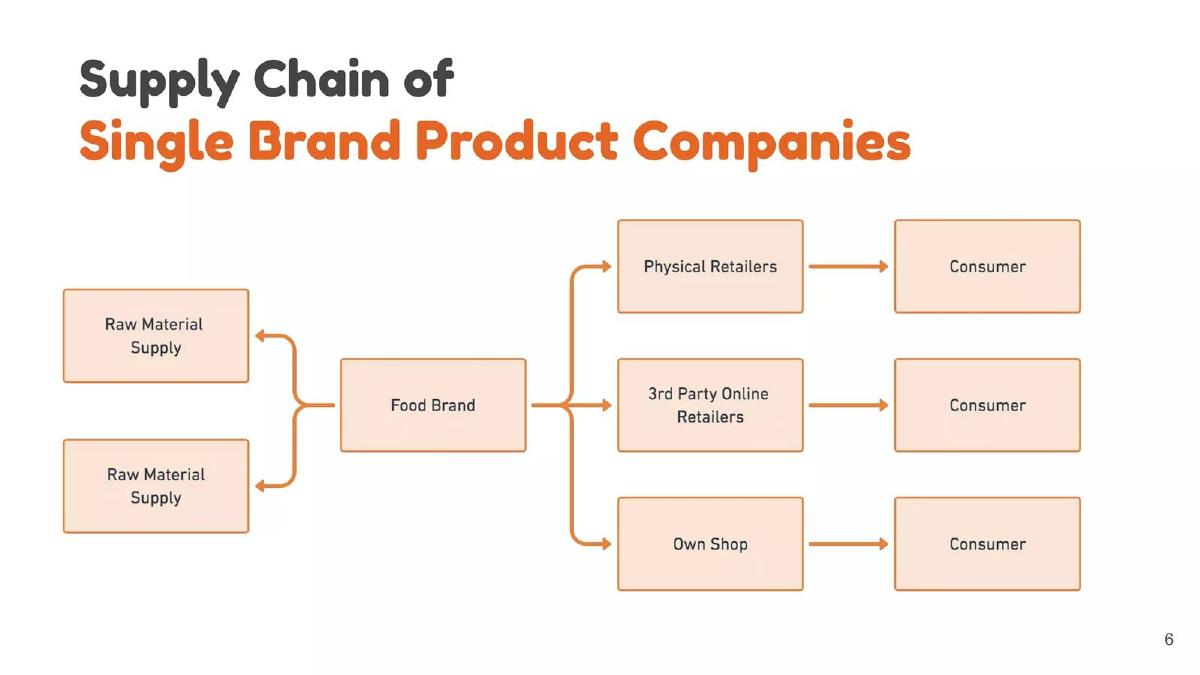
- Scaling via physical retailers and 3rd party online retailers is categorized as 'Bad Money' due to supply chain friction (Slide 7).
- The 'Own Shop' model is identified as the 'Good Money' path for food brands to reach consumers (Slide 7).
- Target audience needs are identified as online storefronts, business development, and branding (Slide 16).
- The deck compares the market to giants like Swiggy ($1.62 Bn funding) and BigBasket ($819 Mn) under the 'Non-curated Retail Marketplace' category (Slide 19).
- Palate Mkt claims a highly optimistic LTV to CAC ratio of 30.22 for its enablement model (Slide 25).
- The total fundraising ask is INR 3.5 Crore, split into a 50L first tranche and a 3 Crore second tranche (Slide 28).
- The first tranche of funding is dedicated to go-to-market, initial traction, and finding product-market fit (Slide 28).
Palate Mkt: The Tech Enablement Play for Gourmet Brands
Palate Mkt presents a deck that is visually clean but structurally focused on the theoretical benefits of their business model rather than realized metrics. The core thesis is that the current food retail ecosystem is broken for individual brands, forcing them into high-friction, low-margin relationships with third-party aggregators and physical retailers. By offering an 'enablement platform,' Palate Mkt intends to give these brands the tools to own their customer journey.
Slide 1: Title Slide
The deck opens with a simple title: Palate Mkt Investment Deck . There is no tagline or immediate value proposition on the cover, which is a missed opportunity to set the stage for the 'enablement' theme that follows.
Slide 4: The Vision
The vision is stated clearly: Tech enablement platform for food vendors . This positioning is important because it moves the company away from being a 'marketplace' (which carries heavy logistics and customer acquisition costs) and toward being a 'SaaS-enabled' service provider for the supply side of the food industry.
Slide 7: The Problem of Scaling Single Brand Products
This is the most substantive slide in the early deck. It uses a flow chart to distinguish between 'Good Money' and 'Bad Money.' Good Money is identified as the flow from raw material supply to the food brand and then directly to the consumer via an Own Shop . Bad Money is defined as sales through Physical Retailers and 3rd Party Online Retailers . The implication is that intermediaries strip away the brand's profit and control, though the slide doesn't explicitly define the financial metrics of this 'badness.'
Slide 10: Market Entry Approach
Palate Mkt defines its entry as an enablement platform for existing and upcoming food and gourmet brands . By targeting 'upcoming' brands, they are positioning themselves as an incubator or launchpad, which could be a high-churn segment but offers a large top-of-funnel for their software services.
Slide 13: Local Gourmet Store Focus
This slide lists keywords associated with their service for local stores: Revenue, Leads, Sales, Commission, Marketing, Identity, Branding, Reach, Growth, Expansion, Enablement, Platform, Business Development . It functions more as a word cloud than a feature list, suggesting the platform aims to be an all-in-one operating system for a small food business.
Slide 16: Target Audience Needs
Similar to Slide 13, this slide categorizes what their customers are looking for. The primary need identified is an Online storefront . This confirms that Palate Mkt is essentially building a 'Shopify for Food,' tailored to the specific needs of gourmet vendors who might require specialized delivery or presentation features.
Slide 19: Competitive Landscape (Route 2)
The deck lists major players in the Indian and global ecosystem: Amazon, BigBasket ($819 Mn funding), Swiggy ($1.62 Bn), Flipkart (Valued at USD 20 Bn), and Dunzo ($84.7 Mn) . Labeling these as 'Non-curated Retail Marketplaces' suggests that Palate Mkt's competitive advantage is curation and brand-first enablement, rather than the volume-heavy approach of these giants.
Slide 22: Operating Model
This is a transition slide with an illustration of a developer. It lacks text, but in a full presentation, this would be where the founder explains the unit economics and the technical stack. Without the accompanying talk track, the 'model' remains opaque.
Slide 25: LTV to CAC Ratio
The deck makes a bold claim here: an Enablement Model LTV to CAC ratio of 30.22 . In the world of venture capital, a 3:1 ratio is considered good, and 5:1 is excellent. A 30:1 ratio is extraordinary and usually indicates either a very low cost of acquisition (perhaps through organic word-of-mouth among vendors) or a very high lifetime value. Without supporting data on churn rates or average revenue per user (ARPU), this number feels more like a projection than a historical fact.
Slide 28: The Fundraising Ask
First Tranche (INR 50L): Focused on Go-to-market, Initial traction, and Product Market Fit. · Second Tranche (INR 3 Crore): Focused on Scaling up, Adding more food brands, Team, and Traction.
This two-step approach is likely designed to de-risk the investment for early backers, essentially saying 'give us a small amount to prove it works, then the rest to scale it.'
What Works in This Deck
The segmentation of 'Good' vs. 'Bad' money is a strong narrative device. It creates an 'enemy' (the high-commission third-party retailer) and positions Palate Mkt as the 'savior' for the independent brand. This is a classic storytelling technique in fundraising that helps investors understand the 'why' behind the product. Additionally, the tranche-based fundraising ask shows a level of fiscal discipline and milestone-based thinking that can be attractive to angel investors or seed funds who are wary of 'spray and pray' capital allocation.
What Is Missing
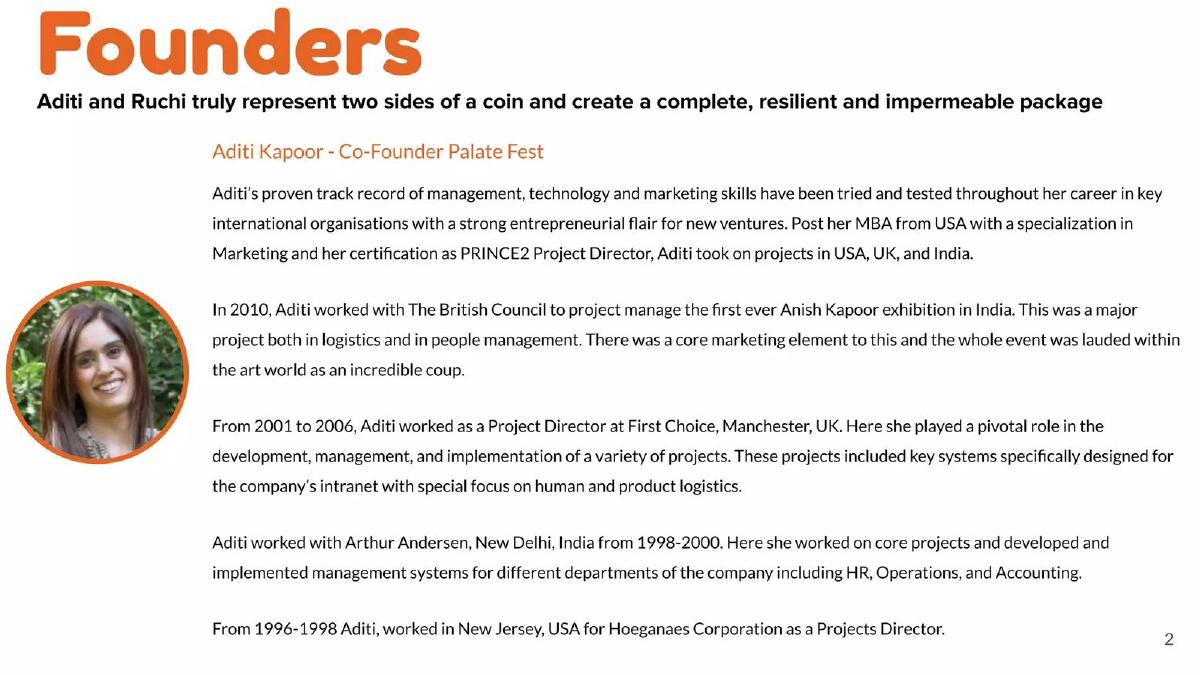
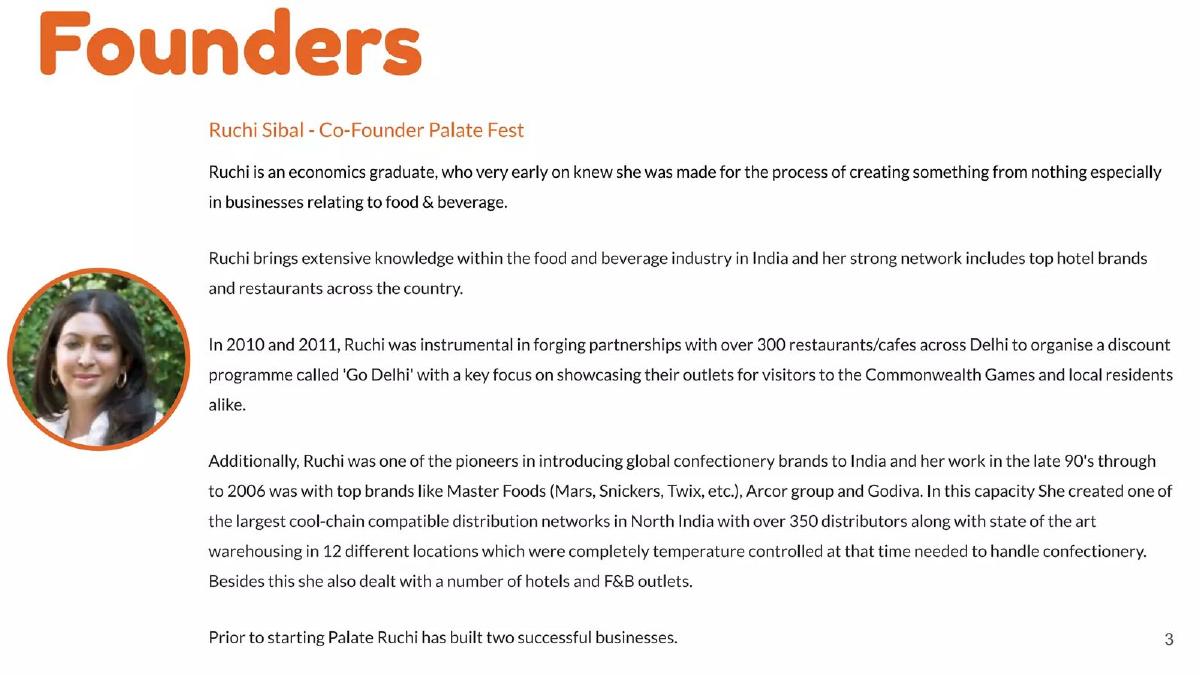
The most glaring omission in these 10 slides is the Team Slide . Investors invest in people, especially at the pre-PMF stage (as indicated by Slide 28). Without knowing who is building the tech or who has the connections in the gourmet food industry, the deck feels incomplete. Also missing is a Product Demo or Screenshots . For a 'tech enablement platform,' seeing the actual interface for the 'Online storefront' mentioned on Slide 16 is crucial. Finally, the 30.22 LTV/CAC ratio is presented without a formula or timeframe, making it difficult to validate.
What a Founder Should Copy
Founders should emulate the clear categorization of market competitors . By grouping Amazon and Swiggy as 'non-curated,' Palate Mkt successfully carves out a niche for itself without having to claim it will 'beat' Swiggy on logistics. The visual consistency —using a limited color palette (orange and grey) and consistent illustration styles—makes the deck look professional and easy to digest. Lastly, the use of a flow chart to explain the problem (Slide 7) is much more effective than a bulleted list of pain points.
Frequently asked questions
- What is the primary problem Palate Mkt aims to solve?
- Palate Mkt addresses the difficulty single-brand food products face when scaling. According to Slide 7, traditional scaling through physical retailers or third-party online marketplaces results in 'Bad Money'—likely referring to high commissions, lost margins, or lack of customer data. They propose an 'Own Shop' model enabled by their platform to capture 'Good Money' and direct consumer relationships.
- How much capital is Palate Mkt seeking and how will it be used?
- The company is seeking a total of INR 3.5 Crore (Slide 28). This is unusually structured into two tranches. The first INR 50L is for GTM and achieving product-market fit. The subsequent INR 3 Crore is earmarked for scaling, adding more food brands, building the team, and driving further traction. This suggests a milestone-based funding approach.
- What is the 'Enablement Model' mentioned in the deck?
- While the specific software features aren't detailed in these slides, Slide 13 and 16 list the components: online storefronts, revenue management, leads, sales, commissions, marketing, and branding. It is positioned as a 'Market Entry Approach' (Slide 10) that provides the infrastructure for local gourmet stores to operate their own digital presence rather than relying on aggregators.
- Is there evidence of existing traction in the deck?
- The provided slides do not show historical revenue, user growth, or active brand counts. Slide 28 explicitly states that the first tranche of funding will be used for 'Initial traction' and 'Product Market Fit,' which strongly implies the company is at the pre-revenue or very early prototype stage despite the specific LTV/CAC projections on Slide 25.
- Who are the competitors identified by Palate Mkt?
- Slide 19 lists 'Non-curated Retail Marketplaces' as Route 2 competitors, including Amazon, BigBasket, Swiggy, Flipkart, and Dunzo. By listing their massive funding rounds (e.g., Swiggy at $1.62 Bn), Palate Mkt attempts to show the scale of the food retail market while positioning itself as a curated, enablement-focused alternative.