Disclo’s 10-slide pitch deck is a lean, problem-oriented narrative that successfully secured $5M in Seed funding. The company targets a specific, high-risk niche within HR: disability disclosure and ADA compliance. By quantifying the legal risks—citing $200,000 average settlement costs for disability lawsuits on Slide 3—and highlighting a massive, underserved demographic (60% of US adults with chronic conditions per Slide 6), Disclo creates an urgent 'must-have' rather than a 'nice-to-have' HR tool. While the deck is light on financial projections and specific unit economics, it leans heavily…
Key takeaways
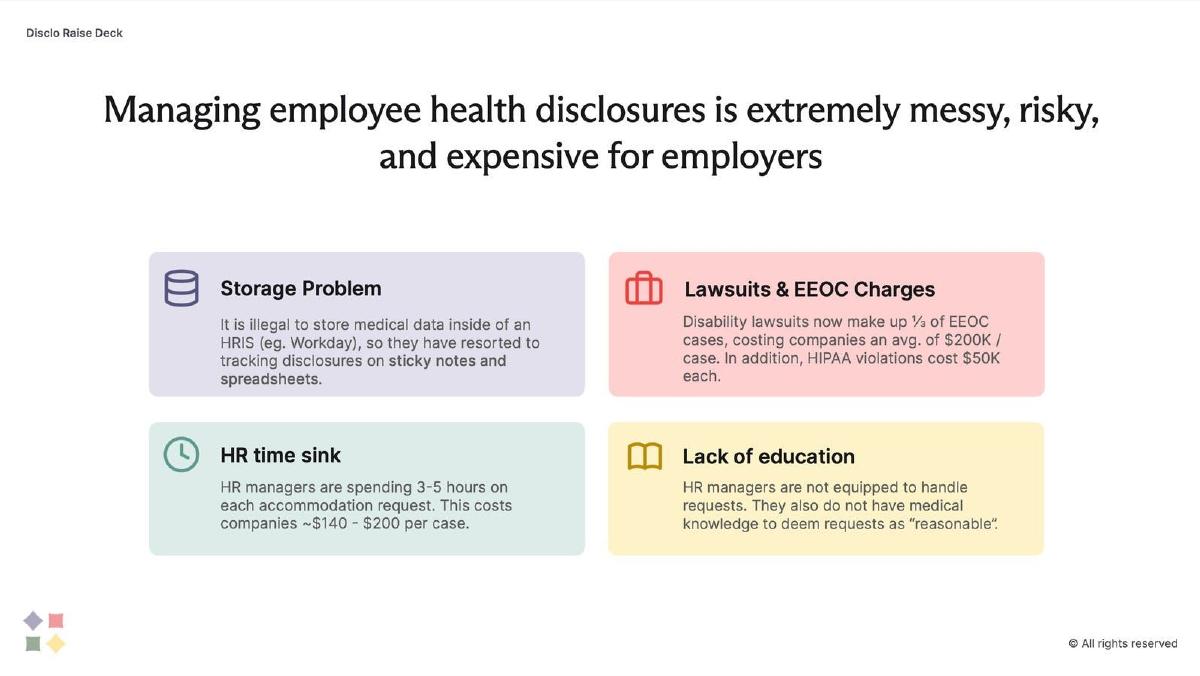
- The deck identifies a specific 'Storage Problem' on Slide 3, noting it is illegal to store medical data inside standard HRIS platforms like Workday.
- Disclo quantifies the administrative burden, stating HR managers spend 3-5 hours per accommodation request, costing companies $140-$200 per case (Slide 3).
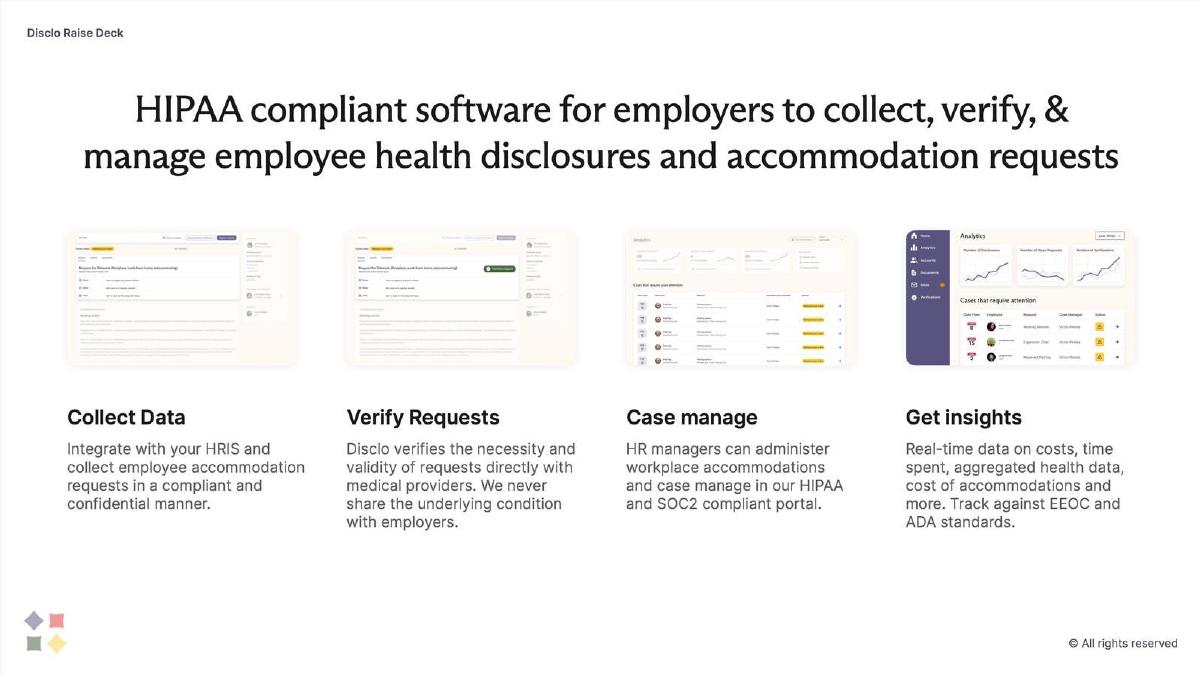
- The product slide (Slide 4) emphasizes HIPAA and SOC2 compliance, which is a critical barrier to entry in the health-data space.
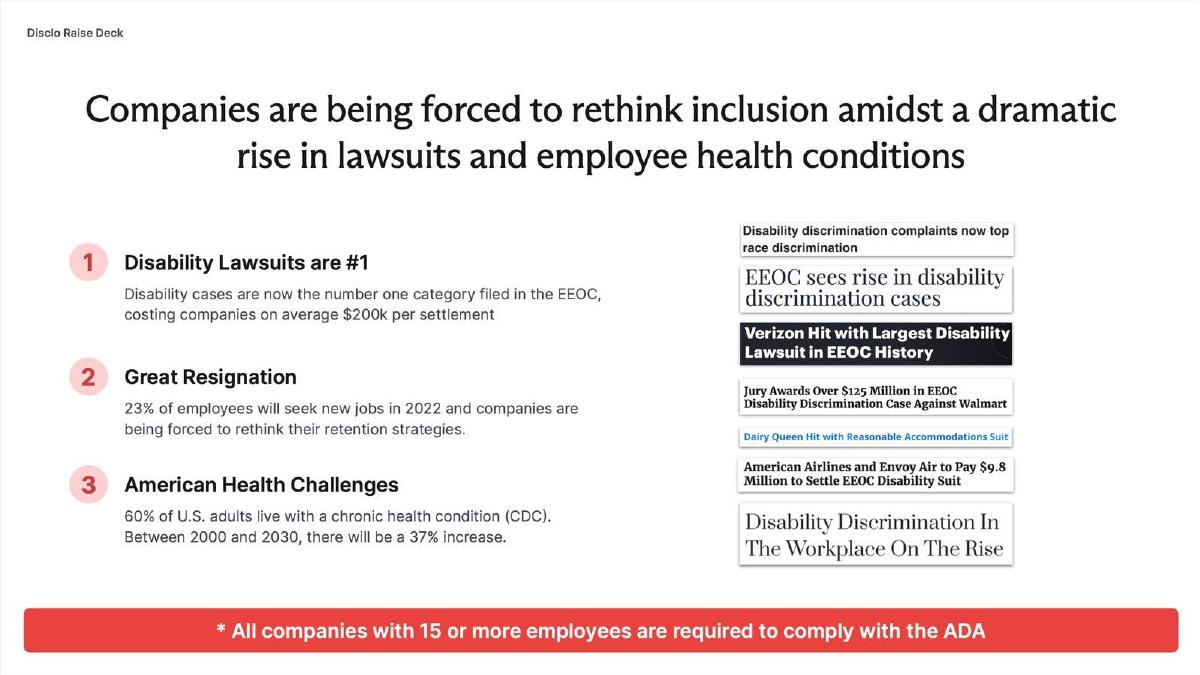
- Slide 5 uses a 'wall of headlines' to demonstrate market urgency, highlighting major settlements from companies like Verizon, Walmart, and American Airlines.
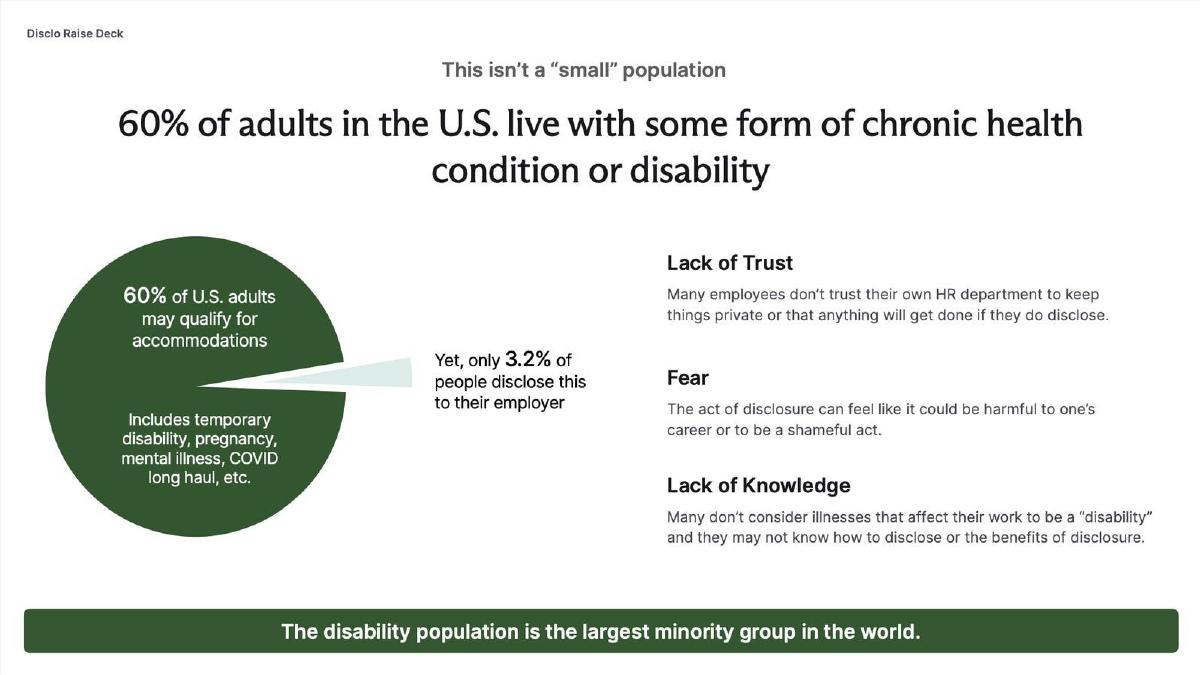
- The market size is framed through a health lens on Slide 6, noting that 60% of U.S. adults live with a chronic condition, yet only 3.2% disclose to employers.
- The roadmap on Slide 7 shows a clear expansion strategy from simple management into WOTC tax credit filing and interview accommodations.
- Founder credibility is established on Slide 8 by referencing their previous experience building 'one of the most-used disability recruiting platforms worldwide.'
- The deck lacks a specific 'Ask' slide detailing the exact dollar amount or valuation sought, though publisher reports confirm a $5M raise.
The Compliance-First Narrative: A Teardown of Disclo’s $5M Seed Deck
Disclo operates in a highly sensitive niche of the HR technology market: disability disclosure and accommodation. In a world where most HR platforms avoid medical data due to HIPAA regulations, Disclo leans into the complexity. Their 10-slide deck, used to secure a $5M Seed round in 2024, is a masterclass in identifying a 'hair-on-fire' problem and positioning a technical solution as the only safe way forward. As reported by Business Insider, the round was backed by industry heavyweights, and the deck reflects a high level of confidence in the regulatory necessity of the product.
Slide 1 & 2: The Visual Hook and Identity
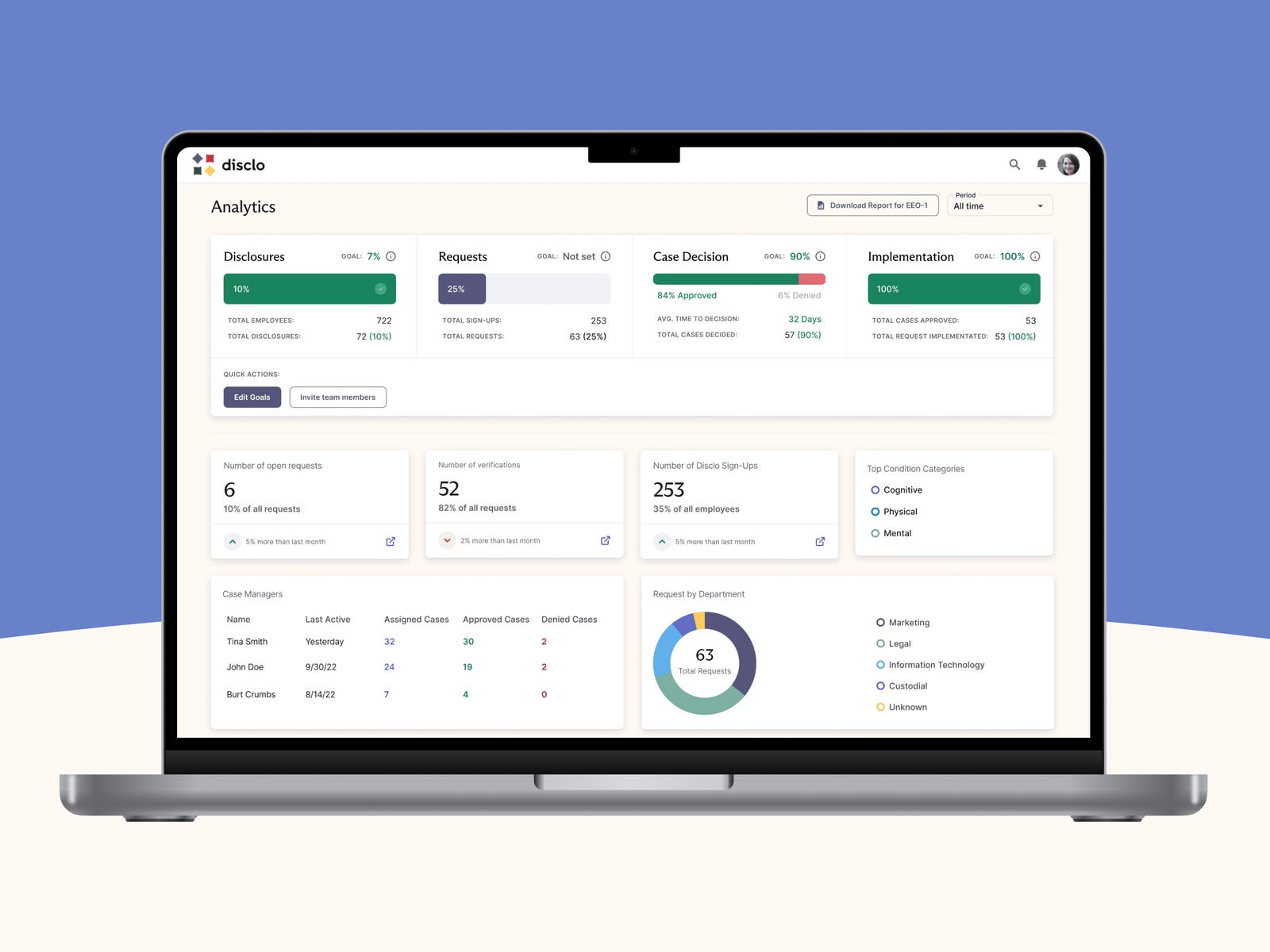
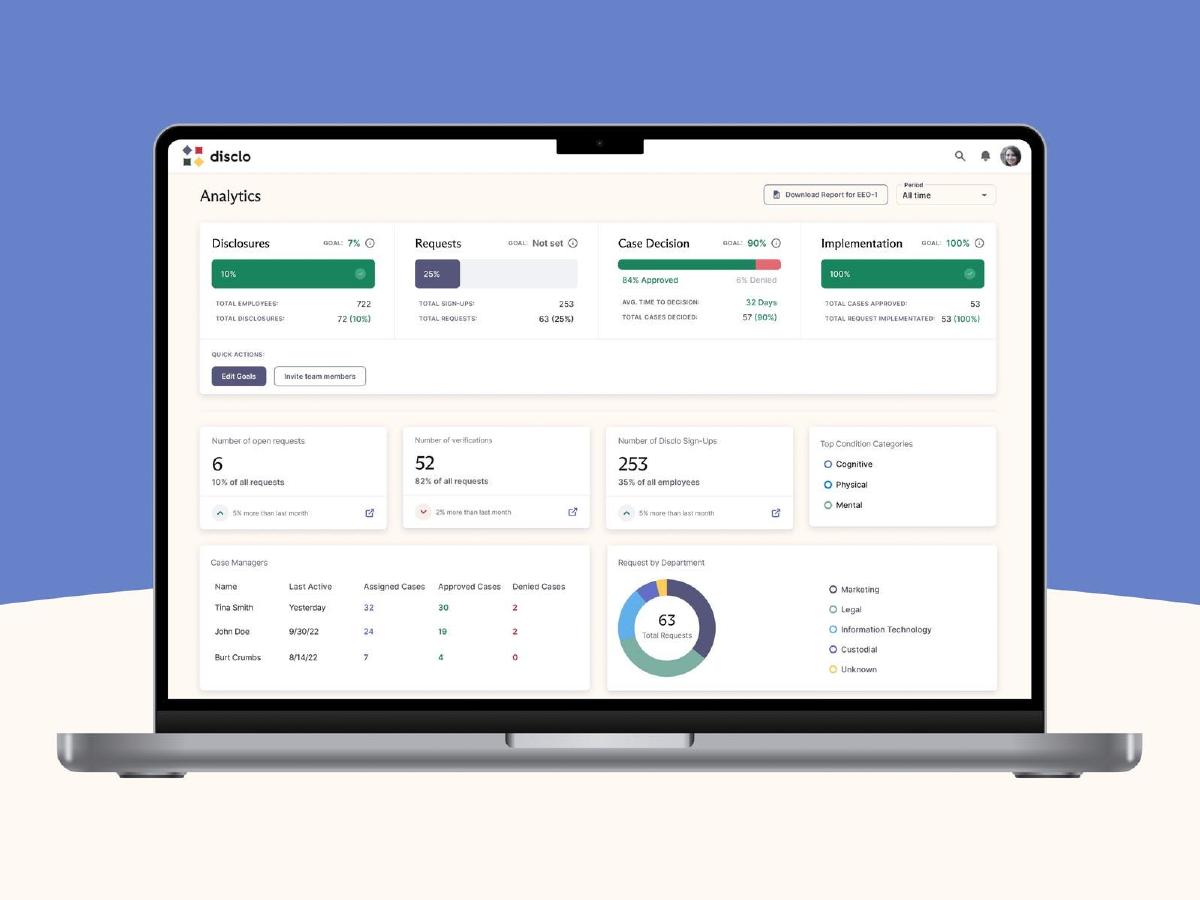
The deck opens with a high-fidelity product mockup on Slide 1. This is a strategic choice for a Seed round; it proves the product isn't just a concept but a functional interface. The 'Analytics' dashboard shown includes metrics for 'Disclosures,' 'Requests,' 'Case Decisions,' and 'Implementation.' Notably, it shows a 'Goal' of 7% for disclosures, suggesting the software helps companies track and improve their inclusivity metrics. Slide 2 is a standard title slide, establishing the brand identity with a clean, multi-colored logo and a clear sub-headline: 'Health disclosure and accommodation management software for employers.'
Slide 3: Defining the Messy Reality
Slide 3 is the most important slide in the deck for establishing urgency. It breaks the problem down into four quadrants: Storage Problem , Lawsuits & EEOC Charges , HR Time Sink , and Lack of Education . The specific mention that it is 'illegal to store medical data inside of an HRIS (eg. Workday)' is a brilliant tactical move. It immediately invalidates the 'we already have an HR tool' objection. By quantifying the cost—$200k per lawsuit settlement and $140-$200 per case in HR time—Disclo transforms their software from a cost center into a risk-mitigation and cost-saving tool.
Slide 4: The HIPAA-Compliant Solution
Having established that current methods are illegal or inefficient, Slide 4 introduces the Disclo platform. The slide highlights four key functions: Collect Data, Verify Requests, Case Manage, and Get Insights. The most critical piece of text here is under 'Verify Requests,' where Disclo states they 'verify the necessity and validity of requests directly with medical providers.' This positions Disclo as a third-party buffer, protecting the employer from seeing underlying medical conditions while ensuring the accommodation is legitimate. This 'buffer' model is a significant value add for legal departments.
Slide 5 & 6: Market Urgency and Demographic Scale
Slide 5 uses social proof through a 'wall of headlines.' By showing that giants like Verizon, Walmart, and American Airlines have been hit with massive disability lawsuits, Disclo signals to investors that no company is too large to ignore this risk. The red banner at the bottom—'All companies with 15 or more employees are required to comply with the ADA'—defines their Total Addressable Market (TAM) as essentially every mid-to-large business in the United States. Slide 6 pivots to the human element, noting that 60% of U.S. adults have chronic conditions, but only 3.2% disclose them. This 'Disclosure Gap' represents the untapped market opportunity for Disclo to build trust through their secure platform.
Slide 7: The Roadmap to a Broader Platform
Slide 7 addresses the 'is this just a feature?' question. By showing 'Where we are' vs. 'Where we're going,' the founders outline a path toward a much larger ecosystem. Future features include 'Reimbursements / Marketplace' and 'Automated WOTC Tax Credit Filing.' The inclusion of WOTC (Work Opportunity Tax Credit) is particularly savvy, as it shows how Disclo can help companies actually recoup money from the government for hiring and retaining employees with disabilities, further strengthening the ROI case.
Slide 8 & 9: Founder-Market Fit and Institutional Backing
Slide 8 introduces Hannah Olson and Kai Keane. The text notes they previously founded 'one of the most-used disability recruiting platforms worldwide.' This gives them immediate credibility; they aren't just tech founders looking for a market, but industry veterans who discovered a specific pain point through their previous venture. Slide 9 reinforces this credibility with a 'backed by industry legends' slide. Featuring logos from Bain Capital Ventures , Y Combinator , Lerer Hippeau , and Lightspeed , this slide tells a new investor that the 'smart money' has already done the due diligence on the regulatory and technical risks.
Slide 10: The Closing Call to Action
The deck concludes on Slide 10 with a simple call to action: 'Let's unlock workplace disclosure, together.' It provides a direct email address for the founders. While the deck lacks a specific 'Ask' amount (we know from publisher reports it was $5M), the closing is professional and focused on the mission of the company.
What Disclo Does Exceptionally Well
The Disclo deck is a masterclass in Problem-Solution framing . By focusing on the illegality of storing medical data in standard HRIS systems, they create a 'moat' around their product category. They aren't competing with Workday; they are the necessary companion to Workday. The use of specific dollar amounts for lawsuits ($200k) and HR time ($200/case) makes the ROI calculation easy for a prospective customer or investor. Furthermore, the deck is visually cohesive, using a consistent color palette that feels modern yet professional, which is important when dealing with sensitive HR and medical topics.
What is Missing from the Deck
Despite its success, the deck leaves several questions unanswered. There is no competition slide . While Disclo claims to be a first-mover in this specific automated verification space, there are legacy providers and manual consultants who perform these tasks. There is also no mention of pricing . Is this a per-employee-per-month (PEPM) model, or a per-case fee? For a Seed round, investors usually want to see a hypothesis on the business model. Finally, there is no traction slide . While the product mockup on Slide 1 shows data, the deck doesn't explicitly state how many customers or 'disclosures' have already been processed through the system. This suggests the round may have been raised primarily on the strength of the founders' previous exit and the clear regulatory gap they identified.
Founder's Playbook: Lessons to Copy
Identify the 'Illegal' Alternative: If you can prove that the way companies currently solve a problem is actually illegal or non-compliant (as Disclo did with medical data in HRIS), your product becomes a mandatory purchase. · Quantify the Risk: Don't just say 'lawsuits are expensive.' Quote the average settlement cost. Don't just say 'HR is busy.' Quote the hours spent per case. · Bridge the Gap: Use a roadmap slide to show how a niche tool (accommodation management) can evolve into a broad platform (tax credits, marketplaces, and recruitment). · Leverage Domain Expertise: If you have built in the space before, make that the centerpiece of your team slide. Disclo’s founders didn't list their hobbies; they listed their specific industry achievements. · Keep it Lean: 10 slides is the 'Golden Ratio' for a Seed deck. It forces you to remove the fluff and focus on the core narrative: Problem, Solution, Market, Team.
Frequently asked questions
- What is the primary value proposition of Disclo?
- Disclo provides HIPAA-compliant software that automates the collection, verification, and management of employee disability disclosure and accommodation requests. It solves the 'Storage Problem' where companies currently use illegal or insecure methods (like spreadsheets or sticky notes) to track sensitive medical data that cannot be stored in standard HRIS systems.
- How does Disclo justify the market need for its software?
- The deck uses two main levers: legal risk and demographic scale. It notes that disability lawsuits are the #1 category filed with the EEOC and cost companies an average of $200,000 per settlement. Furthermore, it highlights that 60% of U.S. adults have chronic conditions, representing a massive population that is currently underserved due to a lack of trust and knowledge.
- Who are the founders and what is their background?
- The company was founded by Hannah Olson (CEO) and Kai Keane (CPO). According to Slide 8, they previously founded and grew a major disability recruiting platform. This 'founder-market fit' is a core pillar of the deck, suggesting they have deep domain expertise in the intersection of disability and employment.
- What is missing from the Disclo pitch deck?
- The deck is notably missing a slide on unit economics, current revenue (ARR), and a competitive landscape analysis. It also lacks a specific 'Ask' slide detailing how the funds will be used. This suggests the deck was likely used as a high-level narrative tool for a round that was already gaining significant momentum from top-tier VCs.
- What is Disclo's long-term product vision?
- Beyond basic accommodation management, Slide 7 outlines a vision to include reimbursements, a marketplace, interview accommodations, and automated Work Opportunity Tax Credit (WOTC) filing. This indicates an intent to move from a pure compliance tool to a broader financial and recruitment platform for inclusive hiring.