DISCO's August 2020 deck presents a compelling case for a market leader in the $14 billion ediscovery space. The company leverages a cloud-native architecture and proprietary AI to automate document review, significantly reducing legal fees for major corporate clients. The deck highlights a 'flywheel' effect where initial ediscovery usage leads to high-margin managed review and case building. With a Net Promoter Score (NPS) that jumped from 17 in 2017 to 52 in 2019, DISCO emphasizes user satisfaction as a primary driver of adoption. The financial narrative is anchored by cohorts that grow 2x-…
Key takeaways
- DISCO identifies ediscovery as a $14bn nondiscretionary, countercyclical market on slide 2.
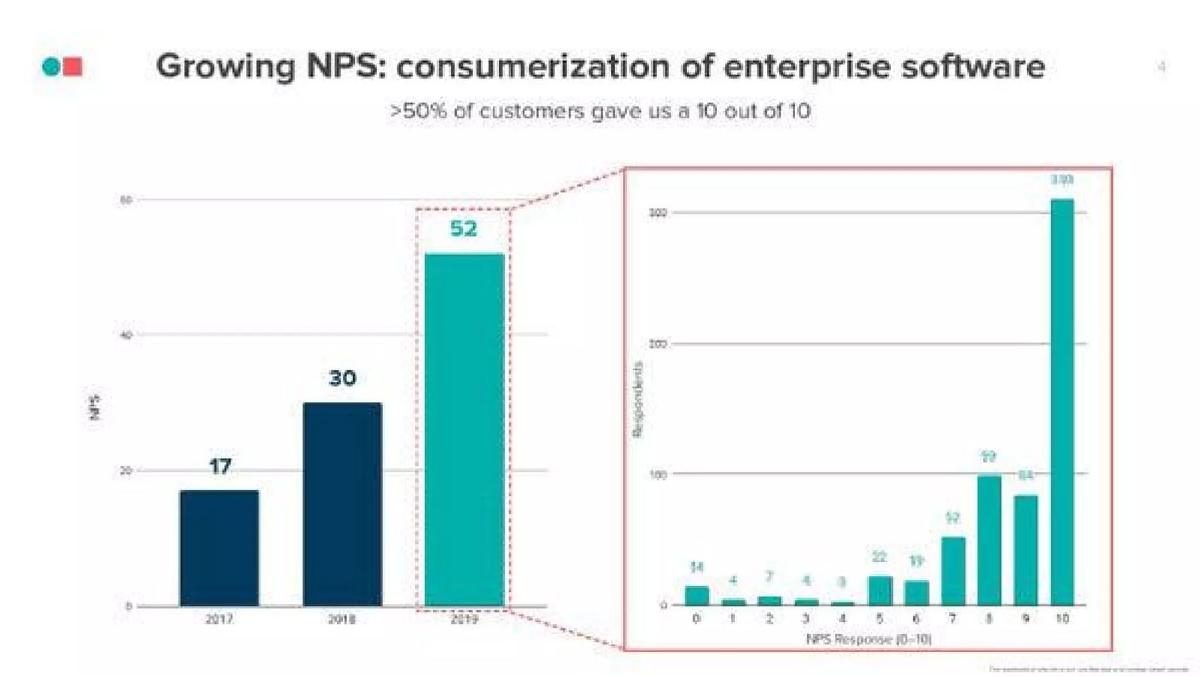
- The company achieved a Net Promoter Score of 52 in 2019, with over 50% of customers giving a 10/10 rating on slide 4.
- AI-powered review allows lawyers to find all relevant documents after reviewing only 30% of the total volume, according to slide 8.
- A case study on opioids litigation shows DISCO reduced a review population from 5.7 million documents to 484,160 using AI on slide 10.
- The deck claims a competitive moat built on a >$75mm product investment across cloud-native architecture, AI, and lawyer-focused design on slide 11.
- Managed Review is described as an eight-figure scale business growing at 500% YoY on slide 19.
- Customer cohorts demonstrate extreme expansion, typically growing 2x-3x in revenue over a 2-3 year period as stated on slide 19.
- The leadership team features deep domain expertise, with specific callouts for legal, public company, and M&A experience on slide 5.
Executive Summary and Category Creation
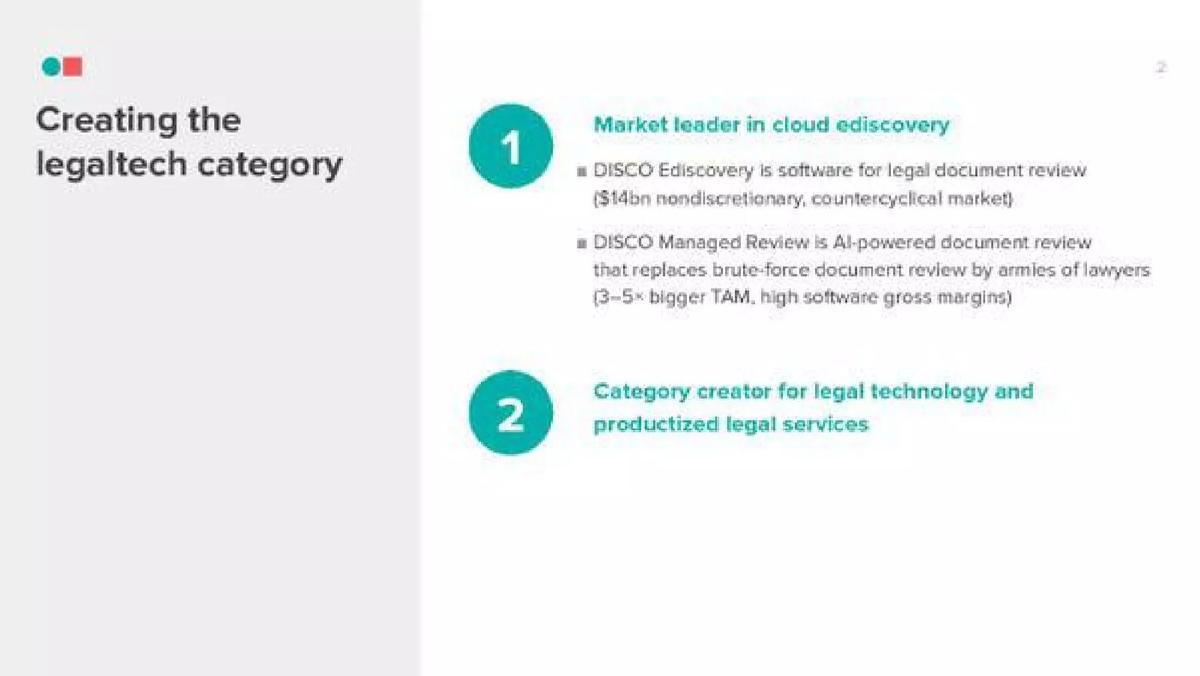
The DISCO August 2020 Company Overview deck is a strategic document designed to position the company as the definitive leader in the legaltech space. Rather than focusing on a niche tool, DISCO frames itself as a category creator. On Slide 2 , the company defines its market as a $14 billion nondiscretionary, countercyclical sector. This is a critical framing for investors, suggesting that the business is resilient regardless of the broader economic climate. The slide introduces two primary offerings: DISCO Ediscovery (software for document review) and DISCO Managed Review (AI-powered review that replaces 'armies of lawyers'). By highlighting that Managed Review addresses a TAM 3-5x larger than ediscovery alone, DISCO sets the stage for a massive expansion narrative.
Growth Metrics and Market Validation
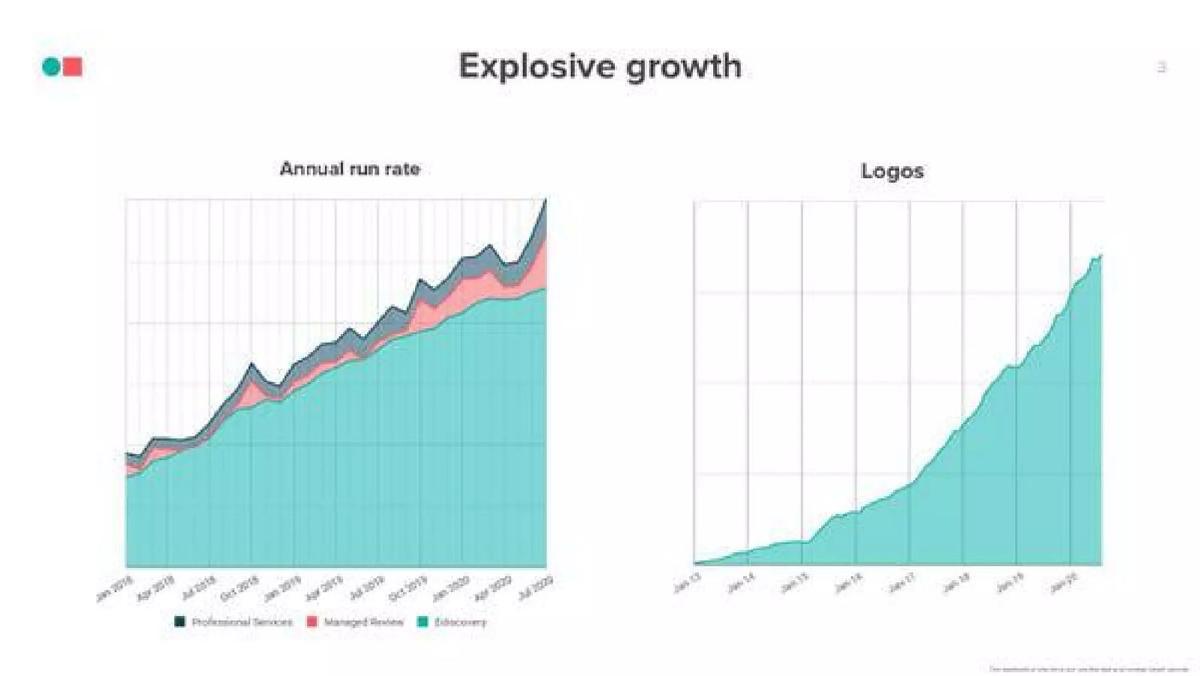
Slide 3 , titled 'Explosive growth,' provides two charts: Annual Run Rate and Logos. While specific dollar amounts are redacted or omitted from the axes, the visual trend shows a steady, steep upward trajectory from January 2018 to July 2020. The 'Logos' chart shows even more aggressive growth starting from the company's inception in 2012. This slide serves to prove that the product-market fit is not just theoretical but has been validated by a rapidly expanding customer base.
Customer satisfaction is given significant weight on Slide 4 . DISCO tracks its Net Promoter Score (NPS), showing a jump from 17 in 2017 to 52 in 2019. The slide notes that over 50% of customers gave the product a perfect 10 out of 10. In the world of enterprise legal software, which is often criticized for being clunky and difficult to use, these figures are used to argue that DISCO is successfully bringing the 'consumerization of enterprise software' to the legal field.
The Team and Domain Expertise
Slide 5 introduces the leadership team. The slide is meticulously organized to show a balance between legal domain expertise and high-growth software experience. Kiwi Camara (Founder and CEO) is positioned at the top, followed by executives like Sean Nathaniel (COO) and Michael Lafair (CFO). The use of color-coded icons (Teal for lawyers, Red for public company/M&A experience) allows an investor to quickly see that the team has the necessary 'scars' to navigate both the legal industry and a potential IPO or acquisition. The slide also emphasizes 'substantial time together at DISCO,' suggesting internal stability.
Product Deep Dive: Ediscovery and AI
The Workflow and Business Case
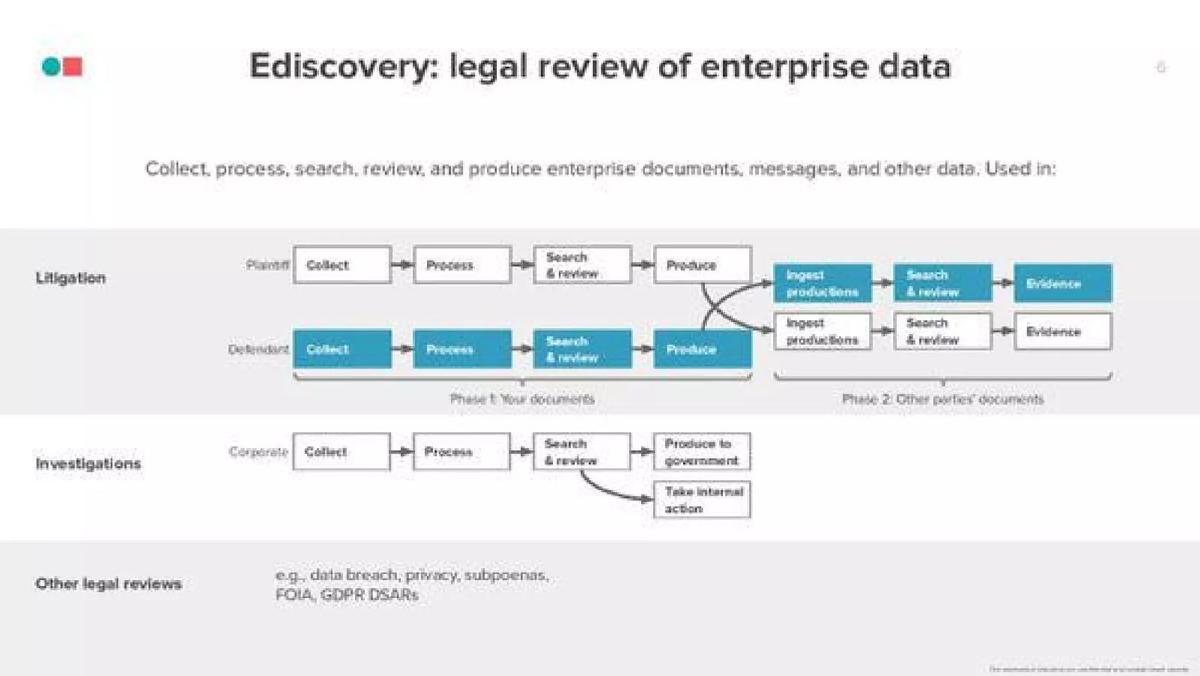
Slide 6 provides a technical but accessible overview of the ediscovery process: collect, process, search, review, and produce. It maps out how DISCO is used in litigation, investigations, and other legal reviews like GDPR DSARs. This slide is essential for non-legal investors to understand exactly where DISCO sits in the legal lifecycle.
The economic argument for the platform is made on Slide 7 . DISCO claims to save clients 30-50% on legal fees. Three case studies are presented: a major U.S. airline (antitrust litigation), an international construction company (Chinese criminal investigation), and a global fast-food restaurant (securing corporate data). The construction company case study is particularly punchy, noting that DISCO resolved a case in 2 months that would have taken competitors 4+ months.
The AI Advantage
Slides 8 and 9 delve into the 'secret sauce' of the technology. Slide 8 compares 'Linear review' to 'AI-powered review.' In a linear review, relevant documents are scattered throughout a dataset. DISCO’s AI scores documents from -100 to 100, pushing the 'good' documents to the top. The result is that 80% of the documents a lawyer looks at are relevant, compared to 10% in traditional methods. This allows for an 'earlier stop,' where 100% of relevant documents are found after reviewing only 30% of the total set.
Slide 9 introduces 'Cross-Matter AI,' which allows customers to take learnings from one legal matter and apply them to others. This creates a data moat; the more a client uses DISCO, the smarter the system becomes for their specific legal needs. This slide also hints at future feature sets like 'real-time litigation prevention' by integrating AI into email applications.
Quantifying Impact: The Opioids Case Study
Slide 10 is perhaps the most powerful slide in the deck. It uses a funnel graphic to show the impact of DISCO on a massive opioids litigation case. Starting with 20 million documents produced by opposing counsel, DISCO's Ediscovery tools culled the set to 5.7 million. Then, AI and analytics identified a review population of 484,160. Finally, Managed Review completed the task by reviewing only 159,880 documents (0.8% of the original set). The financial comparison is stark: a competitor would have charged $5.7 million ($1 per doc for 5.7m docs), while DISCO charged $484,160 ($1 per doc for 484k docs), while maintaining high software margins.
Strategic Positioning and The Flywheel
The Competitive Moat
On Slide 11 , DISCO quantifies its product investment at over $75 million. It identifies three key differentiators: Cloud-native architecture at PB+ (petabyte) scale, lawyer-focused design, and AI/analytics. The slide argues that these are 'three independent axes of differentiation' and that it is 'very difficult for a competitor to catch up on all three.' This is a classic 'moat' slide intended to discourage investors from worrying about legacy incumbents or new entrants.
Slide 12 provides a 'Legaltech market map,' showing how DISCO’s products (Ediscovery, Managed Review, Case Builder) overlay across various legal functions like litigation, transactions, and compliance. This visualizes the company's path from a single-point solution to a comprehensive legal platform.
The Growth Flywheel and Retention
Slide 13 illustrates the 'DISCO growth flywheel.' It shows a virtuous cycle where high satisfaction in Ediscovery leads to usage of Managed Review, which leads to expansion into Case Builder. This is backed up by Slides 14 and 15 , which show 'Land and expand' bar charts for eight different customers, including AmLaw 200 firms and leading pharma companies. Every chart shows a clear 'step-up' in Annual Recurring Revenue (ARR) over time, proving that once DISCO gets into an organization, it grows its footprint significantly.
Culture, Values, and Final Takeaways
Internal Foundations
The final section of the deck focuses on the 'how' and 'who' of the company. Slide 16 lists the company values under the acronym MAGIC: Meaningful impact, All-in, Grit & grace, Innovation, and Craft. Slide 17 highlights 'DISCO Cares,' the company's philanthropic arm, noting that they provided 23,972 meals to the Central Texas Food Bank. Slide 18 details the company's commitment to Diversity, Equity, and Inclusion (DEI), showing photos of a DEI focus group and mentioning partnerships with organizations like Code2College. While these slides don't contain financial metrics, they are designed to show that DISCO is a mature, responsible corporate citizen capable of attracting and retaining top talent.
The Closing Argument
Slide 19 summarizes the 'Takeaways.' It reiterates that DISCO is a market leader in a countercyclical industry with a 'working go-to-market machine.' Key stats mentioned here include the Managed Review business being at 'eight figure scale' and growing '500% YoY.' It also mentions 'high sales rep productivity' and 'compelling LTV:CAC,' though specific ratios are not provided on the slide. The deck concludes on Slide 20 with a simple 'Thank You' and the company website.
What Works, What is Missing, and What to Copy
What Works
The Funnel Case Study (Slide 10): This is the strongest slide in the deck. It takes a complex technical process and turns it into a clear, mathematical 'Us vs. Them' comparison that any investor can understand. · The Flywheel Visualization (Slide 13): It clearly explains the multi-product strategy and how one sale naturally leads to the next, justifying the 'platform' valuation rather than a 'tool' valuation. · NPS Data (Slide 4): Highlighting a jump from 17 to 52 NPS is a powerful way to demonstrate that the company has solved a major pain point (bad UX) in a legacy industry.
What is Missing
Specific Financials: While the trends are clear, the deck omits specific ARR figures, gross margins, and LTV:CAC ratios. These were likely shared in a separate data room, but their absence in the main deck makes the 'explosive growth' claim harder to verify independently. · Competitor Names: Slide 11 mentions that 'competitors must rewrite software,' but it never names who those competitors are (e.g., Relativity, Everlaw). Naming them could have helped frame the 'legacy vs. modern' battle more sharply. · The 'Ask': There is no slide detailing how much capital is being raised or how it will be used. This suggests the deck may have been used for a general company update or a late-stage round where the terms were already being discussed.
What a Founder Should Copy
The 'Three Axes' Framework (Slide 11): Defining your competitive advantage across three distinct, hard-to-replicate pillars is a great way to communicate a moat. · Cohort Expansion Charts (Slides 14-15): Showing multiple real-world examples of 'land and expand' is much more convincing than a single aggregate chart. It proves the strategy works across different customer types. · Domain + Scale Team Slide (Slide 5): The use of icons to show specific types of experience (Legal, Public Co, M&A) is a very efficient way to communicate team strength without using walls of text.
Frequently asked questions
- What is DISCO's core value proposition for legal teams?
- DISCO's value proposition centers on efficiency and cost reduction. According to slide 7, the platform helps clients save 30-50% on legal fees for document review. By using AI to score and sort documents, lawyers can find evidence faster and resolve cases months earlier than with traditional manual methods. The deck emphasizes that ediscovery costs are often 3-5x less than the cost of the subsequent document review, making DISCO's automation highly impactful.
- How does DISCO's AI technology actually work in practice?
- Slide 8 explains that lawyers tag documents by legal issue, and DISCO's AI models score these documents on a scale of -100 to 100. The system learns continuously, pushing 'good' documents to the top of the pile. This results in a 'richer review' where 80% of the documents a lawyer views are relevant, compared to just 10% in a linear review. This allows teams to stop reviewing after seeing only 30% of the total document set.
- What does the 'land and expand' strategy look like for DISCO?
- The strategy is visualized as a flywheel on slide 13 and supported by data on slide 19. DISCO typically enters an account through its core Ediscovery software. High user satisfaction leads to the adoption of Managed Review (AI-powered services) and eventually Case Builder. This results in cohorts growing 2x-3x in revenue over 2-3 years, with some clients showing 7+ years of continuous revenue growth.
- Who are the key members of the DISCO leadership team?
- The team is led by Founder and CEO Kiwi Camara. Slide 5 highlights a mix of legal and software scaling expertise, including COO Sean Nathaniel, CFO Michael Lafair, and CRO Andrew Shimek. The slide uses icons to denote specific strengths: teal for lawyers, red for public company/M&A experience, and blue for deep industry experience. Many team members are noted for having 'substantial time together at DISCO.'
- What market segments does DISCO target?
- DISCO positions itself as a horizontal software provider for the legal function. Slide 19 notes they have customers across all verticals. Specific case studies in the deck include a major U.S. airline, an international construction company, a global fast-food restaurant, AmLaw 200 law firms, a leading pharma company, and a global consultancy (slides 7, 14, and 15).