The 1776 Discovery Fund pitch deck presents a structured approach to venture capital by integrating an accelerator, a physical campus, and a $25 million investment vehicle. The fund targets startups in regulated industries—Education, Health, and Energy—which it claims represent over 50% of GDP. Positioned as a 'graduate' accelerator, it seeks 'Seed C stage' companies that have product-market fit but have not yet reached a Series A. The deck highlights a heavy-hitting advisory board including Brad Feld and David Cohen, and a clear financial structure: a seven-year fund life, 2% management fee,…
Key takeaways
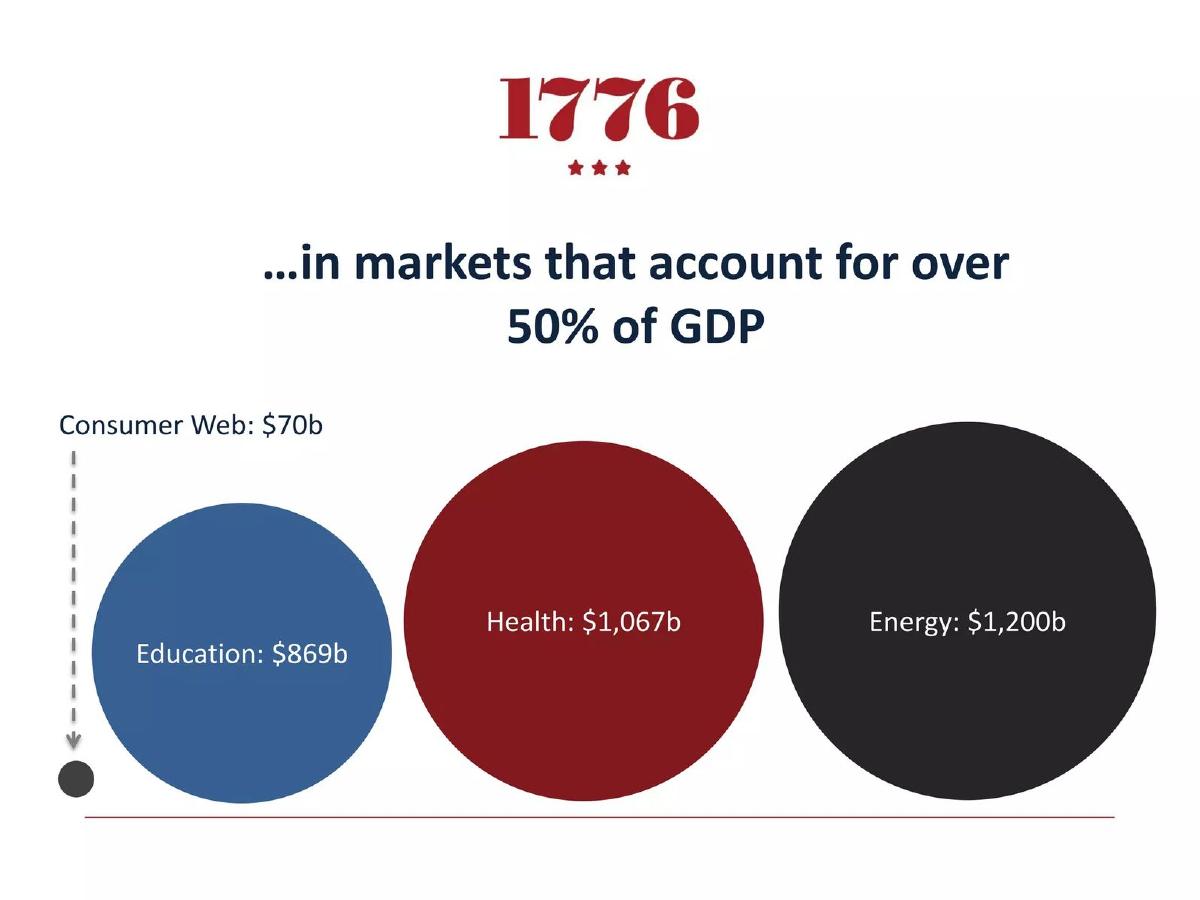
- The fund targets industries representing over 50% of GDP, specifically Education ($869b), Health ($1,067b), and Energy ($1,200b) (Slide 2).
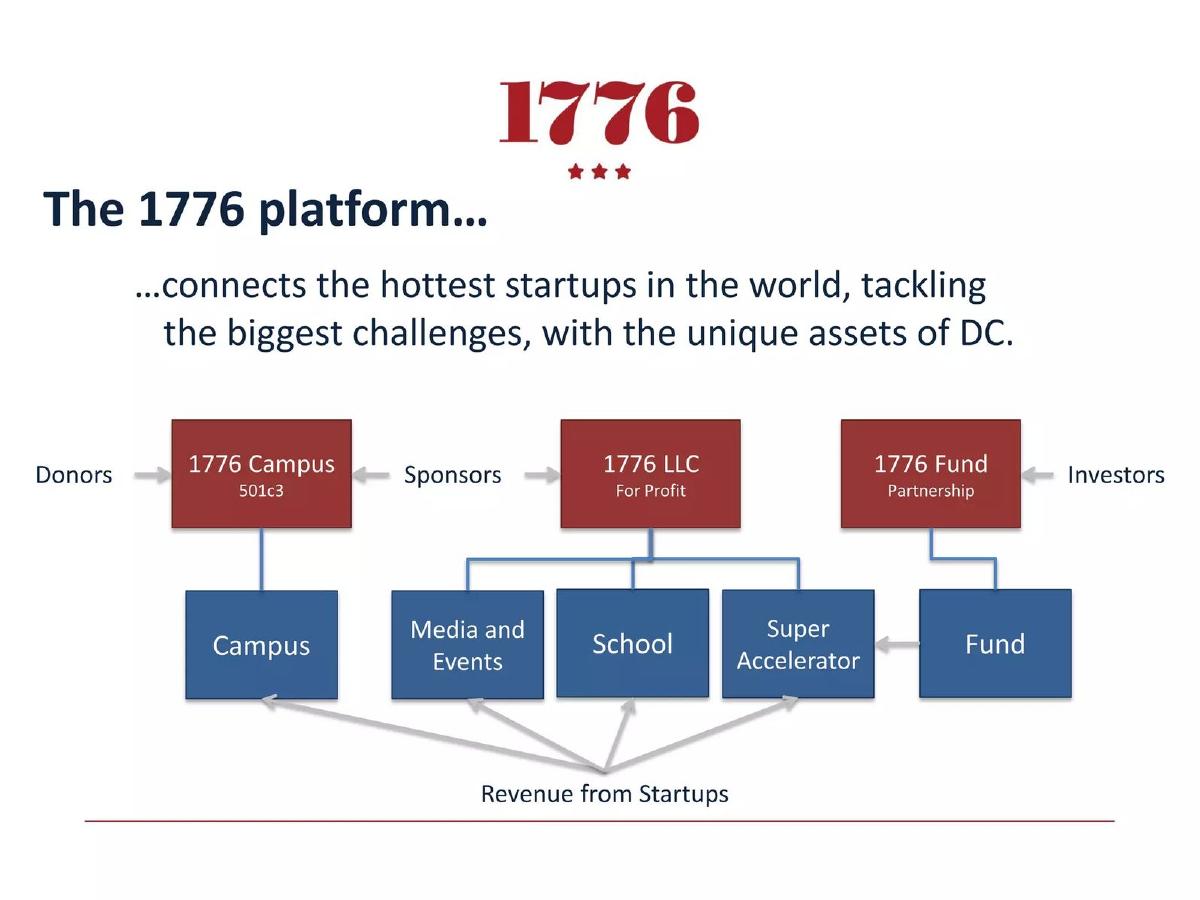
- The 1776 platform is a complex hybrid of a 501c3 Campus, a for-profit LLC, and a Partnership Fund (Slide 3).
- Investment focus is on 'Seed C stage' companies that have raised seed capital but not yet a 'Venture A round' (Slide 5).
- The 'Super Accelerator' is a 90-day program based in Washington D.C. for 10 to 12 startups per class (Slide 6).
- Deal flow is driven by partnerships with TechStars, 500 Startups, and the Global Accelerator Network (Slide 7).
- The fund seeks capital-efficient businesses that are operational with less than $1 million in funding (Slide 8).
- The Discovery Fund is sized at $25 million with a 7-year life and a 2-year investment period (Slide 10).
- Financial terms include a 2% management fee and 20% carry with a ratchet for returns above 3x (Slide 10).
Executive Summary: The Regulated Industry Thesis
The 1776 Discovery Fund pitch deck is a thesis-driven document that argues for a shift in venture capital focus. While much of the VC world in the early 2010s was obsessed with 'Consumer Web' (valued at $70b on slide 2), 1776 points toward the massive, regulated sectors of the economy. By positioning itself in Washington D.C., the fund claims a geographic and strategic advantage in helping startups navigate the regulatory hurdles of the 'public sector consumerization.'
Slide 1: Title and Branding
The cover slide establishes the brand identity: '1776: Where Revolutions Begin.' It clearly labels the document as a 'Super Accelerator and Discovery Fund Investor Pitch.' The branding is patriotic and institutional, signaling a focus on the intersection of private innovation and public policy.
Slide 2: The Macro Opportunity
This slide presents the core 'Why Now' of the fund. It contrasts the $70b Consumer Web market with three massive pillars: Education ($869b), Health ($1,067b), and Energy ($1,200b). The headline claim is that these markets account for over 50% of GDP. This is a classic TAM (Total Addressable Market) slide designed to make the tech-heavy consumer web look small by comparison.
Slide 3: The 1776 Platform Architecture
Slide 3 is a structural diagram showing how the different entities interact. It is a complex ecosystem:
1776 Campus (501c3): Funded by donors, providing the physical space. · 1776 LLC (For Profit): Funded by sponsors, managing Media, Events, School, and the Super Accelerator. · 1776 Fund (Partnership): Funded by investors, providing the capital for the Fund and Super Accelerator.
The diagram shows 'Revenue from Startups' flowing back into the Campus, Media, and School components, suggesting a circular economy within the platform.
Slide 4: The Advisory Board
In the absence of a detailed management team slide in this selection, slide 4 leans heavily on social proof. It features high-profile names in the venture and accelerator world, including Brad Feld (Foundry Group), David Cohen (TechStars), Scott Case (Startup America), and Paul Singh (500 Startups). This slide is intended to signal that while 1776 might be a new fund, it is deeply integrated into the existing elite startup ecosystem.
Slide 5: Defining the 'Super Accelerator'
This slide clarifies the fund's stage focus. It introduces the term 'Seed C stage,' which it defines as companies that have raised seed capital but haven't hit Series A. The focus is on 'graduate' companies with product-market fit. Crucially, it defines the target product type: 'consumer-style products in complex, highly regulated industries.'
Slide 6: Program Logistics
Slide 6 details the operational side of the accelerator. It is a 90-day program for 10 to 12 startups per class. A key requirement is that 'key elements of the team' must be based in D.C. during the program. It also mentions virtual alumni engagement and events in major cities to maintain the network effect.
Slide 7: Deal Flow Strategy
To solve the problem of sourcing high-quality 'Seed C' companies, 1776 relies on partnerships. Slide 7 lists direct partnerships with 500 Startups , TechStars , and the Global Accelerator Network . It also leverages the personal networks of Startup America regional leaders and internal 1776 programs. This suggests a 'top-of-funnel' strategy where other accelerators act as feeders for 1776.
Slide 8: The Investment Checklist
This slide provides a 'rules of thumb checklist' for their investment committee. It is a highly specific list of requirements:
Data-driven iterations. · Solving problems in regulated industries. · Capital efficiency (operational at Slide 9 explains the fund's competitive advantage: 'Inside information.' By building relationships with corporate partners and venture funds who act as both sponsors and LPs, 1776 claims to understand exactly what these entities want to acquire or fund. The goal is to use this knowledge to increase the odds of 'early acquisitions' (small wins) and 'major funding rounds' (big wins).
Slide 10: Fund Terms
The final slide in this set provides the hard numbers for the 1776 Discovery Fund:
Fund Size: $25 million. · Life: 7 years (plus 2-year extension option). · Investment Period: 2 years. · Management Fee: 2%. · Carry: 20% with a ratchet for returns above 3x.
What Works in This Deck
The deck excels at thesis clarity . It doesn't just say 'we invest in startups'; it identifies a specific market gap (regulated industries) and a specific stage gap (Seed C). The use of a 'checklist' on slide 8 is an excellent tool for LPs to understand exactly how the fund managers think and what kind of discipline they apply to their process. Furthermore, the social proof on the advisory slide is exceptionally strong, featuring the founders of the two most successful accelerator programs in the world (TechStars and 500 Startups).
What Is Missing
The most glaring omission in these 10 slides is the General Partnership (GP) team . While advisors are great, LPs invest in the people doing the day-to-day work. There is no slide detailing the track record, biographies, or full-time commitment of the fund's actual managers. Additionally, there is no pipeline slide . For a fund that relies on 'Seed C' companies, showing 3-5 examples of companies currently in the 1776 ecosystem that fit the criteria would have made the thesis feel more tangible. Finally, the financial model for the 'ratchet' mentioned on slide 10 is not explained; LPs usually want to know exactly how the carry structure changes once the 3x hurdle is cleared.
Founder and Fund Manager Takeaways
1. Define your 'Stage' specifically: 1776 didn't just say 'Seed.' They invented the term 'Seed C' to describe a very specific moment in a company's lifecycle. This helps investors place them in a portfolio. If you are a founder or a fund, don't use generic terms if you can be more precise about your entry point.
2. Use a Checklist: Slide 8 is the strongest slide in the deck. It moves the conversation from 'trust our gut' to 'trust our process.' For a fund manager, this demonstrates institutional-grade discipline. For a startup founder, having a similar 'ideal customer profile' checklist can demonstrate the same level of rigor.
3. Leverage Geography: 1776 leans into Washington D.C. as a feature, not a bug. They turn a city often viewed as 'slow' or 'bureaucratic' into a strategic asset for tackling regulated industries. Always frame your location or specific constraints as a competitive advantage.
4. The Power of the Hybrid Model: The structure on slide 3 is complex, but it shows how a fund can lower its 'cost of customer acquisition' (in this case, deal flow) by having a non-profit campus and a for-profit media arm. It suggests a diversified business model that isn't solely dependent on the 2% management fee to keep the lights on.
Frequently asked questions
- What is a 'Super Accelerator' as defined by 1776?
- According to slide 5, a Super Accelerator is a 'graduate' program. It does not target raw startups but rather companies that have already demonstrated product-market fit and capital readiness. These are 'Seed C stage' companies that have raised initial seed money from credible sources but have not yet secured a Series A venture round.
- How does the 1776 organizational structure work?
- Slide 3 illustrates a three-pillar structure. The 1776 Campus is a 501c3 non-profit supported by donors. The 1776 LLC is a for-profit entity managing media, events, a school, and the accelerator. Finally, the 1776 Fund is a partnership supported by investors that feeds capital into the Super Accelerator startups.
- Which specific industries does the fund target?
- The deck focuses on 'complex, highly regulated industries.' Slide 2 and slide 5 specifically name Education ($869b market), Health ($1,067b market), Energy ($1,200b market), transportation, and government. The thesis is that these sectors account for over 50% of GDP but are underserved by traditional consumer web investors.
- What are the specific investment criteria for the Discovery Fund?
- Slide 8 lists a 'rules of thumb checklist.' Criteria include evidence of data-driven iterations, solving problems for specific customers in regulated industries, capital efficiency (operational on <$1M), internet-based distribution, simple revenue models (subscriptions/transactions), and a cross-functional team including engineering and UX.
- What are the fund's financial terms for LPs?
- Slide 10 outlines the terms for the $25 million Discovery Fund. It has a seven-year life with a two-year extension option and a two-year investment period. The management fee is set at 2%, and the carry is 20%, notably featuring a 'ratchet' for portfolio returns that exceed 3x.