The 1953 Disneyland pitch deck is a masterclass in narrative-driven fundraising, created at a time when 'theme parks' did not exist as a recognized asset class. Rather than relying on spreadsheets or market size data—which are entirely absent from these slides—Walt Disney and WED Enterprises focused on a vivid, sensory description of the guest experience. The deck functions as a guided tour, moving from the 'Main Street' entrance through thematic lands like 'Frontier Country' and 'The World of Tomorrow.' By the time the investor reaches the technical site plan on slide 11, the emotional buy-i…
Key takeaways
- The deck contains zero financial projections, revenue models, or unit economics, relying entirely on the strength of the creative vision.
- Slide 1 establishes a powerful temporal hook: 'Where you leave TODAY... and visit the World of YESTERDAY and TOMORROW.'
- The narrative structure follows the physical journey of a visitor, starting at the Railroad Station on slide 4 and ending with seasonal events on slide 9.
- Walt Disney uses cross-media synergy as a selling point, mentioning the 'WALT DISNEY TELEVISION SHOW' on slide 4 and the 'MICKEY MOUSE CLUB TELEVISION SHOW' on slide 9.
- The 'World of Tomorrow' section on slide 5 specifically targets corporate partnerships, listing industries like Rubber, Steel, and Chemical as potential participants.
- Slide 11 provides the only technical data in the deck, specifying an 'APPROX. AREA 47 ACRES WITHIN R.R. TRACKS.'
- The deck uses evocative, sensory language to describe food, such as 'fresh pineapple sticks' and 'crisp cocoanut meats' on slide 5.
- There is no 'Team' slide; the brand equity of 'Walt Disney' and 'WED Enterprises' (slide 1) serves as the primary credibility marker.
The 1953 Disneyland Prospectus: A Narrative Masterclass
The Disneyland pitch deck, prepared by WED Enterprises in 1953, is a historical anomaly in the world of venture capital. While modern decks are judged on their CAC/LTV ratios and MoM growth, Walt Disney’s pitch for a $17 million investment was built entirely on prose and a single, detailed map. This was a 'Seed' round in the truest sense—raising capital for a concept that had no direct competitors and no existing market data. The deck is less of a business presentation and more of a script for a dream.
Slide 1: The Hook and The Brand
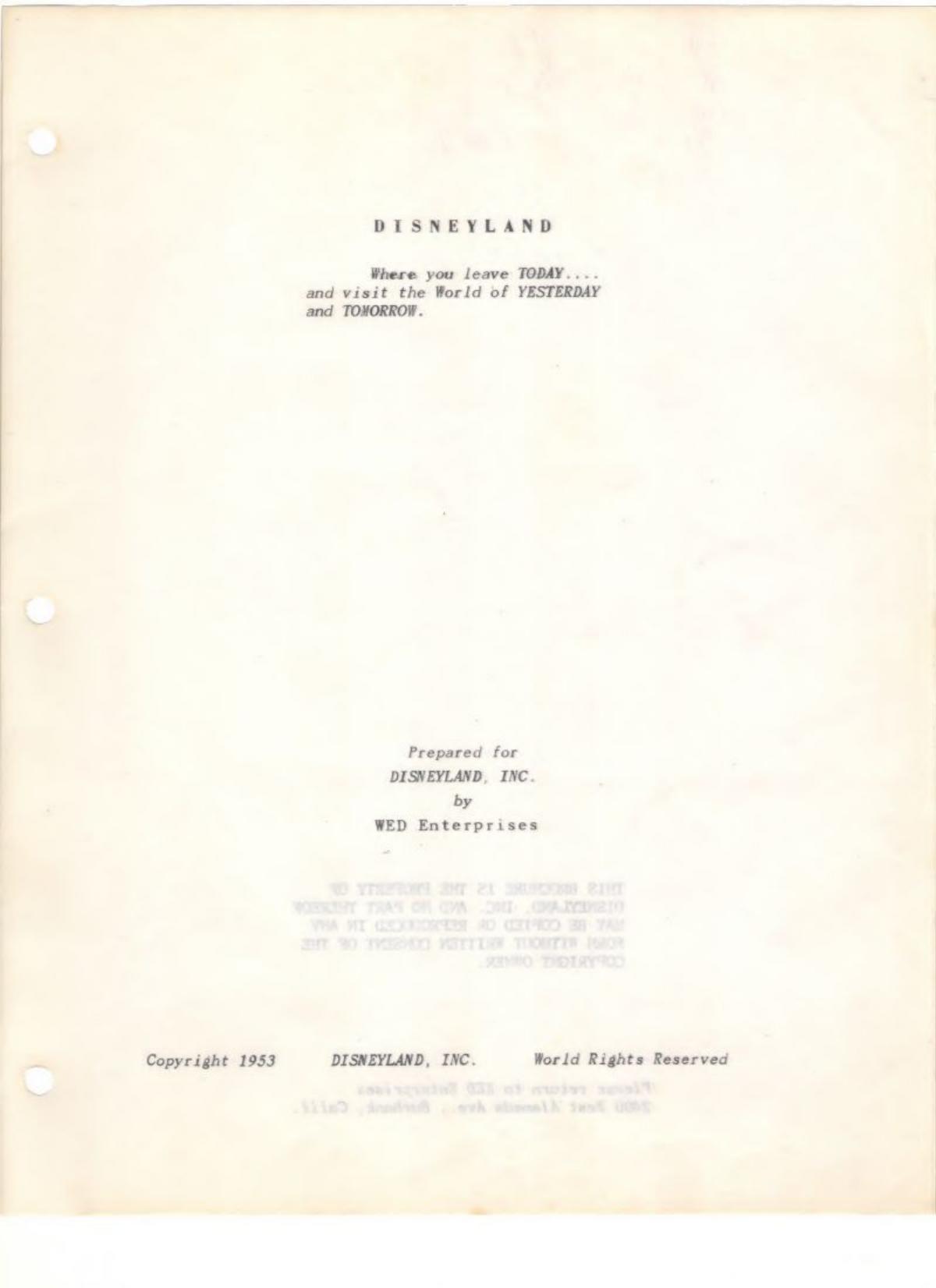
The cover slide is minimalist. It features the title DISNEYLAND followed by the tagline: 'Where you leave TODAY.... and visit the World of YESTERDAY and TOMORROW.' This immediately establishes the core value proposition: escapism through time. The slide also notes it was 'Prepared for DISNEYLAND, INC. by WED Enterprises.' By separating the park entity from the design firm, Disney signaled a professional structure for a project that many at the time considered a 'folly.'
Slide 2: Legal and Confidentiality
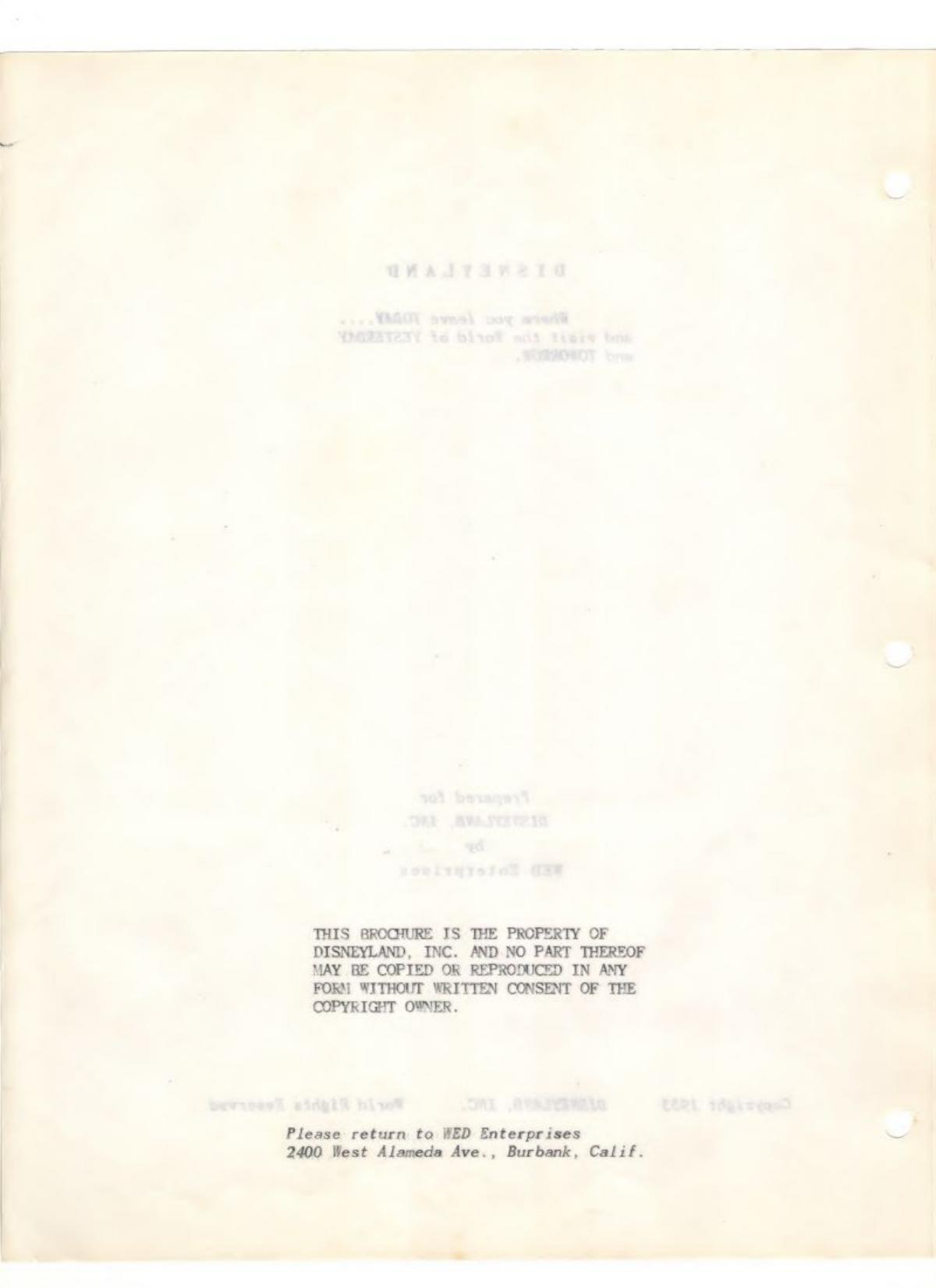
Slide 2 is a standard property notice, stating that the brochure is the property of Disneyland, Inc. and cannot be copied without written consent. It includes the return address: 2400 West Alameda Ave., Burbank, Calif. This grounded the fantastical pitch in a physical, corporate reality.
Slide 3: The Vision Statement
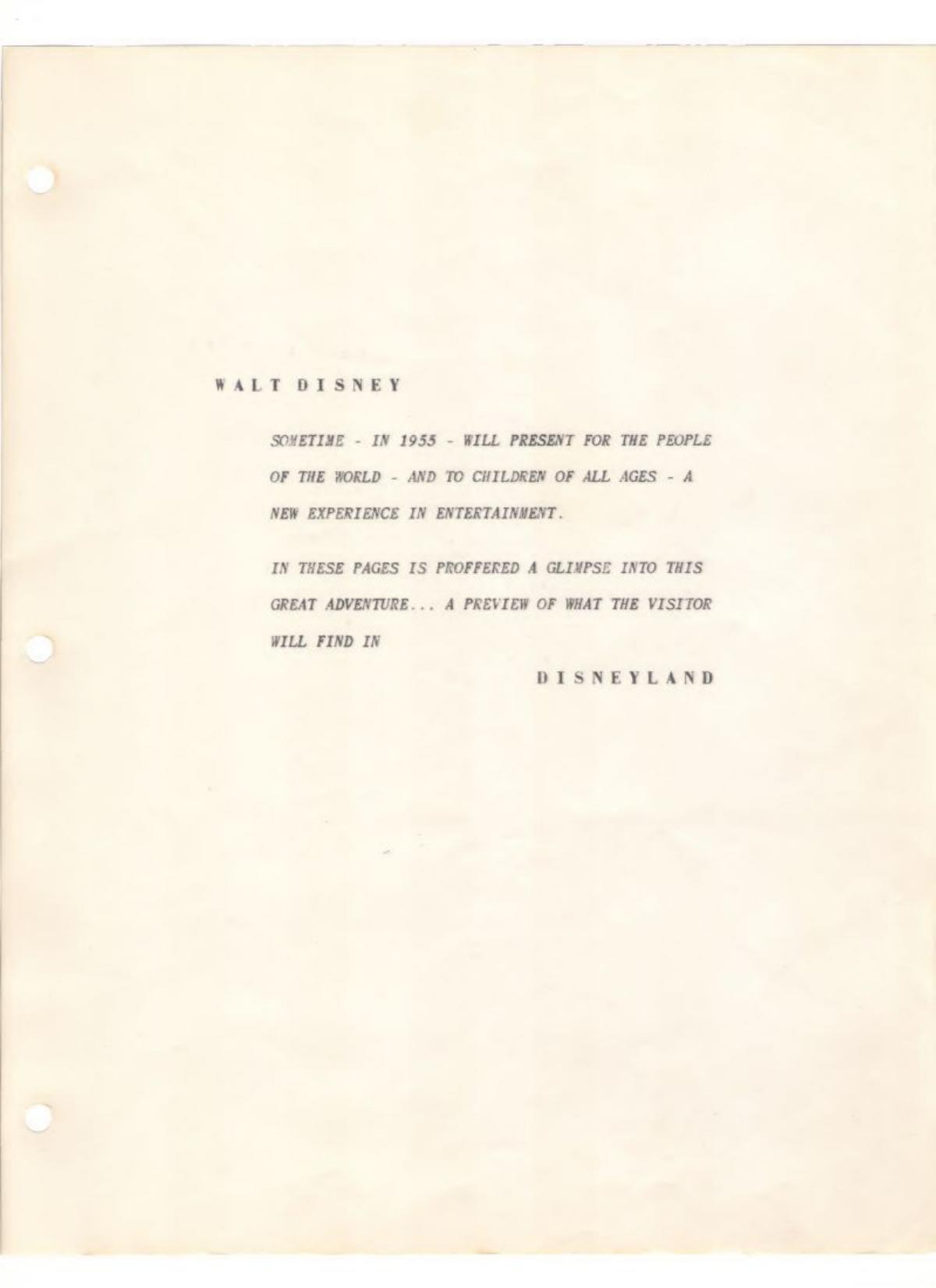
Walt Disney’s name appears at the top of Slide 3. The text promises that 'SOMETIME - IN 1955 - WILL PRESENT FOR THE PEOPLE OF THE WORLD - AND TO CHILDREN OF ALL AGES - A NEW EXPERIENCE IN ENTERTAINMENT.' This slide serves as the executive summary. It defines the target audience ('people of the world') and the timeline (1955). It uses the word 'proffered' to describe the glimpse into the 'great adventure' that follows.
Slide 4: The Entrance and Main Street
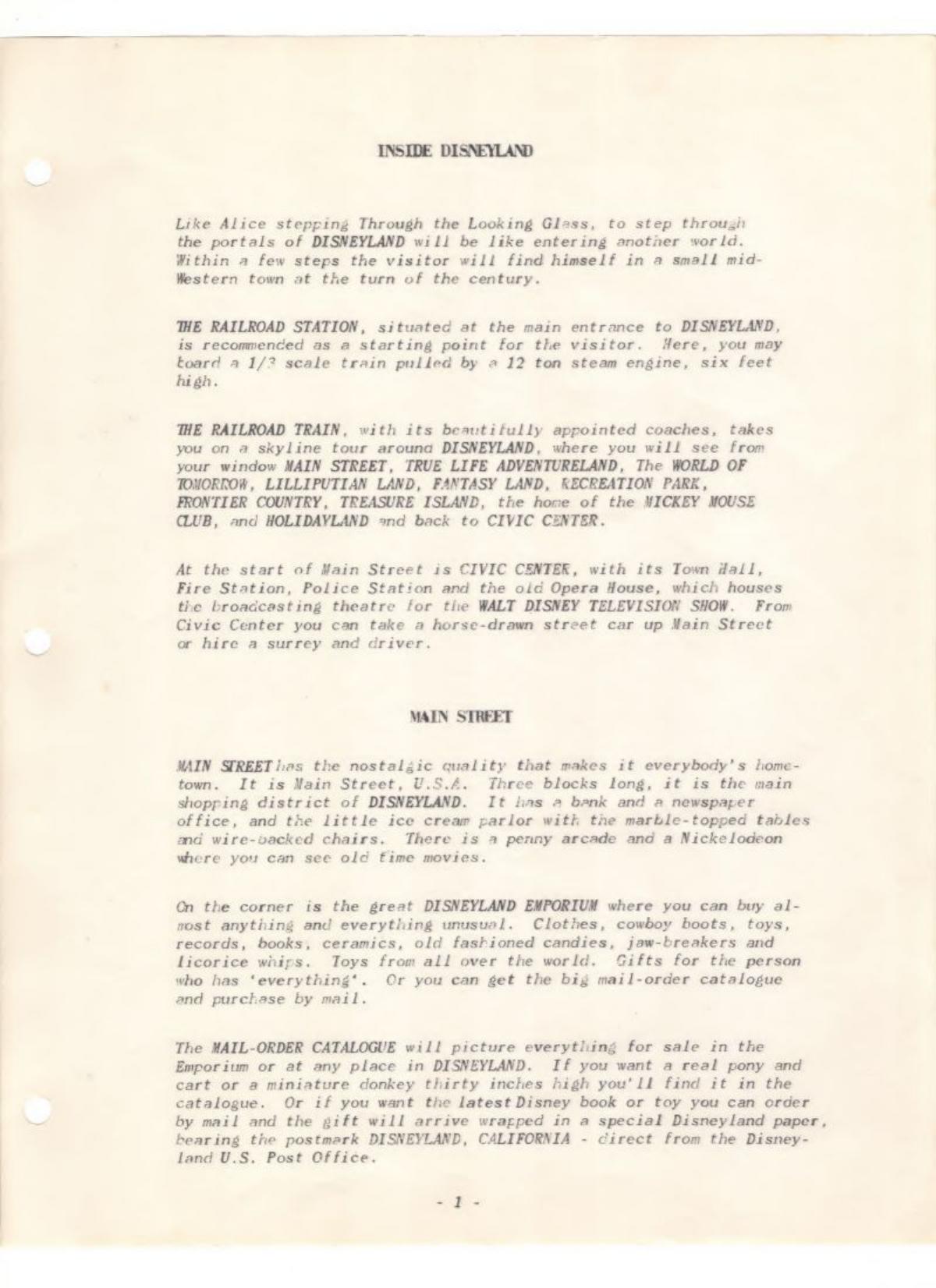
Slide 4 begins the physical walkthrough. It compares the experience to 'Alice stepping Through the Looking Glass.' It introduces the RAILROAD STATION and a '1/3 scale train pulled by a 12 ton steam engine.' This is the first mention of technical specifications. The slide also details MAIN STREET , describing it as a three-block long shopping district with a bank, newspaper office, and a 'penny arcade and a Nickelodeon.' Crucially, it mentions the 'WALT DISNEY TELEVISION SHOW' theatre, highlighting the synergy between the park and the burgeoning medium of TV.
Slide 5: The Hub and Adventureland
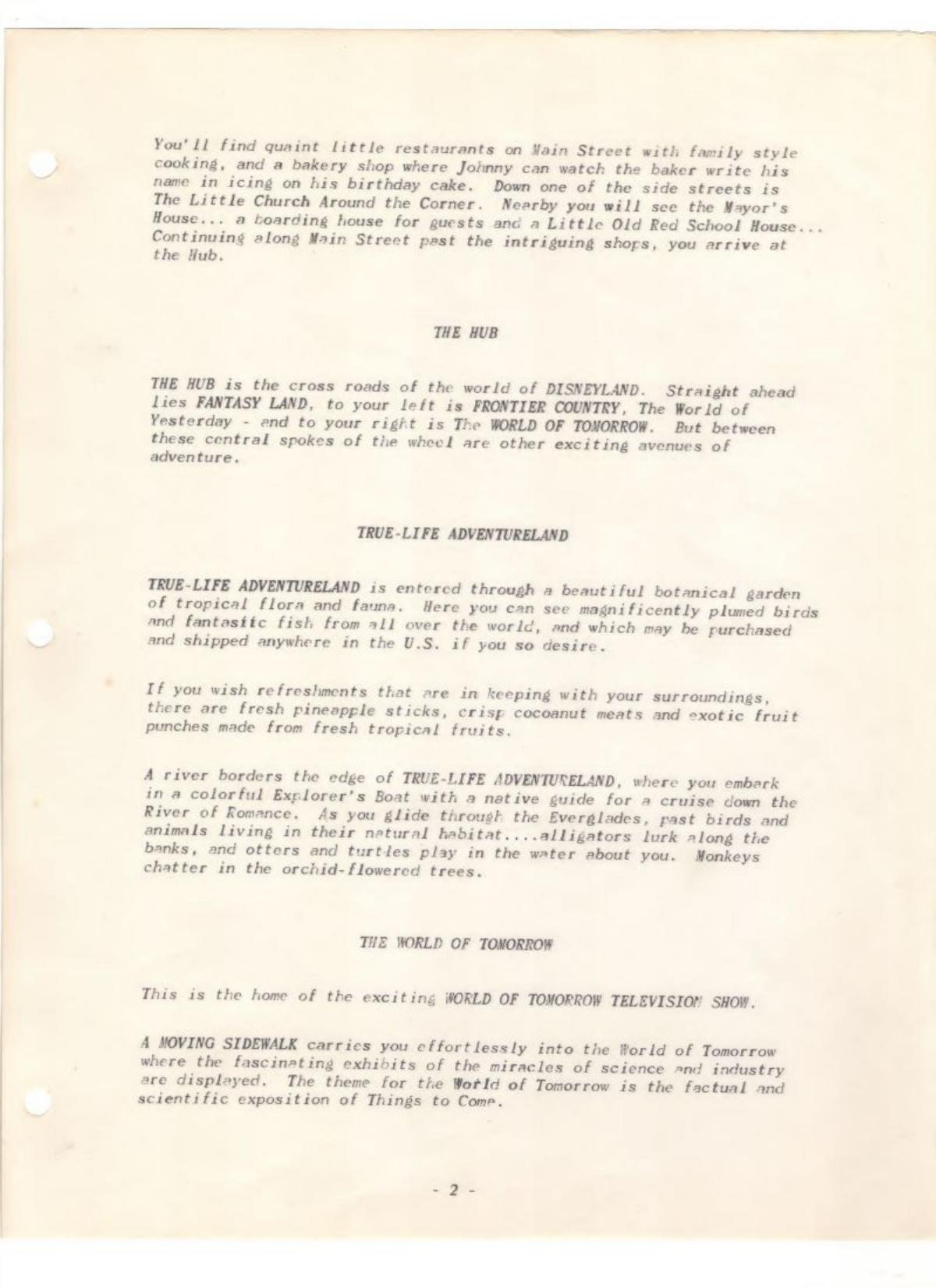
Slide 5 introduces THE HUB , described as the 'cross roads of the world.' From here, the deck branches out. TRUE-LIFE ADVENTURELAND is described with sensory details: 'fresh pineapple sticks, crisp cocoanut meats and exotic fruit punches.' It promises a cruise down the 'River of Romance' featuring alligators and monkeys. The slide also introduces THE WORLD OF TOMORROW , framed as the home of the 'exciting WORLD OF TOMORROW TELEVISION SHOW.'
Slide 6: Tomorrowland and Lilliputian Land
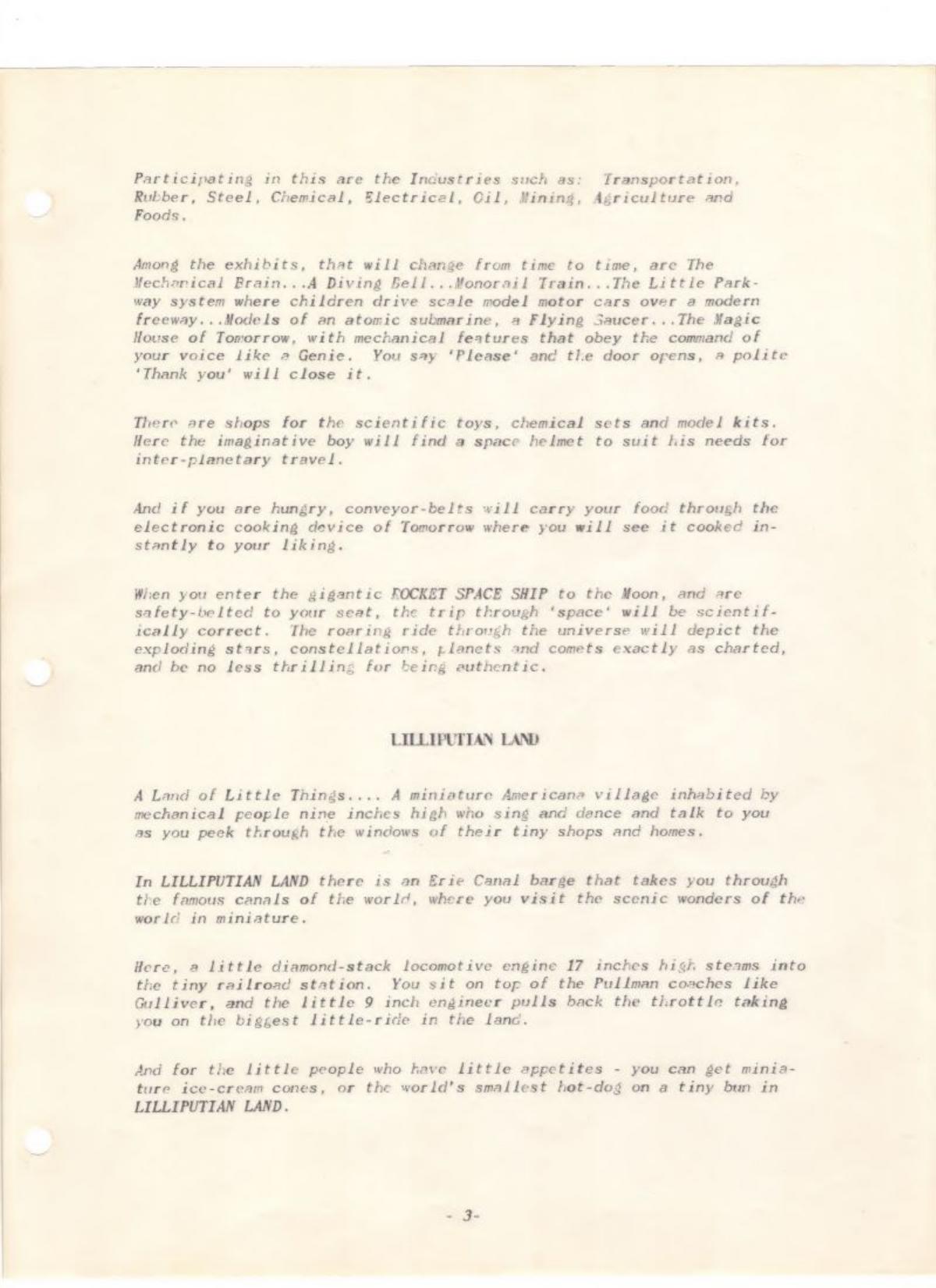
Slide 6 goes deeper into the business-to-business potential of the park. It lists participating industries: 'Transportation, Rubber, Steel, Chemical, Electrical, Oil, Mining, Agriculture and Foods.' This was a clear signal to investors that the park would be a venue for corporate sponsorships. It also describes 'LILLIPUTIAN LAND,' a miniature village with 'mechanical people nine inches high.' The detail here—mentioning the 'world's smallest hot-dog on a tiny bun' —shows the level of granular thought put into the guest experience.
Slide 7: Fantasy Land and Recreation Land
Slide 7 covers FANTASY LAND , anchored by a medieval castle with towers 'seventy feet in the air.' It lists specific IP-based attractions: Snow White, Alice in Wonderland, and Peter Pan. This slide leverages Disney’s existing film success to justify the park's potential. It also mentions RECREATION LAND , a space for clubs and schools, and the start of FRONTIER COUNTRY , where the 'STAGECOACH meets the TRAIN and the RIVERBOAT.'
Slide 8: Frontier Country and The Mickey Mouse Club
Slide 8 continues the description of Frontier Country, mentioning a 'shooting gallery,' a 'saloon... serving root-beer Western style,' and a 'PONY EXPRESS RIDE.' The bottom of the slide introduces the MICKEY MOUSE CLUB headquarters on 'Treasure Island,' featuring a 'hollow tree... several stories high.' This linked the park to Disney's most valuable character asset.
Slide 9: Holiday Land and The Seasonal Strategy
Slide 9 explains the park's year-round viability. HOLIDAYLAND is described as a place for 'SPECIAL ATTRACTIONS that change with the seasons.' It lists events for Spring (Flower Festival), Summer (Fourth of July), Fall (Harvest Festival), and Winter (ice skating and Santa’s home). This addressed the potential investor concern regarding seasonal revenue fluctuations.
Slide 10: The Philosophy of Disneyland
Slide 10 summarizes the 'why.' It states that 'Disneyland will be the essence of America as we know it... the nostalgia of the past, with exciting glimpses into the future.' It defines the mission as a place for 'people to find happiness and knowledge.' This slide elevates the project from a mere amusement park to a cultural institution, a 'museum of living facts.'
Slide 11 & 12: The Master Plan
The final two slides are the same hand-drawn map (one a slightly different crop/exposure). This is the only visual representation of the park in the deck. It shows the 'hub and spoke' design that would become the standard for theme parks. Key data points on the map include: 'APPROX. AREA 47 ACRES WITHIN R.R. TRACKS' and a scale of '1" = 50'-0".' The map proves that the project was not just a dream, but a planned construction project with defined boundaries and zones.
What Makes This Deck Work?
The Disneyland deck works because it uses vivid imagery to overcome the lack of historical data. In 1953, there were no 'theme parks' to point to as a success story. Disney had to build the world in the investor's mind. By describing the smell of the food, the height of the castle, and the specific mechanical nature of the rides, he made the abstract tangible. Furthermore, the inclusion of television synergy (slides 4 and 9) and corporate sponsorship lists (slide 6) showed a sophisticated understanding of multi-channel revenue, even if no numbers were attached.
What is Missing?
From a modern perspective, the omissions are glaring. There is no competition slide (though arguably, there was no direct competition). There is no financial ask (the $17M figure comes from historical records, not the slides). There are no projections for attendance, ticket prices, or operating costs. There is also no team slide ; the deck assumes the reader knows who Walt Disney is and trusts his ability to execute. In today's market, a deck this light on data would likely be rejected, but in 1953, the 'Founder-Market Fit' of Walt Disney was so high that narrative was sufficient.
Founder's Playbook: Lessons to Copy
Use Sensory Details: Don't just say 'good food'; say 'fresh pineapple sticks.' Specificity creates reality. · Highlight Synergies: If your product benefits from another part of your business (like Disney's TV shows), make that a central pillar of the pitch. · Sell the 'Why': Slide 10’s focus on 'happiness and knowledge' gives the project a higher purpose, which can be more persuasive than a 5% increase in margin. · Visual Anchors: The map on slide 11 is the only 'hard' evidence in the deck. Sometimes, one perfect technical drawing is worth more than ten pages of text.
Frequently asked questions
- How did Disneyland raise $17M without a financial slide?
- In 1953, the concept of a theme park was unprecedented. Walt Disney leveraged his existing reputation in film and the promise of a television partnership with ABC. The deck focused on 'world-building' to prove the concept's uniqueness, making the financial risk seem like a secondary concern to the cultural opportunity.
- What is the significance of the 'World of Tomorrow' industry list?
- Slide 6 lists industries like Transportation, Oil, and Mining. This was a subtle B2B pitch within a consumer deck, suggesting that Disneyland would serve as a permanent trade show or marketing platform for major American corporations, thereby diversifying potential revenue streams beyond ticket sales.
- Why is the Mickey Mouse Club mentioned as being on an island?
- Slide 9 describes the Mickey Mouse Club headquarters on 'Treasure Island' in the middle of a river. This highlights how Disney planned to use his most famous IP to anchor physical locations, creating a 'reason to visit' for children who were already fans of the brand.
- What does the 'Lilliputian Land' slide tell us about the original plan?
- Slide 6 describes a miniature Americana village with 9-inch high mechanical people. This shows that the original vision included high-density, mechanical attractions that eventually evolved into the 'animatronics' the park is known for today, proving the technical ambition was present from the start.
- How does the deck handle the 'Problem/Solution' framework?
- It largely ignores it. Instead of solving a 'pain point,' the deck proposes a new 'experience in entertainment' (slide 3). The 'solution' is happiness and knowledge (slide 10), framed as a civic and cultural necessity rather than a simple business fix.