Direct Insite (DIRI) positions itself as a cloud-based, ERP-agnostic solution for Accounts Payable (AP) and Accounts Receivable (AR) automation. The deck focuses heavily on the 'Bank Market,' noting that lockbox services represent a $1 trillion business that is currently threatened by a steady decline in check-based B2B payments. By offering a private-label AR solution for banks, Direct Insite aims to help financial institutions preserve their treasury franchises. The presentation highlights a significant case study with Siemens, where the company reduced invoice processing costs by 24% and s…
Key takeaways
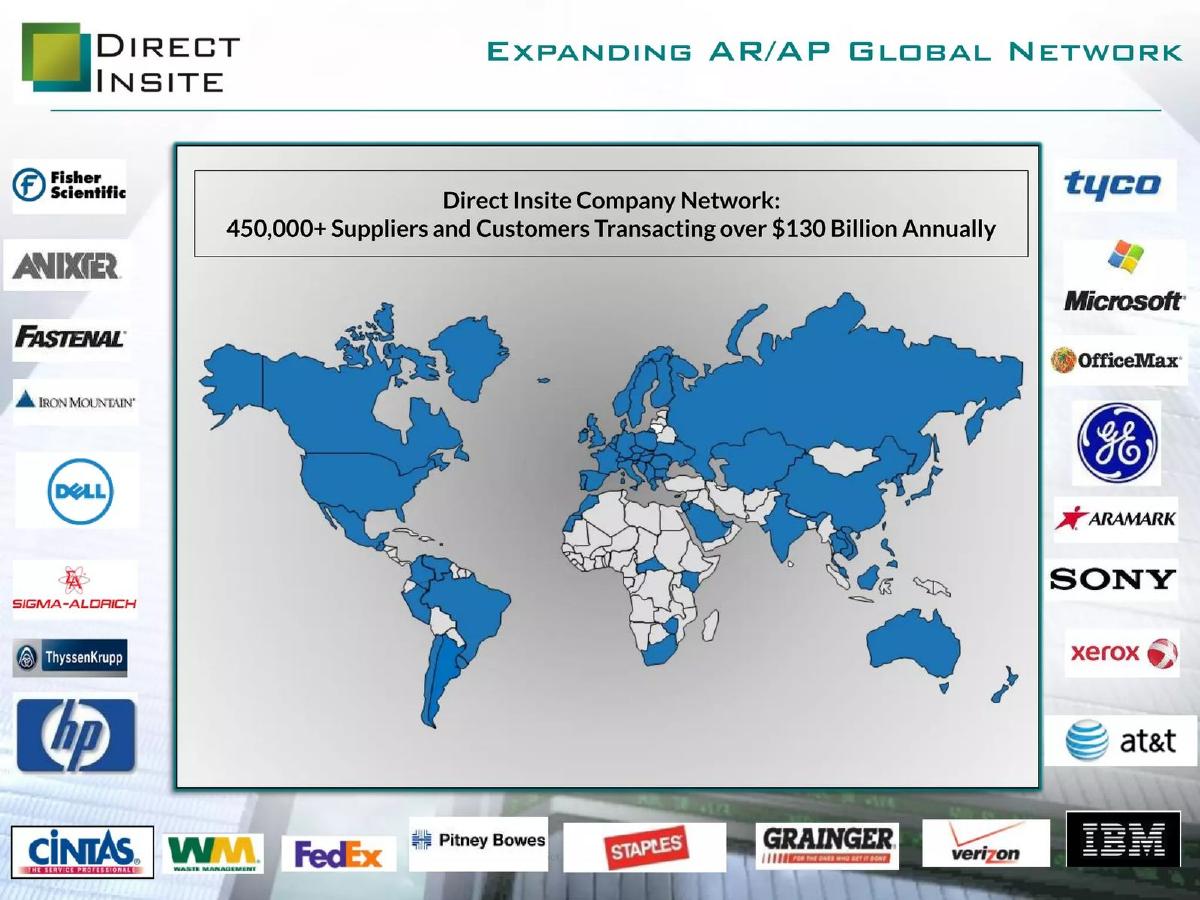
- The company claims a global network of 450,000+ suppliers and companies with plans to monetize this network (Slide 2).
- Direct Insite identifies the top 100 U.S. banks as their primary target market for AR services (Slide 6).
- Lockbox services are cited as a $1 trillion business and the second-most lucrative bank treasury product behind lending (Slide 6).
- B2B check volumes are projected to drop from 5.4 billion in 2006 to an estimated 3.4 billion by 2015 (Slide 7).
- A case study for Siemens shows the platform processes over 2.4 million invoices per year for 60,000 suppliers (Slide 4).
- The platform is ERP-agnostic, meaning it can accept any invoice format from any existing ERP system (Slide 2).
- The company set a goal to reach and exceed 30% top-line growth by 2015 through a combination of sales culture and new products (Slide 9).
- The deck identifies major competitors including Ariba, Basware, and BillTrust across the AP and AR landscapes (Slide 8).
Direct Insite: The Digital Transformation of the Bank Lockbox
Direct Insite (DIRI) presented this deck at the RedChip Global Online CEO Conference. The presentation is designed to position the company as a critical partner for large enterprises and major financial institutions grappling with the transition from paper-based to digital financial workflows. The narrative focuses on the inefficiency of manual AP/AR processes and the existential threat to bank lockbox revenue caused by the decline of physical checks.
Slide 1: Title Slide
The cover slide identifies the company as Direct Insite Corp. and includes its stock ticker, DIRI. The background imagery features a stock ticker on a modern glass building, signaling its status as a publicly traded entity and its focus on the financial sector.
Slide 2: Who is Direct Insite?
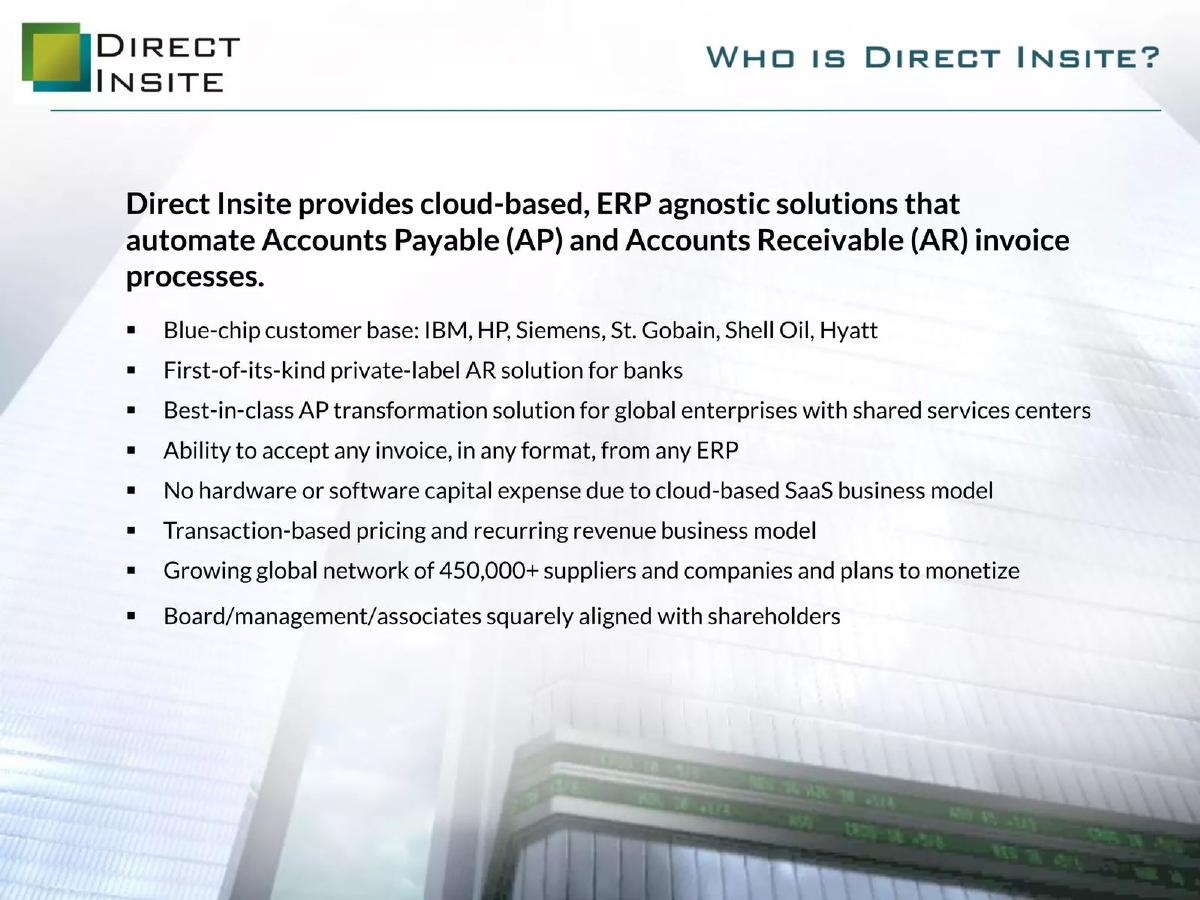
This slide serves as the executive summary. It defines the company as a provider of cloud-based, ERP-agnostic solutions for AP and AR invoice automation. Key highlights include:
A blue-chip customer base including IBM, HP, and Shell Oil. · A 'first-of-its-kind' private-label AR solution for banks. · A transaction-based, recurring revenue SaaS model. · A network of 450,000+ suppliers.
Analysis: By stating they are 'ERP agnostic,' the company removes a major sales objection—integration friction. The mention of 450,000 suppliers suggests a significant 'moat' through network effects, though the slide notes they only 'plan to monetize' this network, implying it is currently an underutilized asset.
Slide 3: AP Solution Modules
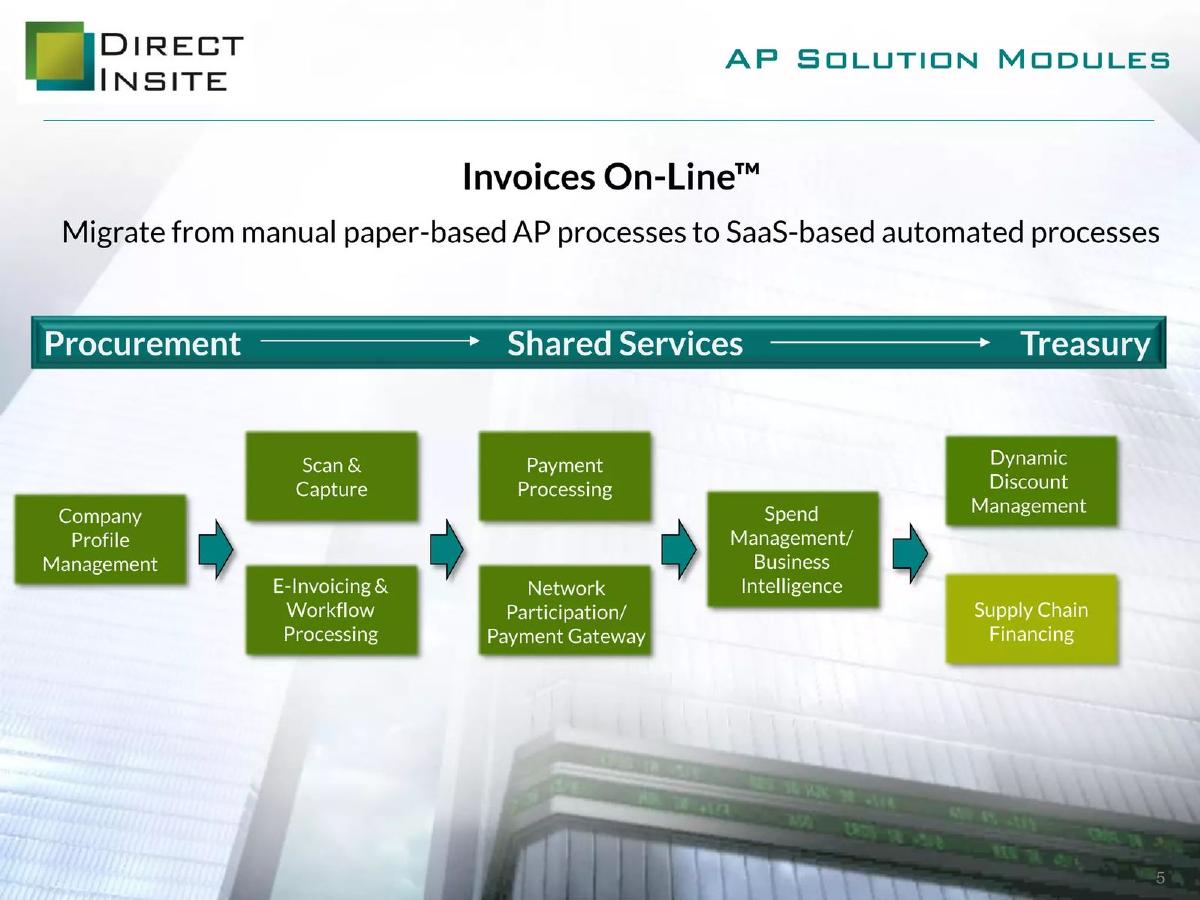
Slide 3 visualizes the 'Invoices On-Line' product for Accounts Payable. It maps the journey from Procurement to Treasury. The workflow includes:
Company Profile Management · Scan & Capture / E-Invoicing & Workflow Processing · Payment Processing / Network Participation · Spend Management / Business Intelligence · Dynamic Discount Management / Supply Chain Financing
Analysis: This slide demonstrates that Direct Insite is not just a digital mailbox; it is a full-stack financial tool that offers high-value features like 'Dynamic Discount Management,' which helps companies save money by paying suppliers early.
Slide 4: Siemens Shared Services Case Study
This is a high-impact slide that provides social proof through a massive global enterprise. Siemens uses the platform to support 50 business units and 60,000 suppliers. The 'Business Results' section lists specific, quantifiable wins:
Reduced average cost to process an invoice by 24%. · 73% of invoices received electronically. · 63% of invoices posted without operator intervention. · Supplier inquiries reduced by 67%.
Analysis: The inclusion of a quote from Roderick Fields, Director of Disbursement Services at Siemens, adds significant credibility. The metrics provided are exactly what a CFO wants to see: lower costs, higher efficiency, and fewer manual errors.
Slide 5: AR Solution Modules
Mirroring the AP slide, this one focuses on Accounts Receivable. The workflow transitions from E-Invoice Presentment through Electronic Payments (ACH, Credit Card) to Payment Reconciliation. Analysis: The symmetry between the AP and AR slides suggests a unified platform that can handle both sides of a company's ledger, simplifying the tech stack for the client.
Slide 6: The AR Opportunity - The Bank Market
This slide shifts the focus from corporate clients to the banking sector. It identifies the top 100 U.S. banks as the target market. It notes that 'Lockbox is a $1 trillion business' and the 'second-most lucrative bank treasury product behind lending.' Analysis: This is the 'Why Now?' slide. By highlighting that 70% of large corporates use a lockbox, Direct Insite is showing that they are targeting a massive, established market that is ripe for disruption.
Slide 7: AR Opportunity - Declining Check Volumes
This slide provides the data to support the urgency of the bank market opportunity. A bar chart shows 'Check Based Payments - Volume Trends' from 2006 to an estimated 2015. B2B check volumes are shown falling from 5.4 billion to 3.4 billion. Analysis: The message is clear: banks are losing their traditional lockbox revenue as checks disappear. Direct Insite offers the digital alternative banks need to 'preserve their lockbox franchise.'
Slide 8: Competitive Landscape
The company uses a tree diagram to categorize competitors into AP and AR groups.
AP Competitors: OB10, Ariba, Taulia, DirectCommerce, Basware, TradeShift. · AR Competitors: BillTrust, Transactis, Corcentric, Esker, Bottomline Technologies, Genpact.
Analysis: While the slide identifies competitors, it does not provide a feature-by-feature comparison or a 'magic quadrant' to show why Direct Insite is superior. It simply acknowledges the crowded nature of the fintech space.
Slide 9: Growth Objectives and Timeline
This slide outlines a three-year roadmap to reach 30% top-line growth by 2015.
2012: Invest in sales force and standardize products (10%+ achieved). · 2013-2014: Launch formal channel programs and leverage first-mover status in banks (10%+ target). · 2015: Monetize the network effect via supply chain financing (10%+ target).
Analysis: The goal of 30% growth is ambitious but presented as a logical progression of their sales and product strategy. However, the slide lacks specific dollar amounts for revenue targets.
Slide 10: Contact Information
The final slide provides the contact details for Matthew Oakes, President & CEO. Analysis: The inclusion of social media icons (Twitter, LinkedIn, Google+, Facebook) reflects the era of the presentation but adds little to the professional investment case.
What Works Well in This Deck
The Siemens case study (Slide 4) is the strongest part of the presentation. It provides hard data and a testimonial from a world-class brand, which validates the technology's scalability and efficacy. Additionally, the 'Bank Market' slides (6 and 7) do an excellent job of identifying a specific, high-value pain point: the death of the check and the resulting threat to bank revenue. This creates a clear 'wedge' for their AR product.
What Is Missing
The most glaring omission is a comprehensive management team slide. Investors back people as much as products, and failing to highlight the leadership's pedigree is a missed opportunity. Furthermore, while the deck mentions a 'transaction-based pricing' model, it provides no specific unit economics—such as Customer Acquisition Cost (CAC) or Lifetime Value (LTV). There is also no clear 'Ask' slide; as a public company, they may not be looking for a specific round of funding, but an investor deck should still clearly state what they want the viewer to do next (e.g., buy shares, join a roadshow).
What a Founder Should Copy
Founders should emulate the way Direct Insite uses industry-wide macro trends (Slide 7) to justify their existence. By showing a chart of declining check volumes, they make their product seem inevitable rather than just 'nice to have.' The use of a 'Solution Module' flow (Slides 3 and 5) is also a great way to explain complex software architecture in a way that is easy for non-technical investors to visualize.
Frequently asked questions
- What is Direct Insite's core value proposition?
- Direct Insite provides a cloud-based, SaaS platform that automates Accounts Payable and Accounts Receivable processes. According to Slide 2, the solution is ERP-agnostic, meaning it integrates with any existing system to eliminate manual, paper-based workflows. The platform aims to reduce processing costs, improve staff efficiency, and enhance supplier relationships by moving invoices into a digital, automated environment.
- How does the company plan to grow its revenue?
- As outlined on Slide 9, the company targets 30% top-line growth by 2015. This strategy involves three phases: investing in a direct sales force (2012), leveraging 'first-mover status' for their PAYBOX product in the top 100 banks (2013-2014), and eventually creating value from the 'network effect' of their 450,000+ supplier base through supply chain financing and compliance management (2015).
- Who are the primary customers mentioned in the deck?
- Slide 2 lists several high-profile 'blue-chip' customers, including IBM, HP, Siemens, St. Gobain, Shell Oil, and Hyatt. The Siemens case study on Slide 4 is particularly detailed, noting that the platform supports more than 50 Siemens business units and 5,000 internal users, handling the massive volume of 2.4 million invoices annually.
- What market trend is Direct Insite capitalizing on?
- The primary trend is the decline of check-based payments. Slide 7 shows that B2B check volumes are steadily decreasing, falling from 5.4 billion in 2006 to an estimated 3.4 billion in 2015. Because banks rely on lockbox services for $1 trillion in fees and deposits, they are under pressure to replace lost check revenue with digital AR services, which Direct Insite provides.
- Does the deck include a management team slide?
- No, the provided slides do not include a dedicated team slide featuring biographies or past successes of the leadership. The only mention of leadership is on Slide 10, which lists Matthew Oakes as the President & CEO, providing his contact information. The lack of a team slide is a notable omission for an investor presentation.