Dii 21 presents a technical solution for a specific industrial pain point: the manual burden of converting legacy paper or raster drawings into layered CAD files. The deck positions the company within the broader strategic trends of digital twins and the circular economy, citing the Centre for Digital Built Britain to validate the problem's severity. Their primary product, 'Reader,' is designed to move the industry from 10% automation to 90% through a phased roadmap. While the deck provides a clear technical value proposition and a logical pathway to market leadership, it lacks critical finan…
Key takeaways
- The company identifies the digitization of legacy assets as a multi-billion dollar challenge for digital twin adoption (Slide 2).
- Dii 21's core product, 'Reader,' focuses on the automated understanding of scanned engineering drawings (Slide 2).
- The solution aims to increase the degree of automation from the current market standard of 10% to a target of 90% (Slide 9).
- The technical approach involves splitting data into separate layers like symbols and technical lines rather than simple raster-to-vector conversion (Slide 8).
- The deck links its value proposition to the circular economy, arguing that re-engineering old assets requires paper-to-CAD conversion (Slide 4).
- A phased 'Pathway to market leadership' outlines a transition from an engineering service to a pure SaaS model (Slide 9).
- The team is described generally as two co-founders and a group of engineers, but lacks specific names or prior achievements (Slide 2).
- There is no mention of a specific funding ask, valuation, or use of proceeds in the provided slides.
Slide-by-Slide Analysis
Slide 1: Title Slide
The deck opens with a minimalist title slide. It features the company name 'DII' and the subtitle 'Automated understanding of engineering information.' This is a functional, high-level summary of the company's purpose, though it lacks visual branding or a compelling hook.
Slide 2: 1 Page Summary
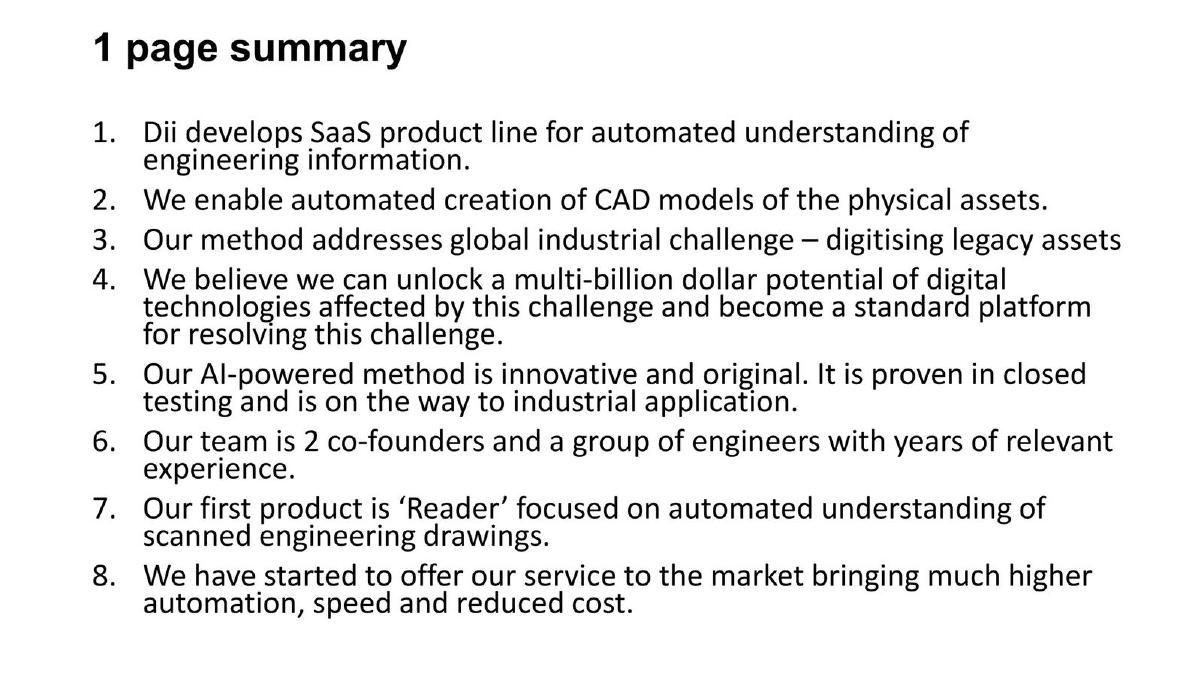
This slide acts as an executive summary. It lists eight key points, including the development of a SaaS product line, the focus on digitizing legacy assets, and the claim of a 'multi-billion dollar potential.' Point 5 notes that the method is 'proven in closed testing,' and point 6 mentions the team consists of '2 co-founders and a group of engineers.' Point 7 identifies their first product as 'Reader.' This slide is text-heavy but provides a comprehensive overview of the business case before diving into details.
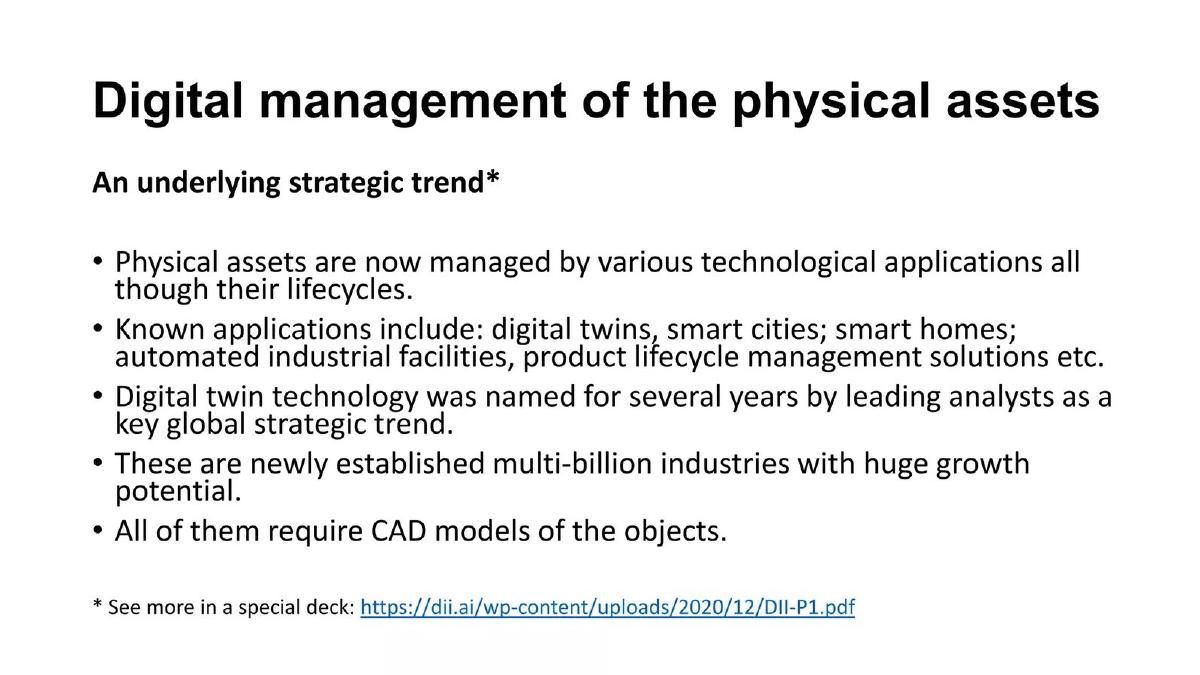
Slide 3: Digital Management of the Physical Assets
This slide establishes the market context. It identifies an 'underlying strategic trend' where physical assets are managed via digital twins, smart cities, and smart homes. It claims these are 'multi-billion industries' and makes the critical point that 'All of them require CAD models of the objects.' This sets up the 'why now' for the company’s technology. A link to a 'special deck' is provided at the bottom for further reading.
Slide 4: Sustainability Dimension
Dii 21 attempts to align itself with ESG (Environmental, Social, and Governance) trends. It argues that the 'circular economy' requires re-using old assets, which in turn requires re-engineering. The slide explicitly states that 'digitising legacy assets is a requirement for sustainable development.' This is a strategic move to appeal to impact-focused investors, though the connection is somewhat secondary to the core industrial utility.
Slide 5: The Roadblock
This slide provides external validation for the problem. It quotes Cambridge University’s Centre for Digital Built Britain (CDBB), calling legacy asset digitization a 'main roadblock.' The slide includes a screenshot of a report listing 'Drivers,' noting that current scan technology is limited in its ability to provide functionality without human intervention. This slide effectively uses authority to prove that the problem Dii 21 is solving is recognized by industry experts.
Slide 6: Our Goal: Automate 90%
This slide introduces the solution's ambition. A flowchart titled 'Automating objects digitalisation' shows the pipeline from 'Existing data' (scanned drawings, technical documents, laser scans) through 'Solutions' (D-reader and future modules) to 'Results.' The ultimate goal is a 'Digital model representing product "as built".' The target of 90% automation is a bold metric that serves as the company's North Star.
Slide 7: Part 2 of 2: The Reader
This is a transition slide that introduces the specific product. It includes a YouTube link to a demo. In a live pitch, this would likely be where a video or live demonstration occurs. For a static deck, providing the link is necessary, though it breaks the flow of the presentation.
Slide 8: Unique Algorithm
This slide explains the technical 'moat.' It describes a 'working algorithm' that reconstructs raster images into layered CAD files. The key differentiator claimed is the ability to 'recognize what’s actually drawn' and 'understand the meaning of vector primitives.' It explains that the software splits data into layers (symbols, lines, etc.) and assigns actual dimensions, which reduces the engineer's role to 'fine-tuning' rather than manual drawing.
Slide 9: Pathway to Market Leadership
This is the roadmap slide. It uses a table to show four steps (0 through 3). Step 0 is the current market (10% automation, manual service). Step 1 is the 'Dii Reader' at 50% automation. Step 2 moves to 70% automation and introduces a SaaS model. Step 3 targets 90% automation and a 'standard solution' status. This slide is excellent for showing how the company plans to scale its technology and evolve its business model over time.
Slide 10: Closing Slide
The deck ends with a simple 'Thank you!' and the company URL: www.dii.ai. Like the opening slide, it is minimalist and lacks a final call to action or contact information for a specific person.
What Dii 21 Does Well
The deck is exceptionally clear about the problem-solution fit . By citing the Centre for Digital Built Britain, the founders move beyond their own opinions and anchor their value proposition in a documented industry pain point. The distinction between 'simple raster to vector conversion' and 'understanding the meaning of vector primitives' is a crucial technical differentiator that explains why this hasn't been solved by generic tools. Furthermore, the phased roadmap on slide 9 shows a realistic understanding of how AI products improve; they don't claim 90% automation on day one, but rather show a logical progression from a service-led approach to a pure SaaS model.
What is Missing from the Deck
The most glaring omission is the Ask and Financials . There is no information regarding how much capital the company is seeking, the valuation, or how they intend to spend the money. Additionally, the Team slide is far too vague. Stating there are '2 co-founders' without providing their names, backgrounds, or previous exits makes it impossible for an investor to assess execution risk. The deck also lacks a Competitive Landscape . While they mention that current market offerings are 'mostly manual,' they do not name specific competitors or explain why a large incumbent like Autodesk couldn't easily replicate this functionality. Finally, there are no Unit Economics or projections regarding customer acquisition costs (CAC) or lifetime value (LTV).
What a Founder Should Copy
Founders in technical or industrial niches should copy the Validation Strategy used on slide 5. Instead of just saying 'the market is big,' Dii 21 identifies a specific report from a prestigious institution that calls their specific niche a 'main roadblock.' This immediately builds credibility. Another strong element is the Automation Metric . By quantifying their goal (90% automation) and comparing it to the status quo (10% automation), they give investors a simple, memorable metric to track their progress. The use of a Product Roadmap that links technical milestones to business model shifts (Service to SaaS) is also a best practice for early-stage AI startups.
Final Thoughts
Dii 21 has a strong grasp of a specific, high-value technical problem. The deck successfully communicates the 'what' and the 'how' of the technology. However, as a fundraising tool, it is incomplete. It functions more as a product overview or a partnership deck than a venture capital pitch. To be successful in a seed or Series A round, the founders would need to add a robust team slide, clear financial projections, and a specific funding request that explains how an investment will accelerate their journey from 50% to 90% automation.
Frequently asked questions
- What specific problem is Dii 21 solving?
- Dii 21 addresses the 'roadblock' of digitizing legacy physical assets. Currently, creating digital twins or smart city models requires CAD files, but many older assets only have paper or raster drawings. Converting these manually is slow and expensive. Dii 21 uses AI to automate this conversion, specifically focusing on understanding engineering information rather than just performing simple vectorization.
- How does Dii 21's technology differ from standard vectorization tools?
- According to slide 8, their 'Unique algorithm' does not just convert pixels to lines. It recognizes 'vector primitives' and the meaning behind them. It automatically splits data into separate layers—such as symbols, technical lines, and the object itself—and recognizes digits to assign actual dimensions, significantly reducing the fine-tuning required by engineers.
- What is the company's long-term business model?
- The company plans to transition from a service-heavy model to a pure SaaS model. Slide 9 shows a four-step evolution: starting with 50% automation delivered as an engineering service, moving to 70% automation as SaaS with supportive service, and finally reaching 90% automation as a standard SaaS solution for various industries.
- Does the deck provide evidence of market demand?
- The deck relies on third-party validation rather than internal sales metrics. It cites Cambridge University’s Centre for Digital Built Britain, which labeled legacy asset digitization as the 'greatest impediment' to digital twin adoption. It also references digital twins and smart cities as 'newly established multi-billion industries' that all require the CAD models Dii 21 produces.
- What critical information is missing from this pitch deck?
- The deck is missing several standard components: a specific financial 'Ask' (how much money they want), a 'Use of Proceeds' slide, a detailed 'Competition' slide comparing them to existing CAD software, and a 'Team' slide with names and photos. It also lacks current revenue figures, customer names, or specific case study data beyond a mention of 'closed testing.'