The Digital Life Collective deck for 'The Social Ledger' is less a traditional startup pitch and more a manifesto for a new way of organizing human activity. Spanning 25 slides (9 provided), it introduces the 'Rhizome' concept to bridge siloed knowledge and uses a 'Social Ledger' to record and reward contributions. The deck leans heavily on the credibility of Jim Whitescarver, described as a founding father of W3C's HTML and HTTP. While it provides a comprehensive map of conversational, organizational, and socioeconomic patterns, it lacks standard venture capital components such as a clear bu…
Key takeaways
- The platform aims to replace traditional organizational charts with 'Maps & Holons' to facilitate ecosystem mapping (Slide 6).
- Identity is defined by action, summarized by the quote: 'You Are What You Do' (Slide 4).
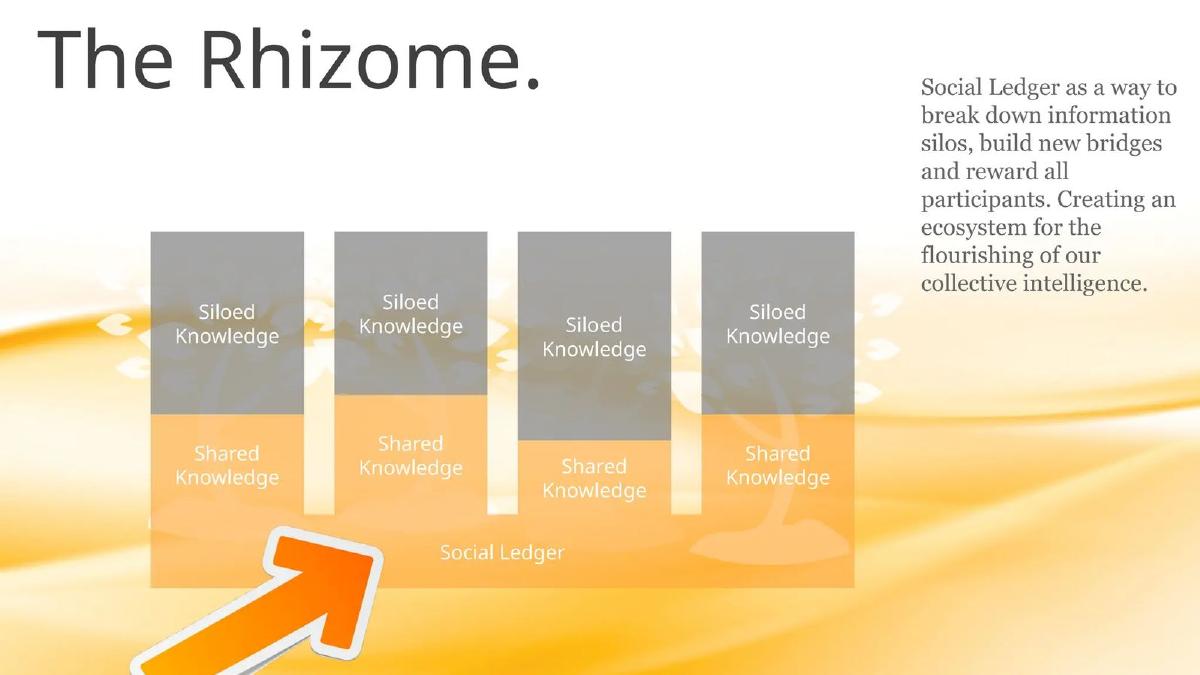
- The 'Social Ledger' serves as a bridge between siloed knowledge and shared collective intelligence (Slide 2).
- The architecture is categorized into six pattern types: Conversational, Organizational, Sociopsychological, Socioeconomic, Rhizomatic, and Sociocultural (Slide 5).
- A 'Role-based Commitments' system tracks activities to generate a 'Social Record' which can be rewarded with a 'token of your choice' (Slide 7).
- The project is associated with ITP Camp 2019 and features Jim Whitescarver and Joachim Stroh as key figures (Slide 1).
- Social cohesion is a primary metric, defined by opposing exclusion, promoting trust, and co-creating social objects (Slide 8).
- The deck omits traditional financial projections, competitor analysis, and a specific investment 'ask' (Slides 1-9).
Introduction and Vision
The Digital Life Collective deck for 'The Social Ledger' is a deeply philosophical document that prioritizes the 'how' and 'why' of collective human interaction over the 'how much' of traditional business. The cover slide (Slide 1) establishes a collaborative tone, featuring a background image of a social gathering and identifying the presenters as Jim Whitescarver and Joachim Stroh, associated with ITP Camp 2019. The subtitle, 'The Social Ledger,' serves as the primary product name, though the overarching entity is the Digital Life Collective.
The Rhizome and Knowledge Silos
Slide 2 introduces 'The Rhizome.' This slide uses a bar-chart-style visual to represent 'Siloed Knowledge'—information trapped within individual or organizational containers. The 'Social Ledger' is depicted as an orange foundation that penetrates these silos, converting a portion of that trapped data into 'Shared Knowledge.' The text defines the Social Ledger as a way to 'build new bridges and reward all participants,' framing the problem as a lack of collective intelligence due to fragmentation.
Weaving Content and Identity
Slide 3, titled 'On Weaving Content,' uses the metaphor of a traditional weaver to explain how online collectives function. It presents a technical flow: Body of People > Org Elements > Body of Work > Boundary Objects > Body of Actions. These are mapped to specific nodes like 'Place,' 'Space,' 'Card,' and 'Action.' This suggests a structured methodology for turning human interaction into tangible digital outputs. Slide 4 reinforces this by focusing on identity. It features a quote from Jim Whitescarver: 'The Social Ledger represents IDENTITY in a sense of "You Are What You Do."' By citing Whitescarver’s credentials as a founding father of W3C’s HTML and HTTP, the deck attempts to establish the Social Ledger as a fundamental evolution of the web's social fabric.
The Pattern Language of the Platform
Slide 5 is the most information-dense slide in the set, titled 'Y/our Platform. Y/our Story.' It provides a grid of twenty-four 'patterns' that the platform aims to refine. These are grouped into six categories: Conversational Patterns (Augmented Chats, Wikis), Organizational Patterns (Maps & Holons, Roles), Sociopsychological Patterns (Protocols, Human Development), Socioeconomic Patterns (Subscription, Community Currencies), Rhizomatic Patterns (Apps & Containers, Local Communities), and Sociocultural Patterns (Media, Education). This slide indicates that the project is not a single app but a comprehensive framework for digital society. The text 'We are not done yet' suggests an ongoing, iterative development process rather than a finished commercial product.
Redefining the Organizational Chart
Slide 6, 'Leave the old org chart behind,' visualizes the 'Maps & Holons' concept. Instead of a pyramid, it uses a series of overlapping and nested circles (bubble charts). The largest circles are labeled 'OPS' and 'DIGLIFE,' with smaller circles representing 'PARTNERS' and 'ECOSYSTEM-MAPS.' This visualizes a decentralized, flat structure where groups interact organically. This is a common theme in 'Web3' or 'DAO' (Decentralized Autonomous Organization) pitches, though those specific terms are not used in these slides.
Role-Based Commitments and Rewards
Slide 7 explains the mechanics of the ledger. It divides the timeline into Future, Present, and Past. In the 'Future/Present' phase, the collective 'takes the pulse' by creating a 'Social Record'—a snapshot of activities. This record then flows into the 'Past' phase, where it becomes a 'Financial Record.' The slide notes that this is a way to 'reward selected activities with a token of your choice.' This indicates a flexible reward system where the collective can choose its own medium of exchange (e.g., Bitcoin, a custom token, or other digital assets) based on the recorded social contributions.
Social Cohesion and Call to Action
Slide 8 defines the success metrics for the project under the heading 'Measure for Cooperation.' Unlike a standard deck that might list Monthly Active Users (MAU) or Revenue, this deck lists 'Social Cohesion' as its goal. The specific objectives include 'Working toward the well-being of all our members,' 'Opposing exclusion,' and 'Promoting trust.' The final slide (Slide 9) is a simple 'Join Us' call to action. It provides the website (diglife.com), a Twitter handle (@techwetrust), and personal email addresses for Stroh and Whitescarver. The use of Gmail addresses rather than corporate domain emails for the founders reinforces the grassroots, collective nature of the project.
What Works
The deck is visually consistent and uses high-quality imagery to support its metaphorical narrative (the weaver, the school of fish, the dolphins). The association with Jim Whitescarver provides immediate technical credibility that a typical startup founder would lack. The 'Pattern' grid on Slide 5 is an excellent way to show the breadth of the vision without getting bogged down in individual feature descriptions. It successfully communicates a complex, abstract concept—decentralized social accounting—through relatable metaphors like 'weaving' and 'taking the pulse.'
What is Missing
From a fundraising perspective, this deck is missing almost all standard 'hard' data. There is no market size analysis (TAM/SAM/SOM) , no competitor matrix , and no business model explaining how the Collective sustains itself financially. While Slide 7 mentions a 'Financial Record,' it does not explain the underlying economics of the tokens or how value is captured. There is no slide detailing the current traction (e.g., number of active members or existing partnerships) and no specific 'Ask' slide detailing how much capital is being raised or how it will be spent. The absence of a traditional team slide with professional bios (beyond the Whitescarver quote) makes it difficult to assess the execution capability of the broader group.
Founder Takeaways
Founders building in the decentralized or 'cooperative' space can learn from how this deck uses philosophical alignment to attract a specific type of stakeholder. The 'You Are What You Do' framing is a powerful way to define a product's value proposition in the identity space. However, founders should be cautious about omitting the 'Ask' and the 'Business Model.' Even for a cooperative, investors (or members) need to understand the sustainability plan. If you are using a 'Pattern' grid like Slide 5, ensure you can point to which patterns are currently functional versus which are aspirational, as a grid of 24 items can look like 'boiling the ocean' to a skeptical analyst.
Frequently asked questions
- What is the core product being pitched?
- The core product is 'The Social Ledger,' described as a tool for online collectives to co-create patterns and stitch them together. It functions as a decentralized record of activity ('Social Record') that bridges information silos and allows for the rewarding of participants based on their contributions and roles within a 'Rhizome' ecosystem.
- Who are the key individuals behind the project?
- The deck identifies Jim Whitescarver and Joachim Stroh. Whitescarver is specifically highlighted as an 'Internet Pioneer and a Founding Father of W3C's HTML & HTTP.' This attribution is used to provide technical and historical weight to the project's philosophical underpinnings regarding digital identity and decentralized systems.
- How does the platform handle organizational structure?
- The deck explicitly states a desire to 'Leave the old org chart behind.' Instead, it utilizes 'Maps & Holons' to visualize ecosystems. This includes nested circles representing operations (OPS), the Digital Life Collective (DIGLIFE), and partners, suggesting a non-hierarchical, fluid structure based on functional groups rather than top-down management.
- What is the 'Rhizome' mentioned in the deck?
- In this context, the Rhizome is a conceptual framework for breaking down information silos. Slide 2 illustrates it as a foundational layer that connects disparate blocks of 'Siloed Knowledge,' turning them into 'Shared Knowledge.' It is presented as an ecosystem designed for the 'flourishing of our collective intelligence.'
- Is there a clear monetization or tokenomics strategy?
- The deck is vague on specific financials. Slide 7 mentions a 'Financial Record' and the ability to reward activities with a 'token of your choice.' Slide 5 lists 'Tokens & Transactions' and 'Community Currencies' under socioeconomic patterns. However, there is no detailed breakdown of token supply, value capture, or revenue generation for the collective itself.