Diamond Standard's 11-slide Series A investor deck makes an unusually strong category-creation argument for turning diamonds into a regulated, exchange-traded commodity. Slide 6's seven-stage fungibility mechanism is better than most Series A decks manage. But the deck contains no traction, no unit economics, no competition slide and no ask — the $30M round size appears only in the PowerPoint file name. It is a thesis deck, not a finished fundraising deck.
Key takeaways
- Diamond Standard's Series A pitch deck is 11 slides and never states its own ask; the $30M round size appears only in the source PowerPoint file name.
- The deck's strongest move is anchoring a new category to a known one in the first sentence: 'a liquid hard asset like gold.'
- Slide 6 explains how diamonds are made fungible in seven stages, naming GIA and IGI as third-party verifiers — evidence beats assertion when the core claim is hard to believe.
- The deck footnotes its own market data as estimates that 'may not be reliable,' which buys credibility for the numbers the founder does stand behind.
- Its worst slide claims revenue potential 'may exceed $250 billion' with no take rate, turning a market number into an apparent company number.
- The same $150 billion figure is reused as an allocation gap, a market increase and a social dividend across three slides, which signals rhetorical rather than analytical use.
- Despite a commodity offering that began March 2021 and a fund launched July 2022, the deck reports no revenue, no AUM and no customer count.
- Founders in deep tech and regulated markets over-invest in 'is this possible?' slides and under-invest in 'is this a business?' slides; investors run the opposite priority.
What this deck actually is
This is an 11-slide investor deck from Diamond Standard, the New York company trying to turn diamonds into a regulated, exchange-traded commodity. The file's own document properties give away what the slides never say out loud: it was exported from a PowerPoint named "PDT NA - $30M - Series A - Diamond Standard.pptx" . So the raise is a $30M Series A — but you will not find that number, or any use of funds, anywhere on the slides.
That gap matters, because the deck is otherwise unusually confident. It opens on a mission, moves through market structure, explains a genuinely complex manufacturing and market-making process, and closes on a founder bio and an org chart. It reads like a category-creation deck written by someone who has raised institutional money before — which the founder has. What it is not is a complete fundraising deck. There is no traction slide, no revenue, no financial model, no competition slide, no cap table, no ask, and no contact information.
Classify it honestly before you copy anything from it: this is a thesis deck for a regulated financial product, not a startup pitch deck in the conventional sense. It is trying to convince you that an asset class exists, not that a company is executing well. Those are different jobs, and the deck only does one of them.
Slide-by-slide walkthrough
Slide 1 — Mission
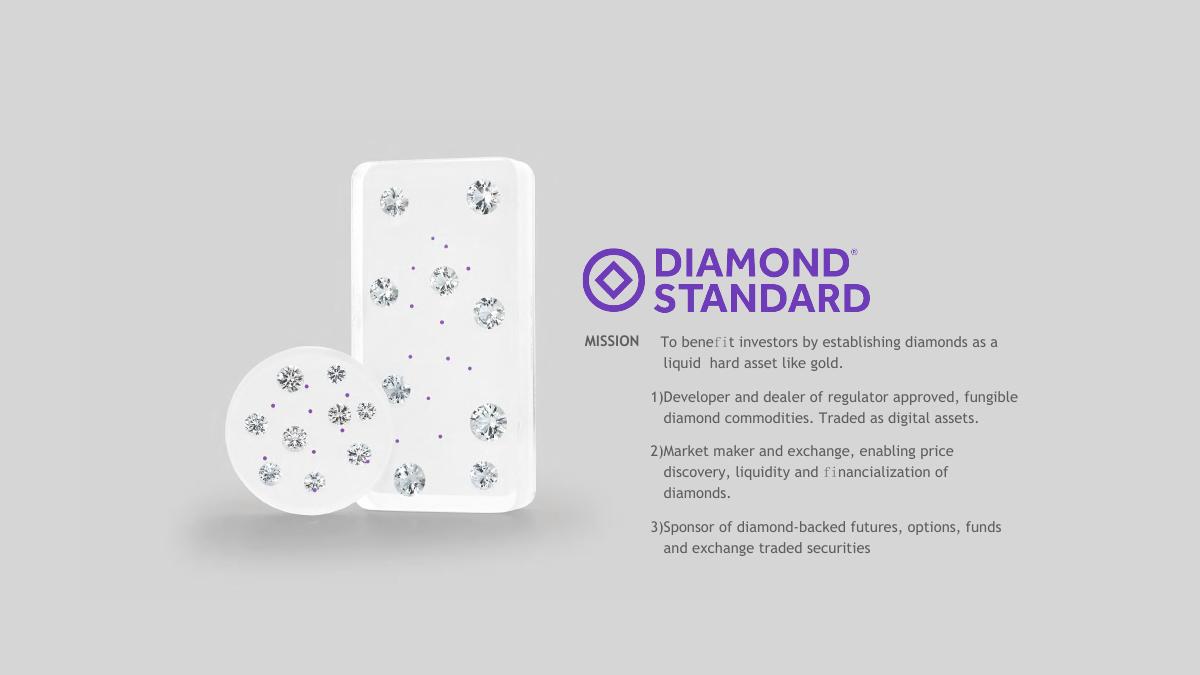
The opening slide states the mission as "to benefit investors by establishing diamonds as a liquid hard asset like gold," then immediately breaks the business into three numbered lines: (1) developer and dealer of regulator-approved, fungible diamond commodities traded as digital assets, (2) market maker and exchange enabling price discovery, liquidity and financialization, (3) sponsor of diamond-backed futures, options, funds and exchange-traded securities.
This is a strong first slide and most founders should study it. In one screen you learn the analogy (gold), the mechanism (fungibility), and the three revenue surfaces (product, market infrastructure, securities). The comparison to gold is doing enormous work — it lets an investor skip five slides of education because they already understand what a liquid hard asset looks like. If your category is genuinely new, find the existing asset or market your investor already understands and anchor to it in the first sentence.
The weakness is that this is all ambition with no evidence. Nothing on slide 1 tells you whether any of the three lines is operating today or is still a plan.
Slide 2 — Overview and product roadmap
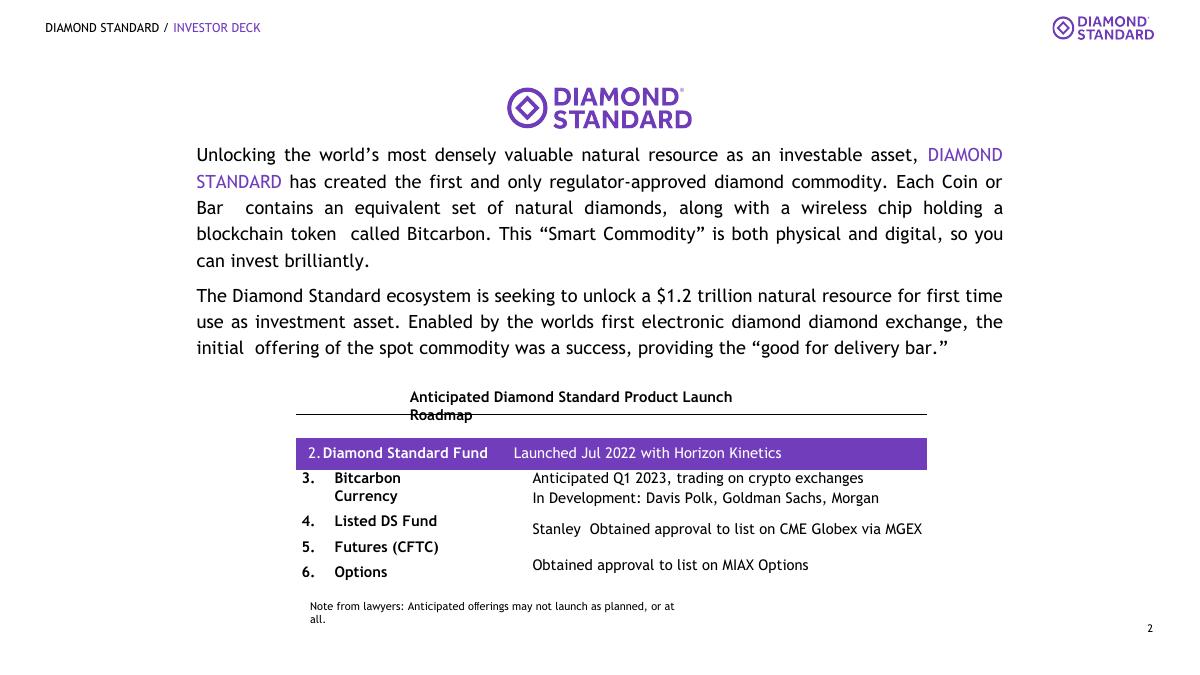
Slide 2 explains the product: each Diamond Standard Coin or Bar contains an equivalent set of natural diamonds plus a wireless chip holding a blockchain token called Bitcarbon, making it a "Smart Commodity" that is both physical and digital. It then claims the ecosystem is "seeking to unlock a $1.2 trillion natural resource for first time use as investment asset," and that the initial offering of the spot commodity was "a success," providing the "good for delivery bar."
The right half is the anticipated product launch roadmap, and this is the most useful slide in the deck: (1) Physical Commodity — offering began March 2021; (2) Diamond Standard Fund — launched July 2022 with Horizon Kinetics; (3) Bitcarbon — anticipated Q1 2023, trading on crypto exchanges; (4) Currency — in development with Davis Polk, Goldman Sachs, Morgan Stanley named; (5) Listed DS Fund / Futures — approval obtained to list on CME Globex via MGEX (CFTC); (6) Options — approval obtained to list on MIAX Options.
A legal footnote adds that anticipated offerings may not launch as planned. That disclaimer is correct practice for a regulated product and it does not weaken the slide.
What the roadmap does well is separate shipped from unshipped. Two items have dates in the past, four have dates in the future or no date at all. Investors reading fast will look for exactly that split. What it does badly is confuse regulatory approval with demand . Getting approval to list on CME Globex and MIAX is a serious, hard-won milestone. It is not the same as having an authorized participant, a market maker, or a single dollar of committed order flow — and this deck never draws the distinction.
Slide 3 — Introducing the smart commodity
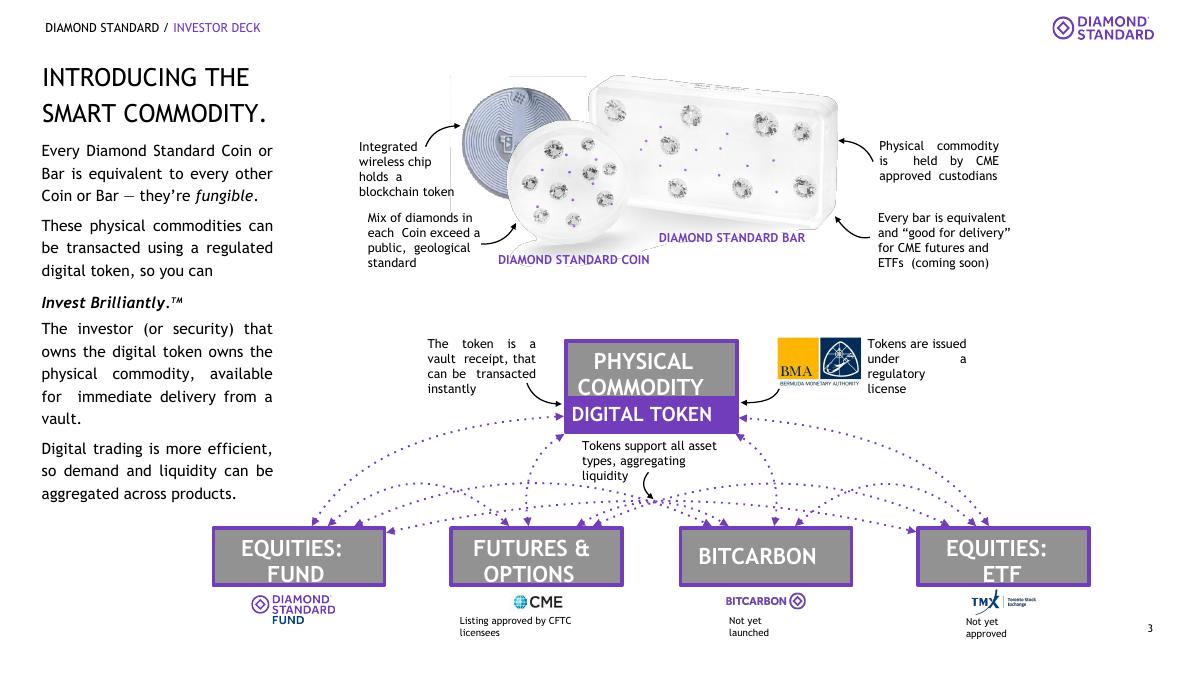
The product explainer. Every Coin or Bar is equivalent to every other, so they are fungible. An integrated wireless chip holds a blockchain token. The mix of diamonds in each Coin exceeds a public, geological standard. The physical commodity is held by CME-approved custodians. Every bar is "good for delivery" for CME futures and ETFs (marked "coming soon"). The token is a vault receipt that can be transacted instantly, and the investor who owns the token owns the physical commodity, available for immediate delivery from a vault. The slide ends with logos for the four surfaces the token supports: the Diamond Standard Fund, CME futures and options, Bitcarbon, and an ETF.
Fungibility is the whole company and the deck knows it. Diamonds have never traded like gold precisely because no two stones are identical, so this slide's job is to say "we solved the non-fungibility problem" and then prove it in the next few slides. It sets that up cleanly. The "(coming soon)" parenthetical next to ETFs is honest and should be imitated — mark unshipped things unshipped, inline, rather than letting the reader assume.
Slide 4 — Diamonds are severely underallocated
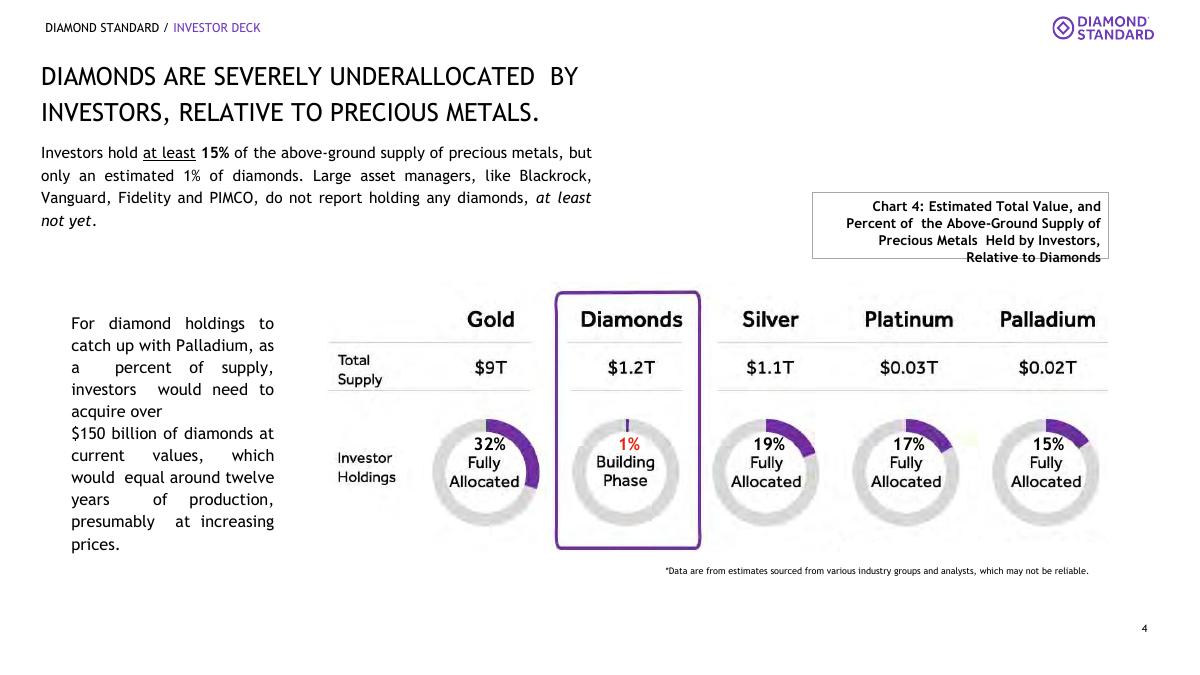
The core market argument, delivered as a chart. Investors hold at least 15% of the above-ground supply of precious metals but only an estimated 1% of diamonds. Gold is $9T total supply with 32% investor-held; diamonds $1.2T with 1%; platinum 19%; silver 17%; palladium 15% at $0.02T. The deck labels gold "fully allocated" and diamonds "building phase." The callout: for diamond holdings to catch up with palladium as a percent of supply, investors would need to acquire over $150 billion of diamonds at current values — around twelve years of production, "presumably at increasing prices."
The footnote is the most credible line in the whole deck: "Data are from estimates sourced from various industry groups and analysts, which may not be reliable." Very few founders will disclaim their own TAM chart. It buys goodwill because it signals that the founder knows which numbers are soft.
The logical weakness is the assumption embedded in the whole slide: that the 1% figure is a gap to be closed rather than a revealed preference . Investors may hold 1% of diamonds not because the market lacks plumbing but because diamonds have historically been a poor store of value with retail-to-resale spreads that destroy returns. The deck asserts the plumbing explanation and never argues against the preference explanation. In a real meeting, that is the first question you get.
Slide 5 — Market opportunity
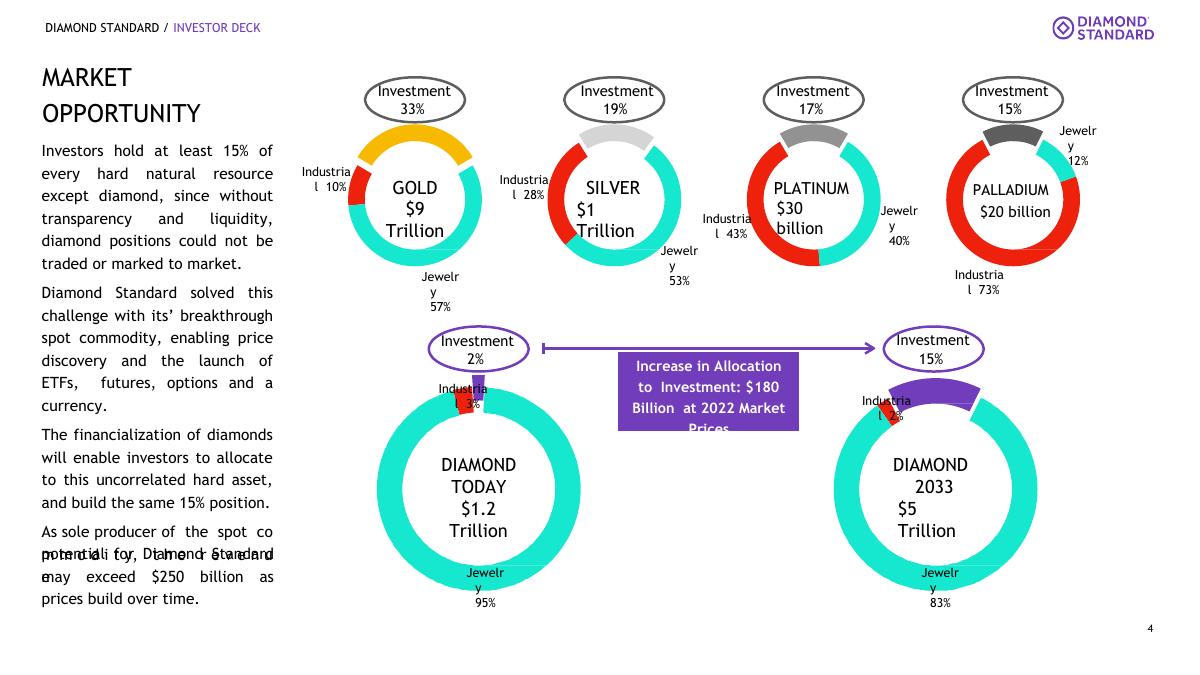
An extension of slide 4 with the allocation split for each metal (gold 33% investment / 10% industrial; silver 19% investment / 28% industrial; platinum 17%; palladium 15% with 73% industrial and 12% jewelry) versus diamonds today: $1.2 trillion, 95% jewelry, ~5% investment. A "today vs 2033" panel projects diamonds at $5 trillion with a 15% investment allocation, described as an increase in allocation to investment of $180 billion at 2022 market values. The slide also claims the revenue potential for Diamond Standard as sole producer of the spot commodity "may exceed $250 billion as prices build over time."
That last claim is where the deck loses a sophisticated investor. A $250 billion figure is not a revenue projection, it is a notional market-size figure being presented in the same visual register as company revenue. There is no take rate, no fee schedule, no assumption about the spread Diamond Standard earns per Coin, and no path from "market grows to $5T" to "we earn X." If you take one thing from this teardown: never state a company number that is really a market number . Show the take rate instead. A 40bps fee on $180 billion of new allocation is a defensible, checkable claim; "$250 billion" is not.
Slide 6 — How do we make a diamond commodity?
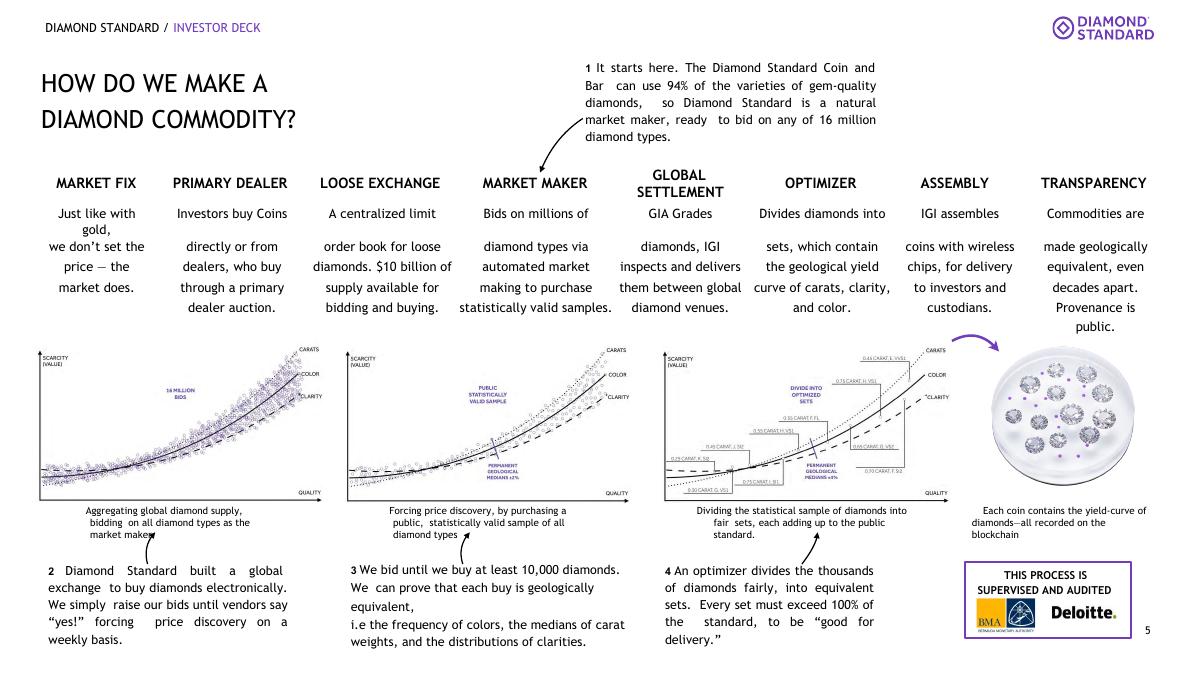
A seven-stage process diagram: Market Fix (like gold, we don't set the price, the market does) → Primary Dealer (investors buy Coins directly or from dealers through a primary dealer auction) → Loose Exchange (a centralized limit order book for loose diamonds, with $10 billion of supply available for bidding and buying) → Market Maker (automated bidding on millions of diamond types) → Global Settlement (GIA grades, IGI inspects and delivers between global diamond venues) → Optimizer (divides diamonds into sets containing statistically valid samples of the geological yield curve of carats, clarity and color) → Assembly (IGI assembles coins with wireless chips for delivery to investors and custodians) → Transparency (commodities are made geologically equivalent even decades apart; provenance recorded). A callout notes the Coin and Bar can use 94% of the varieties of gem-quality diamonds, so the company is a natural market maker ready to bid on any of 16 million diamond types.
This is the best-executed slide in the deck. It answers the only question that really matters — "how can diamonds possibly be fungible?" — with a mechanism rather than an assertion, and it names third parties (GIA, IGI) who are doing the verification. Naming an external, credible verifier is worth more than three slides of your own claims.
It is also, at seven stages plus a callout, far too dense for a live pitch. If you build a process slide like this, build the two-stage version for the meeting and keep the seven-stage version in the appendix for diligence.
Slide 7 — Diamond Standard Exchange
The supply side. The company built the Diamond Standard Exchange, described as the world's first and only electronic loose diamond exchange with a market maker and global settlement. All natural diamonds for the commodities are purchased there. Vendors are registered, established diamond manufacturers and dealers globally; the company does not buy from consumers here. The purchase process is described as regulator-approved and audited, with the system automatically buying or bidding on thousands of round diamond types to acquire statistical samples across a wide range of natural supply, paying COD with no returns. A screenshot of the live exchange sits on the right.
Two things work. First, the screenshot: a real, live product surface beats a mockup every time. Second, "COD with no returns" is a concrete operating detail that makes the whole thing feel built rather than described.
What's missing is volume. How many vendors are registered? How many diamonds have been purchased? What is the fill rate, and what did the company pay versus retail? A supply-side slide without a single number is a slide about architecture, not about a working market.
Slide 8 — Diamond Standard Recycling
A second sourcing channel, described as "preparing to launch" and expected to become the world's leading buyer of used jewelry from consumers. Six numbered reasons: 85% of natural diamonds are owned by consumers, so supply is diminishing; ESG framing as a $150 billion "social dividend"; an "unprecedented trusted buyer" that is regulated, transparent and audited by Deloitte; buying via FedEx with instant payment; use or scrap of all materials with no selling cost; and combination with Coin assembly. A screenshot shows the recycling site with the tagline "Brands Don't Impress Us."
Strategically this is the sharpest idea in the deck: consumer recycling both improves gross margin and turns the supply problem into a marketing problem the company can control. The honest label "preparing to launch" is again good practice.
But note what the deck does not do: it never quantifies the margin improvement. "Improving our margins" is a sentence, not a number. If your slide claims a margin benefit, put a before-and-after on it or cut the claim.
Slide 9 — ESG
Four stat tiles: 85% projected share of commodity diamonds recycled from consumers, 1,000+ global jobs created via production and distribution, a $150 billion projected "societal dividend" to families who own unused diamonds, and 8 diamond intake centers enabling small vendors to sell globally. Beneath them, three pillars — Natural Capital, Economic Integration, Industry Leadership — arguing that nature determines scarcity, that the exchange creates an accessible online market, and that as the first regulator-approved diamond commodity the company set the standard for the industry.
The problem is that three of the four tiles are projections and one ("8 intake centers") is a fact, and they are styled identically. When you mix shipped facts with forecasts in the same visual treatment, a careful investor discounts all four. Separate them. Also, the $150 billion appears here for the third time in the deck wearing a different hat each time — allocation gap on slide 4, market growth on slide 5, social dividend on slide 9. Reusing one big number for three different arguments is a tell that the number is doing rhetorical rather than analytical work.
Slide 10 — Founder, Cormac Kinney
A full-slide founder bio. Four exits to public companies or funds; over $600 million in capital raised and managed; three degrees from Carnegie Mellon; innovations cited in over 4,000 U.S. patents filed by others; inventor of heatmaps, combined with in-memory analytics and middleware to redesign over 100 institutional trading systems; an early developer of sentiment analysis used to manage over $500 million for Tudor and Millennium. It closes on the current focus: unlocking a $1.2 trillion asset class through the invention of the fungible diamond commodity.
Giving a full slide to one founder is unusual and here it is justified. For a company asking investors to trust it with regulated financial infrastructure, "this person has built institutional trading systems and managed institutional money" is the risk-reduction argument. Founder credibility is a legitimate slide when the risk being underwritten is execution against regulators and exchanges.
The bio is also doing something subtle: every credential is adjacent to the current business . Quant finance, trading systems, institutional capital. Nothing about unrelated ventures. Prune your own bio the same way — relevance beats volume.
Slide 11 — Organization
An org chart with the CEO (Cormac Kinney — strategy, legal, R&D) at the centre and seven functions around him: Markets (Douglas Jordan — primary dealer, marketplace, fund ops/trading, exchange listings, futures/options, Bitcarbon, bus dev); Marketing & E-Commerce (Chris Dessi); DSAM institutional sales (Mark Lieberman); Operations (John Betts — technology/platforms, product management, CRM development, facilities, contracts, custody); Risk & Compliance (Corey Reason); Commodities (Kyle Denbrook — diamond buying, assembly, logistics, recycling, exchange); Finance (James Campbell — accounting, audit, reporting); and Development (Rajiv Sohal — architecture).
Including a named Risk & Compliance lead is the right call for a regulated business — it signals the function exists as a peer to Markets rather than as an afterthought. Several boxes carry a "+" prefix on responsibilities, which appears to mark roles that are being added, though the deck never explains the notation. Unexplained notation on a team slide is a small unforced error.
And then the deck stops. Slide 11 is the last slide. There is no ask, no use of funds, no valuation, no traction summary, no contact details.
What this deck does better than most startup pitch decks
It anchors a new category to a known one in the first sentence. "A liquid hard asset like gold" does more explanatory work than a paragraph of description. · It disclaims its own data. The footnote admitting industry estimates "may not be reliable" is rare and buys credibility for the numbers the founder does stand behind. · It marks unshipped items unshipped. "(coming soon)," "anticipated," "preparing to launch," and the legal footnote all keep the roadmap honest. · It shows real product screenshots. The exchange and the recycling site both appear as live surfaces, not mockups. · It names third-party validators. GIA, IGI, Deloitte, CME, MIAX, MGEX, Davis Polk, Horizon Kinetics — every one of them is a name the investor can independently check. · It explains the hard mechanism instead of asserting it. Slide 6 answers "how are diamonds fungible?" with a seven-stage process, which is the only way that claim survives scrutiny. · Its founder slide is pruned for relevance. Every credential maps directly onto the risk the investor is underwriting.
Where this deck would fail in an investor meeting
No ask. The file name says $30M Series A. The slides say nothing. The investor has to infer the round size from a filename, which is not a strategy. · No use of funds. If the roadmap has four unshipped products, the natural question is which ones the $30M buys and by when. Unanswered. · No traction. The physical commodity offering began in March 2021 and a fund launched in July 2022, yet the deck contains zero dollars of commodity sold, zero AUM, zero customer count, zero revenue. · No unit economics. How much does one Coin cost to source, grade, assemble and custody, and what does it sell for? That single number would carry the whole deck and it is absent. · A market number dressed as a company number. "$250 billion" revenue potential with no take rate is the kind of claim that makes an investor distrust the careful slides too. · One number, three jobs. $150 billion appears as an allocation gap, a market increase, and a social dividend. Pick one. · No competition or substitutes. Lab-grown diamonds, existing diamond funds, gold itself, and simply not allocating are all live alternatives. None appears. · Regulatory risk is only shown as an asset. Approvals are listed as wins; nothing addresses what happens if Bitcarbon is treated as a security, or how the company handles a CFTC or SEC change of posture. · No contact slide. The deck ends on an org chart. An investor who is sold has nowhere to go.
Thesis deck vs. complete Series A deck
Element What the Diamond Standard deck does What a complete Series A deck does
Opening Mission plus three business lines Same — this one is strong
Market Two slides of allocation-gap analysis One slide, with the counter-argument acknowledged
Mechanism Detailed seven-stage process Two-stage version, full detail in appendix
Traction Absent Revenue or volume, growth rate, cohort behaviour
Unit economics Absent Cost to produce, price, gross margin per unit
Risk Regulation framed only as a moat Top three risks named with mitigations
Team Founder slide plus org chart Same, with hires the round funds
Ask Only in the file name Amount, use of funds, milestones it buys
How you would rebuild this deck
Keep slides 1, 3, 6 and 10 almost untouched. Mission, product, mechanism and founder are the strongest sequence in the deck. · Collapse slides 4 and 5 into one market slide. Lead with the 1% versus 15% allocation gap, keep the data disclaimer, and delete the $250 billion claim entirely. · Add a traction slide after the product slide. Commodity sold since March 2021 in dollars, fund AUM since July 2022, number of registered exchange vendors, number of Coins assembled. Whatever the real numbers are, they beat their absence. · Add a unit economics slide. Cost per Coin — diamonds, grading, chip, assembly, custody — versus the sale price, with the recycling channel shown as the margin lever it is claimed to be. · Split the ESG tiles into shipped and projected. Eight intake centres is a fact; the other three are forecasts and should be visually labelled as such. · Add a substitutes slide. Lab-grown diamonds, gold, existing diamond funds, doing nothing — and the one-line reason each fails for the target allocator. · Reframe the regulatory slide as risk plus moat. List the approvals held, then the two regulatory outcomes that would hurt, then the mitigation. Investors trust founders who name their own downside. · End on the ask. $30M, the three milestones it funds, the date each lands, and a contact line. Never let the round size live only in the file name.
The transferable lesson
Diamond Standard's deck is a category-creation argument of unusual quality attached to a fundraising deck that is missing its second half. The founder clearly knows how to explain a hard mechanism to a sophisticated audience — slide 6 is better than what most Series A companies produce — and just as clearly decided that the mechanism was the pitch. It isn't. Once an investor believes the mechanism works, every subsequent question is commercial: what have you sold, at what margin, to whom, and what does my money buy.
The pattern generalises. Deep-tech, fintech and regulated-market founders consistently over-invest in the "is this even possible?" slides and under-invest in the "is this a business?" slides, because the first set is the part they find intellectually interesting. Investors run the opposite priority: they give you about ninety seconds of benefit of the doubt on feasibility, then spend the rest of the meeting on economics. A deck that never gets to economics leaves that time to be filled by the investor's own assumptions, which are always worse than your real numbers.
Look at your own deck and count the slides. If more than half of them are explaining how the thing works and fewer than three contain a number that came out of your own operations, you have written a thesis deck. Add traction, unit economics, competition and a clear ask, and you have a fundraising deck — the same one, finished.
Frequently asked questions
- Is the Diamond Standard deck a real pitch deck for investors?
- Yes. The 11-slide deck is an investor deck exported from a PowerPoint file named 'PDT NA - $30M - Series A - Diamond Standard.pptx', which indicates a $30 million Series A raise. The slides themselves never state the round size, use of funds or contact details, so it functions more as a category-creation thesis deck than a complete fundraising deck.
- What is Diamond Standard?
- Diamond Standard is a New York company that developed what it describes as the first and only regulator-approved diamond commodity. Its Coins and Bars each contain an equivalent set of natural diamonds plus a wireless chip holding a blockchain token called Bitcarbon, making the commodity fungible and tradeable so diamonds can be held and priced like gold or silver.
- Which slides should founders copy from the Diamond Standard deck?
- Four. Slide 1 anchors a new category to gold in one sentence. Slide 3 marks unshipped products '(coming soon)' inline. Slide 6 explains the hard mechanism in stages and names third-party verifiers instead of asserting the claim. Slide 10 prunes the founder bio so every credential maps to the risk investors are underwriting.
- What is missing from the Diamond Standard pitch deck?
- Traction, unit economics, competition and the ask. Despite a commodity offering launched in March 2021 and a fund launched in July 2022, the deck reports no revenue, AUM or customer numbers. It also omits cost per Coin, gross margin, substitutes such as lab-grown diamonds or gold, use of funds and any contact slide.
- Why is the $250 billion revenue claim a problem?
- Because it is a market number presented as a company number. The deck states revenue potential 'may exceed $250 billion' without a take rate, fee schedule or spread per Coin, so there is no path from market growth to company earnings. A defensible version would show a basis-point fee applied to the projected new allocation instead.
- How many slides should a Series A deck have?
- Most Series A decks land between 12 and 18 slides. Diamond Standard's 11 slides are not too few in themselves — the problem is what they spend space on. Roughly seven slides explain the mechanism and market, while traction, unit economics, competition, risk and the ask get zero slides between them.