The Albert pitch deck is a study in restraint. In just 10 slides, the founders articulate a clear psychological barrier (millennials avoiding money decisions), a two-pronged solution (advice + action), and a compelling financial engine. The deck’s strength lies in its transparency regarding unit economics, claiming a $5 acquisition cost against a $200 revenue per action. While it lacks a traditional roadmap or detailed competitive analysis, it compensates with social proof and founder pedigree. This deck was instrumental in a journey that eventually raised $175.6 million, proving that for ear…
Key takeaways
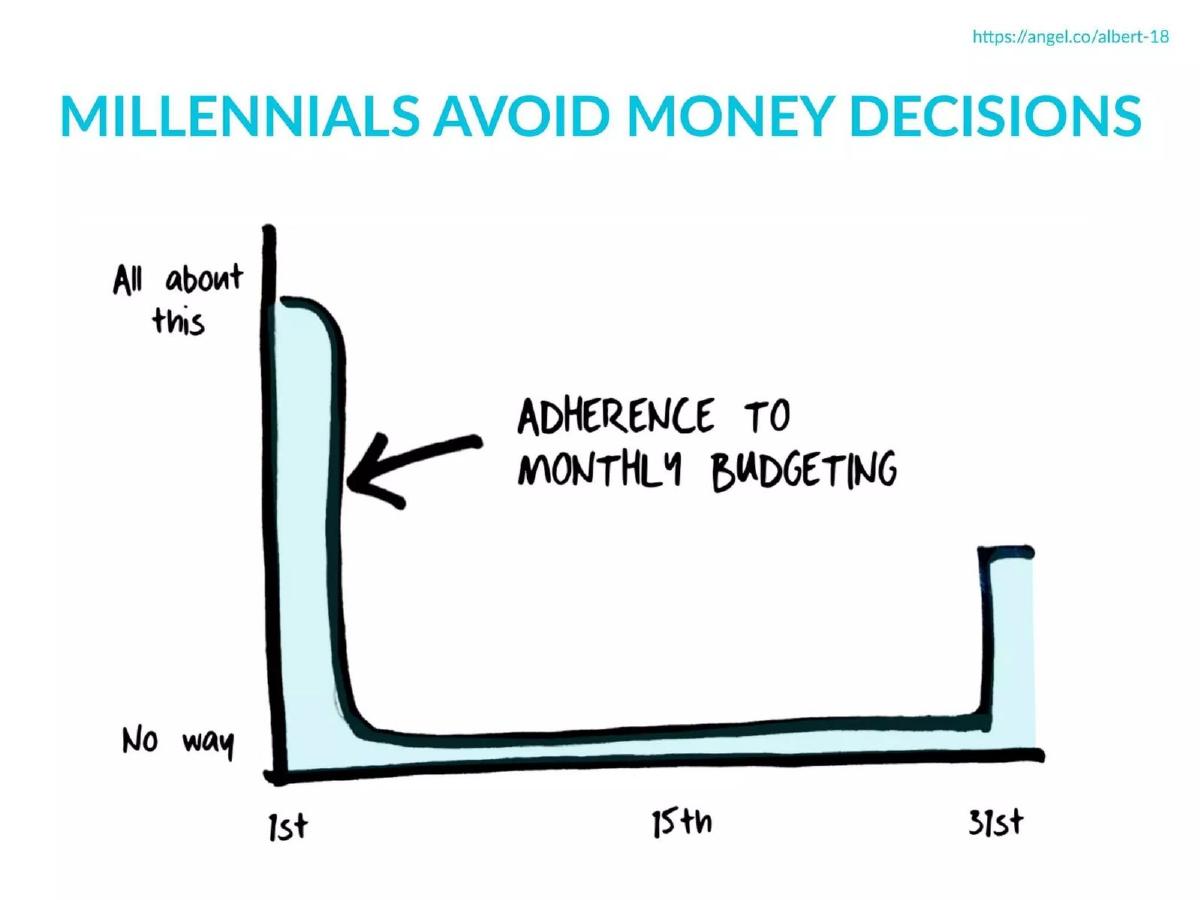
- The deck identifies a specific psychological problem: the 'drop-off' in budgeting adherence after the 1st of the month (Slide 2).
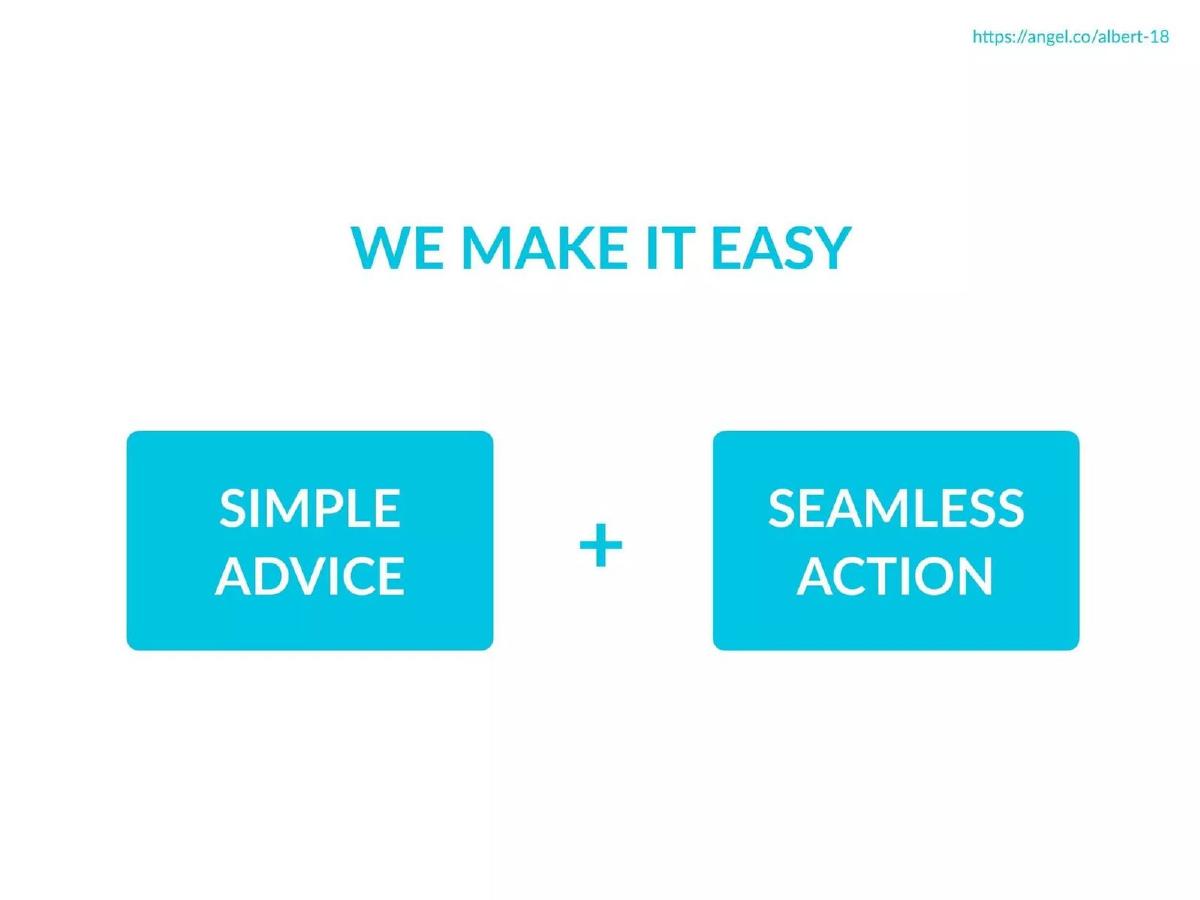
- The value proposition is distilled into a simple equation: Simple Advice + Seamless Action (Slide 3).
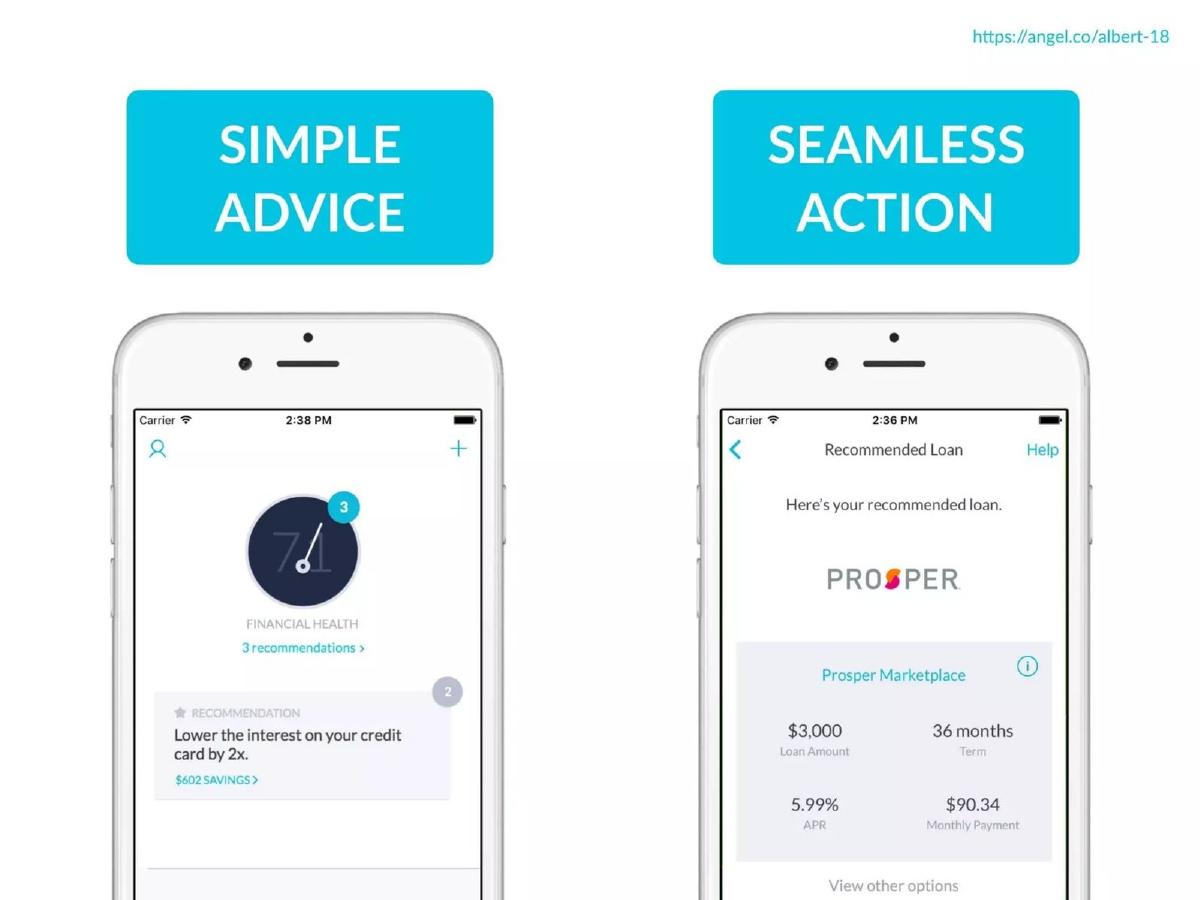
- Product functionality is demonstrated through a partnership with Prosper to show how advice leads to immediate financial products (Slide 4).
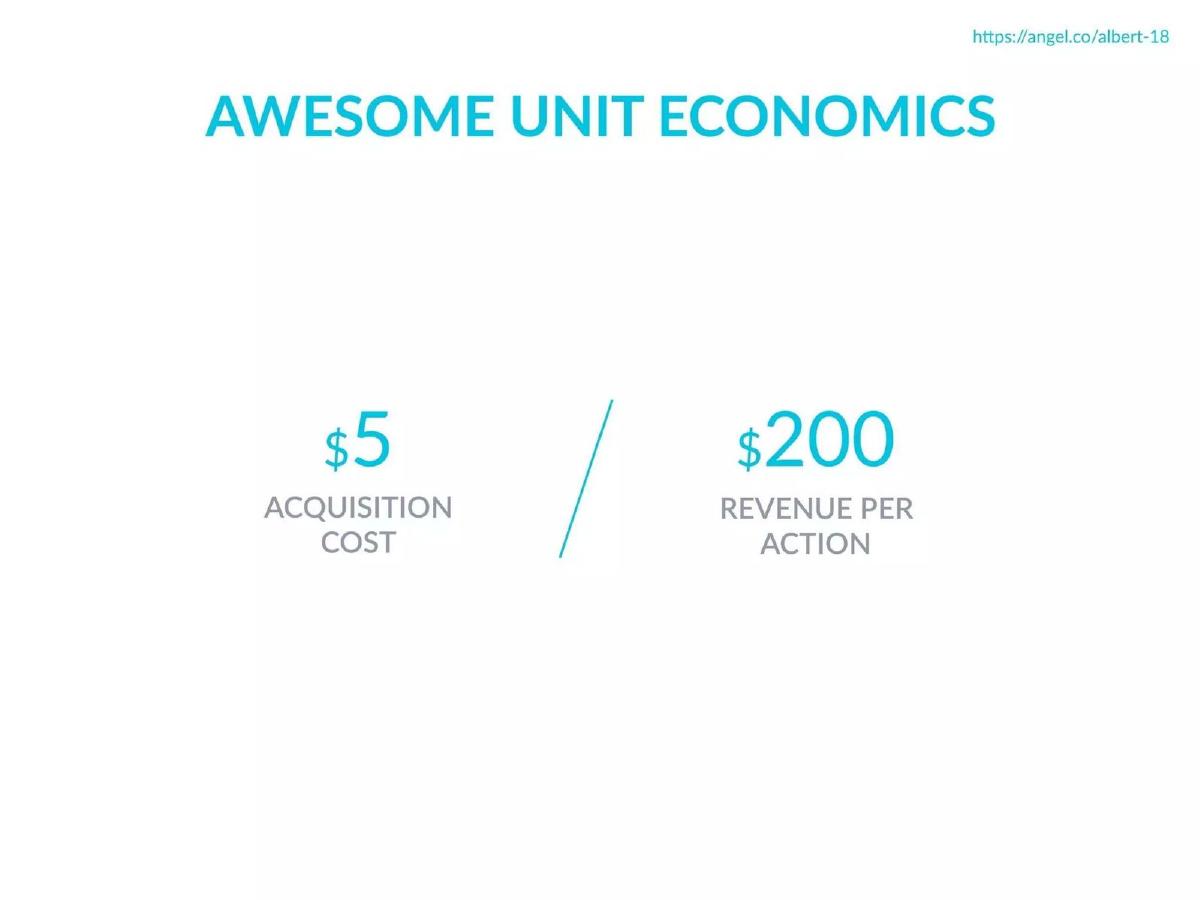
- The startup claims a highly efficient 40x ratio between acquisition cost ($5) and revenue per action ($200) (Slide 5).
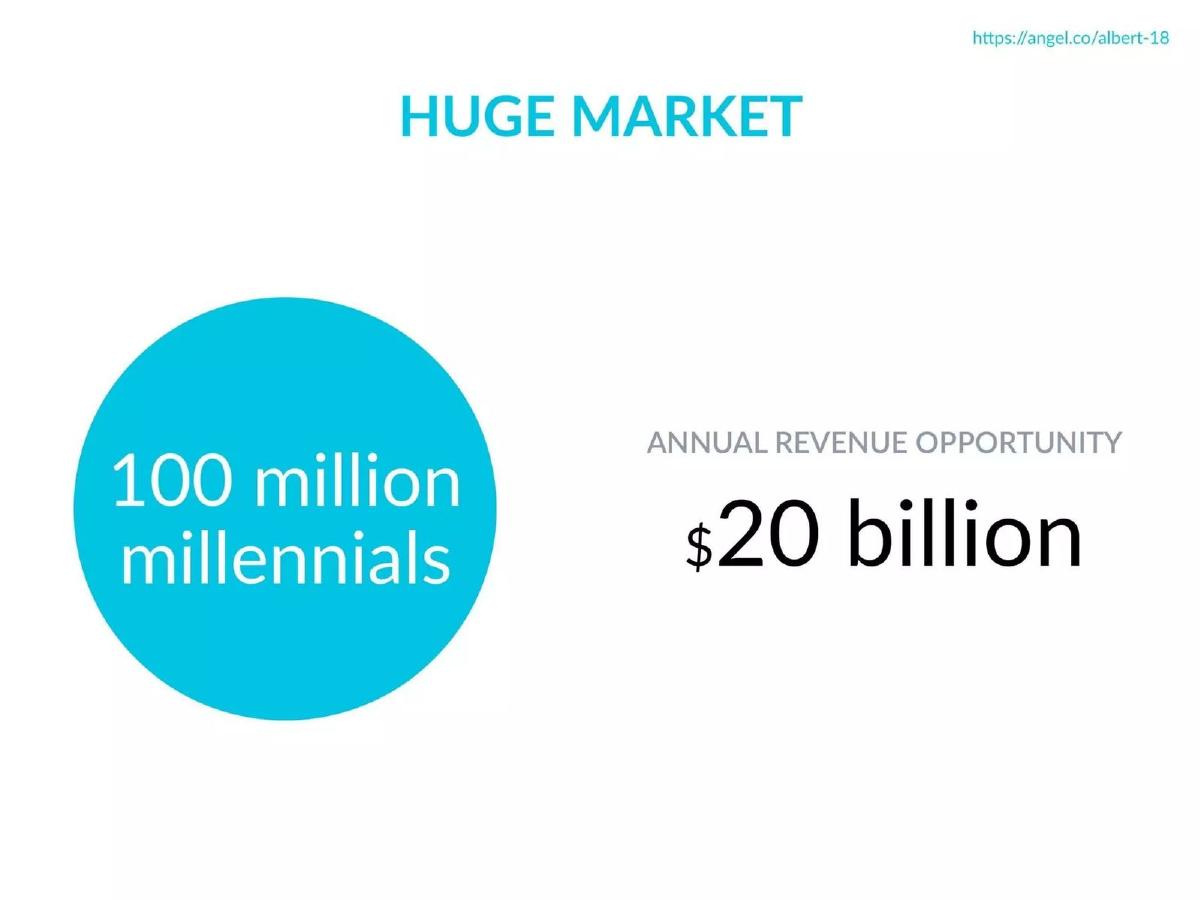
- Market size is defined by a specific demographic: 100 million millennials representing a $20 billion opportunity (Slide 6).
- The team slide emphasizes 'Engineers with Financial Expertise,' highlighting backgrounds at BCG, Harvard, and Columbia (Slide 7).
- Traction is presented as a single, bold figure: 15,000 signups (Slide 8).
- The deck uses actual social media creative to prove their marketing message resonates with the target audience (Slide 9).
The Power of Simplicity in Fintech Fundraising
The Albert pitch deck is a refreshing departure from the data-dense, 30-slide presentations common in the fintech sector. Established in 2015 in Culver City, California, Albert set out to democratize financial advice. This deck, consisting of only 10 slides, manages to cover the essential pillars of a venture-backed business: problem, solution, unit economics, market size, team, and traction. It does so with a minimalist aesthetic that mirrors the product’s core promise: making money management simple.
Slides 1-2: The Hook and the Psychological Problem
Slide 1 is a standard title slide featuring the Albert logo and the URL meetalbert.com. It establishes the brand's primary color—a bright, approachable cyan—which carries through the entire presentation.
Slide 2 introduces the problem statement: "MILLENNIALS AVOID MONEY DECISIONS." Rather than using a wall of text or generic statistics about debt, Albert uses a hand-drawn style graph showing "Adherence to Monthly Budgeting." The graph shows a massive spike on the 1st of the month ("All about this") followed by a total collapse until the 31st. This is a brilliant piece of storytelling because it identifies a behavioral truth rather than just a financial one. It suggests that the problem isn't a lack of tools, but a lack of sustained engagement.
Slides 3-4: The Two-Part Solution
Slide 3 presents the solution in the simplest possible terms: "WE MAKE IT EASY." It breaks the product down into a formula: Simple Advice + Seamless Action . This is the 'North Star' of the deck. It tells the investor that Albert isn't just a budgeting app (advice) and isn't just a marketplace (action), but the bridge between the two.
Slide 4 provides the evidence for this formula. It shows two mobile mockups. The first, under "Simple Advice," shows a financial health score and a specific recommendation: "Lower the interest on your credit card by 2x." The second, under "Seamless Action," shows a direct integration with Prosper, offering a $3,000 loan at 5.99% APR. This slide is critical because it demonstrates the monetization path without needing a dedicated 'Business Model' slide. It shows that Albert intends to make money by facilitating financial transactions that benefit the user.
Slide 5: The 'Awesome' Unit Economics
Slide 5 is perhaps the most important slide for a Series-stage investor. Titled "AWESOME UNIT ECONOMICS," it displays two numbers: a $5 Acquisition Cost and $200 Revenue Per Action . In the world of consumer fintech, where customer acquisition costs (CAC) often exceed $50 or $100, a $5 CAC is extraordinary. By showing a 40x return on a single 'action,' Albert makes the case that they have found a highly efficient way to acquire and monetize users. This slide alone likely did the heavy lifting for their early rounds.
Slide 6: Market Opportunity
Slide 6 addresses the TAM (Total Addressable Market). It identifies "100 million millennials" as the target demographic and calculates an "ANNUAL REVENUE OPPORTUNITY" of $20 billion . While the slide doesn't show the math behind the $20 billion figure, the previous slide's $200 revenue per action provides a logical basis for high-value monetization across a large user base.
Slide 7: The Team
Slide 7 introduces the founders, Andrzej Baraniak and Yinon Ravid, under the headline "ENGINEERS WITH FINANCIAL EXPERTISE." This is a strategic framing. It tells investors that the founders have the technical chops to build the product and the industry knowledge to navigate the complex world of finance. The slide highlights prestigious institutions: Boston Consulting Group, Harvard Business School, Columbia University, Openfolio, and Oak Hill Advisors . This provides the necessary 'institutional credibility' to handle consumer capital.
Slides 8-9: Traction and Social Proof
Slide 8 is a 'vanity' metric slide in the best sense: "15,000 SIGNUPS" in large, bold letters. For an early-stage company, this number proves initial product-market fit.
Slide 9 reinforces this traction by showing how they achieved it. It displays a Facebook sponsored post and an Instagram post. The Facebook ad uses the same 'budgeting adherence' graph from Slide 2, closing the loop on their marketing strategy. The Instagram post shows a Venn diagram where the intersection of "All of the financial advice out there" and "Things you can actually do" is labeled "WHAT YOU NEED TO KNOW." This slide proves that their minimalist, psychological approach to finance actually resonates with users on social platforms, justifying the $5 CAC claimed earlier.
Slide 10: The Conclusion
Slide 10 is a simple closing slide with the URL MEETALBERT.COM. Notably, there is no 'Ask' slide in this version of the deck. This is common in decks shared publicly or used as 'teasers,' though in a live pitch, the founders would have specified the amount they were raising and the milestones they intended to hit.
What Works in This Deck
The primary strength of the Albert deck is its clarity of purpose . It doesn't get bogged down in technical architecture or regulatory hurdles. Instead, it focuses on the user's psychological barrier and the company's financial efficiency. The use of the 'Advice + Action' formula is a powerful mnemonic that helps investors remember exactly what the company does. Furthermore, the unit economics slide is a 'mic drop' moment; a 40x LTV/CAC ratio (even if based on a single action rather than lifetime value) is an immediate attention-grabber for any VC.
What Is Missing
Competitive Landscape: There is no mention of how Albert differs from established players like Mint, or emerging competitors like Acorns and Robinhood. · Roadmap: The deck shows what the product is today but doesn't outline the future. There is no mention of the 'Albert Instant' feature or the automated investing mentioned in the company's later descriptions. · The 'Ask': As mentioned, the lack of a funding goal or use-of-funds breakdown is a missing piece of the fundraising puzzle. · Detailed Financials: Beyond the unit economics, there is no information on burn rate, runway, or projected revenue growth over the next 3-5 years.
What a Founder Should Copy
Founders should emulate Albert’s visual storytelling . The graph on Slide 2 is far more effective at explaining a problem than a bulleted list of 'Pain Points.' Additionally, the way Albert integrated their business model into the product demo (Slide 4) is a masterclass in efficiency. It shows the investor the user experience and the revenue stream simultaneously. Finally, the Team Slide framing is excellent. Instead of just listing titles, they used a headline ("Engineers with Financial Expertise") that explicitly states why this specific team is the right one to solve this specific problem.
Frequently asked questions
- How much did Albert raise with this deck?
- While this specific 10-slide deck was used in their early stages (circa 2015), the company has raised a total of $175,600,000 according to catalogue data. Key investors include General Atlantic, CapitalG, and 500 Startups.
- What is the core revenue model shown in the deck?
- The deck implies a lead-generation or marketplace model. Slide 4 shows a 'Recommended Loan' from Prosper, and Slide 5 highlights '$200 Revenue Per Action,' suggesting that Albert earns commissions when users take financial actions based on their advice.
- Is there a competitive analysis in the Albert deck?
- No. The deck completely omits a competitive landscape slide. It relies on the uniqueness of its 'Advice + Action' approach and its superior unit economics to imply a competitive advantage rather than naming rivals like Mint or Acorns.
- Who are the founders of Albert?
- The founders are Andrzej Baraniak and Yinon Ravid. As shown on Slide 7, they position themselves as 'Engineers with Financial Expertise,' with experience at Boston Consulting Group, Openfolio, and Oak Hill Advisors.
- What is the 'Albert Instant' feature mentioned in the description?
- Although not explicitly detailed in these 10 slides, the company description notes that Albert Instant offers customers an advance against their paychecks to avoid overdrafts. The deck focuses more on the broader 'Advice + Action' framework.