Algosave's March 2017 investor deck targets the financial services sector with a focus on integrating risk and finance. The presentation, though partially obscured in this filtered version, outlines a dual-revenue model centered on IFRS9 reporting solutions for large institutions and a credit risk database for industry benchmarking. The team brings significant experience from investment banking and credit proprietary trading. While the deck effectively identifies legacy competitors like Oracle and Moody's, it relies heavily on high-level thematic slides and lacks granular technical detail in…
Key takeaways
- The deck dates back to March 2017, positioning the company during a period of significant regulatory shifts in financial reporting (Slide 1).
- Algosave identifies a 'storm' in the financial sector, likely referring to impending regulatory or market volatility (Slide 2).
- The leadership team includes a CEO with 15 years of investment banking experience and a Co-Founder with 20 years in credit proprietary trading (Slide 10).
- The company differentiates itself from Oracle and Moody's by claiming real-time capabilities and a lack of legacy system constraints (Slide 13).
- Revenue is driven by two main products: an IFRS9 Reporting Solution ($500k annual cost) and a Credit Risk Database ($75k annual subscription) (Slide 16).
- The IFRS9 solution is specifically marketed as a 'Challenger Model' for large financial institutions (Slide 16).
- The deck includes an appendix covering funding needs, business model assumptions, and competitor valuations, though specific funding amounts are not visible on the summary slide (Slide 25).
- Competitor valuation data highlights massive incumbents, including Oracle with a $184 billion market cap and $37.5 billion in revenue at the time (Slide 28).
Algosave Pitch Deck Analysis: Integrating Risk and Finance
The Algosave investor deck from March 2017 presents a specialized financial technology solution aimed at the institutional banking sector. The deck focuses on the intersection of algorithmic risk management and financial reporting, specifically targeting the complexities of IFRS9 compliance. This teardown examines the structure and content of the filtered deck, highlighting its strengths in team expertise and its clear, high-value business model.
Slide 1: Title Slide
The cover slide establishes the brand identity with the tagline "Integrate risk & finance." It clearly states the document is an "INVESTOR DECK" and provides a date of "MARCH 2017." The background imagery features a hand interacting with a digital interface showing financial charts, which reinforces the company's focus on data-driven financial technology.
Slide 2: The Hook
Slide 2 uses a dramatic visual of a man with an umbrella facing a lightning storm, accompanied by the text "A storm is coming." In the context of 2017, this likely refers to the implementation of new regulatory standards like IFRS9 or broader market volatility. This is a classic "problem" slide designed to create a sense of urgency for the solution that follows.
Slide 7: Presentation Roadmap
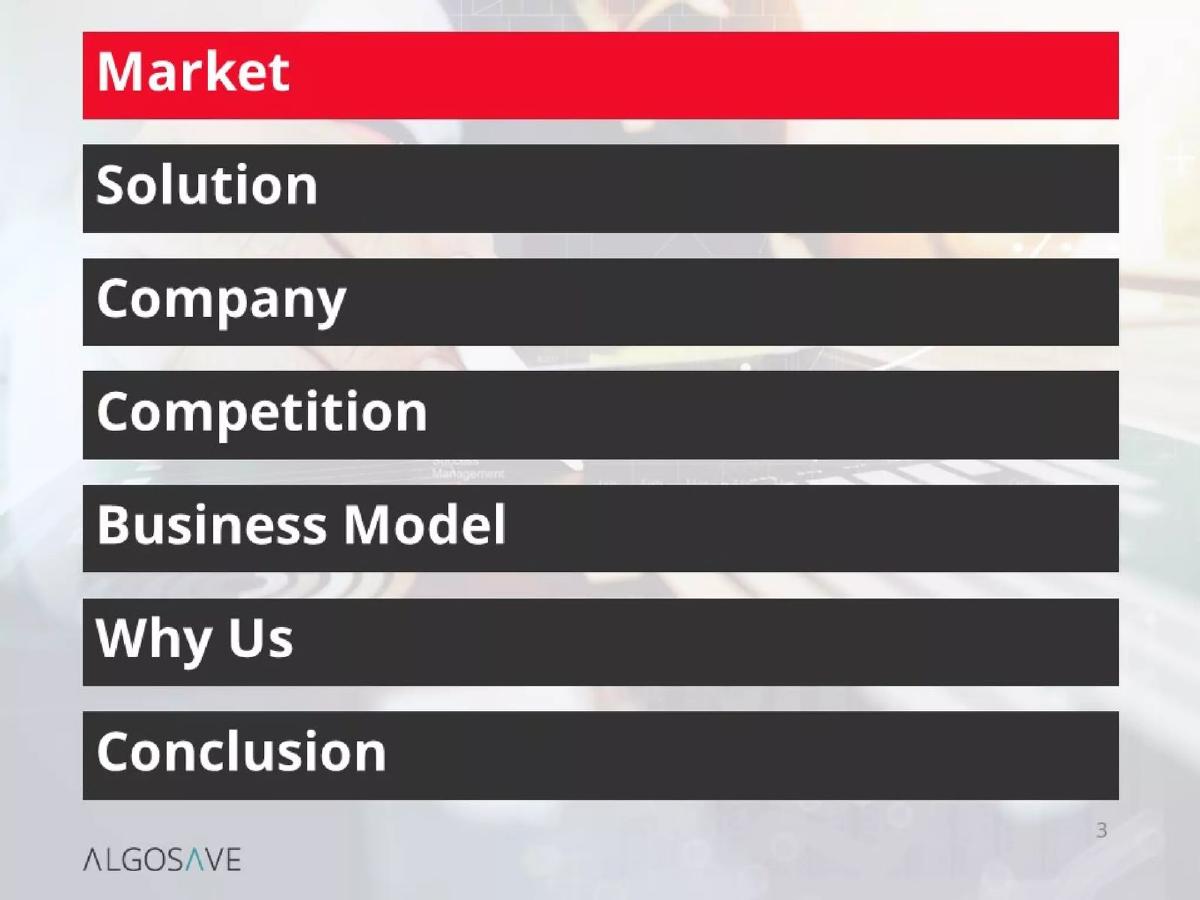
This slide serves as a table of contents, highlighting the "Solution" section in red. The planned sections include Market, Solution, Company, Competition, Business Model, Why Us, and Conclusion. Using a roadmap helps investors track the narrative flow of the pitch, though this specific slide is a transition marker rather than a content-heavy slide.
Slide 10: The Leadership Team
The "Company" slide introduces the core team. The CEO is credited with 15 years of experience in Investment Banking, specifically in capital markets and credit derivatives. The Co-Founder is listed with 20 years of experience in credit proprietary trading, having managed a credit hedge fund until 2013. Finally, Dr. Michel Crouhy is presented as a Business and Scientific Advisor with 40 years of experience in banking and risk management. The text on this slide is heavily stylized and somewhat difficult to read due to the filtering, but the pedigree of the team in high-finance is clear.
Slide 13: Competitive Landscape
Under the heading "A DIFFERENT APPROACH," Algosave compares itself to Oracle and Moody's. The comparison is based on three criteria: "Improved Accuracy," "Real-Time," and "No Legacy." Algosave claims to possess all three. Oracle is shown to have accuracy but lacks real-time capabilities and suffers from legacy issues. Moody's is shown to have real-time capabilities but lacks accuracy and also suffers from legacy constraints. This slide is a standard competitive matrix designed to show a "white space" that only the startup occupies.
Slide 16: Business Model and Revenue Streams
This slide outlines two distinct revenue paths. The first is the "IFRS9 REPORTING SOLUTION," priced at a "$500K annual cost." It is described as a "Challenger Model for large financial institutions." The second is the "CREDIT RISK DATABASE," which carries a "$75K annual subscription fee" and provides "Industry Benchmarks for regulatory consistency." The high price points indicate a low-volume, high-margin enterprise sales strategy.
Slide 19: Value Proposition Transition
Similar to slide 7, this is a transition slide highlighting the "Why Us" section. It maintains the consistent visual theme of the deck but contains no new data or arguments.
Slide 22: Conclusion Transition
This slide marks the transition to the "Conclusion" of the main presentation. It serves as a visual break before the final summary and the subsequent appendix.
Slide 25: Appendix Overview
The Appendix slide lists four sub-sections: "What We Need," "Business Model Assumptions," and "Competitors Valuation." This indicates that the founders prepared deeper financial and operational details to be used during the Q&A portion of a pitch, which is a professional practice in fundraising.
Slide 28: Competitor Valuations
The final visible slide provides a table of "Competitors Valuation." It lists Moody's with a Market Cap of $22 billion and Revenue of $3.6 billion (a 15x EV/Revenue multiple). Oracle is listed with a Market Cap of $184 billion and Revenue of $37.5 billion (a 12x multiple). A third, partially obscured competitor is listed with a $2.2 billion market cap and $0.3 billion in revenue (a 12x multiple). This slide is intended to justify a high valuation for Algosave by showing the rich multiples at which established players in the risk and finance space trade.
What Works in This Deck
Deep Domain Expertise: The team slide (Slide 10) is a significant asset. For a fintech startup dealing with complex regulatory requirements like IFRS9, having founders with decades of experience in investment banking and credit trading is essential for credibility. Investors in this space prioritize "insider" knowledge, and this team appears to have it.
Clear Pricing Strategy: Slide 16 does not shy away from high numbers. By stating a $500,000 annual cost for their primary solution, Algosave clearly defines itself as an enterprise-grade software provider. This helps investors immediately understand the sales cycle and the type of customer the company is targeting.
Focused Competitive Differentiation: Instead of listing dozens of features, slide 13 focuses on three high-level architectural advantages: accuracy, speed (real-time), and modern infrastructure (no legacy). This is an effective way to communicate a technical edge to a non-technical audience.
What Is Missing or Omitted
Product Visuals: The filtered deck lacks screenshots or mockups of the actual software. While the "Solution" section is mentioned in the roadmap, the specific slides showing how the IFRS9 reporting tool or the Credit Risk Database actually looks or functions are not included in this selection. This makes it difficult to assess the user experience or technical sophistication of the product.
Traction and Pipeline: There is no mention of current pilots, signed contracts, or a sales pipeline. For a company seeking investment in 2017, especially with a $500k product, evidence of market validation (even in the form of Letters of Intent) is a critical omission.
The "Ask": While slide 25 mentions a "What We Need" section in the appendix, the actual funding amount, valuation, and use of proceeds are not visible in the provided slides. A pitch deck teardown is incomplete without understanding the capital requirements and the milestones that capital is intended to reach.
What a Founder Should Copy
The Thematic Roadmap: Using transition slides (Slides 7, 19, 22) to guide the audience through a 28-slide deck is a good practice. It prevents the audience from feeling lost and allows the presenter to reset the energy between sections.
Market Cap Benchmarking: Slide 28 is a very effective way to frame the "exit potential." By showing that incumbents trade at 12x to 15x revenue multiples, the founders are implicitly suggesting that Algosave could eventually command a similar premium if it captures even a small slice of the market.
Dual-Product Strategy: The business model on slide 16 shows a smart way to diversify revenue. By offering a high-cost compliance tool alongside a lower-cost data subscription, the company creates two different entry points for customers, which can help shorten sales cycles for the database while pursuing the larger reporting contracts.
Final Thoughts
Algosave's deck is a professional, albeit high-level, introduction to a complex B2B fintech solution. It leans heavily on the professional pedigree of its founders and the massive scale of its competitors to build a case for investment. While the filtered nature of the deck obscures some of the more granular details, the core value proposition—modernizing risk and finance integration for large institutions—is clearly communicated. Founders in the enterprise SaaS or fintech space can learn from Algosave's clear pricing and its focus on high-level competitive advantages over legacy incumbents.
Frequently asked questions
- What is Algosave's primary product offering?
- Based on slide 16, Algosave offers two primary products: an IFRS9 Reporting Solution and a Credit Risk Database. The reporting solution is designed as a 'Challenger Model' for large financial institutions to handle regulatory reporting, while the database provides industry benchmarks for regulatory consistency. The reporting solution carries a significantly higher price point of $500,000 per year compared to the $75,000 database subscription.
- Who are the key members of the Algosave team?
- Slide 10 lists three key figures: the CEO, who has 15 years of experience in investment banking; a Co-Founder with 20 years of experience in credit proprietary trading and hedge fund management; and Dr. Michel Crouhy, serving as a Business and Scientific Advisor with 40 years of experience in banking and risk management. This suggests a team with deep domain expertise in institutional finance.
- How does Algosave position itself against competitors?
- On slide 13, Algosave compares itself to Oracle and Moody's. It claims superiority by offering 'Real-Time' processing and having 'No Legacy' systems, which it contrasts against the competitors' perceived weaknesses in these areas. While it acknowledges Oracle has 'Improved Accuracy,' it suggests Moody's lacks it, positioning Algosave as the only provider checking all three boxes: accuracy, real-time data, and modern architecture.
- What is the target market for Algosave?
- The deck specifically mentions 'large financial institutions' on slide 16 in the context of their IFRS9 Reporting Solution. The pricing model ($500k/year) and the focus on regulatory compliance (IFRS9) and industry benchmarks indicate an enterprise-level B2B focus, specifically targeting banks and financial firms that must adhere to international accounting and risk standards.
- What financial information is provided about competitors?
- Slide 28 provides a valuation comparison for three competitors: Moody's, Oracle, and an unidentified third firm. It lists Moody's with a $22 billion market cap and $3.6 billion in revenue, and Oracle with a $184 billion market cap and $37.5 billion in revenue. This slide is intended to show the massive scale of the market Algosave is entering and the high revenue multiples (12x to 15x) enjoyed by incumbents.