The Skydance × Paramount merger deck is a sophisticated M&A document designed to convince public shareholders of the value in combining a legacy studio with a modern, 'prolific' independent production house. The deal involves a $2.4 billion acquisition of National Amusements and a subsequent merger valuing Skydance at $4.75 billion. The strategic core of the deck rests on 'unifying marquee rights'—bringing together franchises that were previously co-produced but split in ownership. Beyond the creative synergy, the deck promises $2 billion in run-rate cost efficiencies and a deleveraging of th…
Key takeaways
- The transaction is led by the Skydance Consortium, involving the Ellison family and RedBird Capital, contributing $6 billion in total capital (Slide 6).
- Skydance is valued at a $4.75 billion equity value for the merger, representing an 8.7x EV/2026E EBITDA multiple with realized efficiencies (Slide 28).
- A primary goal is the unification of rights for franchises like Top Gun ($1.5bn WWBO) and Mission: Impossible ($2.7bn WWBO) (Slide 18).
- The 'New Paramount' aims for $2 billion in run-rate cost efficiencies, with 50% delivered by Year 1 (Slide 22).
- The deal structure offers existing Class B shareholders $15.00 cash per share or one share of New Paramount Class B (Slide 6).
- Skydance positions itself as a 'de-risked' studio model that already owns or co-owns all its productions with diverse distribution partners (Slide 14).
- The financial plan targets an investment-grade credit rating and expects net leverage to fall below 2.5x by 2027 (Slide 30).
- The combined entity will prioritize five growth pillars: Unifying IP, Scripted, Animation, Interactive/Gaming, and Sports (Slide 20).
The $8 Billion Consolidation: A Deep Dive into the Skydance × Paramount Merger
The merger between Skydance Media and Paramount Global represents one of the most significant media consolidations of the 2020s. This deck, dated July 8, 2024, serves as the definitive roadmap for 'New Paramount.' It is not a traditional startup pitch deck; it is a sophisticated M&A document designed to satisfy institutional investors, regulatory bodies, and public shareholders. The narrative shifts from Paramount’s legacy IP to Skydance’s modern production efficiency, eventually landing on a combined financial future defined by aggressive cost-cutting and IP unification.
Slides 1-4: The Foundation and Transaction Overview
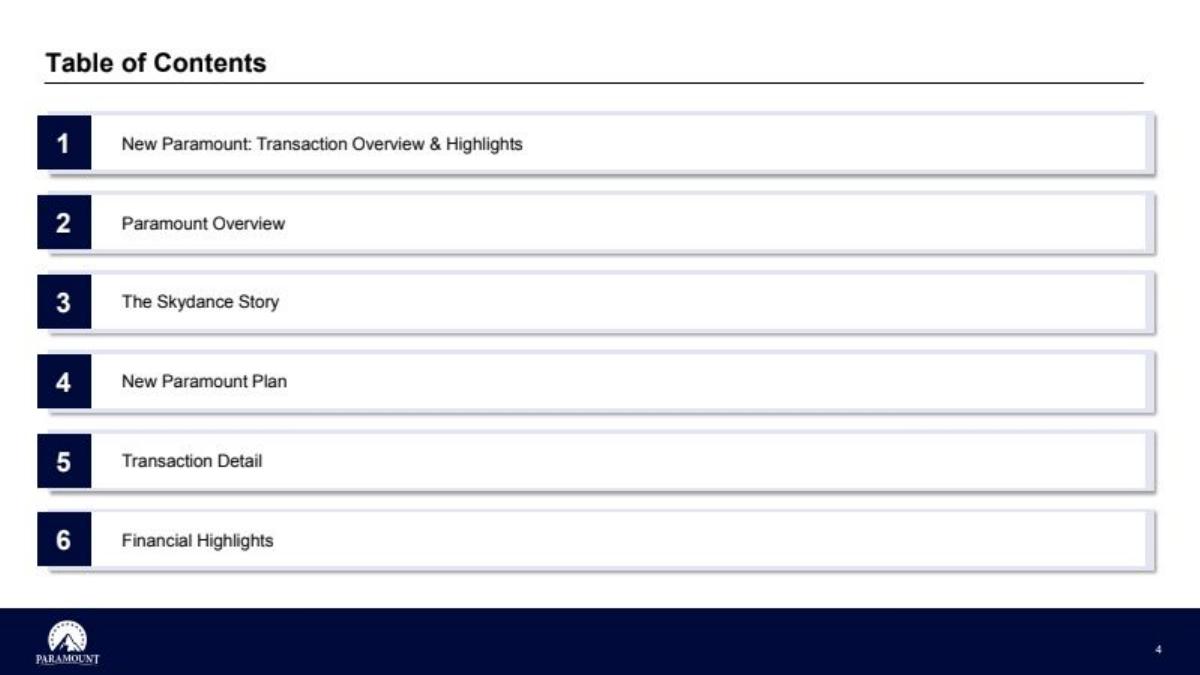
The deck opens with a standard title slide (Slide 1) and a dense legal disclaimer (Slide 2). The table of contents (Slide 4) breaks the presentation into six distinct phases: Transaction Overview, Paramount Overview, The Skydance Story, New Paramount Plan, Transaction Detail, and Financial Highlights. This structure is designed to build a logical case for the merger, starting with the 'what' before explaining the 'why' and the 'how much.'
Slide 6: The $8 Billion Capital Structure
Slide 6 is the most critical slide for understanding the mechanics of the deal. It explicitly states that the Skydance Consortium, led by the Ellison family and RedBird Capital, is investing $8 billion. The breakdown is as follows: $2.40 Billion Enterprise Value for the acquisition of National Amusements, $1.50 Billion in primary capital for Paramount, and $4.50 Billion for a cash election. The slide also notes that the Skydance Consortium will retain 100% pro forma voting ownership, while the company remains public. This slide addresses the immediate concerns of shareholders regarding liquidity and control.
Slides 10-14: Paramount’s Assets and the Skydance Track Record
Slide 10 serves as a 'wall of fame' for Paramount’s IP, categorized into Marquee Sports (NFL, NCAA), Iconic Movies (Top Gun, Mission: Impossible), Kids' Characters (SpongeBob, Paw Patrol), and News (60 Minutes). This establishes the value of the 'target' company. Slide 14 then introduces Skydance as a 'Scaled Live-Action Film & Television Studio.' It highlights Skydance’s track record with hits like Top Gun: Maverick (the most successful film in Paramount history) and Reacher (#1 streaming show on Amazon Prime Video). By positioning Skydance as a 'prolific independent studio' with a 'de-risked model,' the deck argues that Skydance brings the operational discipline that Paramount’s legacy structure lacks.
Slides 18-20: The 'Creative First' Strategy
The strategic heart of the merger is found on Slide 18, titled 'Unification of Marquee Rights.' It points out that Skydance and Paramount have already partnered on nearly 30 productions. By merging, they unify the rights to massive franchises. The slide lists the Total Co-Produced Worldwide Box Office (WWBO) for key franchises: Top Gun (~$1.5bn) , Mission: Impossible (~$2.7bn) , Star Trek (~$800mm) , and Hasbro (~$850mm) . Slide 20 expands this into a five-tier growth pyramid: Unifying Franchise IP, Expanding Quality Scripted, Accelerating Animation, Unlocking Interactive (gaming), and Amplifying Sports. This slide is intended to show that the merger isn't just about movies; it's about a multi-platform content ecosystem.
Slide 22: The $2 Billion Efficiency Mandate
For many investors, Slide 22 is the most important. It outlines the plan to 'Reorganize and Restructure Business to Prioritize Cash Flow Generation.' The headline figure is $2bn+ in run-rate cost efficiencies . The deck claims that 50% of these savings will be delivered by Year 1. The plan involves five pillars: Streamlined Operating Model, Unify & Transform Technology Platform, Reshape Organizational Pyramid, Accelerate Unfinished Transformation Efforts, and Content Optimization. This is a clear signal that the new management intends to lean out the organization significantly to improve margins.
Slide 28: Skydance Media Valuation Overview
Slide 28 provides the financial justification for the valuation of Skydance Media within the deal. It lists the Equity Capitalization at $4.75 billion and the Enterprise Value at $4.764 billion . To make this valuation palatable, the slide presents implied multiples. With realized cost efficiencies, the EV/2026E EBITDA multiple is 8.6x. This slide is a classic piece of financial engineering, showing that while the price tag is high, the 'pro forma' multiples are reasonable compared to industry standards.
Slide 30: Shareholder Alignment and De-leveraging
The final content slide (Slide 30) focuses on the benefit to all stockholders. It promises a 'Strengthened Balance Sheet' and a path to maintain investment-grade credit metrics. Specifically, it states that the $1.5bn in primary capital will help reduce net leverage to below 2.5x by 2027E . This addresses the debt concerns that have historically plagued Paramount Global.
What Works in This Deck
Clear Transaction Mechanics: Slide 6 is a masterclass in explaining a complex multi-step merger in a single visual. It leaves no ambiguity about who is paying what and what shareholders receive. · IP-Centric Narrative: By focusing on 'Unification of Rights' (Slide 18), the deck provides a compelling creative reason for the merger that goes beyond simple financial consolidation. It makes the merger feel inevitable. · Aggressive Cost-Cutting Targets: The $2 billion efficiency target (Slide 22) is a bold, specific number that gives analysts a concrete metric to model. · Visual Proof of Success: The use of posters and logos for high-performing IP (Slides 10 and 14) reminds the audience of the tangible value of the assets involved.
What Is Missing from This Deck
Detailed Tech Roadmap: While 'Unifying Technology Platforms' is mentioned as a cost-saving measure, there is no detail on how the company will compete with the tech stacks of Netflix or Disney+ on a technical level. · Specific Headcount Reductions: The deck mentions 'reshaping the organizational pyramid,' which is corporate shorthand for layoffs, but it does not specify the scale or the departments most affected. · Linear TV Decline Mitigation: The deck focuses heavily on streaming and film IP but offers little detail on how it will manage the continuing decline of legacy linear television assets, which still represent a large portion of Paramount's revenue. · Team Slide: Interestingly, the 17 slides provided do not include a traditional 'Team' slide. While the Ellison family and RedBird Capital are mentioned, the specific management structure of 'New Paramount' is not detailed in this subset.
What a Founder Should Copy
The 'Growth Pyramid' (Slide 20): Founders should use this visual style to show how their core product (the base) enables expansion into adjacent markets (the top). It’s a great way to communicate long-term vision. · The 'Track Record' Slide (Slide 14): Skydance doesn't just say they are good; they show their hits alongside the logos of major platforms (Apple TV+, Netflix, Amazon). This 'borrowed credibility' is highly effective. · Specific Efficiency Metrics: If your business model relies on operational improvements, don't just say 'we will be more efficient.' State a dollar amount and a timeline, as seen on Slide 22. · Consolidation of Value: If your startup is an M&A play or a roll-up, use the 'Unification' logic from Slide 18. Show how 1+1 equals 3 by bringing fragmented assets under one roof.
Frequently asked questions
- What is the total capital being invested in the Paramount deal?
- According to slide 6, the Skydance Consortium (led by the Ellison family and RedBird Capital) is investing a total of $8 billion. This includes $2.4 billion for the acquisition of National Amusements, $1.5 billion in primary capital for the balance sheet, and $4.5 billion for a cash election for existing shareholders.
- How is Skydance Media valued in this merger?
- Slide 28 details the Skydance Media valuation. It lists an equity capitalization of $4.75 billion. When accounting for $375 million in revolver borrowings and $361 million in cash, the total Enterprise Value for Skydance is calculated at $4.764 billion.
- What are the specific 'cost efficiencies' promised by the management?
- Slide 22 outlines a plan for $2 billion+ in run-rate cost efficiencies. The deck claims that approximately 50% of these savings will be delivered by Year 1. These efficiencies represent about 7% of the pro forma cost structure of the new combined company.
- What happens to existing Paramount shareholders?
- As shown on slide 6, non-NAI Class A shareholders can choose $23.00 cash or 1.53 New Paramount Class B shares. Existing public Class B shareholders can elect to receive $15.00 cash per share or one share of New Paramount Class B, subject to a $4.3 billion total cash cap.
- Which major film franchises are highlighted as 'co-owned'?
- Slide 18 identifies Top Gun, Mission: Impossible, Star Trek, and the Hasbro universe (Transformers/G.I. Joe) as representative co-owned libraries. The deck notes that Skydance and Paramount have already partnered on nearly 30 productions prior to this merger.