Paramark’s 34-slide deck (of which 9 key slides are analyzed here) successfully secured a $6M Seed round in 2024 by positioning itself as the bridge between CMOs and CFOs. The company focuses on Marketing Mix Modeling (MMM) and incrementality testing to quantify ad spend value. The deck's strength lies in its 'Top Tier CXO Angels and Advisors' slide, which features 15 heavyweights from companies like Salesforce, OpenAI, and Google, providing immediate category authority. Furthermore, the deck avoids vague market numbers, instead presenting a detailed bottoms-up TAM of $8.9B based on specific…
Key takeaways
- The deck leverages an exceptionally strong advisor slide featuring 15 CXOs from major tech firms to establish instant credibility (Slide 2).
- Paramark targets the friction between CMOs and CFOs, focusing on 'confidence and predictability' in marketing spend (Slide 1).
- The TAM is calculated using a bottoms-up approach, identifying ~60k US businesses with >$50M in sales to reach an $8.9B market figure (Slide 4).
- A competitive matrix uses Harvey Balls to show Paramark's superiority in 'Connect to Execution' compared to six unnamed competitors (Slide 5).
- The product workflow moves from data collection to ML-based correlation, causation experimentation, and finally predictive forecasting (Slide 6).
- Paramark admits to currently using open-source models with a stated plan to build proprietary models in the future (Slide 6).
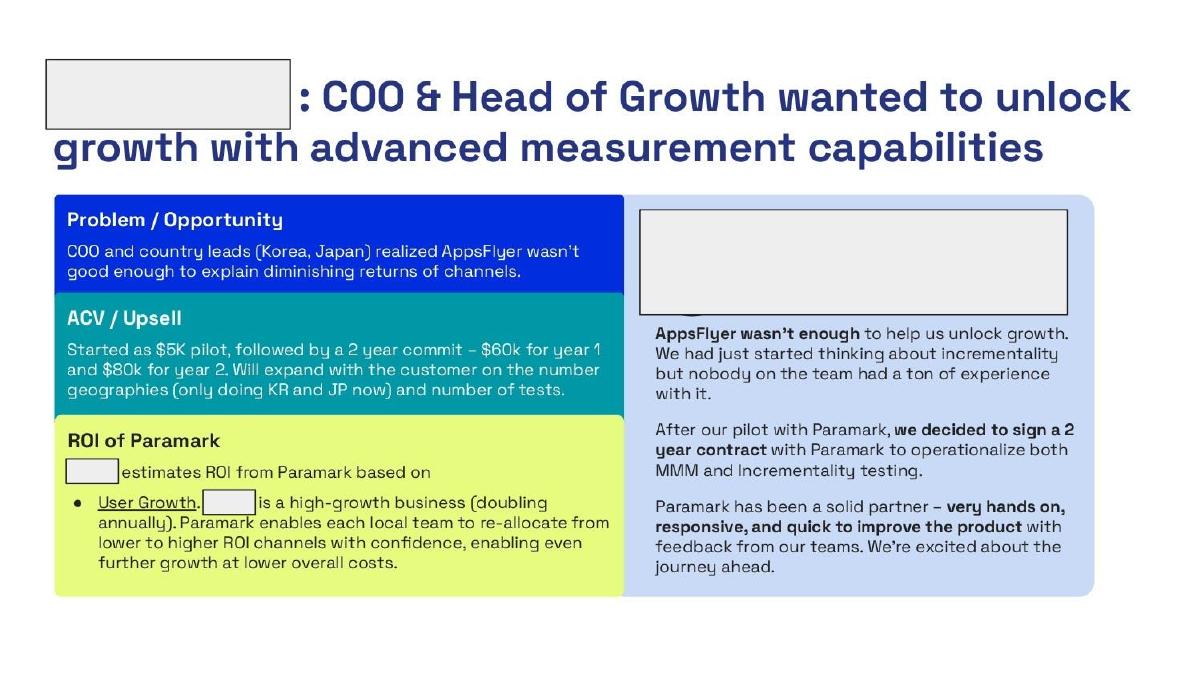
- A detailed case study shows an initial $58k/year deal that upsold by $20k within months, demonstrating clear expansion potential (Slide 8).
- The deck highlights a '5x talent cost' saving for customers compared to building an internal measurement team (Slide 8).
The Strategic Bridge Between Marketing and Finance
Paramark’s pitch deck is a clinical example of how to position a B2B SaaS tool in a mature market. By focusing on the tension between the CMO (who wants to spend) and the CFO (who wants to see returns), Paramark identifies a high-value problem: the lack of predictability in marketing outcomes. The deck, used to raise a $6M Seed round in 2024, moves quickly from high-level vision to granular market data and social proof.
Slide 1: The Hook
The title slide is minimalist, featuring the Paramark logo and a clear value proposition: "Helping CMOs and CFOs invest in marketing with confidence & predictability." This immediately identifies the two primary stakeholders in the buying process and promises an emotional benefit (confidence) backed by a functional one (predictability).
Slide 2: The Power of Social Proof
Slide 2 is perhaps the most impressive slide in the deck. Titled "Top Tier CXO Angels and Advisors," it features 15 headshots of prominent industry figures. The list includes Sarah Franklin (CMO, Salesforce), Udi Ledergor (CMO, Gong), GC Lionetti (CRO, OpenAI/Zapier), and Arash Ferdowsi (Cofounder, Dropbox). For a Seed stage company, this level of advisory support is an incredibly strong signal. It tells investors that the founders have the network to navigate complex enterprise sales and that the product solves a problem recognized by the industry's elite.
Slide 3: Defining the CMO's Struggle
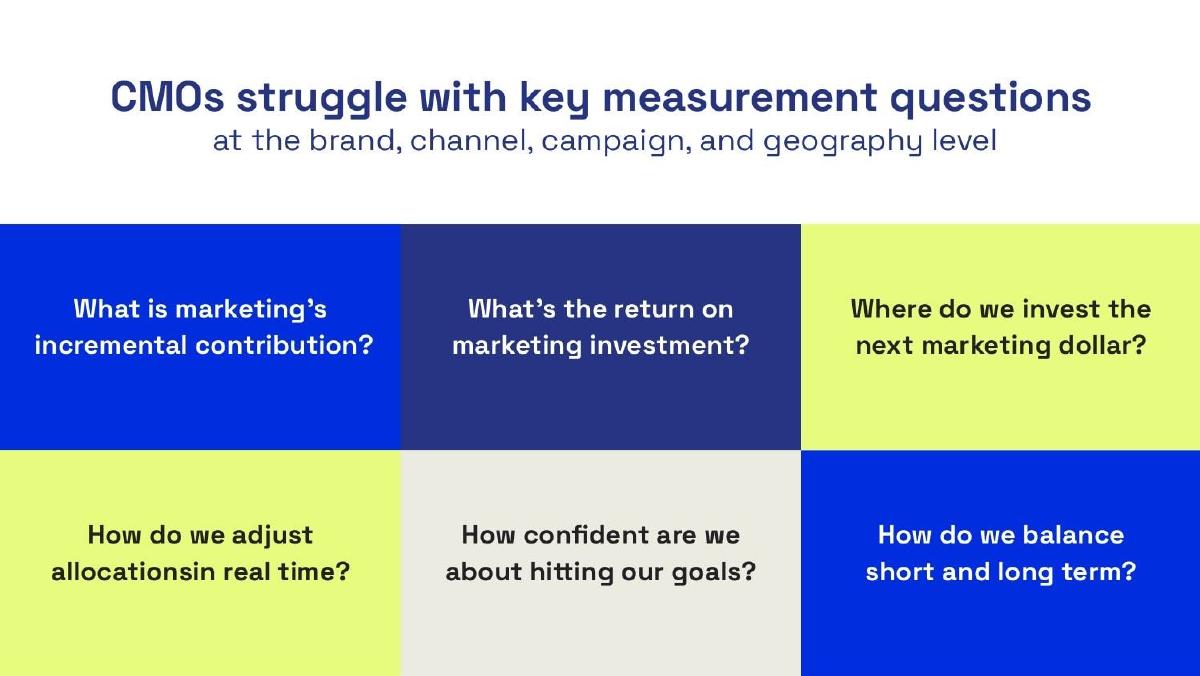
This slide breaks down the problem into six specific questions that CMOs struggle to answer, such as "What is marketing’s incremental contribution?" and "Where do we invest the next marketing dollar?" By framing the problem as a series of unanswered questions, Paramark sets the stage for their product to be the definitive answer key. The slide emphasizes that these struggles exist at every level: brand, channel, campaign, and geography.
Slide 4: A Masterclass in Bottoms-Up TAM
Many startups fail by presenting a "top-down" TAM (e.g., "The marketing market is $500B, and we will take 1%"). Paramark does the opposite. On Slide 4, they present a "bottoms-up view based on number of businesses by segment / ACV." They identify ~60k US businesses with >$50M in sales across verticals like Retail, Healthcare, and Finance. They then apply a formula: average sales per business, estimated marketing spend (5-18%), and a 1% budget allocation for measurement. This results in a calculated TAM of $8.9B . This level of detail makes the market opportunity feel real and attainable.
Slide 5: The Competitive Landscape
Slide 5 uses a Harvey Ball matrix to compare Paramark against six unnamed competitors across B2B and B2C sectors. The criteria include "Multiple methods," "Full channel coverage," "Win over The CFO," "Complex Buyer Journeys," and "Connect to Execution." Unsurprisingly, Paramark claims full marks across the board, while competitors are shown to have gaps, particularly in connecting insights to execution and winning over the CFO. While the competitors are not named, the categories suggest they are targeting legacy MMM providers and newer digital attribution tools.
Slide 6: Product Workflow and Technical Transparency
This slide outlines the four-step process: Collect, Model (Correlation), Experiment (Causation), and Forecast (Prediction). It explains that their Marketing Mix Modeling (MMM) applies ML to detect ROI and diminishing returns. Crucially, the slide includes a note: "For now, we leverage several open source models. In future, we will build our own models." This honesty is refreshing in a Seed deck; it shows the founders are focused on delivering value immediately rather than waiting for perfect proprietary tech, while still having a long-term IP strategy.
Slide 7: The Actionable UI
Slide 7 provides a glimpse into the product's output. It shows a "Spend Optimization" dashboard. A specific example is highlighted: "+5% projected pipeline ROI when $300k is reallocated from Google to Facebook." This slide proves that the tool doesn't just provide data; it provides specific, actionable instructions that a marketing team can execute to improve performance.
Slide 8: The Proof of Concept (Case Study)
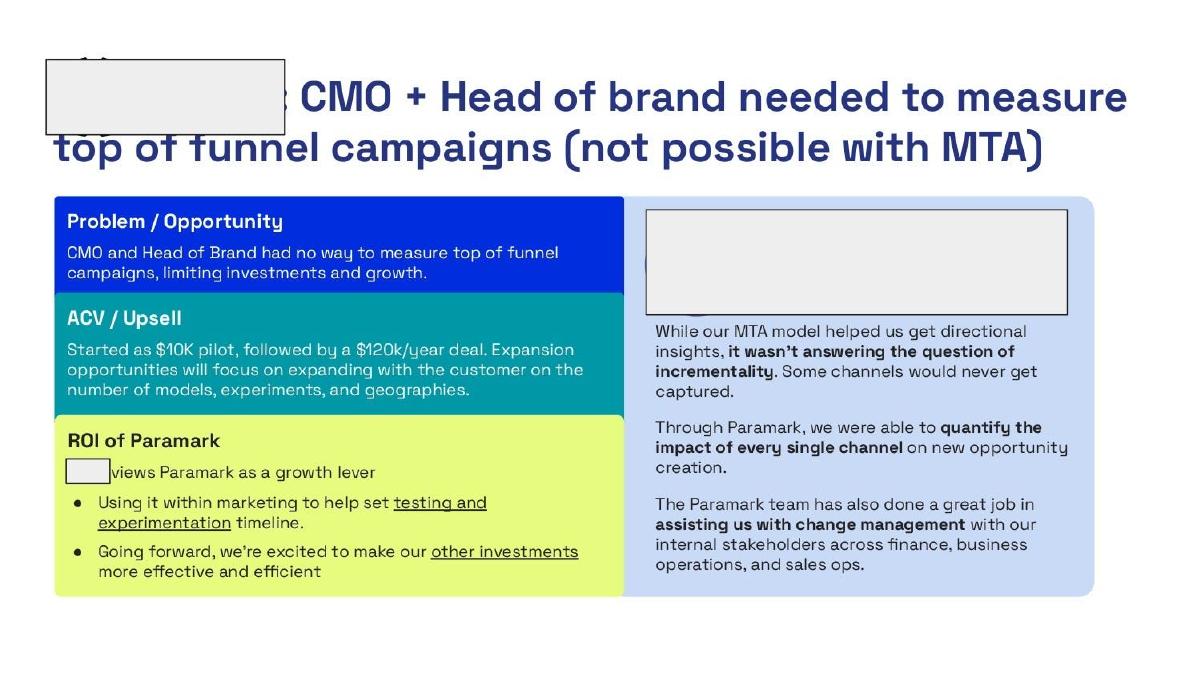
This slide features a case study for a customer with a "Top-down mandate to treat every campaign launch as an experiment." It details the financial trajectory of the deal: started at $58k/year and was upsold by $20k/year in June. The slide also lists the ROI of using Paramark, noting that the "total cost of ownership of DIY-ing this internally would be at least 5x (talent)." This is a powerful economic argument—Paramark isn't just a tool; it's a cost-saving alternative to hiring an expensive data science team.
Slide 9: The Future Vision
The final slide in this selection presents a pyramid with "Measure" at the base, "Plan" in the middle, and "Execute" at the top. It asks, "What does the future hold?" and suggests that Paramark intends to move up the stack. By mastering measurement first, they earn the right to help companies plan and eventually execute their entire marketing strategy through AI.
What Paramark Does Exceptionally Well
Paramark’s deck is a masterclass in building credibility through association . The advisor slide is not just a list of names; it is a strategic asset that suggests the company has a direct line to the biggest buyers in the industry. Furthermore, their bottoms-up TAM is one of the most logical and well-defended market sizing exercises seen in recent Seed decks. They don't just say the market is big; they show you the math, which builds significant trust with investors.
The deck also excels at stakeholder alignment . By constantly referencing both the CMO and the CFO, Paramark acknowledges the reality of enterprise purchasing. They aren't just selling a "cool tool" to marketers; they are selling a "financial instrument" to the C-suite that helps manage risk and optimize capital allocation.
What is Missing from the Deck
While the 9 slides provided are strong, the full 34-slide deck likely contains information that is missing here. Specifically, there is no team slide in this selection. While the advisors are great, investors ultimately bet on the founders. We don't see the backgrounds of the people actually building the product day-to-day. Additionally, there is no explicit "Ask" slide in this set, though publisher reports confirm they raised $6M. Finally, while there is a case study, there is no aggregate traction data (e.g., total number of customers, total ARR, or growth rate) shown in these slides, which would be necessary to validate the "land and expand" story at scale.
Founder Takeaways: What to Copy
Build a 'Wall of Social Proof': If you have high-profile advisors or early investors, don't hide them at the end. Use them early to establish that you are a serious player in your category. · Do the Math on TAM: Avoid generic market reports. Build a spreadsheet-style TAM slide that shows how many customers exist, what they spend, and what percentage of that spend you can capture. It is much harder for an investor to argue with a bottoms-up model. · Focus on the 'So What?': Paramark doesn't just show charts; they show a box that says "Move $300k from X to Y to get 5% more ROI." Always show the specific action your product enables. · Be Honest About Tech: If you are using open-source tools or APIs to get started, say so. Investors value a roadmap that shows how you will move from "using tech" to "owning tech." · Quantify the 'DIY' Cost: One of the best ways to sell B2B software is to show that hiring a team to do the same thing would cost 5x more. This makes the software feel like a bargain rather than an expense.
Frequently asked questions
- Why does Paramark include so many advisors in their Seed deck?
- In a crowded adtech market, credibility is everything. By listing 15 high-profile CXOs from companies like Salesforce, Figma, and OpenAI, Paramark signals to investors that the industry's top buyers and practitioners believe in their approach. This 'social proof' reduces perceived risk regarding product-market fit and go-to-market strategy.
- How does Paramark justify its $8.9B TAM?
- Instead of quoting a generic Gartner report, Paramark uses a bottoms-up model. They identify 60,000 US businesses with over $50M in sales, estimate their marketing spend (5-18%), and assume 1% of that budget is allocated to measurement. This granular approach makes the multi-billion dollar figure much more defensible to skeptical investors.
- What is the core technical value proposition of the product?
- Paramark uses Marketing Mix Modeling (MMM) and Machine Learning to detect the ROI and diminishing returns of various advertising channels. The product provides a 'Spend Optimization' dashboard that suggests specific reallocations—for example, moving $300k from Google to Facebook to achieve a projected 5% ROI increase.
- Does the deck mention proprietary technology?
- Slide 6 contains a candid admission: 'For now, we leverage several open source models.' However, it immediately follows this with the promise to build proprietary models in the future. This transparency builds trust while highlighting the 'AI' component of their roadmap.
- What does the case study reveal about their pricing and sales motion?
- Slide 8 shows a B2B SaaS/Cloud customer case study where the initial ACV was $58k. The account was upsold by $20k in just a few months based on testing volume. This indicates a 'land and expand' strategy where revenue grows alongside the client's marketing experimentation frequency.