Paperstreet’s pitch deck outlines a three-sided marketplace connecting Entrepreneur Support Organizations (ESOs), startups, and investors. The product focuses on structured private updates, investor discovery, and compliance tools for capital raising. While the deck excels at showcasing a functional, high-fidelity product interface—including dashboards for investment management and deal rooms—it leans heavily on features rather than market validation. The inclusion of blockchain-specific terminology, such as 'tokenizing cap tables' and accepting cryptocurrency for investments, suggests a spec…
Key takeaways
- The platform targets three distinct personas: accelerators/incubators, founders, and investors/mentors (Slide 7).
- Future product roadmap items include tokenizing cap tables and syndicating investments (Slide 7).
- The product includes a password-protected virtual deal room with integrated KYC/AML and accreditation verification (Slide 13).
- The investment dashboard supports multiple currencies, showing transactions in BTC and ETH alongside USD values (Slide 16).
- CEO Matt deCourcelle claims to have bootstrapped two previous companies into millions of dollars in revenue (Slide 19).
- The team has a strong pedigree in enterprise software, citing experience at Salesforce, S&P Capital IQ, and EY (Slide 19).
- Paperstreet is seeking $1,000,000 to accelerate development by 4x and secure an 18-month runway (Slide 22).
- The deck highlights a partnership or integration with the Alchemist Blockchain Techstars Accelerator 2019 (Slide 10).
Executive Summary
Paperstreet is a relationship management and investment platform tailored for the startup ecosystem. The deck positions the company as a central hub where accelerators manage portfolios, founders send updates, and investors discover deal flow. With a clear emphasis on the blockchain sector, the platform integrates cryptocurrency transactions and compliance tools directly into the investment workflow. The deck is product-centric, utilizing high-fidelity screenshots to prove the existence of a sophisticated technical infrastructure.
Slide 1: Title Slide
The deck opens with a minimalist title slide featuring the Paperstreet logo—a stylized blue 'P' that resembles a folded sheet of paper. The branding is clean and professional, establishing a corporate yet modern visual identity. No tagline or mission statement is present on this slide, leaving the brand name to stand alone.
Slide 4: The Solution
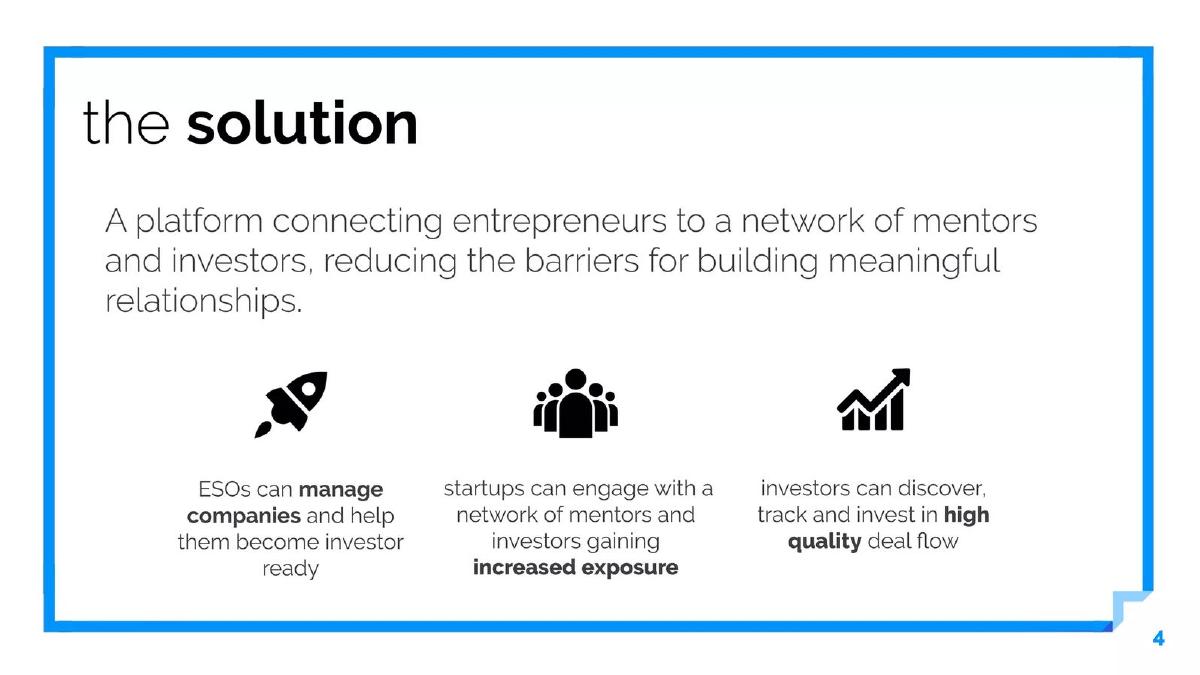
Slide 4 defines the platform's value proposition. It describes Paperstreet as a platform connecting entrepreneurs to a network of mentors and investors. The slide breaks down the benefits for three groups: ESOs (Entrepreneur Support Organizations) can manage companies; startups gain increased exposure; and investors can discover high-quality deal flow. This slide establishes the three-sided marketplace nature of the business model.
Slide 7: User Persona Use Cases
This slide provides a granular look at how different users interact with the platform. Accelerators/Incubators use it for portfolio management and data analytics. Founders use it for broadcasting updates and raising capital. Investors use it for tracking companies and direct contact with CEOs. Notably, this slide introduces 'future' features, including tokenizing cap tables and syndicating investments, which signals a long-term vision involving decentralized finance (DeFi) elements.
Slide 10: Our Product (Discover)
Paperstreet uses this slide to showcase the discovery interface. It features real-world examples, specifically the Techstars Berlin 2019 and Alchemist Blockchain Techstars Accelerator 2019 . The UI allows investors to 'track' specific classes of startups. This slide serves as social proof, suggesting that established accelerators are already using the platform to showcase their cohorts.
Slide 13: Our Product (Invest)
This slide focuses on the transactional side of the platform. It highlights a password-protected virtual deal room for a company called Gilded. The interface includes a 'My To-Do List' for investors, featuring 'Verify KYC/AML,' 'Verify Accreditation,' and 'Sign Documents.' The slide explicitly mentions 'integrated compliance services,' which is a critical hurdle for any platform facilitating private equity investments.
Slide 16: Our Product (Investment Dashboard)
The investment dashboard slide is the most data-dense in the deck. It shows a table of deposits with columns for Tx ID, Deposit Amount, Currency (BTC, ETH), USD Value, and Tx Fee . The data shows transactions ranging from small amounts to over $100,000 USD. This slide confirms that the platform is functional and capable of handling cross-border cryptocurrency investments with automated USD valuation tracking.
Slide 19: Our Founders
The team slide features three co-founders. Matt deCourcelle (CEO) is described as a software engineer from Salesforce who bootstrapped two previous companies to millions in revenue. Carter Lathrop (CTO) brings full-stack development experience from Levis & Co., Wells Fargo, and Salesforce. Alex Ratner (Director of Operations) has a background in UI/UX and database engineering at S&P Capital IQ and EY. The team is balanced between engineering, operations, and proven entrepreneurial success.
Slide 22: Our Ask
The final slide in the sequence is a clear call to action. Paperstreet is seeking $1,000,000 . The allocation is straightforward: hiring developers and a product manager to accelerate development 4x, building marketing and investor relations teams, and securing an 18-month runway. This slide provides investors with a clear understanding of the capital requirements and the expected duration of the funding round.
What Paperstreet Does Well
The deck is exceptionally strong in its product visualization . By using actual screenshots of the dashboard (Slide 16) and the deal room (Slide 13), the founders remove any doubt about their ability to build complex software. They aren't pitching a concept; they are pitching a functioning tool. The inclusion of compliance features like KYC/AML shows a sophisticated understanding of the regulatory requirements in the investment space, which is often a red flag for investors in the crypto/blockchain niche.
Furthermore, the persona breakdown on Slide 7 is highly effective. It clearly articulates the 'what's in it for me' for every participant in the ecosystem. By catering to ESOs (Accelerators), Paperstreet creates a built-in acquisition channel—if an accelerator adopts the platform, all their startups and mentors follow, creating a powerful network effect.
What is Missing from the Paperstreet Deck
Despite the strong product showing, the deck has several notable omissions based on the provided slides:
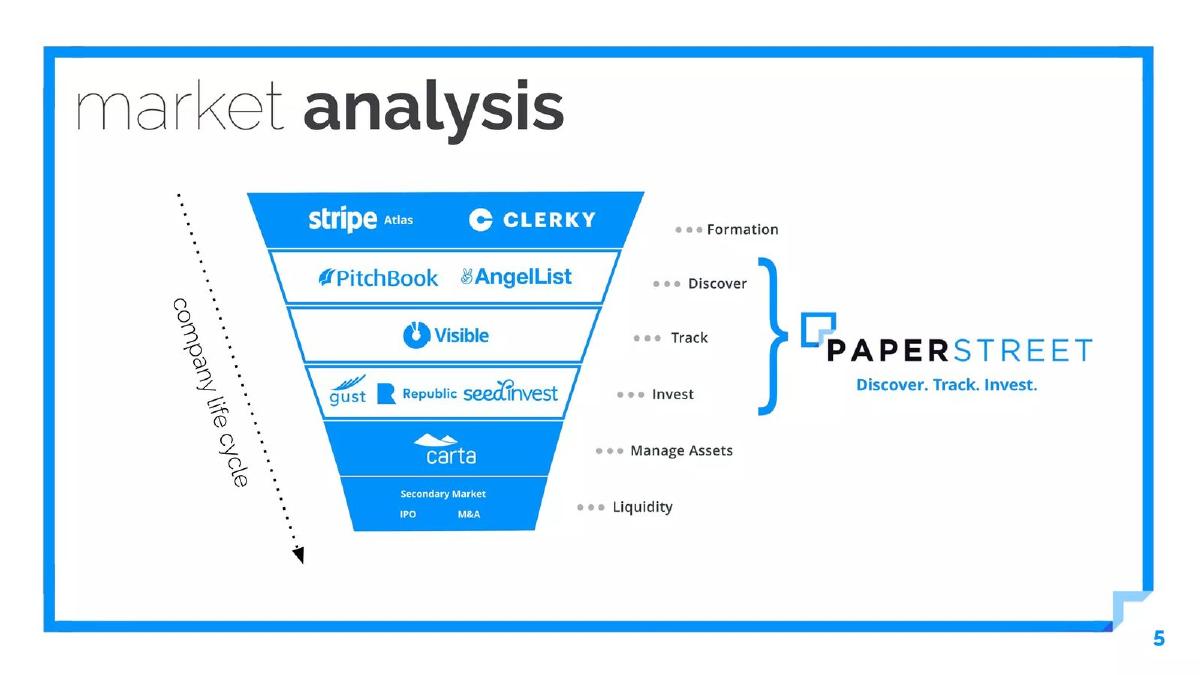
Market Size (TAM/SAM/SOM): There is no slide quantifying the total addressable market for startup investment platforms or the specific blockchain niche they are targeting. · Business Model/Revenue: While the product is clear, the monetization strategy is not. It is unclear if Paperstreet charges a SaaS fee to accelerators, a transaction fee on investments, or a listing fee to founders. · Traction Metrics: While Slide 16 shows transactions, there is no aggregate data on total users, total capital raised to date, or month-over-month growth. · Competition: The deck does not mention how Paperstreet differentiates itself from incumbents like AngelList, Gust, or Carta. · Unit Economics: There is no mention of customer acquisition costs (CAC) or lifetime value (LTV), which are crucial for a $1M seed round.
Founder Takeaways: What to Copy
Use High-Fidelity Mockups: If your product is live or in advanced beta, follow Paperstreet's lead. Showing a 'My To-Do List' for compliance (Slide 13) is much more convincing than simply saying 'we handle compliance.' It shows the user journey and the technical depth of the solution.
Leverage Social Proof via Partnerships: Mentioning Techstars (Slide 10) immediately elevates the company's credibility. If you have a pilot or a partnership with a known entity, make it a central part of your product slides rather than burying it at the end.
Be Specific with the Ask: Slide 22 is a model for a seed-stage ask. It doesn't just ask for a million dollars; it explains exactly what that money buys (4x development speed) and how long it will last (18 months). This gives investors a sense of the 'burn' and the 'milestones' they are funding.
Design for Readability: The deck uses a consistent color palette and plenty of white space. Even the complex dashboard on Slide 16 is presented in a way that is easy to scan. Founders should avoid cluttered slides and stick to one primary message per page.
Frequently asked questions
- What is the primary problem Paperstreet is trying to solve?
- According to Slide 4, Paperstreet aims to reduce the barriers for building meaningful relationships between entrepreneurs, mentors, and investors. It addresses the friction in startup discovery for investors and the difficulty founders face in managing updates and compliance when raising capital.
- Does Paperstreet have a specific industry focus?
- While the platform is broadly for startups, the deck shows a heavy lean toward the blockchain and cryptocurrency sector. Slide 10 features the Alchemist Blockchain Techstars Accelerator, and Slide 16 shows an investment dashboard tracking BTC and ETH deposits, indicating the platform is built for the Web3 ecosystem.
- What are the core features of the founder-facing product?
- Founders use the platform to broadcast updates to a global network, send structured private updates, track investor engagement, and use integrated compliance tools to raise capital. Slide 7 also mentions a future feature for tokenizing cap tables.
- How does the team plan to use the $1 million investment?
- As stated on Slide 22, the funds are earmarked for hiring developers and a product manager to increase development speed fourfold, building out small investor relations and marketing teams, and maintaining an 18-month operational runway.
- What evidence of product-market fit is provided in the deck?
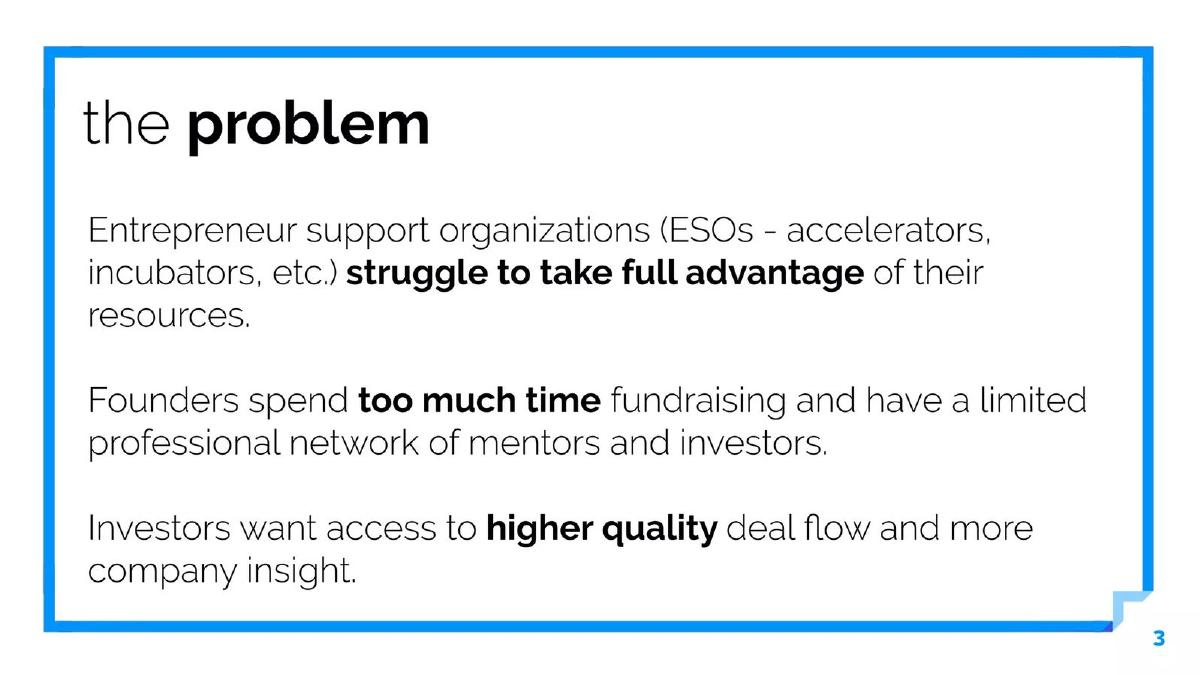
- The deck relies on product screenshots and mentions of specific accelerators like Techstars Berlin 2019 and Alchemist Blockchain Techstars 2019 (Slide 10). However, the provided slides do not list specific user growth numbers, revenue, or the total volume of capital raised through the platform.