Pitch Deck Go-to-Market Slides: Real Examples and What Works
How to write a go-to-market slide investors believe: the first customer segment, the channel that reaches it.
Pitch Deck Go-to-Market Slides: Real Examples and What Works
Compare twelve real go-to-market slides across enterprise sales, product-led growth, partners, retail, and consumer acquisition, then define a focused first route to customers.
TL;DR
A go-to-market slide should name the first customer segment, the channel that reaches it, the order of expansion, and evidence that the route works. These examples show why a narrow, sequenced plan with one real proof point is stronger than an unranked list of marketing activities.
Go-to-market slides from real pitch decks
Each example pairs the exact go-to-market slide from its public deck with specific analysis when the image is available. Company claims remain unverified; missing exact images are recorded and never replaced with unrelated slides.
Limis go to market slide — slide 6
An early-stage industrial company from a master's programme deck. Stage and year not recorded.
Limis deck, slide 6. Exact stored slide matched to this analysis.
Our analysis: It names a beachhead the founders can actually reach: former employers where they have relationships. For industrial B2B, warm access to a buyer is a real advantage.
Evidence and limitation: The logos could be read as customers. Label them as former employers and targets, and add what stage each conversation is at.
What a founder can adapt: If your team has worked inside target customers, say so and name them; it answers "how will you get the first meeting?"
Supporting analysis
What the deck claims: Titled "Go to market" with the line "Start with companies you've worked for" and three logos: K2 Pure Solutions, Dow and Ecolab.
Presentation choice: It names a beachhead the founders can actually reach: former employers where they have relationships. For industrial B2B, warm access to a buyer is a real advantage.
When it does not fit: The logos could be read as customers. Label them as former employers and targets, and add what stage each conversation is at.
A cloud-storage company selling largely through partners.
Verified source excerpt — slide 9
Focused on channel: 45% of revenue and rising, 100% channel in Europe and Japan, through managed service providers, cloud service providers and technology alliance partners.
The exact go-to-market slide image is not present in the stored slide-image set. No substitute is used.
Our analysis: It names the channel, its share of revenue and the partner types — evidence, not intention.
Evidence and limitation: Heavy channel dependence gives partners leverage; be ready to explain margin after partner fees.
What a founder can adapt: If partners drive sales, show their share of revenue and which kinds of partner matter.
Supporting analysis
What the deck claims: Focused on channel: 45% of revenue and rising, 100% channel in Europe and Japan, through managed service providers, cloud service providers and technology alliance partners.
Presentation choice: It names the channel, its share of revenue and the partner types — evidence, not intention.
When it does not fit: Heavy channel dependence gives partners leverage; be ready to explain margin after partner fees.
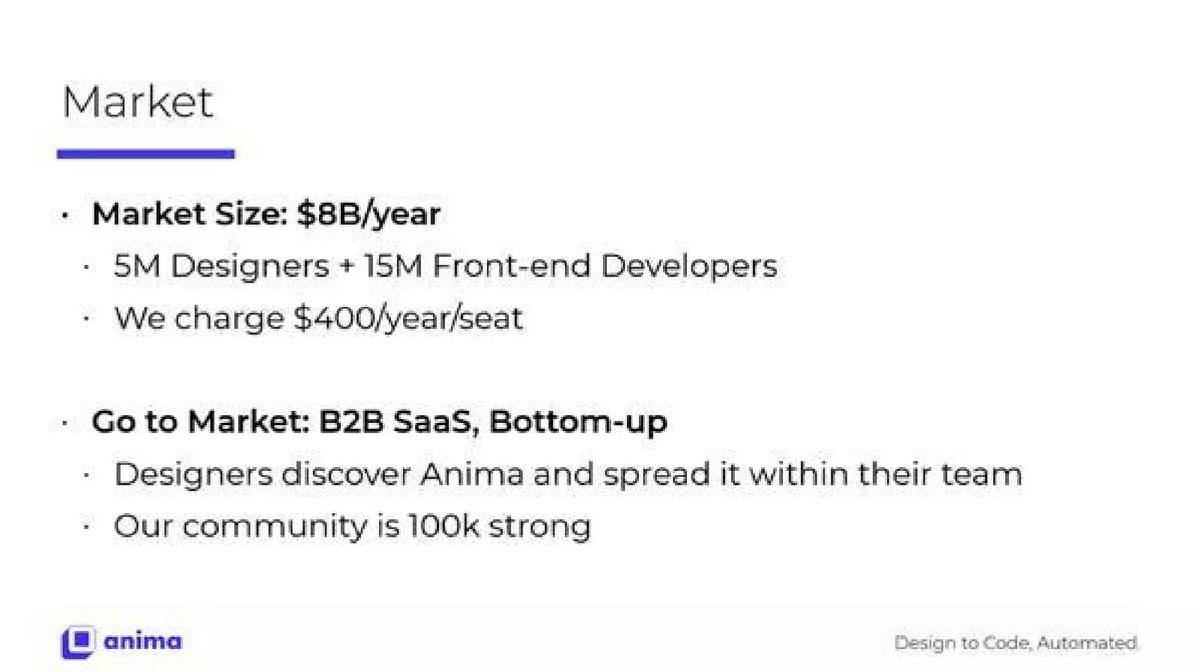
Design-to-code software for designers and developers. The slide is titled "Market". Stage and year not recorded.
Anima deck, slide 5. Exact stored slide matched to this analysis.
Our analysis: It links price, user count and channel on one slide: a low per-seat price suits bottom-up adoption, and the community figure is the starting audience.
Evidence and limitation: "Community" isn't defined (users, followers, sign-ups?), and there is no conversion from free to paid. Market size and go-to-market sharing a slide leaves little room for either.
What a founder can adapt: For product-led software, state who discovers you, how it spreads inside a team, and the size of the audience you already reach.
Supporting analysis
What the deck claims: Market size $8B/year (5M designers + 15M front-end developers, $400/year/seat), then "Go to market: B2B SaaS, bottom-up — designers discover Anima and spread it within their team; our community is 100k strong".
Presentation choice: It links price, user count and channel on one slide: a low per-seat price suits bottom-up adoption, and the community figure is the starting audience.
When it does not fit: "Community" isn't defined (users, followers, sign-ups?), and there is no conversion from free to paid. Market size and go-to-market sharing a slide leaves little room for either.
An internet infrastructure company (the deck is labelled "Meeting 8" in our collection). Year not recorded.
Internap deck, slide 4. Exact stored slide matched to this analysis.
Our analysis: It connects what is sold, why it wins and which sales route leads to which customer, the logic an enterprise buyer journey needs.
Evidence and limitation: "All available channels" is not a strategy: it doesn't say which route matters most or what each costs. Three routes with no split of revenue or pipeline invite that question.
What a founder can adapt: Map product to route to customer in one line so investors can see which channel sells what.
Supporting analysis
What the deck claims: "Our go-to-market strategy": target customers "for whom infrastructure performance is business critical via all available channels to market", shown as four arrows: product portfolio (cloud/IaaS, managed hosting, colocation, network) → differentiation (performance) → routes to market (direct, channel, inside/eCom) → target market.
Presentation choice: It connects what is sold, why it wins and which sales route leads to which customer, the logic an enterprise buyer journey needs.
When it does not fit: "All available channels" is not a strategy: it doesn't say which route matters most or what each costs. Three routes with no split of revenue or pipeline invite that question.
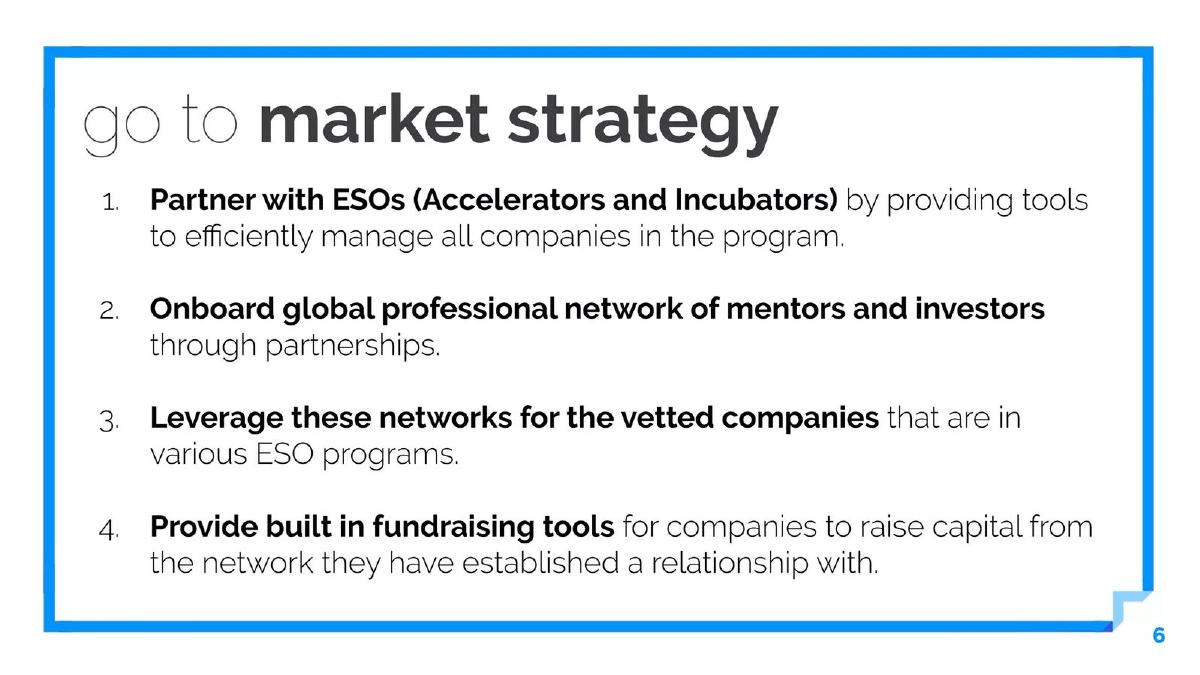
Software for accelerators and incubators and the startups in their programmes. Stage and year not recorded.
PaperStreet deck, slide 6. Exact stored slide matched to this analysis.
Our analysis: One partner type gives access to many end users at once, and the steps show how each side of the network is added in order.
Evidence and limitation: There are no numbers: how many programmes, how many companies each, or any partner signed. Steps 3 and 4 describe product features rather than acquisition.
What a founder can adapt: If a partner can bring you many customers at once, make that partner your first channel and show the order you add the other sides.
Supporting analysis
What the deck claims: A numbered "go to market strategy": 1) partner with ESOs (accelerators and incubators) by giving them tools to manage their companies; 2) onboard mentors and investors through those partnerships; 3) use these networks for vetted companies in the programmes; 4) provide built-in fundraising tools.
Presentation choice: One partner type gives access to many end users at once, and the steps show how each side of the network is added in order.
When it does not fit: There are no numbers: how many programmes, how many companies each, or any partner signed. Steps 3 and 4 describe product features rather than acquisition.
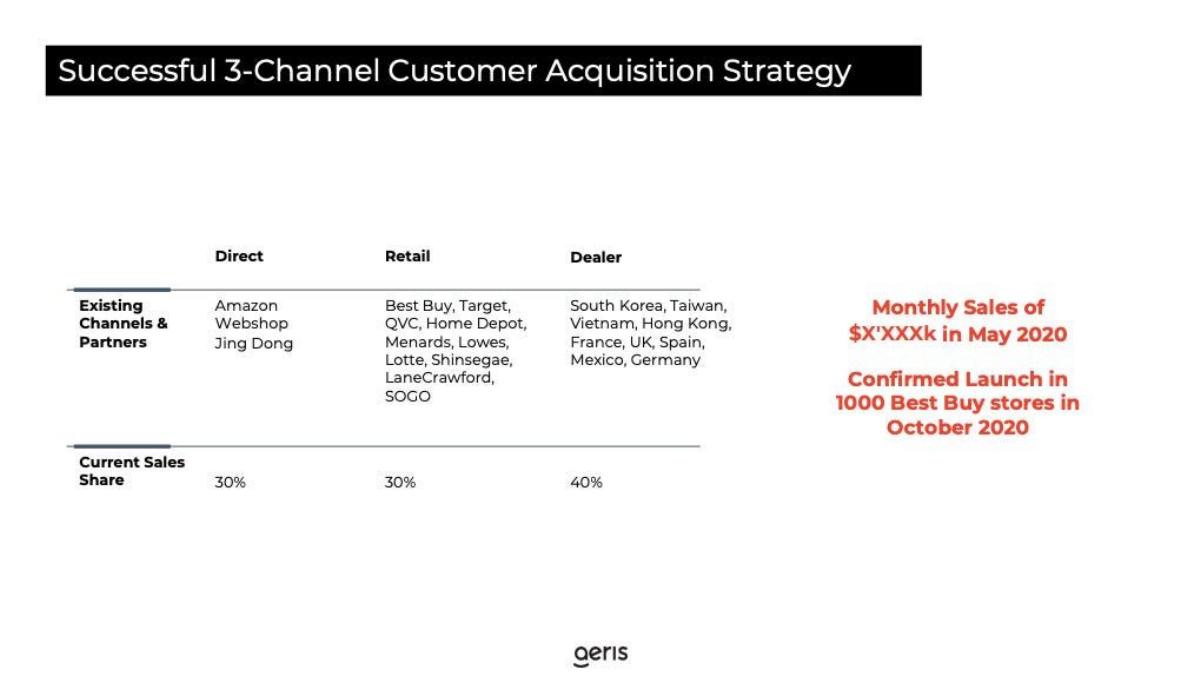
A consumer air-purifier brand selling across several countries.
Aeris deck, slide 6. Exact stored slide matched to this analysis.
Our analysis: Named retailers and a confirmed launch turn a channel list into evidence.
Evidence and limitation: Monthly sales figures shown as placeholders weaken the slide; use real figures or ranges.
What a founder can adapt: For physical products, list confirmed retail placements separately from targets.
Supporting analysis
What the deck claims: A three-channel customer acquisition strategy — direct, retail and dealer — naming online marketplaces, major retailers and dealer countries, with a confirmed launch in 1,000 Best Buy stores.
Presentation choice: Named retailers and a confirmed launch turn a channel list into evidence.
When it does not fit: Monthly sales figures shown as placeholders weaken the slide; use real figures or ranges.
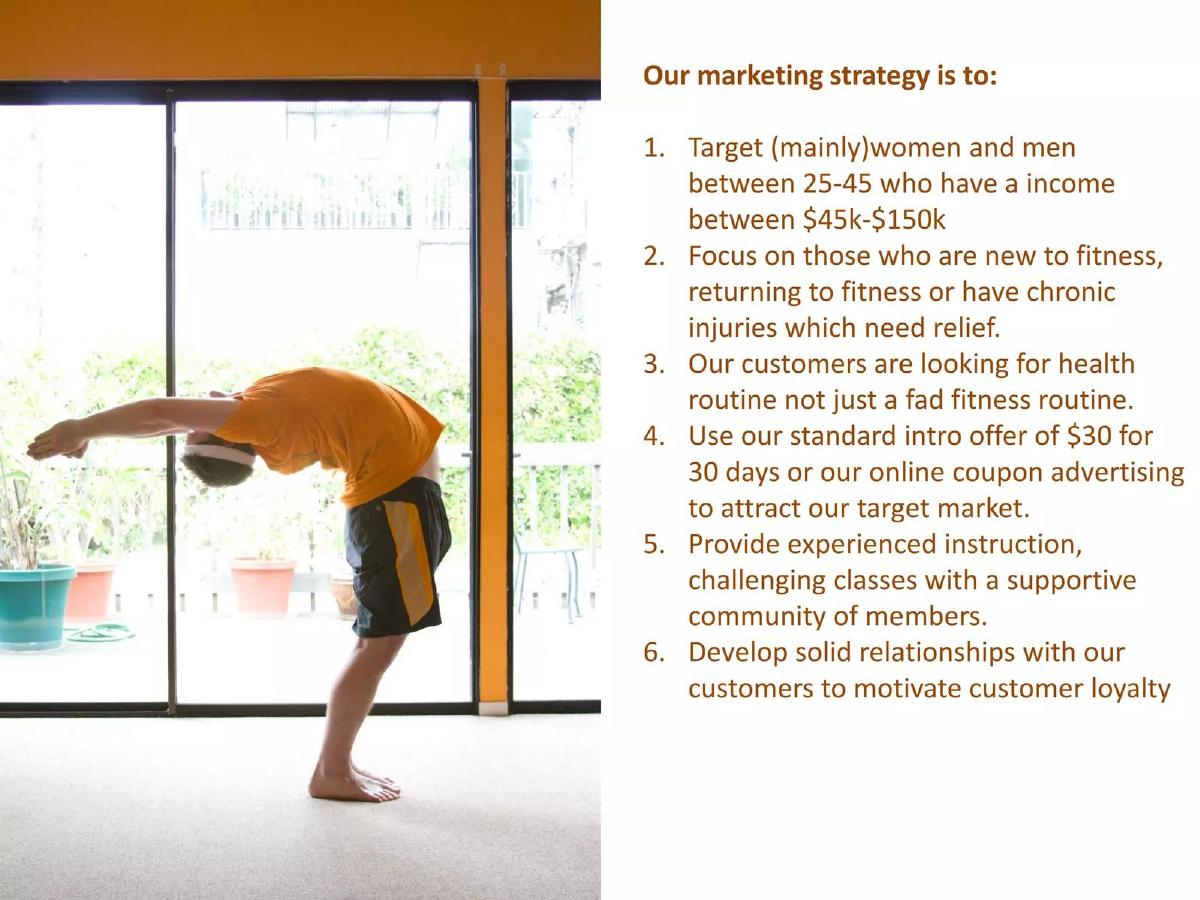
CalYoga deck, slide 6. Exact stored slide matched to this analysis.
Our analysis: It defines the customer precisely (age, income, need) and names one concrete acquisition offer, which is more than many local-business decks do.
Evidence and limitation: Points 5 and 6 describe service quality, not acquisition. There is no conversion rate from the $30 intro offer to membership, which is the number that makes this strategy work or fail.
What a founder can adapt: Pair a narrow customer definition with the specific offer you use to win them.
Supporting analysis
What the deck claims: "Our marketing strategy is to": target mainly women and men aged 25–45 with income $45k–$150k; focus on people new to fitness, returning, or with chronic injuries; customers want a health routine, not a fad; use a standard intro offer of $30 for 30 days or online coupon advertising; provide experienced instruction; build relationships to motivate loyalty.
Presentation choice: It defines the customer precisely (age, income, need) and names one concrete acquisition offer, which is more than many local-business decks do.
When it does not fit: Points 5 and 6 describe service quality, not acquisition. There is no conversion rate from the $30 intro offer to membership, which is the number that makes this strategy work or fail.
Solid growth engines: three go-to-market engines in place, including outbound sales and inbound marketing, described as proven, structured and scalable.
The exact go-to-market slide image is not present in the stored slide-image set. No substitute is used.
Our analysis: It shows how a later-stage company presents channels that already work and are ready to scale.
Evidence and limitation: Seed companies should not copy this framing without equivalent evidence.
What a founder can adapt: At Series A and beyond, describe each engine's contribution and how it scales.
Supporting analysis
What the deck claims: Solid growth engines: three go-to-market engines in place, including outbound sales and inbound marketing, described as proven, structured and scalable.
Presentation choice: It shows how a later-stage company presents channels that already work and are ready to scale.
When it does not fit: Seed companies should not copy this framing without equivalent evidence.
An industrial materials company selling to large industry players.
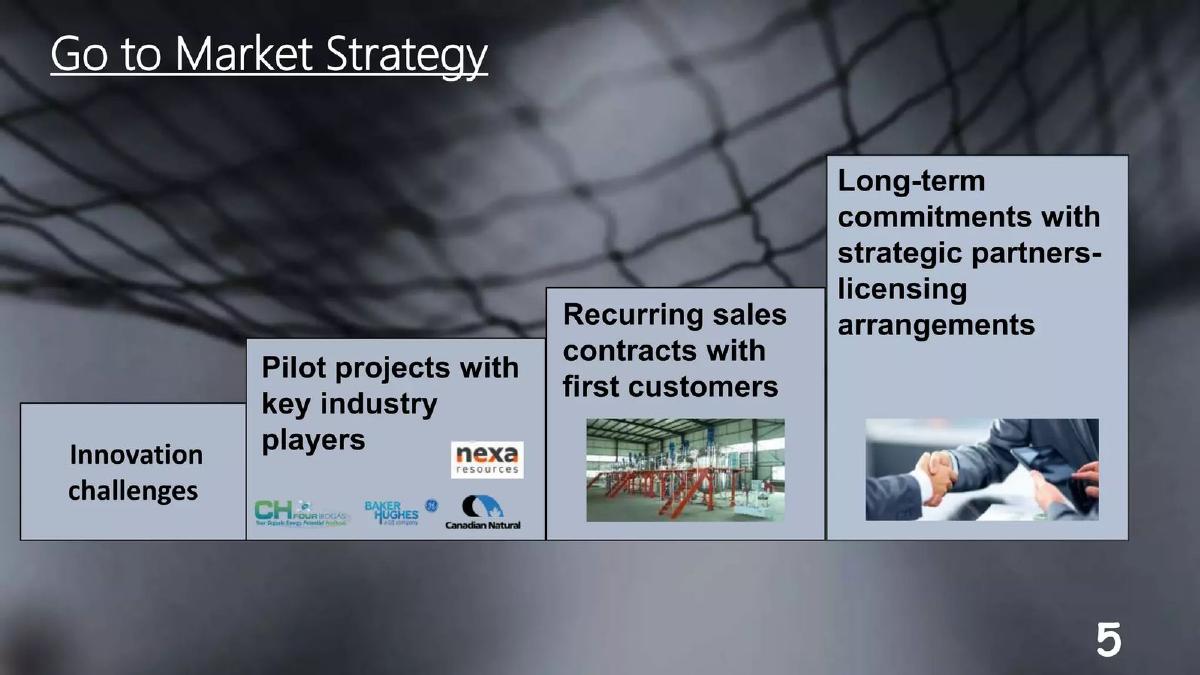
BioPolyNet deck, slide 5. Exact stored slide matched to this analysis.
Our analysis: It shows the typical industrial path from pilot to contract to partnership in order.
Evidence and limitation: Named customers should be labelled as pilot, contract or partner.
What a founder can adapt: For industrial and deep-tech products, show the pilot-to-contract path and where each customer sits on it.
Supporting analysis
What the deck claims: Innovation challenges and pilot projects with key industry players, leading to recurring sales contracts with first customers and long-term commitments or licensing with strategic partners.
Presentation choice: It shows the typical industrial path from pilot to contract to partnership in order.
When it does not fit: Named customers should be labelled as pilot, contract or partner.
An Indigenous-owned fashion and handbag brand in Canada. Stage and year not recorded.
SheNative deck, slide 6. Exact stored slide matched to this analysis.
Our analysis: Splitting pre-launch from launch shows sequencing, and specific venues and partners (Shopindigenous.ca, Saskatoon Farmers Market) fit a community-rooted consumer brand.
Evidence and limitation: Nine tactics with no budget, target or priority read as a to-do list. Say which one or two you expect to drive most sales, and what they cost.
What a founder can adapt: For consumer products, name the actual places and partners you'll sell through at launch, in order.
Supporting analysis
What the deck claims: "Marketing & sales strategy" in two phases. Pre-launch: build social following (blogging, Facebook giveaways, design contests, Twitter and Pinterest), gain media exposure, celebrity gifting of handbags, soft launch party. Launch: pop-up shops in major Canadian cities and Saskatoon Farmers Market, online shop, Shop Indigenous, a launch event with Shopindigenous.ca, and Aboriginal and local tradeshows and fashion shows.
Presentation choice: Splitting pre-launch from launch shows sequencing, and specific venues and partners (Shopindigenous.ca, Saskatoon Farmers Market) fit a community-rooted consumer brand.
When it does not fit: Nine tactics with no budget, target or priority read as a to-do list. Say which one or two you expect to drive most sales, and what they cost.
School bus routing and operations software sold in the US. Stage and year not recorded on the slide.
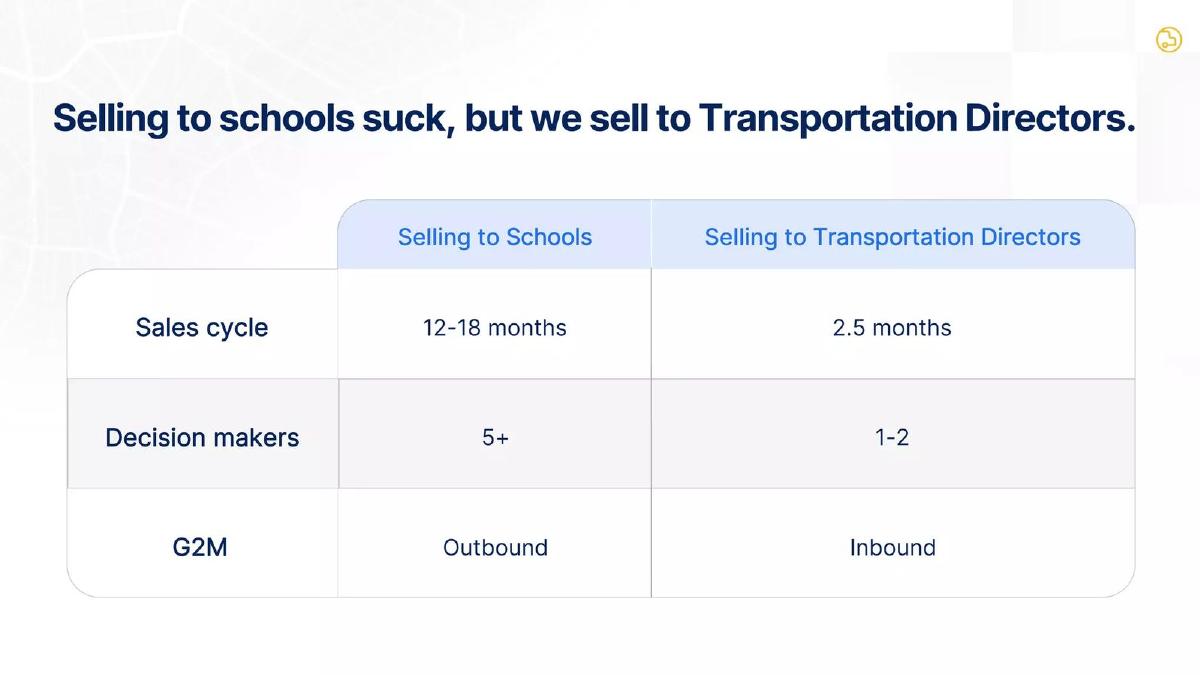
BusRight deck, slide 2. Exact stored slide matched to this analysis.
Our analysis: It turns a known risk (slow school procurement) into a stated choice of buyer, and shows the three things that change with that choice: cycle length, number of approvers and how leads arrive.
Evidence and limitation: The slide does not say how the 2.5 months is measured or across how many deals. Add the definition and sample, and whether the budget sits with that director.
What a founder can adapt: If your market has a slow default buyer, show the buyer you sell to instead and the cycle and approver count for each.
Supporting analysis
What the deck claims: "Selling to schools suck, but we sell to Transportation Directors." A table compares the two buyers: sales cycle "12-18 months" vs "2.5 months"; decision makers "5+" vs "1-2"; go-to-market "Outbound" vs "Inbound".
Presentation choice: It turns a known risk (slow school procurement) into a stated choice of buyer, and shows the three things that change with that choice: cycle length, number of approvers and how leads arrive.
When it does not fit: The slide does not say how the 2.5 months is measured or across how many deals. Add the definition and sample, and whether the budget sits with that director.
An education company selling to US school districts. Stage and year not recorded on the slide.
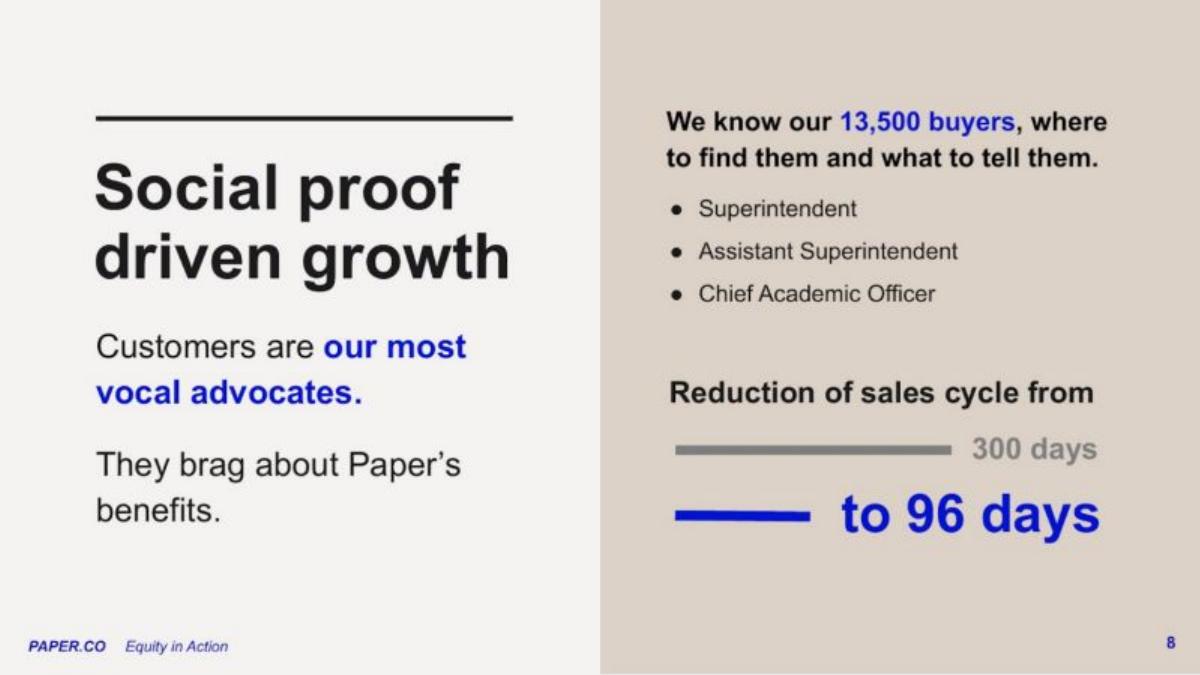
Paper deck, slide 8. Exact stored slide matched to this analysis.
Our analysis: It names the buyer by title and sizes the buyer pool, then links word of mouth among those buyers to a shorter cycle.
Evidence and limitation: "300 days to 96 days" is the slide's claim; it gives no period, deal count or definition of start and end. State those, and do not present a single best deal as the typical cycle.
What a founder can adapt: Name the titles that sign, how many exist in your market, and how you reach them.
Supporting analysis
What the deck claims: "Social proof driven growth": "Customers are our most vocal advocates. They brag about Paper's benefits." "We know our 13,500 buyers, where to find them and what to tell them" (Superintendent, Assistant Superintendent, Chief Academic Officer), and "Reduction of sales cycle from 300 days to 96 days".
Presentation choice: It names the buyer by title and sizes the buyer pool, then links word of mouth among those buyers to a shorter cycle.
When it does not fit: "300 days to 96 days" is the slide's claim; it gives no period, deal count or definition of start and end. State those, and do not present a single best deal as the typical cycle.
These are common fits, not rules. Investors will ask why your channel suits your customer.
Customer and price
Typical first channel
Numbers investors ask for
Large enterprise, high price
Direct sales with paid pilots
Sales cycle, pilot-to-paid conversion
Small business or team, low price
Self-serve or product-led
Sign-up to paid conversion, payback
Fits another vendor's offering
Channel partners or resellers
Partner share of revenue, margin after fees
Consumers, physical product
Retail and direct online
Confirmed placements, sell-through
Consumers, digital product
Content, referral, paid acquisition
Acquisition cost, retention
Key Takeaways
Start with a beachhead, not an entire market. Limis starts with companies its founders have worked for, while CalYoga defines its customer by age, income and need.
Show the order of expansion. SheNative moves from pre-launch social and media work to pop-ups and online sales; BioPolyNet moves from pilots to recurring contracts and strategic partnerships.
Turn channels into evidence. Wasabi states channel revenue share, and Aeris names a confirmed 1,000-store launch rather than only listing retail logos.
Match acquisition effort to customer value. Anima pairs a $400-a-seat price with bottom-up adoption, while Internap uses direct, channel and inside sales for infrastructure; a founder should pair each route with sales cycle, acquisition cost, or conversion evidence.
Build your go-to-market slide
Reduce the plan to one first customer, one primary route, and the evidence that earns expansion.
Beachhead. Define the first customer segment narrowly enough to reach and learn from directly.
Channel. Name the primary acquisition or sales route and explain why it fits the customer value.
Evidence. Add one measured result: signed pilots, partner revenue, conversion, acquisition cost, or sales cycle.
Sequence. State what expands next and what evidence must be true before that move.
Copyable framework: We reach [first segment] through [primary channel]; [evidence] supports it, then we expand to [next segment/channel] after [condition].
Illustrative example 1 — written by us
Before: SEO, social, events, partnerships, and outbound
After: Founder-led sales to independent travel agencies; three paid pilots validate a 45-day cycle before expanding through consortia
What improved: The rewrite identifies a buyer, prioritises a channel, supplies evidence, and defines the next step.
What the slide needs to prove
Investors know that good products fail when they cannot reach customers at a cost the business can afford. The go-to-market slide is where you show you have thought about that. It should answer three questions: who will buy first, how you will reach them, and how that approach scales once the first segment is won.
Sequoia's business plan outline asks founders to "Identify your customer and your market". The go-to-market slide makes that practical. Having identified the customer, what is the path from them never having heard of you to them paying? Who does the selling? What does it cost? How long does it take?
The slide is also a test of focus. A seed-stage company with a short runway cannot run five channels well. Naming one or two channels, and explaining why they fit the customer, signals that the founders understand their constraints. (Sequoia Capital)
The parts of a strong go-to-market slide
The beachhead segment. The first group of customers you will win, defined narrowly enough that you can reach most of them. Limis starts with "companies you've worked for". CalYoga targets people aged 25–45 who are new to fitness, returning, or managing injuries. A narrow start is easier to believe than a claim to serve everyone.
The channel. How you reach that segment: direct sales, inside sales, self-serve sign-up, partners and resellers, marketplaces, retail, or content and referral. Internap, an infrastructure company, maps each product to direct, channel or inside sales; PaperStreet reaches startups through the accelerators that host them. The channel should fit the price: expensive products justify salespeople, inexpensive ones need self-serve or partners.
The sequence. What happens after the first segment. SheNative's slide separates pre-launch (social following, media, gifting) from launch (pop-up shops, an online store, Indigenous marketplaces and tradeshows). A sequence shows how today's work creates the conditions for tomorrow's growth. When the next step is a new country, name why that market was chosen and what must be in place first, such as a licence or local partner.
The evidence. Anything that shows the channel works: pilots signed, partner revenue share, a conversion rate, cost per acquisition, or a launch commitment. Aeris's slide notes a confirmed launch in 1,000 Best Buy stores alongside direct and dealer channels. One real proof point is worth more than a list of intended activities.
Matching the channel to the customer and price
Business software sold to large companies usually requires direct sales, often with pilots first. BioPolyNet's route from pilot projects to recurring contracts is a typical enterprise pattern. Investors will want to know the length of the sales cycle and who inside the customer signs.
Lower-priced software can often grow through self-serve sign-up and product-led growth, where users try the product and upgrade. Anima, design-to-code software, describes designers discovering the product and spreading it within their team, at $400 a seat — a route that avoids a long procurement process.
Channel partners suit products that fit into what another company already sells. Wasabi, a cloud-storage company, sells through managed service providers, cloud service providers and technology alliance partners, and says channel is 100% of its business in Europe and Japan. Partners can scale reach quickly but take a share of revenue and control the customer relationship.
Consumer products typically rely on brand, content and retail. Faye, a travel-insurance company, describes a strategy driven by three principles, starting with building a strong brand that generates organic sales, supported by press coverage. Physical goods often depend on retail placement, which should be shown as confirmed or targeted.
Seed versus Series A go-to-market
At seed, the go-to-market slide is mostly a hypothesis with early evidence. Name the first segment and channel, show what has worked in the first customers, and say what the round will test. It is acceptable to say that founders are doing the selling; most seed companies have no sales team.
At Series A, investors expect the channel to be proven and the question to be how it scales. Aircall's slide, from a later-stage deck, says the company has three go-to-market engines in place — outbound sales, inbound marketing and a third motion — described as proven and structured. That is a scaling slide: it assumes the channels work and explains how they will be expanded.
The mistake at either stage is to present a Series A slide without Series A evidence. A seed deck that claims multiple scaled engines, without numbers, invites the question of why the company needs seed money at all.
What numbers make the slide credible
Customer acquisition cost, even an early estimate, tells investors whether the channel is affordable. Pair it with average revenue per customer from your business model slide so the payback is visible.
Sales cycle length matters for business customers. If deals take nine months, a twelve-month runway leaves little room. Stating the cycle shows you have planned for it.
The cycle depends on who signs. BusRight's slide 2 (below) sets two buyers side by side: "Selling to Schools" takes "12-18 months" with "5+" decision makers and outbound sales, while "Selling to Transportation Directors" takes "2.5 months" with "1-2" decision makers and inbound demand. The go-to-market choice is the buyer, and the cycle follows from it. Paper's slide 8 names its buyers ("Superintendent", "Assistant Superintendent", "Chief Academic Officer", "our 13,500 buyers") and claims a "Reduction of sales cycle from 300 days to 96 days". The slide does not say over what period, across how many deals, or from which start and end points the days are counted, so treat it as a company claim.
What to disclose: the buyer by title and budget, how many people must approve, how you define the cycle (for example, first meeting to signed contract), and the evidence behind the number — how many deals, over what dates, and whether it is a median or a best case. A range such as BusRight's is fine if you say what drives the difference.
Channel mix tells investors how dependent you are on one route. Wasabi's statement that channel is 45% of revenue and rising is a simple, useful example.
Conversion rates from pilot to paid, or from free to paid, show the channel is not just generating interest. If you do not yet have them, say what the round will measure.
How this slide relates to others
Go-to-market sits between the business model and traction. The business model says how you charge; go-to-market says how you reach people who will pay that; traction shows how well it has worked so far. The three should use consistent units and customer definitions.
Some decks merge go-to-market with the business model, as Lola's combines "SaaS and Transactional revenue" with "Go to Market via inside sales & partner reselling". That works for short statements. A broader go-to-market strategy — positioning, pricing, messaging — belongs in your planning documents; our article on defining a go-to-market strategy covers that wider topic, while this guide covers the slide.
Common mistakes
Listing every channel. Five channels with no priority suggests no focus. Lead with one or two and explain why they fit.
No first segment. "Small businesses" is too broad. Name the first group you can realistically reach.
A build timeline instead of a plan. Product milestones belong on the roadmap. The go-to-market slide is about customers.
Intentions without evidence. Add at least one proof point: a signed pilot, a partner, a conversion rate.
Channel that does not fit the price. Direct salespeople for a low-priced product rarely pay back. Match the channel to revenue per customer.
Confusing strategy and slide. Positioning and messaging frameworks belong in planning documents. The slide shows who, how and proof.
Diagnostic checklist
A narrow first customer segment
One or two primary channels, ranked
A reason the channel fits the price
A sequence for what comes after the first segment
At least one proof point
Acquisition cost or sales cycle if known
Confirmed and targeted partners labelled
Consistent with business model and traction slides
Frequently asked questions
What is the difference between a go-to-market slide and a marketing slide?
Marketing is one part of go-to-market. The go-to-market slide covers who you sell to first, how you reach them — through sales, partners, self-serve or marketing — and how that expands.
How detailed should the slide be at seed?
Name the first segment, one or two channels, what has worked with your first customers and what the round will test. Founder-led selling is normal at seed.
Should I include customer acquisition cost?
If you have a reasonable estimate, yes, alongside revenue per customer so payback is visible. If not, say which number the round will establish.
Can go-to-market be combined with the business model slide?
Yes, if each fits in a line or two. Several decks in our examples do this. If either needs a chart, split them.
What does Sequoia say about this section?
Sequoia's business plan outline asks founders to identify their customer and market. The go-to-market slide turns that into a plan for reaching that customer. (Sequoia Capital)
How should partnerships be shown?
Label each partner as signed, piloting or in discussion, and say what the partner does — resells, refers or integrates. Unlabelled logos invite scepticism.
How we chose these examples
Corpus: published pitch deck teardowns on StartupFundraising.com. Founder-uploaded private decks are excluded entirely.
Selection: our slide-type classifier is not reliable enough to pick examples, so we searched extracted slide text for go-to-market, sales strategy and customer acquisition language combined with channel terms, between slides three and twenty-five. We read 38 matching slides and chose ten that show a clear approach, including one common pattern to improve on.
Review: examples were selected and described by our editorial model from the extracted slide text and checked against that text. No person has yet reviewed these examples for this page.
Figures and partner names quoted are the companies' own statements on their slides; we have not verified them.
We make no claim that any go-to-market slide caused a fundraising outcome.