Aeris Health’s Series A deck is a compelling example of how to pitch a hardware-heavy business by emphasizing software stickiness and massive retail validation. Raising $3.3M in 2020, the company successfully positioned itself at the intersection of consumer electronics and medical-grade health tech. The deck shines by showcasing a diverse revenue mix—ranging from $499 consumer units to $3,500 bespoke systems—while highlighting a 68% recurring filter sales rate driven by their mobile app. By explicitly calling out the failures of market leaders like Dyson and Molekule, Aeris created a clear '…
Key takeaways
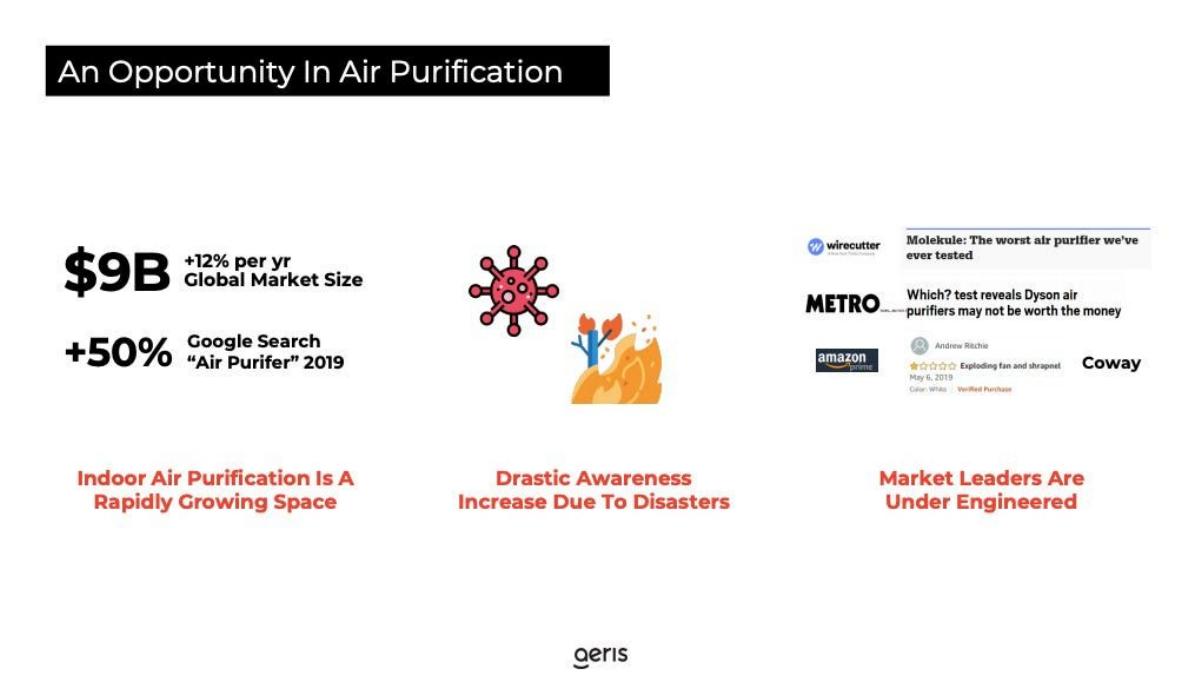
- The deck identifies a $9B global market growing at 12% annually, with a 50% spike in search interest in 2019 (Slide 4).
- Aeris uses negative press for competitors like Molekule and Dyson to position their own products as superior engineering (Slide 4).
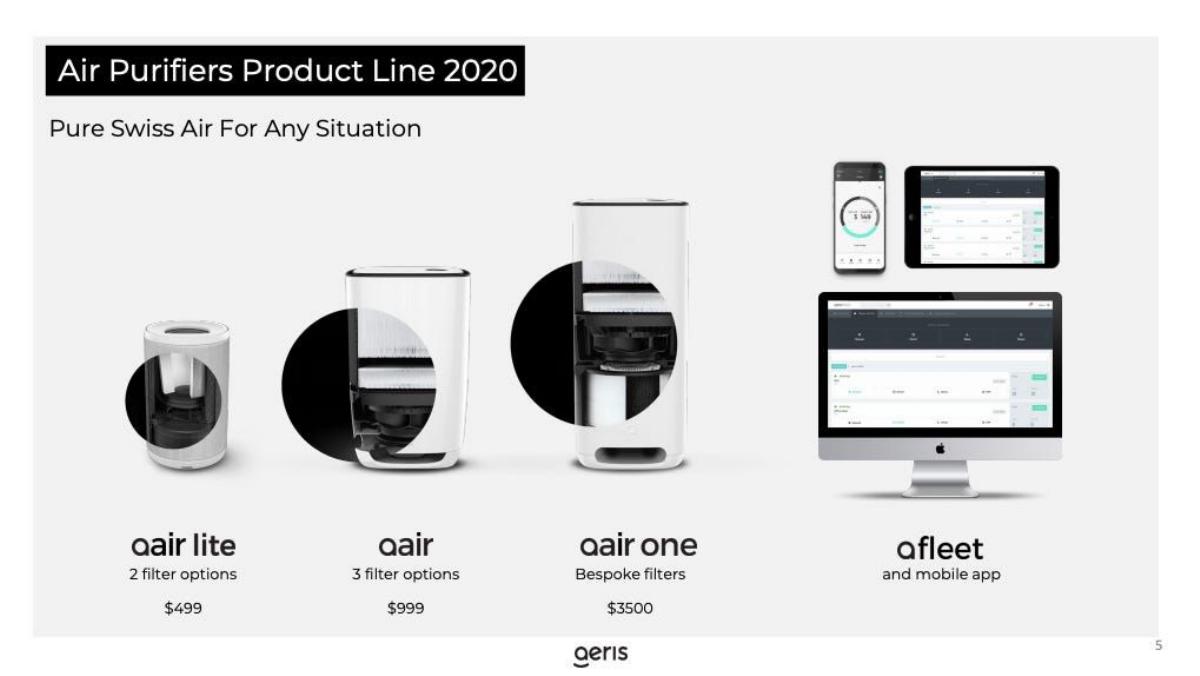
- The product line covers a wide price range from the $499 'aair lite' to the $3,500 'aair one' (Slide 5).
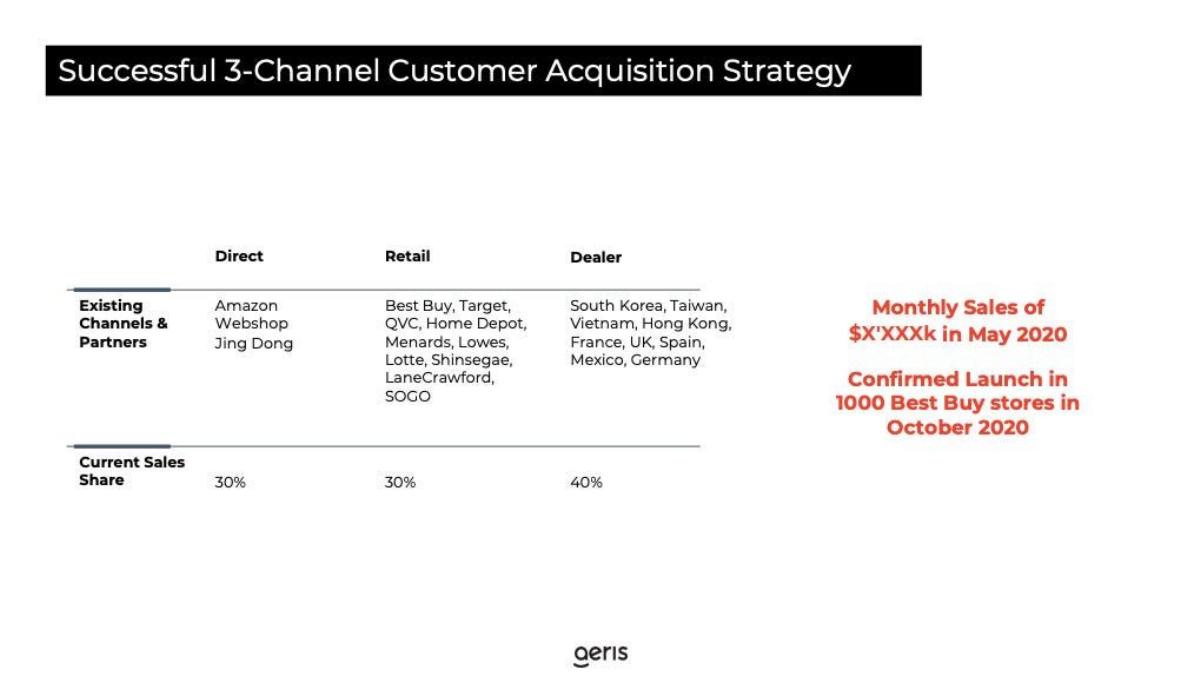
- Retail validation is a core strength, citing 20+ retailers and 200+ premium locations including Target, Home Depot, and Lowe's (Slide 6).
- A critical metric for hardware investors is the 68% recurring filter sales rate enabled by app-based tracking (Slide 7).
- The company successfully pivoted to medical sales during COVID-19, preselling to 300+ dental clinics in the US and Canada (Slide 8).
- The 'afleet' management software positions the hardware as a building efficiency tool, claiming ventilation can be 80% of energy costs (Slide 9).
- The team slide highlights significant industry experience, including a Head of Sales US with 30 years of retail experience at IQair and Duracell (Slide 11).
Executive Summary: The Swiss Engineering Play
Aeris Health’s pitch deck is a clinical, high-execution document that successfully raised $3.3M in a Series A round in 2020. Based in Switzerland, the company positions itself not just as a consumer electronics firm, but as a medical-grade air quality solution. The deck is particularly effective because it bridges the gap between high-end hardware manufacturing and the recurring revenue models that venture capitalists crave. By showcasing massive retail partnerships alongside a 68% recurring revenue rate for filters, Aeris demonstrates that they have solved the distribution and retention hurdles that kill most hardware startups.
Slide 1-3: Branding and Identity
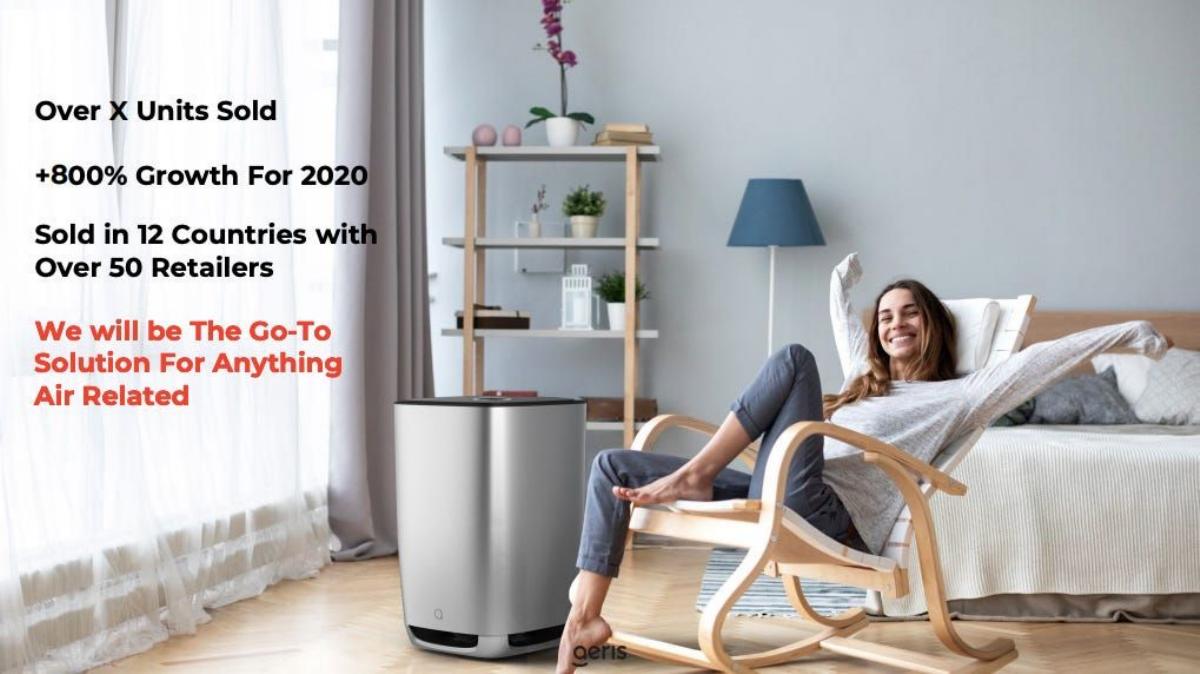
The opening slides are minimalist, focusing on the 'aeris' logo and the tagline 'Indoor Air Climate For Our Future.' The inclusion of the 'swiss + made' label is a strategic choice. In the world of high-end appliances and medical technology, Swiss engineering carries a premium connotation of precision and reliability. This sets the stage for their later claims of superior engineering over mass-market competitors.
Slide 4: The Opportunity and Market Gap
Slide 4 is a dense but effective 'Problem/Opportunity' slide. It cites a $9B Global Market Size growing at +12% per year . Crucially, it notes a +50% increase in Google Searches for 'Air Purifier' in 2019 , providing data-backed evidence of rising consumer intent. The slide also uses 'social proof of failure' by showing headlines criticizing competitors: Wirecutter calling Molekule 'the worst air purifier we've ever tested' and Metro questioning if Dyson units are worth the money. This immediately positions Aeris as the competent alternative to under-engineered market leaders.
Slide 5: The Product Lineup
This slide introduces the 2020 product line, showing a clear 'Good, Better, Best' pricing strategy. The aair lite ($499) , aair ($999) , and aair one ($3,500) allow the company to capture different market segments. The inclusion of 'afleet'—a mobile and desktop app—on the same slide as the hardware is a subtle but important signal that this is an integrated tech solution, not just a 'dumb' appliance. The bespoke nature of the $3,500 unit suggests high margins and professional-grade capabilities.
Slide 6: Retailer Validation
Traction is the heart of this deck. Slide 6 displays an impressive array of logos, claiming 20+ Retailers and 200+ Premium Locations . Seeing household names like Target, Home Depot, Lowe's, and QVC alongside luxury retailers like Lane Crawford and SOGO proves that Aeris has mastered both mass-market and high-end distribution. The photos of the products in-store provide physical evidence that these aren't just 'pilot' programs, but active retail presences.
Slide 7: The Recurring Revenue Engine
For a Series A investor, hardware sales are often seen as 'one and done.' Aeris counters this on Slide 7 by highlighting 68% Recurring Filter Sales . They attribute this high retention to their mobile app and remote tracking features. By making the filter replacement process seamless and data-driven, they turn a hardware purchase into a long-term subscription-like relationship. This is the most important slide for justifying a tech-style valuation for a hardware company.
Slide 8: The COVID-19 Pivot
Raised in 2020, this deck had to address the pandemic. Slide 8 shows how the company moved into the medical space, specifically targeting dental clinics. They mention running webinars for the American Dental Association (ADA) mailing list and coordinating through distributors like Benco Dental and Henry Schein . The standout metric here is that they presold to 300+ dental clinics in the US and Canada. This demonstrates agility and the ability to capture high-intent B2B markets during a crisis.
Slide 9: B2B Value Proposition and Energy Efficiency
Slide 9 shifts the narrative toward building management. It claims that traditional ventilation can account for up to 80% of a building's energy consumption . By using the 'afleet' management system and sensors, Aeris purifiers can reduce the need for heavy-duty HVAC ventilation. This transforms the product from a 'health luxury' into a 'cost-saving infrastructure' tool, opening the door for large-scale enterprise contracts.
Slide 10: The Competitive Landscape
The competitive matrix on Slide 10 is bold. It places Aeris in the top-right quadrant for both 'Tech' and 'Brand.' They explicitly name Dyson, Molekule, Blueair, and IQair as their main competitors, estimating their total market share at ~$600M . By positioning themselves as higher-tech than Dyson and stronger-branded than niche players like AustinAir, they carve out a unique 'premium-tech' niche.
Slide 11: The Team
The team slide is exceptionally strong for a Series A. Co-founders Pierre Bi and Constantin Overlack bring pedigrees from MIT, ETH Zurich, Bosch, and BCG . However, the 'hired guns' are even more impressive: KC Wong (Head of Sales Asia) has 20 years in the industry, and Scott Trowbridge (Head of Sales US) has 30 years of retail experience, including a VP role at IQair and Duracell USA . This tells investors that the company has the adult supervision necessary to manage global supply chains and retail relationships.
Slide 12: Roadmap and Milestones
The timeline shows a steady climb from a $1.5M Angel investment in 2015 to a full product line completion in 2018. The 2020 'Scale Up' phase includes expanding to 20 large retailers and 15 international dealers. The 2021 vision—extending into carbon dioxide control and humidification —suggests that Aeris doesn't just want to be an air purifier company, but a total 'Indoor Climate Solution.'
What Aeris Health Does Exceptionally Well
The deck is a masterclass in de-risking . Hardware is notoriously risky, but Aeris systematically knocks down every investor objection. Worried about distribution? They show Target and Home Depot logos. Worried about one-time sales? They show 68% recurring filter revenue. Worried about technical competence? They show MIT/ETH Zurich degrees and Swiss manufacturing. Worried about market relevance? They show 300+ dental clinic presales during COVID. The narrative is cohesive: they are the high-tech, high-reliability alternative in a market currently dominated by 'under-engineered' giants.
What is Missing from the Deck
While the deck is strong on traction and product, it is light on unit economics . There is no mention of Customer Acquisition Cost (CAC) versus Lifetime Value (LTV), which is critical given their high retail presence (where margins are typically thinner). There is also no financial summary slide showing historical revenue growth or burn rate. Most importantly, the Ask slide is missing in this version—investors are left knowing the company is great, but not how much capital they need or exactly how that capital will be deployed to reach the 2021 milestones.
Founder's Guide: What to Copy
The 'Competitor Failure' Hook: Don't just say you are better; show third-party evidence (like Wirecutter reviews) that your competitors are failing. It creates an immediate vacuum that your product fills. · The Revenue Mix: If you are selling hardware, find a way to track and report recurring revenue. The 68% filter sales metric is likely what secured their $3.3M round more than the hardware itself. · Industry-Specific Pivots: The dental clinic slide is a perfect example of finding a 'niche of high need.' Founders should look for similar high-compliance B2B environments where their product is a 'must-have' rather than a 'nice-to-have.' · Pedigree and Experience: Notice how they balanced young, technical founders with 'grey-haired' sales veterans. This balance is highly attractive to Series A and B investors who worry about scaling operations.
Frequently asked questions
- What was the primary 'Why Now' factor in the Aeris Health deck?
- The deck leveraged a 'perfect storm' of factors: a $9B growing market, increased awareness due to environmental disasters, and the specific demand for virus-filtering technology during the COVID-19 pandemic. By showing they were already preselling to 300+ dental clinics, they proved immediate relevance to current global events.
- How does Aeris Health address the 'hardware is hard' investor bias?
- They counter this by focusing on recurring revenue and software. Slide 7 highlights that 68% of filter sales are recurring, driven by their mobile app. Slide 9 introduces 'afleet,' a fleet management tool that turns individual purifiers into an integrated building management system, moving the business toward a SaaS-like model.
- Who are the main competitors identified by Aeris?
- Slide 10 explicitly names Dyson, Molekule, Blueair, and IQair as their main competitors. They use a 2x2 matrix to position themselves as the leader in both 'Tech' and 'Brand' compared to these incumbents, noting that the total market share for these leaders is approximately $600M.
- What is the significance of the 'aair one' product in their lineup?
- The 'aair one' is their high-end, bespoke filter unit priced at $3,500. This serves as a flagship product that anchors their brand in the professional/medical space, allowing the $499 and $999 consumer units to seem more accessible while still benefiting from the 'Swiss-made' engineering pedigree.
- Is there a clear exit strategy or 'Ask' in the deck?
- No. The provided slides do not include a specific funding ask, valuation, or exit strategy. While the publisher reports a $3.3M raise, the deck focuses entirely on the business case, traction, and product roadmap rather than the financial mechanics of the round.