AERA Health’s 12-slide pitch deck was instrumental in securing a $4.3M Seed round in 2024. The Swiss-German startup positions itself as the connective tissue in the fragmented longevity market, moving away from traditional 'sickcare' toward a predictive, participatory model. The deck excels at defining a clear 'Challenge' vs. 'Solution' dichotomy, using a B2B2C framework to show how they integrate with existing clinics, gyms, and hotels. By focusing on behavior change and measurable health data, AERA addresses the primary friction point in preventative health: sustained user engagement. While…
Key takeaways
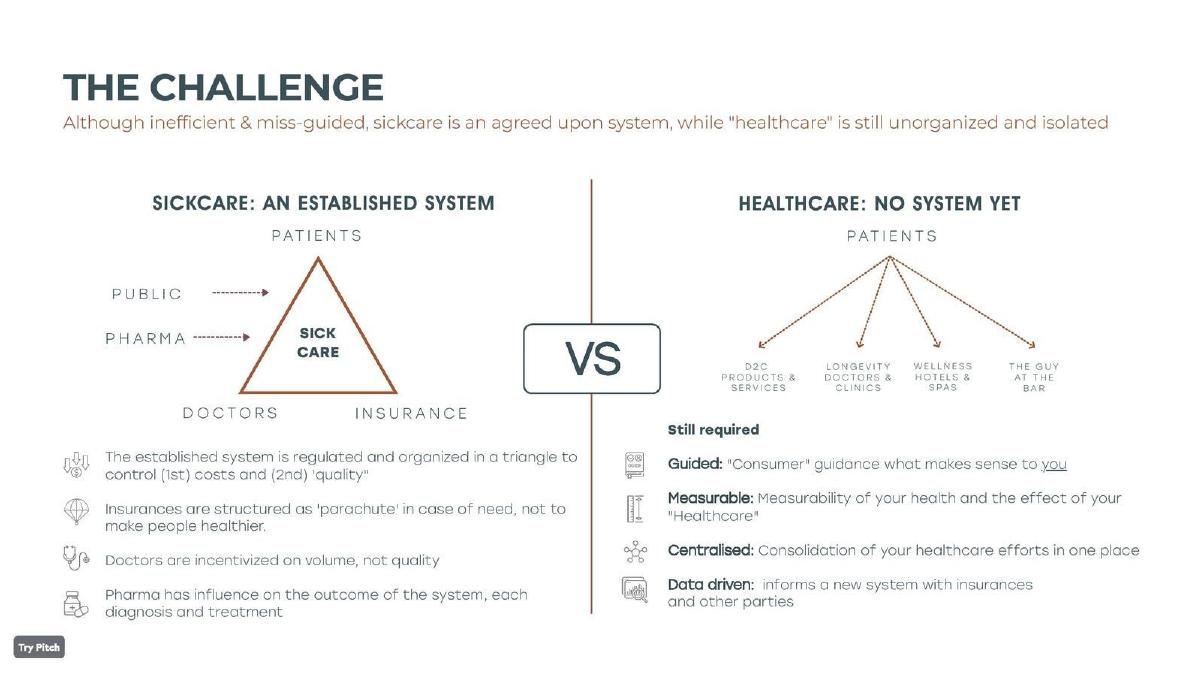
- The deck defines the current system as 'Sickcare'—a regulated triangle of patients, doctors, and insurance focused on volume rather than health (Slide 3).
- AERA identifies four pillars for the new system: Guided, Measurable, Centralized, and Data-driven (Slide 3).
- The 'For The Locations' slide outlines a clear B2B2C revenue model, targeting longevity players, medical practices, and hotels (Slide 4).
- The solution is presented as a three-step journey: modern diagnostics, guided journeys through wellness clubs, and better health outcomes via coaching (Slide 5).
- Behavior change is visualized as a 'Transformation Process' that moves users from 'doing nothing' to an 'optimal healthspan' (Slide 6).
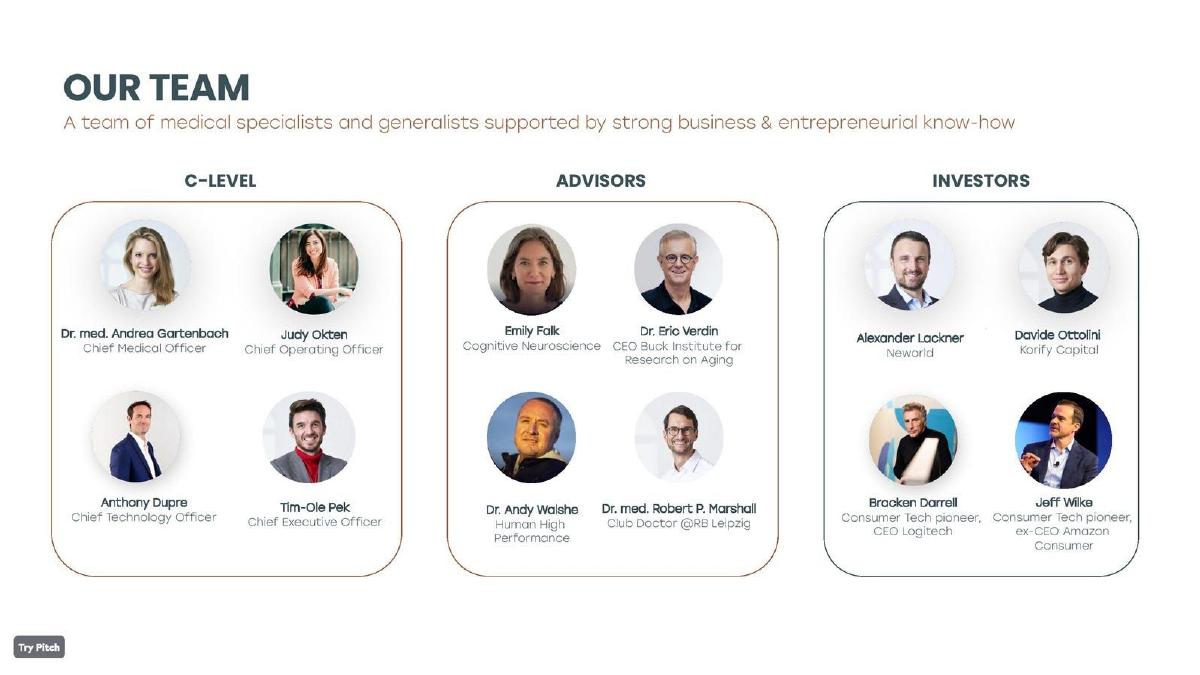
- The team slide features a heavy emphasis on medical and scientific credibility, including the CEO of the Buck Institute for Research on Aging as an advisor (Slide 2).
- AERA raised $4.3M in 2024 for its Swiss-German operations, as reported by Business Insider.
- The deck omits specific unit economics, CAC/LTV projections, and a detailed product roadmap.
AERA Health: Bridging the Gap Between Wellness and Medicine
AERA Health’s pitch deck is a focused exercise in market positioning. In a sector often crowded with vague 'wellness' promises, AERA uses its 12 slides to argue for a systematic, data-driven infrastructure that connects fragmented health services. As reported by Business Insider, the company raised $4.3M in a 2024 Seed round to expand its Swiss-German footprint. The deck’s strength lies in its ability to frame the 'longevity' trend not as a luxury hobby, but as a necessary evolution of a failing global healthcare system.
Slide 1: The Vision
The title slide introduces the brand with a minimalist aesthetic. The tagline, "ENABLING A NEW ERA OF HEALTHCARE," is supported by four descriptors: Preventive, Personalised, Predictive, and Participatory . This sets an immediate tone of clinical authority combined with modern technology. It avoids flashy imagery in favor of a clean, professional look that appeals to both medical professionals and institutional investors.
Slide 2: The Team, Advisors, and Investors
This is arguably the strongest slide in the deck. AERA divides its human capital into three distinct buckets: C-Level, Advisors, and Investors. The C-Level team, led by CEO Tim-Ole Pek and CMO Dr. med. Andrea Gartenbach , provides the necessary mix of business and medical expertise. The Advisors section is particularly impressive, featuring Dr. Eric Verdin , CEO of the Buck Institute for Research on Aging, which lends massive scientific credibility to a longevity startup. Finally, the Investors column lists heavyweights like Jeff Wilke (ex-CEO Amazon Consumer) and Bracken Darrell (CEO Logitech), signaling to new investors that the company has already passed the due diligence of world-class operators.
Slide 3: The Challenge - Sickcare vs. Healthcare
AERA uses a classic 'us vs. them' framework here. They define the current status quo as "SICKCARE: AN ESTABLISHED SYSTEM" represented by a rigid triangle of Patients, Doctors, and Insurance. The slide notes that doctors are incentivized on volume and insurance acts as a 'parachute' rather than a health improver. On the right, "HEALTHCARE: NO SYSTEM YET" shows a fragmented landscape where patients are left to navigate D2C products, wellness hotels, and 'the guy at the bar' on their own. AERA identifies the missing components: a system that is Guided, Measurable, Centralised, and Data-driven .
Slide 4: For The Locations - The B2B2C Strategy
This slide explains the 'how' of their market entry. AERA isn't just a consumer app; it is a "Consumer driven solution to help drive demand for longevity offering." They target three types of partners: Existing longevity players , Medical Practices , and Non-longevity Organisations (offices, hotels, gyms). The benefits for these locations are clearly quantified: Exposure to new clients, Revenue (direct and passive), Conversion Fees , and a New Offering for their existing base. This 'Plug n Play' approach suggests a scalable model that doesn't require AERA to build its own physical clinics everywhere.
Slide 5: The Solution - Making Health Measurable
Slide 5 breaks down the product into a three-step flow. First, "WE MAKE HEALTH MEASURABLE" through diagnostics in Cardio, Metabolic, Brain, Microbiome, and Hormone categories. Second, "TO GUIDE THE HEALTH JOURNEY" by acting as the hub for doctors, wellness clubs, and D2C products. Third, "AND MAKE YOUR HEALTH BETTER" through treatments and coaching. The visual of the "Health Action Plan" via the app serves as the central anchor for the entire user experience.
Slide 6: Driving The (Behaviour) Change
The final slide in this set addresses the hardest part of preventative health: long-term engagement. It maps out a "Transformation Process" on a vertical axis of "Optimal healthspan." It shows a user moving from a 'Start' where they might 'do nothing' to a new 'Start' powered by AERA's Health Profile & Action Plan . By tracking biomarkers, supplements, and exercise, the user moves toward 'Health Re-Profiling.' This slide is critical because it shows investors that AERA understands the psychological journey of the consumer, not just the medical data.
What Works in the AERA Health Deck
1. Credibility by Association: The team and advisor slide is a masterclass in building trust. By including the head of a major aging research institute and former top-tier tech CEOs, AERA bypasses the skepticism often directed at 'wellness' startups. 2. Clear Market Gap: The 'Sickcare' vs. 'Healthcare' slide (Slide 3) creates a logical vacuum that AERA naturally fills. It makes the lack of a centralized health system feel like an obvious business opportunity rather than a theoretical problem. 3. The B2B2C Angle: By positioning themselves as a partner for 'Locations' (Slide 4), AERA demonstrates a capital-efficient way to scale. They aren't competing with gyms and clinics; they are providing the digital layer that makes those businesses more profitable.
What is Missing from the AERA Health Deck
1. Financial Projections: While the deck mentions revenue streams like 'Conversion Fees' and 'Direct/Passive Revenue,' it provides no hard numbers. There is no mention of current ARR, projected growth, or the specific breakdown of the $4.3M raise allocation. 2. Competitive Landscape: The deck implies that the current market is 'unorganized,' but it ignores direct competitors in the longevity space (e.g., Fountain Life, Tally Health). A slide showing how AERA differs from other digital health platforms would strengthen the case. 3. Unit Economics: There is no data on Customer Acquisition Cost (CAC) or Lifetime Value (LTV). For a Seed round, investors want to see that the founders understand the math behind their growth, especially in a hybrid digital-physical model.
Lessons for Founders
Lead with Authority: If you have high-profile advisors or investors, don't hide them at the end. AERA puts their team and backers on Slide 2, which immediately validates every subsequent claim in the deck. · Define the 'New System': Don't just say your product is better; argue that the entire existing category is broken. AERA's use of the term 'Sickcare' is a powerful linguistic tool that rebrands the competition as obsolete. · Show the Ecosystem: If your product relies on other businesses (like clinics or gyms), show exactly how you make them more money. Slide 4 is a perfect example of a B2B value proposition that makes the startup look like a 'must-have' partner rather than a 'nice-to-have' app. · Visualize the Journey: Use a 'Transformation' slide to show the delta between a user's life before and after your product. It helps investors visualize the 'stickiness' of the solution.
Frequently asked questions
- What is AERA Health's primary business model?
- Based on Slide 4, AERA utilizes a B2B2C 'Plug n Play' model. They partner with 'Locations' such as medical practices, longevity clinics, gyms, and hotels. AERA provides the digital interface and health action plan, earning revenue through conversion fees and direct/passive revenue streams while helping these locations increase their own service offerings.
- How does AERA differentiate 'Sickcare' from 'Healthcare'?
- Slide 3 explicitly contrasts the two. 'Sickcare' is an established, regulated system where doctors are incentivized by volume and insurance acts as a 'parachute' only in case of need. 'Healthcare' (AERA's space) is described as currently unorganized and isolated, requiring a centralized, data-driven system to make health measurable and guided.
- Who are the key people behind AERA Health?
- The leadership includes CEO Tim-Ole Pek, CMO Dr. med. Andrea Gartenbach, COO Judy Okten, and CTO Anthony Dupre. They are supported by high-profile advisors like Dr. Eric Verdin (Buck Institute) and investors including Jeff Wilke (ex-Amazon) and Bracken Darrell (Logitech), as shown on Slide 2.
- What specific health metrics does AERA track?
- Slide 5 indicates that AERA focuses on 'Modern / Personalized Diagnostics' across several categories: Cardio, Metabolic, Brain, Microbiome, and Hormone. These benchmarks are used to create a personalized 'Recommendation & Treatment Plan' for the user.
- What is the 'Transformation Process' mentioned in the deck?
- Slide 6 illustrates this as a shift in focus. It moves a user from a starting point of 'doing nothing' or basic exercise to a 'Health Profile & Action Plan' powered by AERA. This leads to data-backed 'Health Re-Profiling' and eventually an 'Optimal Healthspan' through biohacking and supplement tracking.