Adventureclicknblog presents a dual-phase business model targeting the $150 billion global adventure tourism market. The platform initially focused on 'Experience Sharing' (launched June 2014) to build a community of 250 bloggers, before introducing a 'Request Raise' feature to connect travelers with organizers. The deck highlights a significant market opportunity in India ($2 billion) and a 65% CAGR for the sector. Seeking $1 million, the founders plan to scale from 2,000 contributions to a target of 2,000 trip requests per day by 2017. While the deck provides clear timelines and a structure…
Key takeaways
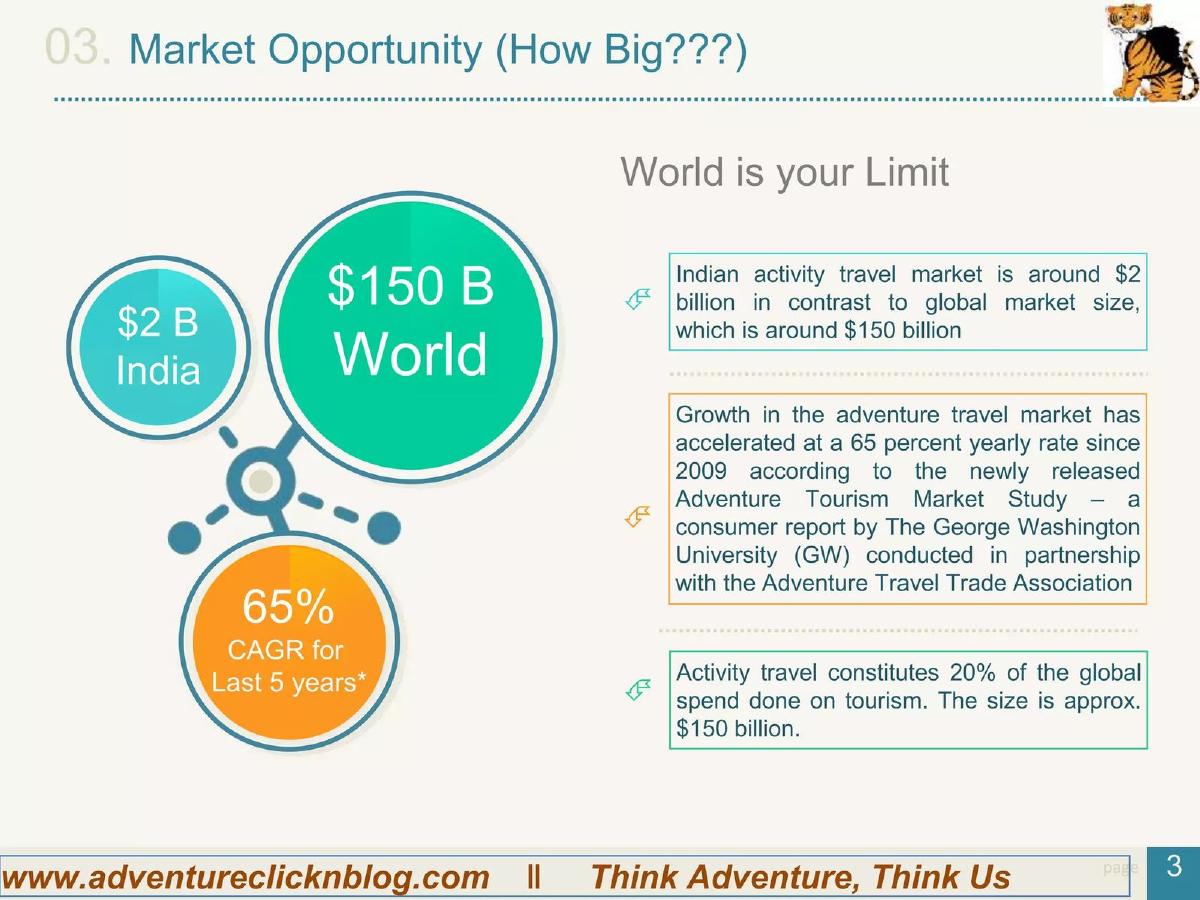
- The global adventure travel market is valued at $150 billion, with India representing a $2 billion segment (Slide 3).
- The platform utilizes a two-product strategy: 'P1' for sharing experiences and 'P2' for raising trip requests (Slide 6).
- Traction as of April 2015 included 250 bloggers and over 2,000 contributions (Slide 15).
- The company is seeking a $1 million investment to fund manpower, product development, and marketing (Slide 20).
- Monetization is deferred, with plans to introduce subscription and commission models after a 6-month free period for organizers (Slide 11).
- The marketing strategy relies heavily on IP acquisition, educational partnerships, and flagship events (Slide 14).
- Projected growth targets 1,000,000 monthly visits and 60,000 trip requests per month by March 2017 (Slides 12-13).
- The competitive landscape is segmented into primary, secondary, and tertiary competitors, including National Geographic and TripAdvisor (Slide 16).
Adventureclicknblog Pitch Deck Teardown
Adventureclicknblog positions itself as a comprehensive hub for the adventure travel industry, bridging the gap between content creation (blogging) and commerce (booking). The deck is structured to show a progression from a community-led content site to a high-volume marketplace for customized adventure trips.
Slide 1: Title and Vision
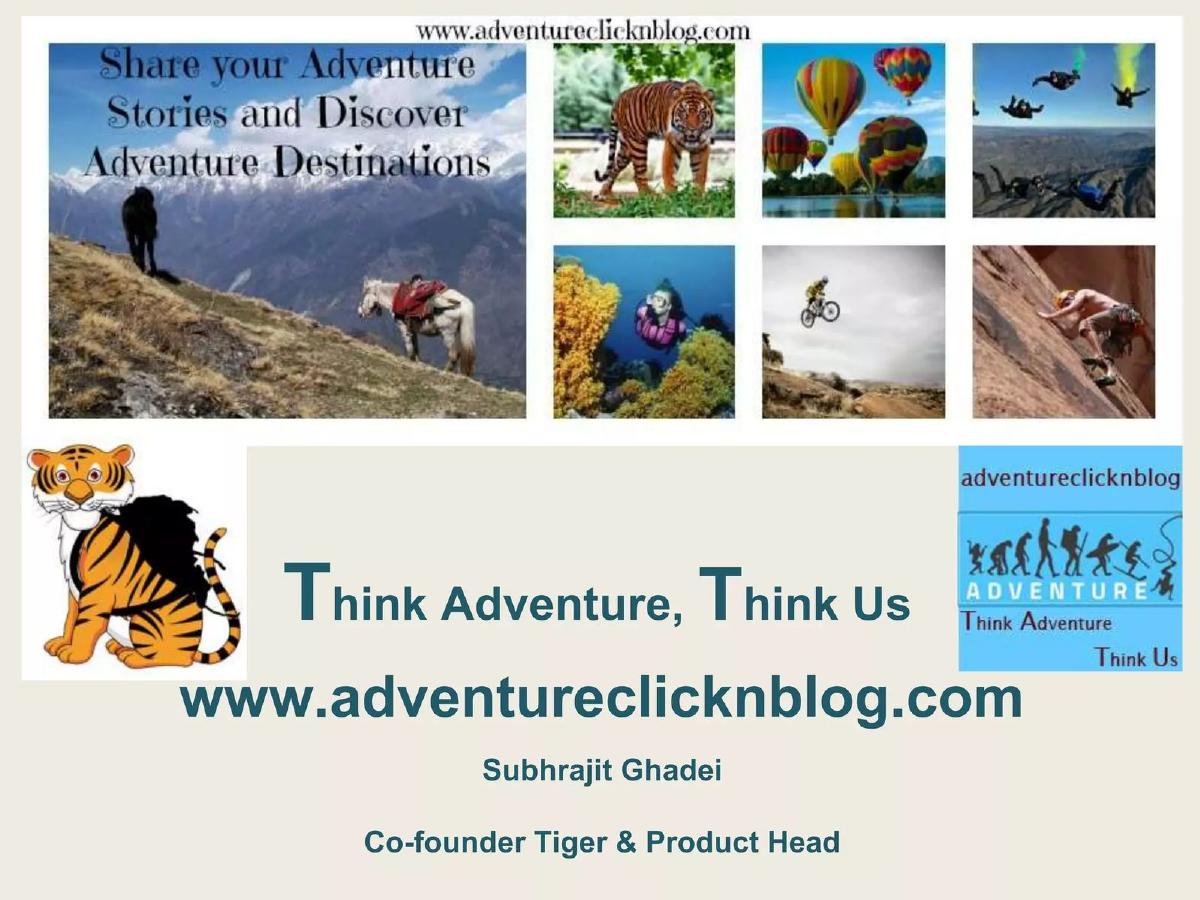
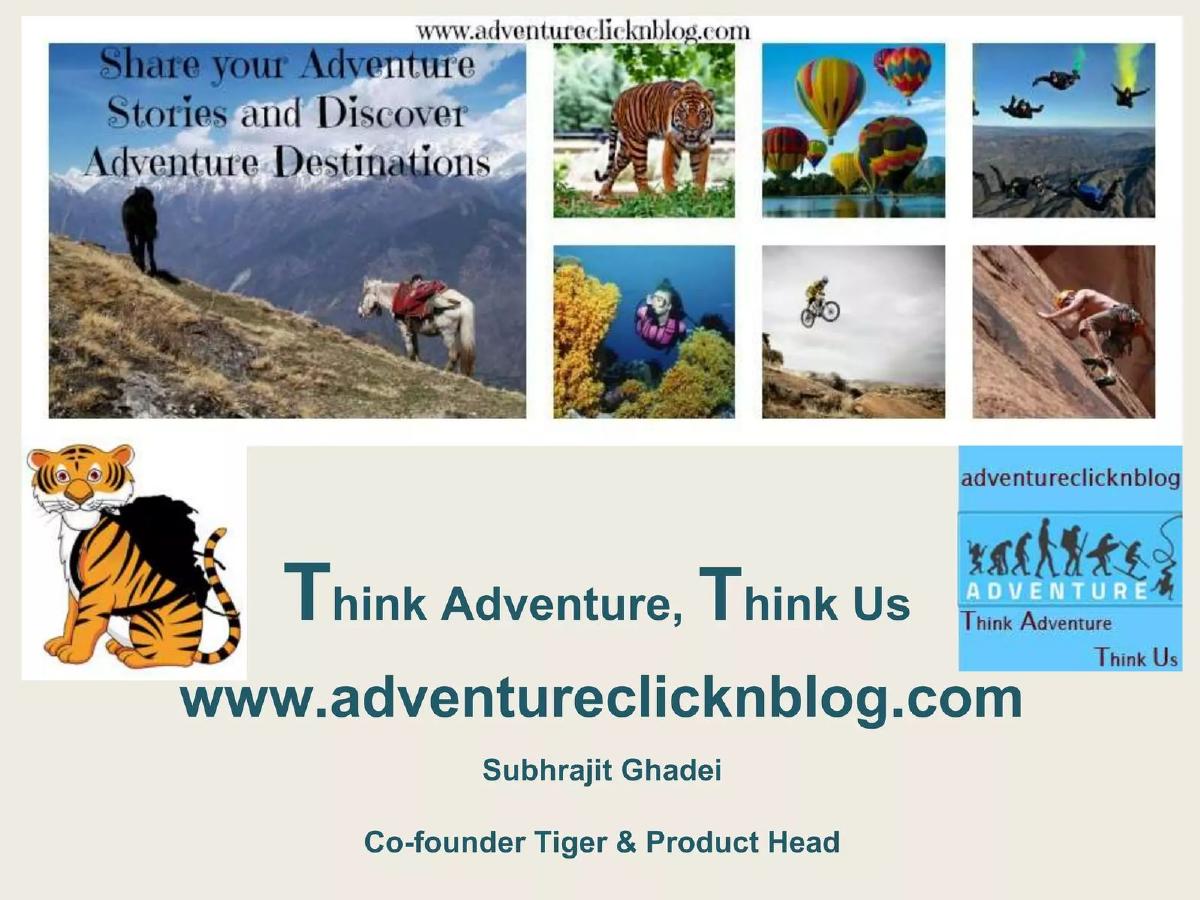
The cover slide introduces the brand with the tagline "Think Adventure, Think Us." It features a collage of adventure activities—scuba diving, hot air ballooning, skydiving, and trekking—to establish the sector. Subhrajit Ghadei is listed as the Co-founder and Product Head. The visual branding includes a tiger mascot, which appears consistently throughout the deck.
Slide 2: The Core Mission
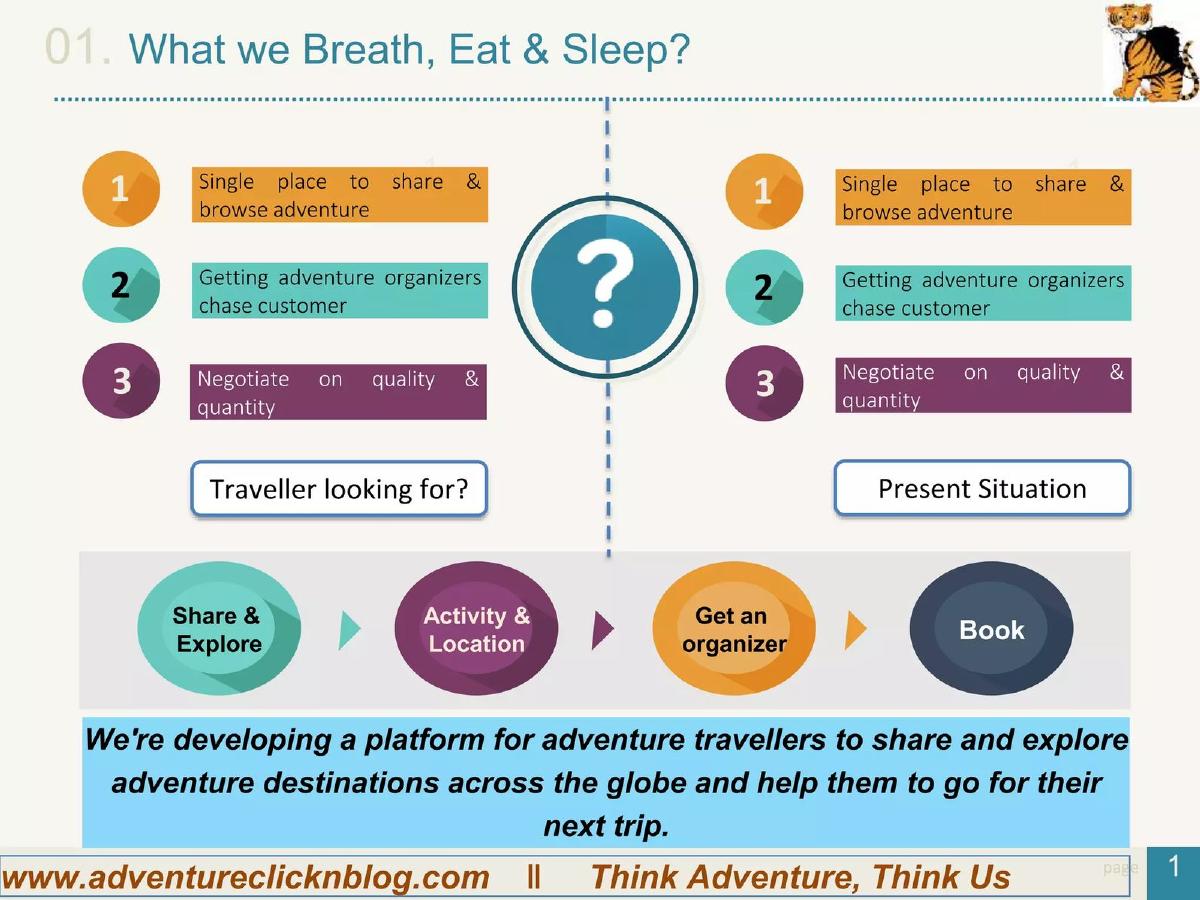
Titled "What we Breath, Eat & Sleep?", this slide defines the platform's dual purpose. It contrasts the "Traveller looking for?" with the "Present Situation." The goal is to provide a single place to share and browse adventures, help organizers find customers, and facilitate negotiations on quality and quantity. The workflow is defined as: Share & Explore > Activity & Location > Get an organizer > Book.
Slide 3: The Unstructured Sector Problem
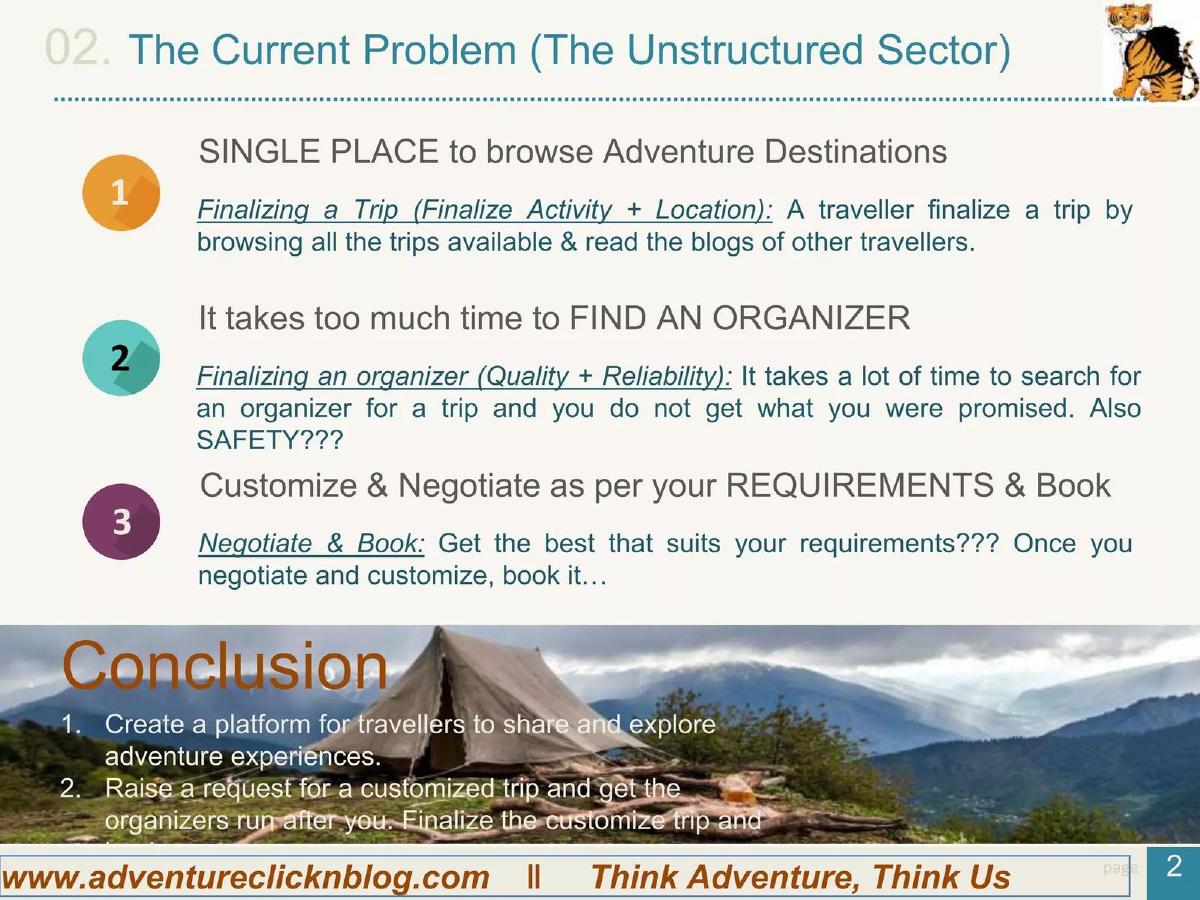
Slide 2 (labeled 02) details the "Current Problem." It highlights the difficulty in finalizing trips due to fragmented information and the time-consuming process of finding reliable, safe organizers. The "Conclusion" section proposes a platform where travelers share experiences and organizers "run after" travelers who raise customized requests.
Slide 4: Market Opportunity
The deck cites a $150 billion global market size for activity travel, with India representing a $2 billion opportunity. A key metric provided is a 65% CAGR for the adventure travel market over the last five years, sourced from a George Washington University and Adventure Travel Trade Association study. The slide emphasizes that activity travel constitutes 20% of global tourism spend.
Slide 5: The Solution
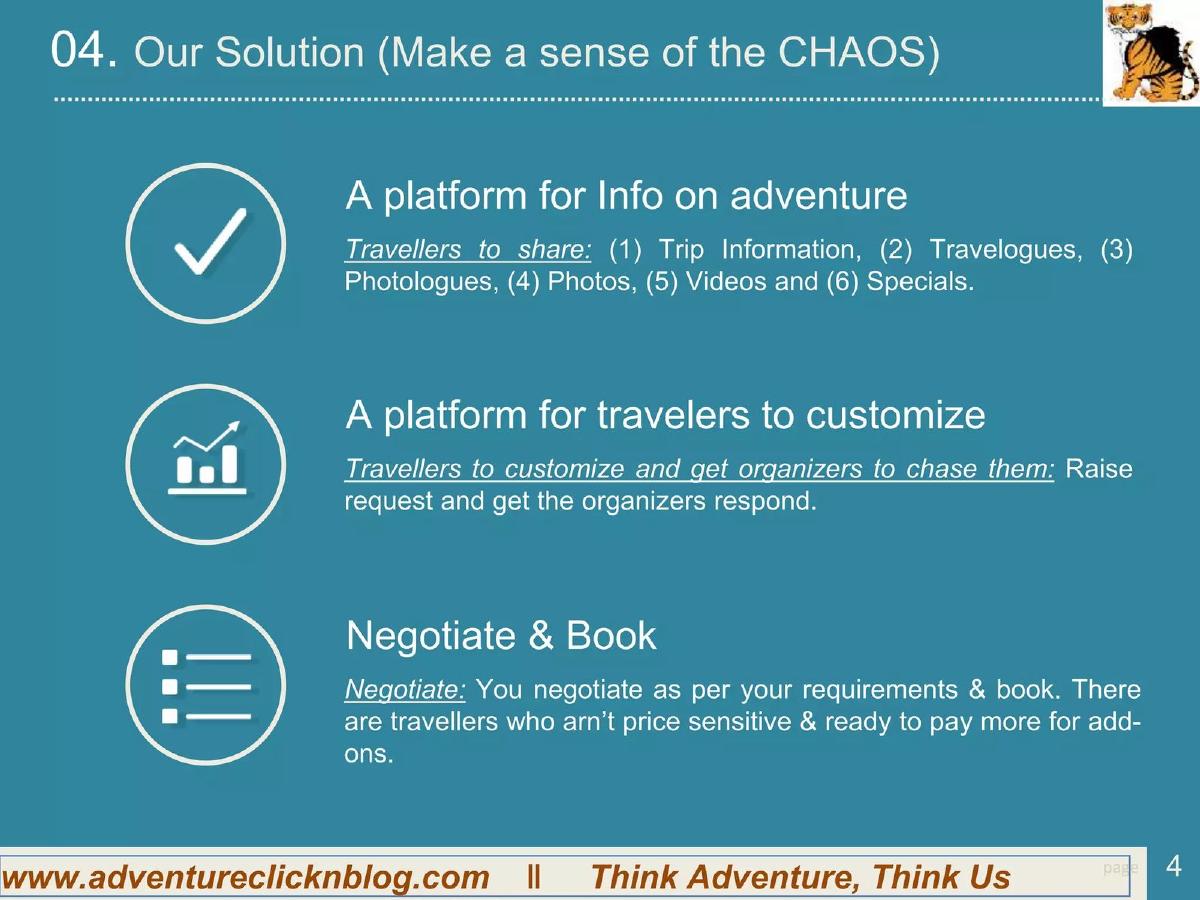
The solution is presented in three tiers: a platform for info (travelogues, photos, videos), a platform for customization (where organizers respond to traveler requests), and a negotiation/booking engine. It explicitly mentions targeting travelers who are not price-sensitive and are willing to pay for add-ons.
Slide 6: Product Demo
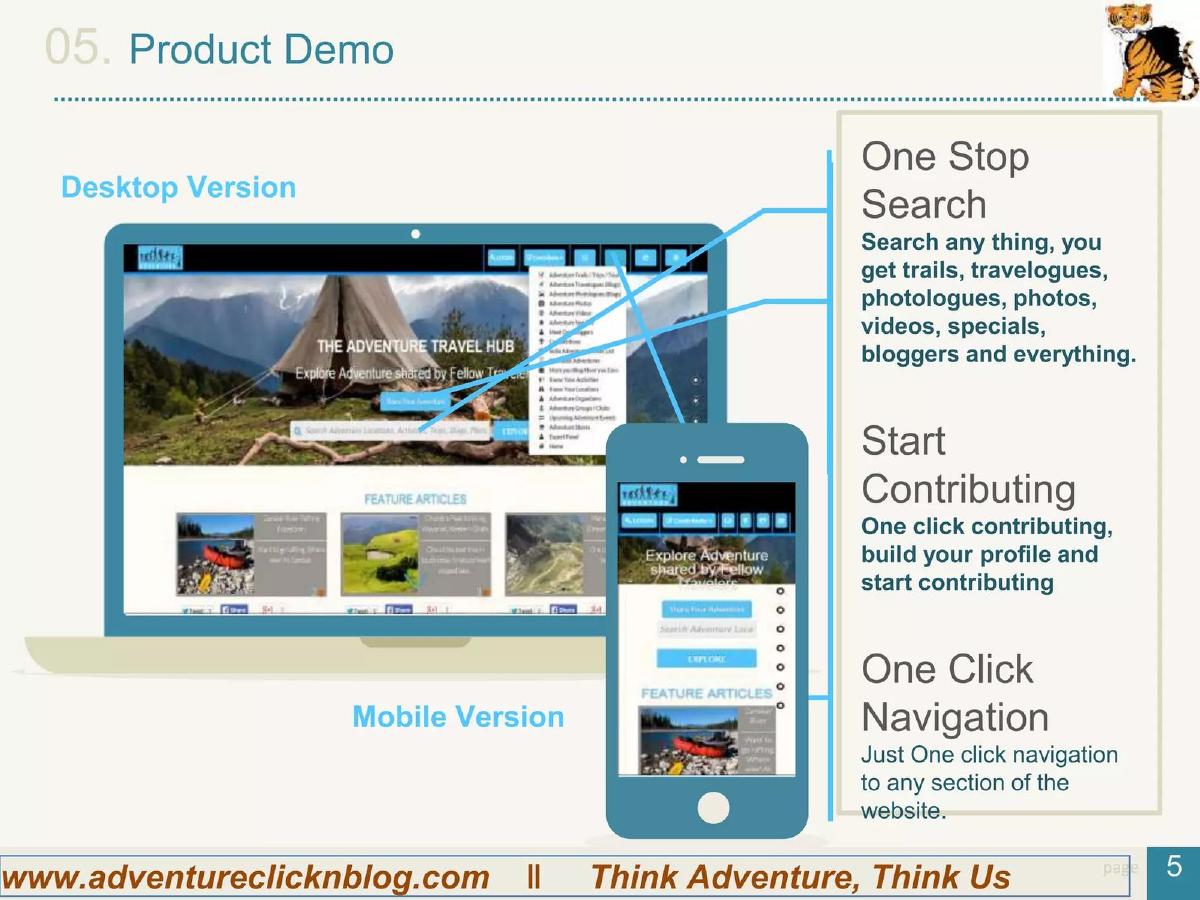
This slide displays the user interface for both desktop and mobile versions. It highlights features like "One Stop Search" for trails and travelogues, "One click contributing" for building profiles, and "One Click Navigation" for site sections.
Slides 7-8: Business Model and Roadmap
The business model is split into Product 1 (P1: Experience Sharing) and Product 2 (P2: Trip Requests). The timeline shows P1 launched in India in June 2014 and P2 in May 2015. The roadmap targets "Making 2000 requests / day" by 2017. Slide 8 provides a grid view of these launch dates for India versus the rest of the world.
Slides 9-10: Execution Strategy
These slides detail how the company acquires content and customers. For P1, they "attack trekking first" and contact bloggers personally via call and mail. For P2, the focus is on planning before the season starts and being "Customer Focused," selling exactly what the traveler wants. Social media icons (Facebook, Twitter, Google+) are central to their outreach strategy.
Slide 11: Monetization Strategy
The revenue model is transparent about its delay: "We are not planning to make any money till December-2015." Post-December 2015, they planned to introduce monthly subscriptions for organizers and commission fees on bookings. They also mention a potential digital or print product for 2016.
Slides 12-13: Key Goals and Timelines
These slides use bar charts to project growth. By March 2017, the company aims for 1,000,000 monthly visits and 100,000 experience shares. On the marketplace side, they project 15,000 registered organizers and 60,000 requests raised per month by the same date.
Slide 14: Marketing Strategy
The marketing plan is multifaceted, focusing on IP acquisition, partnerships with educational institutes, and hosting flagship events. They aim to create at least two annual "properties" (events) in the first two years to drive brand awareness.
Slide 15: Traction and Response
This is a critical slide for investors, showing an Alexa Rank improvement from 6.5 million in June 2014 to 900,000 in April 2015. It also notes 250 bloggers and over 2,000 contributions achieved within the first ten months of operation.
Slide 16: Competitive Landscape
The deck uses a Venn diagram to categorize competitors. Primary segments include National Geographic and Lonely Planet. Secondary segments include Tripoto and TripHobo. Tertiary segments include general travel sites like MakeMyTrip and Yatra. It positions Adventureclicknblog at the intersection of these categories.
Slides 17-18: Team and Advisors
The team consists of Rakesh Nahak (CEO), Saroshi Nahak (Content), and Subhrajit Ghadei (Product). The advisor slide lists a photographer, an adventure athlete, and an event organizer, suggesting a focus on industry expertise rather than just technical or financial background.
Slide 19: Funding Timeline
A simple linear timeline shows the progression from the June 2014 launch to a projected Series A funding round in December 2015.
Slide 20: Testimonials
Two testimonials from an adventure blogger and an adventure traveler are included. Both highlight the "one stop hub" concept but also offer constructive criticism regarding site navigation and content comprehensiveness.
Slide 21: Funding Needs
The company sets a goal of $1 million. The use of funds is clearly broken down: manpower (6 people), product development for the request system, digital marketing, and a 3-person customer service team. Immediate plans include setting up an office and completing legal requirements.
Slide 22: Contact Information
The final slide provides social media handles, an email address, and a phone number, repeating the "Think Adventure, Think Us" slogan.
What Works in This Deck
Clear Phasing: The distinction between P1 (Content) and P2 (Marketplace) shows a logical progression for building a community before trying to monetize it. · Specific Use of Funds: The $1M ask is backed by a specific headcount (6 for manpower, 3 for customer service), which gives investors a clear picture of the operational scale. · Market Context: Citing a 65% CAGR and the specific $2B Indian market opportunity provides a strong macro-economic tailwind for the pitch. · Transparency: Including testimonials that mention site limitations (e.g., "one can get lost easily") shows a level of honesty and awareness of user experience challenges.
What Is Missing
Unit Economics: While the deck mentions commission fees and subscriptions, it does not provide the expected Take Rate, Customer Acquisition Cost (CAC), or Lifetime Value (LTV). · Current Revenue: The deck explicitly states they aren't making money yet, but it lacks a detailed financial projection showing when the company reaches break-even. · Technical Depth: There is little information on the technology stack or how the "Request Raise" matching algorithm works to ensure quality responses from organizers. · Exit Strategy: There is no mention of potential acquirers or long-term outcomes for investors.
Founder Takeaways
Build the Community First: If you are entering a fragmented market, follow this deck's lead by using content (P1) to aggregate supply and demand before launching the transactional layer (P2). · Use Industry Advisors: The inclusion of a "highly decorated photographer" and "adventure junkey" as advisors adds credibility to a niche travel startup that a purely corporate board might lack. · Define Your Segments: The competitive landscape slide is effective because it doesn't just list logos; it categorizes them into primary, secondary, and tertiary segments, showing where the startup fits in the broader ecosystem. · Be Specific with Headcount: When asking for money for "manpower," always state the number of people you intend to hire, as seen on Slide 20.
Frequently asked questions
- What is the primary problem Adventureclicknblog aims to solve?
- According to Slide 2, the company targets the 'unstructured sector' of adventure travel. It identifies three pain points: the lack of a single place to browse destinations, the excessive time required to find reliable and safe organizers, and the difficulty in negotiating and customizing trips to specific requirements.
- How does the company plan to generate revenue?
- Slide 11 outlines a delayed monetization strategy. The platform was free for organizers for the first six months. Post-launch, they planned to introduce a monthly subscription fee for organizers, booking fees, and an additional commission fee on every booking, alongside potential digital and print products in 2016.
- What is the current traction of the platform?
- As of Slide 15, the platform launched its 'Experience Share' feature in June 2014. By April 2015, it reported an Alexa Rank of 900,000 (improved from 6,500,000), 250 registered bloggers, and more than 2,000 total contributions.
- What are the specific funding needs mentioned in the deck?
- Slide 20 specifies a $1 million goal. The funds are earmarked for manpower (hiring 6 people), product development for the 'Request Raise' feature, digital marketing expenses, and setting up a customer service team with at least 3 members.
- Who are the key members of the leadership team?
- Slide 17 introduces Rakesh Nahak (CEO & Sales), Saroshi Nahak (Content Head & Expansion Strategy), and Subhrajit Ghadei (Product Head & Marketing). They are supported by three advisors specializing in photography, events, and blogger behavior (Slide 18).