Adventr’s pitch deck is a masterclass in using comparative data to justify a new medium. By positioning interactive video as the necessary successor to 'linear old school video,' the company highlights a massive performance gap that enterprise brands are currently spending millions to bridge internally. The deck reports that a SundanceTV proof-of-concept achieved a 9.5% CTR versus the 0.7% industry standard for linear video. With a team featuring deep roots at Vimeo and a business model based on a freemium SaaS approach, the deck successfully argues that Adventr democratizes high-end interact…
Key takeaways
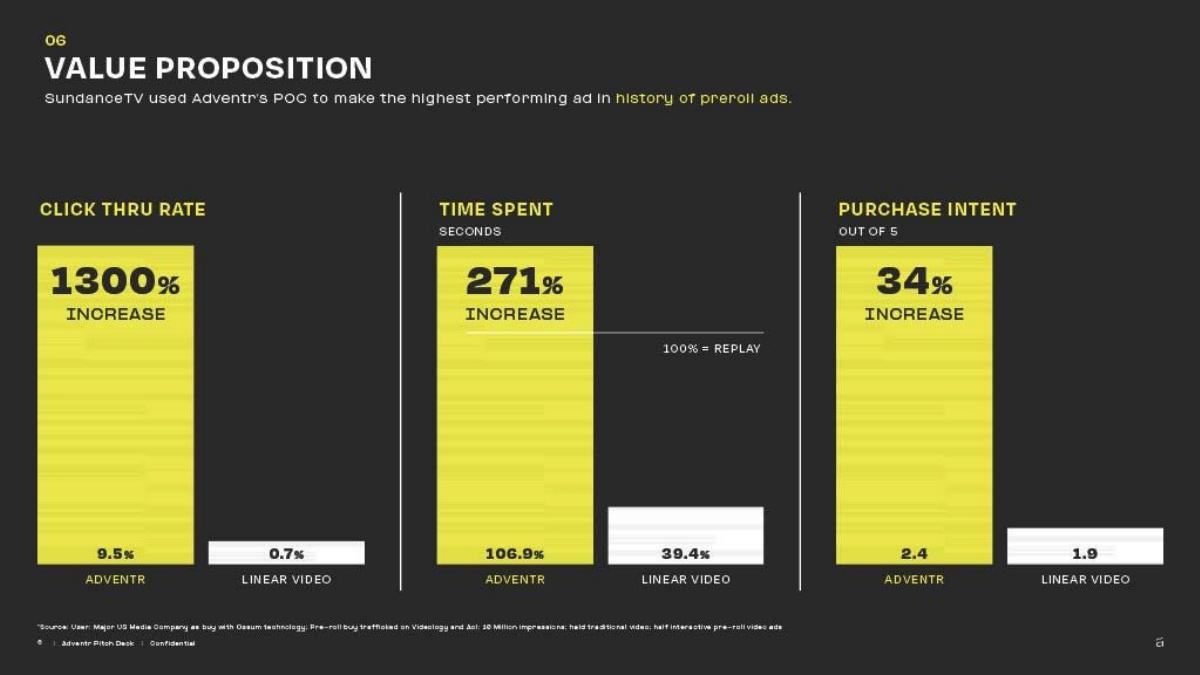
- Adventr reports a 1300% increase in click-through rates (9.5% vs 0.7%) for their interactive format compared to traditional linear video on slide 6.
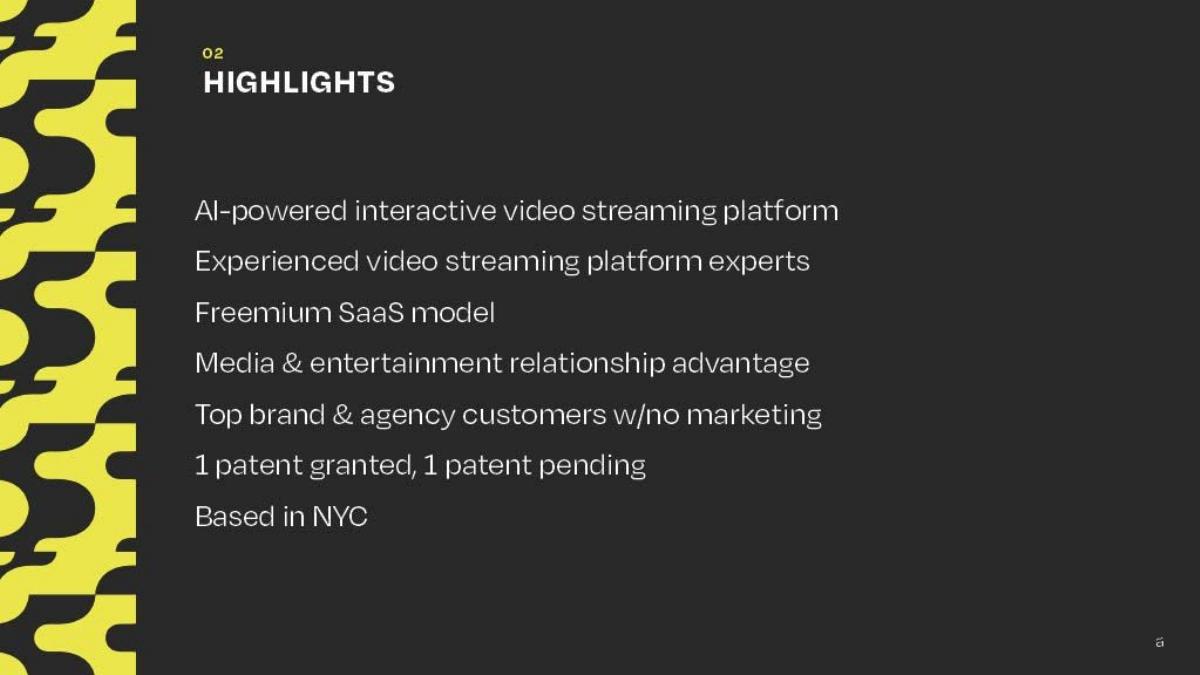
- The company claims to have 1 patent granted and 1 patent pending to protect its AI-powered streaming technology as stated on slide 2.
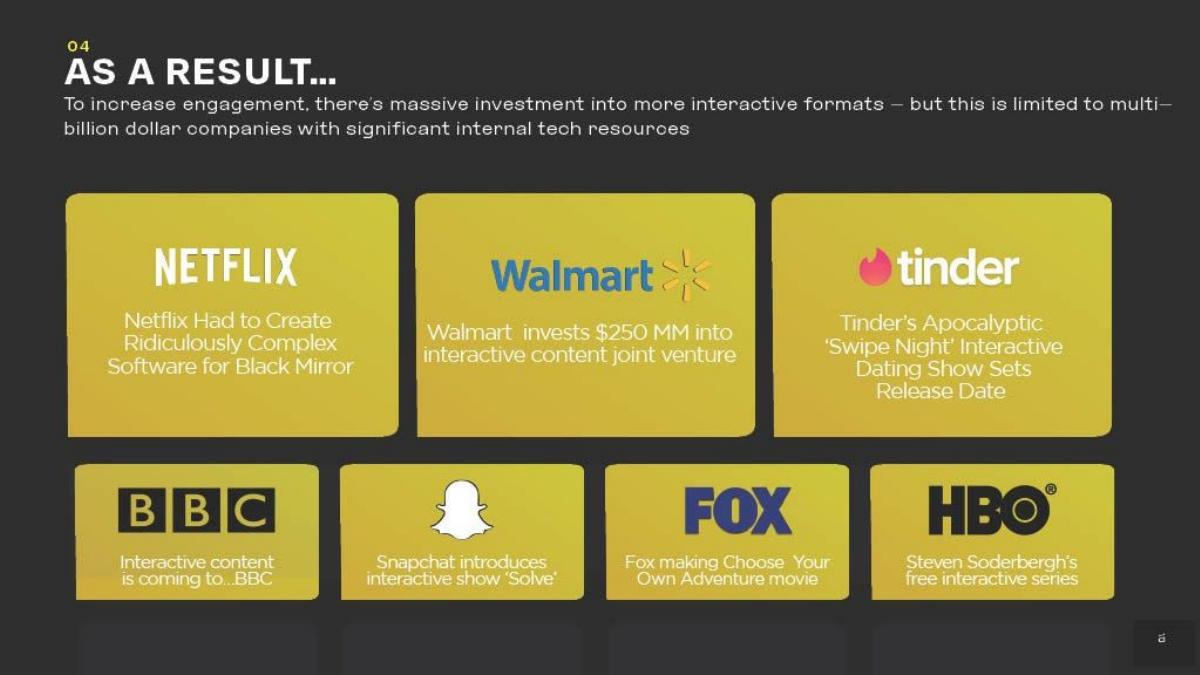
- The deck identifies a 'multi-billion dollar' barrier to entry, noting that only companies like Netflix and Walmart currently have the resources for interactive content (slide 4).
- Adventr operates on a Freemium SaaS model and achieved top brand customers with zero marketing spend according to slide 2.
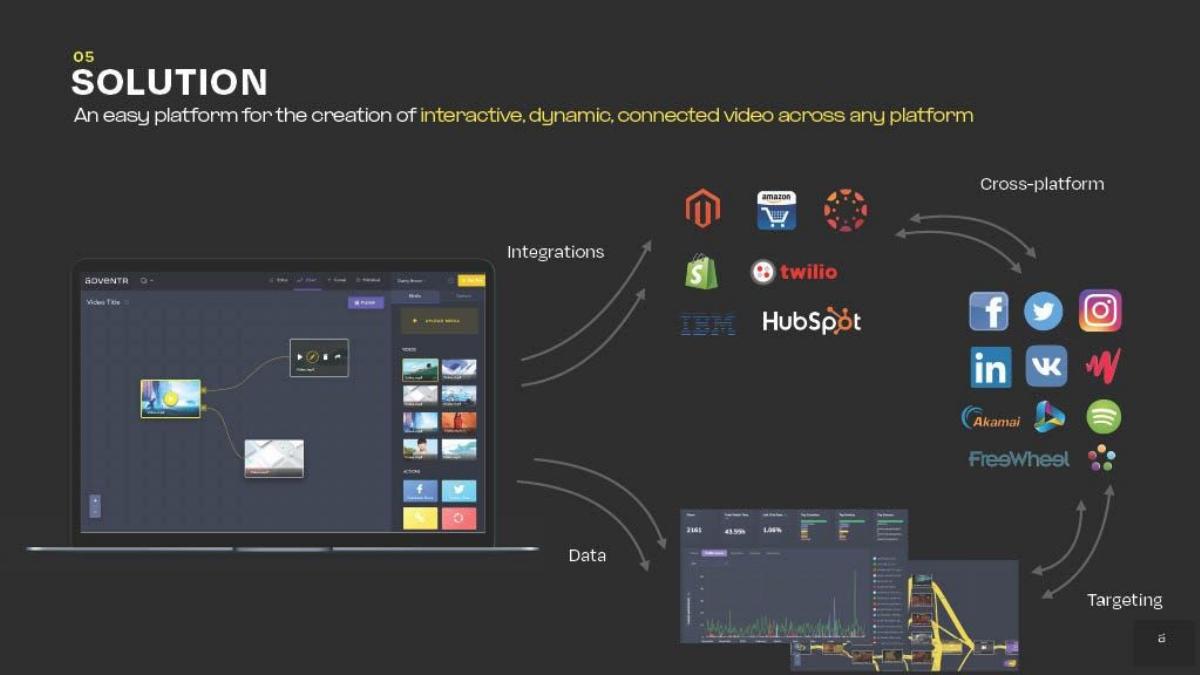
- The platform integrates with major enterprise tools including HubSpot, Twilio, Shopify, and Amazon as visualized on slide 5.
- Performance data shows a 271% increase in time spent on videos and a 34% increase in purchase intent for Adventr content (slide 6).
- The founding team includes the former GM of Vimeo and a founding team member of GOOD Music, establishing deep industry credibility on slide 9.
- The deck uses a specific ROI comparison on slide 8, projecting $785 in sales for Adventr vs $42 for traditional media based on 1,000 views.
The Adventr Pitch Deck Teardown
Adventr, a New York-based startup, raised $8M in 2024 to scale its AI-powered interactive video platform. In a world where consumer attention is increasingly fragmented, Adventr argues that traditional 'linear' video is no longer enough. Their 10-slide deck focuses heavily on the performance gap between old media and their new interactive format, using dramatic data points to capture investor interest.
Slide 1: Title Slide
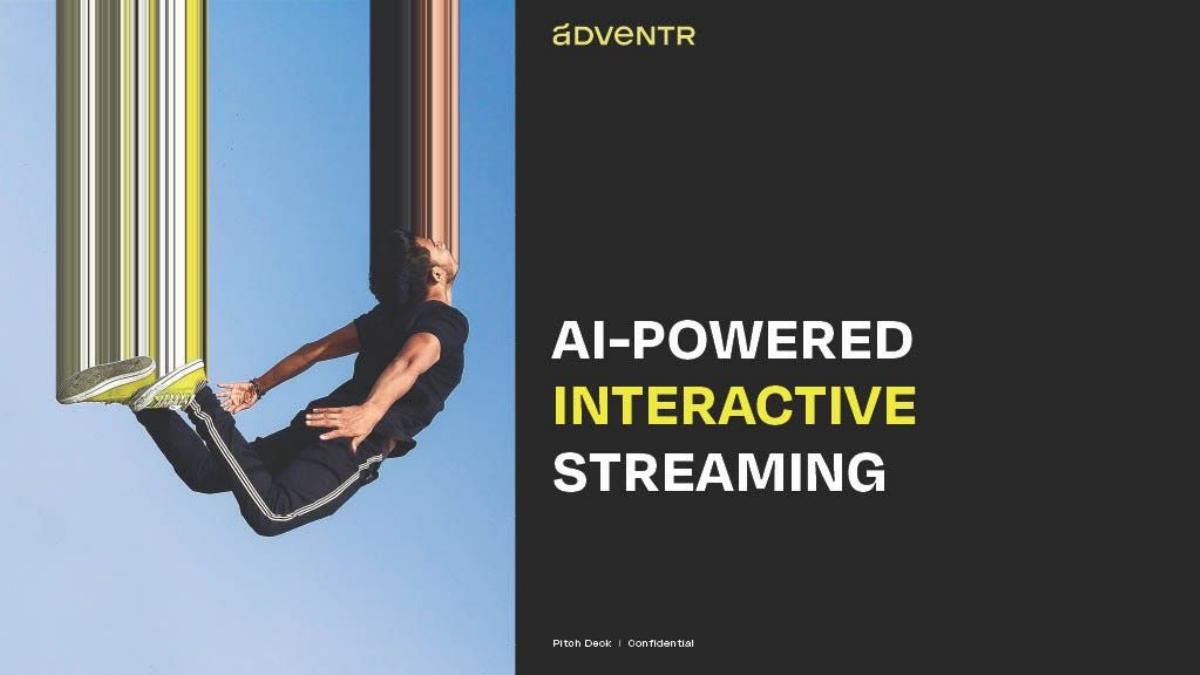
The deck opens with a high-energy image of a person seemingly suspended or falling through a stylized, glitched 'U' shape, paired with the headline 'AI-POWERED INTERACTIVE STREAMING.' The branding is minimalist, using a black, white, and yellow color palette that persists throughout the deck. It immediately establishes the company as a tech-forward media entity.
Slide 2: Highlights
Slide 2 serves as an executive summary. It lists seven key pillars of the business: the AI-powered platform, the expertise of the team, the Freemium SaaS model, media relationships, organic customer acquisition, and intellectual property (1 patent granted, 1 pending). By stating they have 'Top brand & agency customers w/no marketing,' Adventr signals strong product-market fit and efficient growth potential right out of the gate.
Slide 3: The Problem
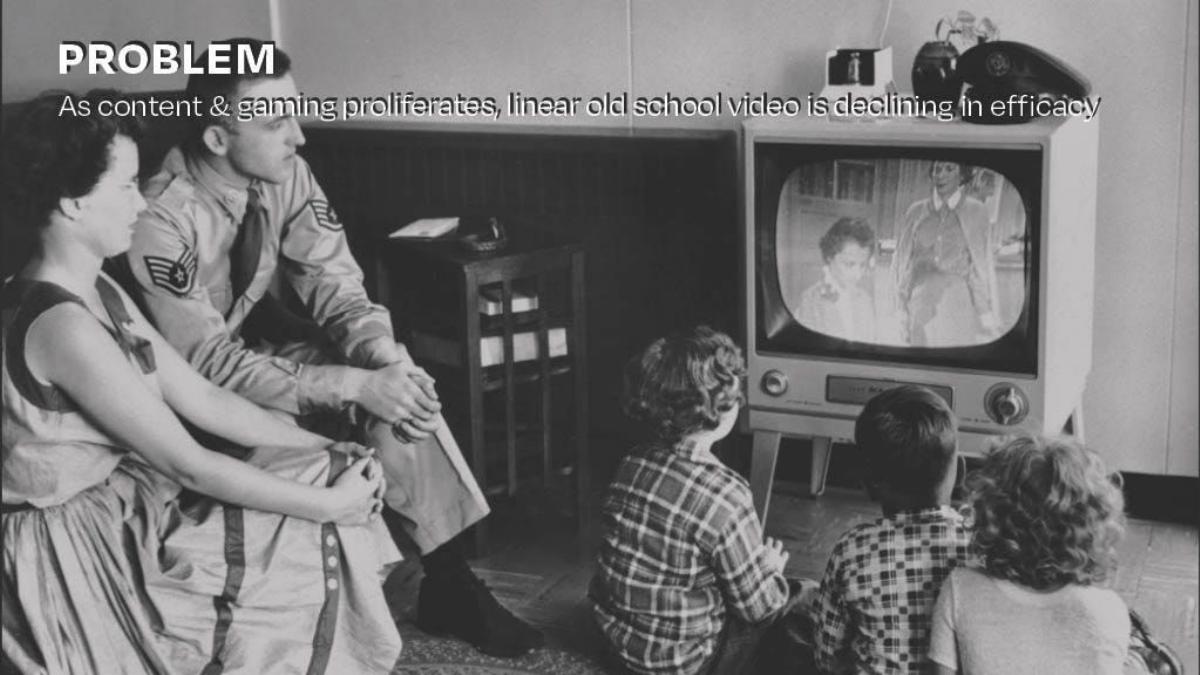
Using a black-and-white photo of a 1950s family watching a small television, slide 3 defines the problem: 'As content & gaming proliferates, linear old school video is declining in efficacy.' This slide sets up the 'villain' of the story—linear video—and suggests that the current standard for video communication is an outdated relic of a previous century.
Slide 4: The Market Gap
Slide 4, titled 'AS A RESULT...', explains why the problem hasn't been solved yet. It notes that while there is 'massive investment into more interactive formats,' this technology is currently 'limited to multi-billion dollar companies with significant internal tech resources.' It displays logos for Netflix, Walmart, Tinder, BBC, Snapchat, Fox, and HBO, citing specific examples like Netflix's software for Black Mirror and Walmart's $250M joint venture. This positions Adventr as the democratizer of a high-value technology.
Slide 5: The Solution
The solution slide provides a visual overview of the Adventr platform. It shows a drag-and-drop interface where video clips are connected in a logic flow (similar to a node-based editor). The slide emphasizes 'Integrations' with logos for Shopify, Amazon, Twilio, and HubSpot, and 'Cross-platform' distribution to social media like Instagram, LinkedIn, and Twitter. This illustrates that Adventr isn't just a creative tool, but a connected piece of the enterprise tech stack.
Slide 6: Value Proposition and Hard Metrics
This is the 'money slide' of the deck. It compares Adventr's performance against 'Linear Video' using a SundanceTV proof-of-concept. The figures are stark: a 1300% increase in Click Thru Rate (9.5% for Adventr vs. 0.7% for Linear), a 271% increase in Time Spent (106.9 seconds vs. 39.4 seconds), and a 34% increase in Purchase Intent. By citing a 'Major US Media Company' as the source in the footer, Adventr adds significant weight to these claims.
Slide 7: Early Product Market Fit
Slide 7 demonstrates the versatility of the platform. It shows six use cases: Advertising, Media, Training, Gamified Marketing, Education, and Political. The slide notes they have 'thousands of users' and have identified 'higher monetization within marketing & advertising.' A red circle highlights the Advertising and Gamified Marketing sections, indicating where the company sees the most immediate commercial traction.
Slide 8: Supercharging Media ROI
Slide 8 translates the engagement metrics from slide 6 into a direct financial comparison. It walks through a funnel: 1,000 views at a 9.5% CTR leads to 95 site visitors, which at a 5.5% conversion rate results in 5.23 sales. Compared to the 0.28 sales generated by traditional media, Adventr claims to produce $785 in value for every $42 produced by traditional ads. This clear ROI calculation is designed to make the investment feel like a mathematical certainty for advertisers.
Slide 9: Team - Streaming Experts
The team slide leans heavily on pedigree. CEO Devo Harris is highlighted as a former Sr. Product Manager at Vimeo and a Grammy-winning producer. Peter Gerard is noted as the former GM at Vimeo. The presence of logos for Vimeo, Dashlane, Braze, and McKinsey suggests a team that understands both the technical challenges of video streaming and the operational requirements of scaling a SaaS business. The advisor section includes engineering and business development leaders from Zendesk, Microsoft, and Meta.
Slide 10: Mission Statement
The deck concludes not with an 'Ask' slide, but with a mission statement: 'Adventr exists to inspire and enable storytellers to: USE THE FULL CAPABILITIES OF THE INTERNET FOR MORE ENGAGING, CONNECTED COMMUNICATION.' This brings the narrative back to the 'old school' problem introduced on slide 3, framing the company as the bridge to the future of the internet.
What Adventr Does Well
Comparative Data: The deck’s strongest asset is the direct comparison between linear video and interactive video. By showing a 1300% increase in CTR, they aren't just claiming to be 'better'; they are claiming to be an order of magnitude more effective. This makes the 'why now' and 'why this' arguments very easy for an investor to digest.
Democratization Narrative: By listing companies like Netflix and Walmart as the only ones currently able to build this tech, Adventr creates a high-value 'moat' around the technology while simultaneously positioning themselves as the only way for the rest of the market to access it. It frames the product as an equalizer.
Team-Market Fit: Having the former GM and a Sr. Product Manager from Vimeo—the most successful non-YouTube video platform—is a massive signal. It tells investors that the founders have already seen what it takes to build a video platform at scale and likely have the industry connections to distribute it.
What is Missing from the Adventr Deck
The Financial Ask: The deck completely omits a slide detailing how much they are raising, the valuation, or the specific use of funds. While this information is often handled in the verbal pitch or a separate document, its absence in the primary deck leaves a gap in the narrative regarding the company's immediate roadmap.
Unit Economics and Pricing: While the deck mentions a 'Freemium SaaS model,' it provides no information on what the paid tiers look like, what the Average Contract Value (ACV) is, or what the Customer Acquisition Cost (CAC) looks like. For a Seed round, investors usually want to see the early mechanics of the revenue engine.
Competitive Landscape: The deck ignores other startups in the interactive video space (such as Wirewax or Eko). While they position 'Linear Video' as the competitor, sophisticated investors will want to know why Adventr’s specific AI-powered approach is superior to other interactive video tools that have existed for years.
What Other Founders Should Copy
The ROI Funnel: Slide 8 is a brilliant piece of sales engineering. Instead of just saying 'we have better engagement,' they walk the investor through the entire funnel to show how that engagement leads to 18x more revenue ($785 vs $42). Founders should always try to translate their technical metrics into dollars and cents for the end customer.
Visualizing the Workflow: Slide 5 does a great job of showing the product without needing a live demo. By showing the node-based editor and the integration logos, they communicate that the product is sophisticated yet user-friendly and 'plugs in' to existing workflows. This reduces the perceived friction of adoption.
Focus on 'Proof of Concept' Success: If you don't have 100 customers yet, do what Adventr did on slide 6: take one high-profile Proof of Concept (SundanceTV) and extract every possible metric from it. One deeply analyzed success story is often more convincing than ten vague testimonials.
Frequently asked questions
- What is Adventr's core value proposition?
- Adventr positions itself as an easy-to-use platform for creating interactive, dynamic, and connected video across any platform. According to slide 5 and 6, the core value is significantly higher engagement, specifically a 1300% increase in CTR and a 271% increase in time spent compared to traditional linear video, making it highly effective for advertising and marketing.
- Who are Adventr's primary competitors according to the deck?
- The deck does not list direct startup competitors. Instead, slide 4 highlights that interactive video is currently limited to 'multi-billion dollar companies with significant internal tech resources' like Netflix, Walmart, Tinder, and HBO. Adventr positions itself as the solution that makes this technology accessible to everyone else.
- What evidence of Product-Market Fit does the deck provide?
- Slide 7 notes that the company has 'thousands of users' and has identified organic affinity in sectors including Advertising, Media, Training, Education, and Politics. Slide 2 further supports this by stating they acquired top brand and agency customers with no marketing spend, suggesting strong organic demand for the technology.
- How does Adventr monetize its platform?
- As stated on slide 2, Adventr utilizes a 'Freemium SaaS model.' While the deck does not detail specific pricing tiers or average contract values, it emphasizes the platform's ability to drive sales, showing a comparison on slide 8 where Adventr generates $785 in sales compared to $42 for traditional media.
- What is the background of the leadership team?
- The team is described on slide 9 as 'Streaming Experts.' CEO Devo Harris was a Sr. Product Manager at Vimeo and a Grammy-winning producer. Peter Gerard (Operations & Product) was the former GM at Vimeo. The team also includes veterans from Braze, Dashlane, and McKinsey, providing a mix of technical streaming expertise and enterprise SaaS experience.