A-Champs presents a compelling case for a hardware-enabled fitness platform that has already found its footing in the professional sports world. With $600,000 in revenue recorded for 2019 (Slide 6), the company demonstrated significant market validation from elite organizations like the UFC and ASICS before seeking capital to enter the consumer 'family' market. The deck is lean, focusing heavily on the transition from a 'Smart Assistant for Professionals' to a 'Smart Coach for Families.' While it lacks detailed financial projections and a specific 'ask' slide, the strength of the founding tea…
Key takeaways
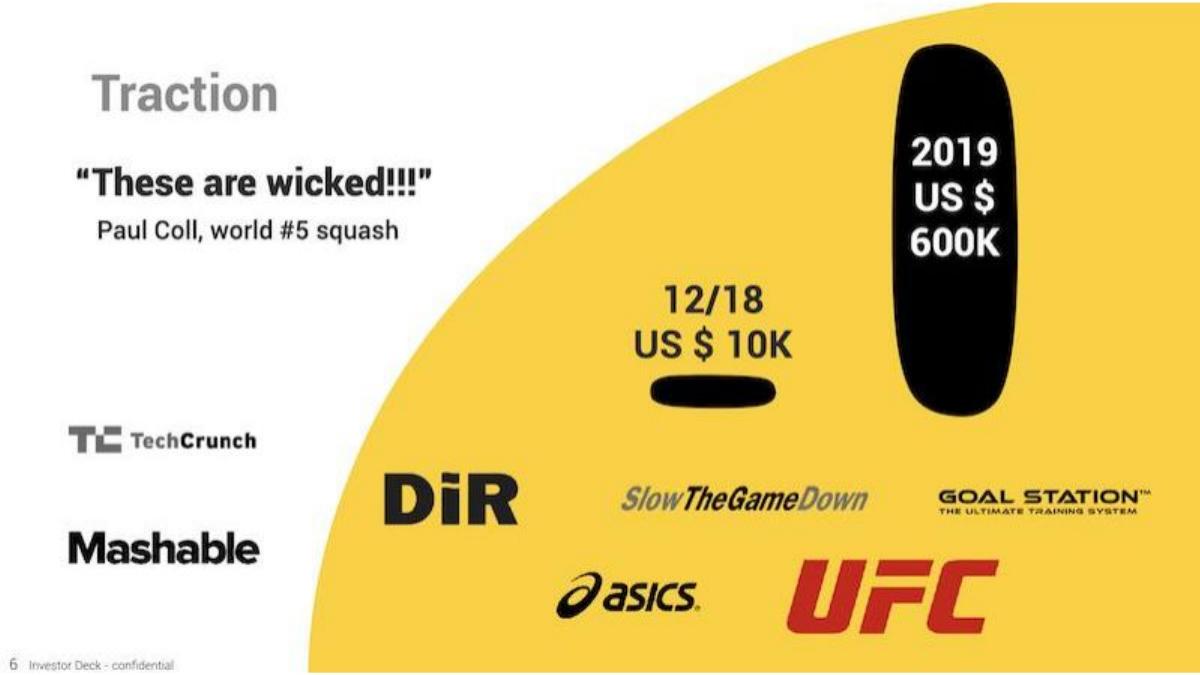
- The company achieved $600,000 in revenue in 2019, up from just $10,000 in late 2018 (Slide 6).
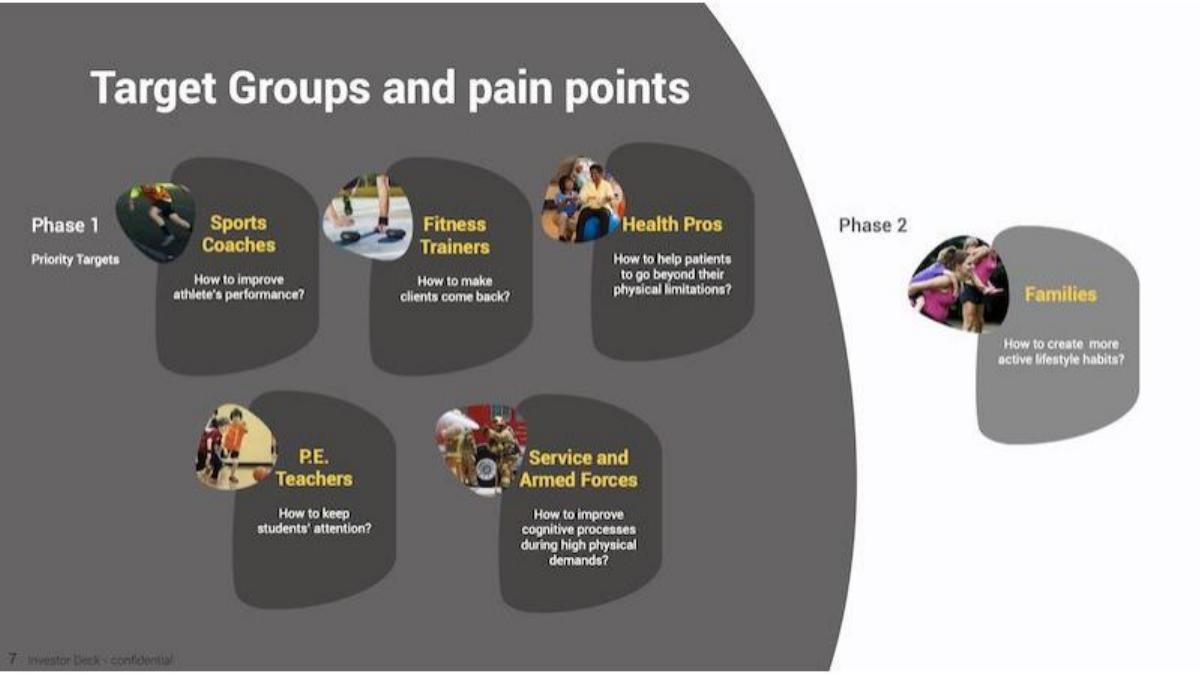
- A-Champs utilizes a 'Phase 1' B2B strategy to validate tech with pros before a 'Phase 2' B2C push into the family market (Slide 7).
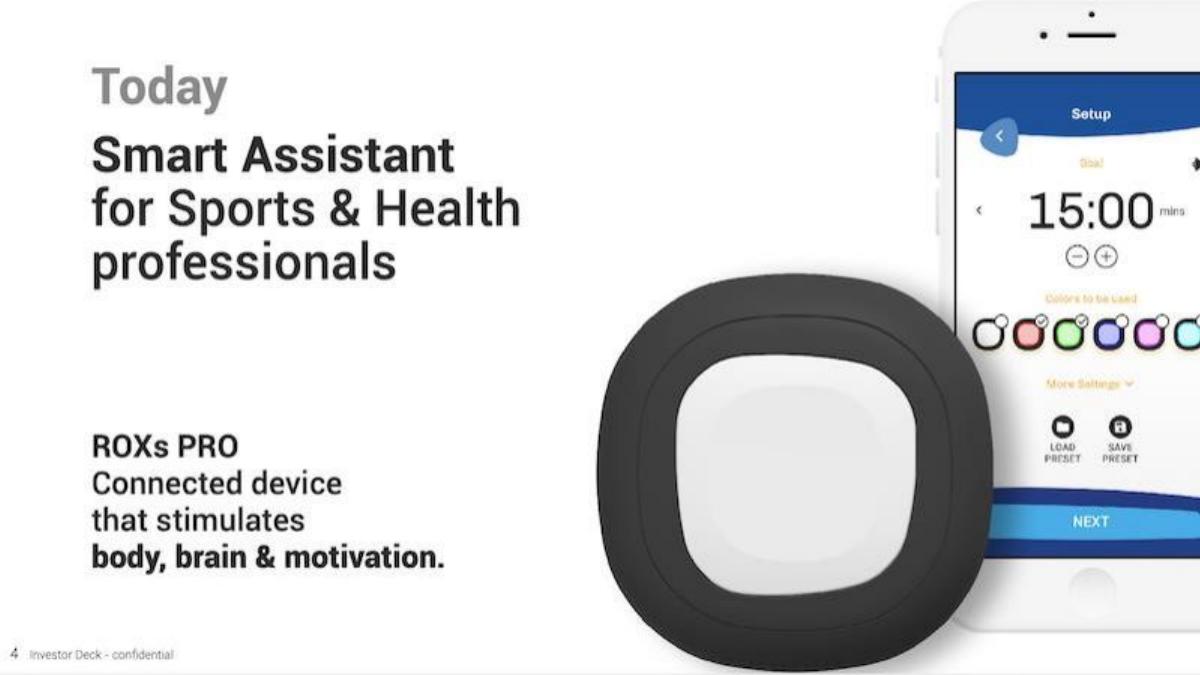
- The product, ROXs PRO, is a connected IoT device designed to stimulate body, brain, and motivation (Slide 4).
- The business model transitions from one-time product sales to recurring licensing and subscription fees (Slide 10).
- The team includes high-level domain expertise, specifically an ex-FC Barcelona performance coach and a CTO with a Ph.D. in Robotics (Slide 12).
- A-Champs claims a unique market position by intersecting interactive light tools, fitness apps, and virtual assistants (Slide 11).
- The deck omits a formal 'Ask' slide detailing the specific amount of capital being raised and the planned allocation of funds.
- The 'Why' slide provides a deeply personal narrative regarding the founder's motivation, citing screen time statistics of 5-7 hours per day for the average kid (Slide 13).
The Narrative: From the Training Ground to the Living Room
A-Champs enters the crowded fitness tech market with a distinct advantage: they didn't start by trying to sell to distracted parents. They started by selling to the most demanding athletes in the world. The 13-slide deck is a masterclass in the 'Prosumer' strategy—using professional validation to justify a consumer expansion. By the time the investor reaches the business model, the founders have already proven that the technology works for the UFC and world-class soccer coaches. This teardown explores how A-Champs balances hardware complexity with a clear path to recurring software revenue.
Slide 1: Title Slide
The deck opens with the A-Champs logo, a stylized monkey face. There is no tagline or mission statement on the cover. While minimalist, it relies entirely on the subsequent slides to define the brand. In a cold-send scenario, a subtitle explaining 'IoT Gamified Fitness' might have added immediate clarity.
Slide 2: The Problem
"How to get families moving?" Slide 2 presents the core problem as a simple question. It identifies the target demographic (families) and the desired outcome (movement). It is a broad problem statement, but it sets the stage for the 'Why' narrative that concludes the deck on Slide 13.
Slide 3: The Solution
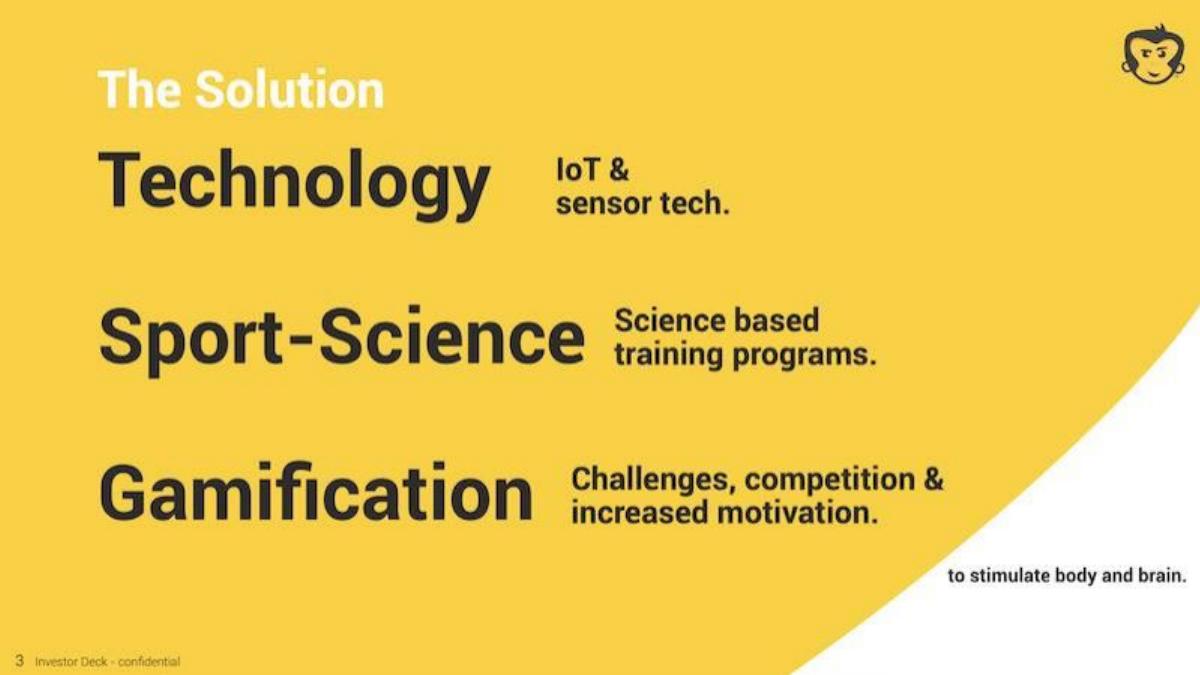
The solution is broken down into three pillars: Technology (IoT & sensor tech), Sport-Science (Science-based training programs), and Gamification (Challenges, competition & increased motivation). The slide explicitly states the goal is "to stimulate body and brain," signaling that this is more than just a physical workout tool; it is a cognitive training platform.
Slide 4: The Product (Today)
Slide 4 introduces the ROXs PRO . It is described as a "Smart Assistant for Sports & Health professionals." This is a critical distinction—the company is currently a B2B professional tool. The visual shows a physical puck-like device alongside a mobile app interface showing a 15-minute setup screen. This confirms the product is a hardware-software hybrid.
Slide 5: ROXs PRO in Action
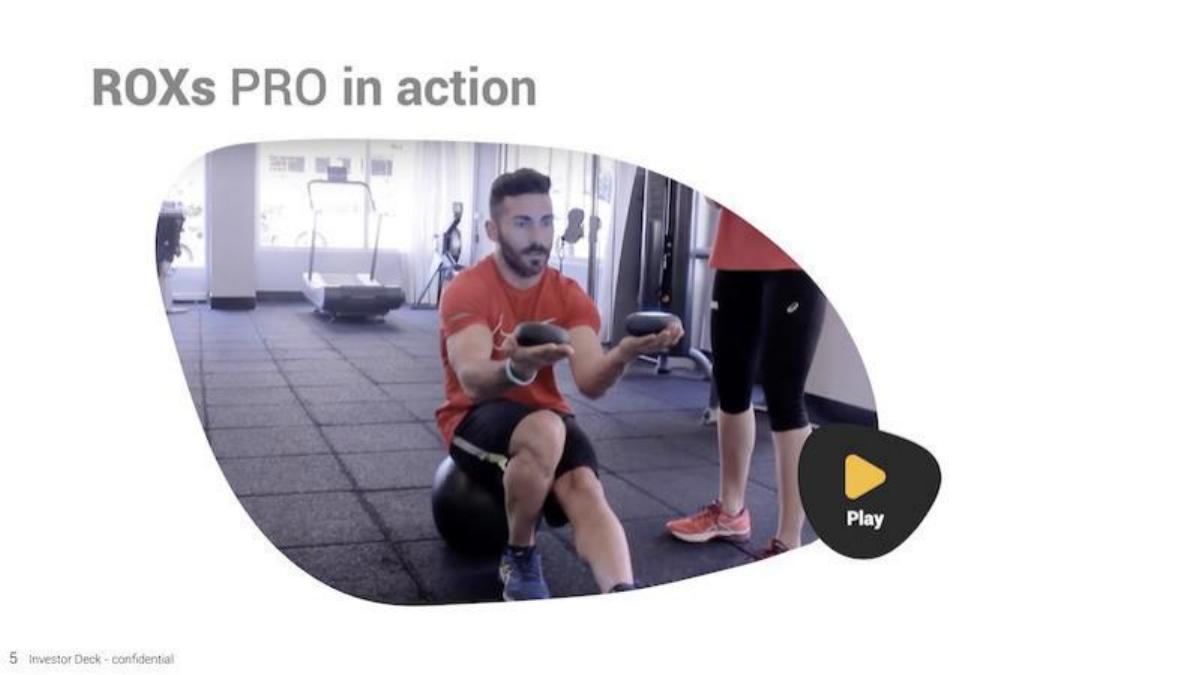
This slide features a video placeholder showing a trainer using the devices during a squat exercise. Using a video (or a high-quality still of a video) is essential for hardware decks to prove the form factor is functional and ergonomic. It shows the device being held in the hands, emphasizing its portability.
Slide 6: Traction
This is the strongest slide in the deck. It shows a massive revenue jump: from US $10K in 12/18 to US $600K in 2019 . The slide also features logos from UFC, ASICS, DiR, and Goal Station , alongside press mentions from TechCrunch and Mashable. A quote from Paul Coll (World #5 Squash) adds elite athletic validation. This slide proves that people are willing to pay for the technology at scale.
Slide 7: Target Groups and Pain Points
A-Champs maps out its market evolution. Phase 1 (Priority Targets) includes Sports Coaches, Fitness Trainers, Health Pros, P.E. Teachers, and Armed Forces. Each has a specific pain point, such as "How to keep students' attention?" Phase 2 is the pivot to Families, addressing the habit-formation challenge. This slide tells investors that the company has a focused entry point but a much larger 'Phase 2' upside.
Slide 8: The Future (Tomorrow)
Slide 8 defines the B2C vision: "Smart Coach for Families: Train like a Pro." It previews app content like "Active Games," "Family Fitness Program," and a "60 Day Weight Loss Challenge." This transition from 'Assistant' to 'Coach' is the bridge to a subscription-based revenue model.
Slide 9: Intellectual Property
Under the heading "What's to Come," Slide 9 details the company's IP. It mentions In-House and Co-developed Content IP (with ASICS) and Patented IP covering both Software and Hardware. It also hints at an SDK for 3rd party content and hardware (like wearables or smart speakers), suggesting A-Champs wants to be the platform, not just the device manufacturer.
Slide 10: Business Model
The revenue strategy is visualized as a flow. It starts with Product Sales , moves into Phase 1 B2B Licensing Fees , and culminates in Phase 2 B2C Subscriptions . By tying the subscription model to the ASICS partnership and IP content, A-Champs demonstrates a path to high-margin recurring revenue that offsets the lower margins of hardware sales.
Slide 11: Differentiation
The competitive landscape is shown via a Venn diagram. A-Champs positions itself at the intersection of Interactive Light Tools (BlazePod, Fitlight), Fitness Apps (MyFitnessPal, Fitbit Coach), and Virtual Assistants (Google Home, Echo Dot). This effectively argues that while others do pieces of the puzzle, A-Champs is the only "Smart Training Assistant" combining all three.
Slide 12: The Team
The team slide, titled "Harder than Hardware," highlights the difficulty of their task and the expertise they bring to it. Kilian Saekel (CEO) is a 3x entrepreneur with 13+ years in manufacturing. Wayne Lin (CTO) holds a Ph.D. in Robotics with 10+ years in R&D (with a Xiaomi logo). Peter Muñoz brings the domain expertise as an Ex-FC Barcelona coach. They also mention +12 full-time engineers and Alan Pearson , a "Founding Father" of speed training. This is a very high-pedigree team for a $400K seed round.
Slide 13: The "Why"
The deck ends on a deeply personal note. CEO Kilian Saekel shares a story about his wife's cancer diagnosis and his desire to keep his daughters, Polly and Pippa, healthy. He cites a "crazy scary number": the average kid spends 5-7 hours in front of screens every day . This slide transforms the pitch from a hardware play into a mission-driven crusade, which is often what closes a deal with impact-oriented investors.
What Works in This Deck
The Revenue Growth: Going from $10k to $600k in one year is the ultimate proof of concept. It silences most questions about product-market fit for the hardware itself. · The Pro-to-Consumer Bridge: Using the UFC and FC Barcelona as 'beta testers' for a family product is a brilliant way to build brand equity. It makes the 'Family' product feel like a premium, professional-grade tool. · Technical Pedigree: Having a CTO with a Ph.D. in Robotics and experience at a giant like Xiaomi is a major de-risking factor for a hardware startup. · Clear Phasing: The deck clearly distinguishes between what they are doing now (B2B) and what they will do with the investment (B2C).
What is Missing
The Ask: There is no slide stating how much money they are raising, what the valuation is, or specifically how the funds will be spent (e.g., % to R&D vs. % to Marketing). · Unit Economics: While they show total revenue, they don't show the Cost of Goods Sold (COGS) for the ROXs PRO or the expected Customer Acquisition Cost (CAC) for the family market. Hardware investors need to see these margins. · Financial Projections: There is no forward-looking graph showing when they expect to hit break-even or what the Phase 2 subscription revenue looks like in years 3-5. · Distribution Strategy: Moving into B2C requires a massive marketing and distribution engine. The deck doesn't explain how they will reach families (Retail? Amazon? D2C social ads?).
What a Founder Should Copy
The Traction Visualization: Slide 6 is excellent. It uses simple shapes to show the scale of growth and surrounds it with high-authority logos. It’s a 'trust' slide that does a lot of heavy lifting. · The Pain Point Mapping: Slide 7 is a great way to show a multi-vertical strategy without looking unfocused. By labeling them 'Phase 1' and 'Phase 2,' they show a logical progression. · The Personal Narrative: If you have a genuine, personal reason for starting your company, put it in. A-Champs places it at the end, leaving the investor with an emotional connection after the data-heavy slides. · The Competitive Positioning: Using a Venn diagram to show you are the 'only one' at the intersection of three established categories is often more effective than a standard 'check-box' grid.
Frequently asked questions
- How much did A-Champs raise with this deck?
- According to the catalogue listing, A-Champs raised $400,000 in a Seed round in 2020. Interestingly, the deck itself does not specify the target raise amount or the terms of the investment.
- What is the core product being sold?
- The core product is the ROXs PRO, described on Slide 4 as a 'connected device that stimulates body, brain & motivation.' It is an IoT-based sensor tool used for gamified physical training, as shown in action on Slide 5.
- Who are A-Champs' existing customers?
- Slide 6 lists several high-profile partners and clients, including the UFC, ASICS, DiR, and Goal Station. The deck also features a testimonial from Paul Coll, the world #5 squash player.
- What is the long-term revenue strategy?
- As outlined on Slide 10, the company intends to move beyond hardware sales into 'Phase 2,' which involves B2C subscriptions and IP content licensing, specifically mentioning a partnership with ASICS.
- Is there a competitive analysis in the deck?
- Yes, Slide 11 uses a three-way Venn diagram to position A-Champs against competitors like BlazePod and Fitlight (Interactive Light Tools), Fitbit and MyFitnessPal (Fitness Apps), and Google Home/Echo Dot (Virtual Assistants).