Awesome People Ventures Fund 2 is a $20M early-stage fund led by Julia Lipton, targeting the Web3 ecosystem with a specific focus on the future of work and creator tools. The deck stands out by proposing a decentralized venture model where up to 50% of the GP carry is shared with the community for sourcing and diligence. This teardown examines how the fund leverages a 'talent-first' approach, utilizing a proprietary network to secure deal flow and provide post-investment value. While the deck is text-heavy and lacks traditional visual design, it provides deep transparency into Fund 1's perfor…
Key takeaways
- The fund is raising $20M for its second vehicle to invest in Web3, creators, and finance (Slide 3).
- Awesome People Ventures intends to share up to 50% of the GP carry with its community for sourcing and diligence (Slide 3).
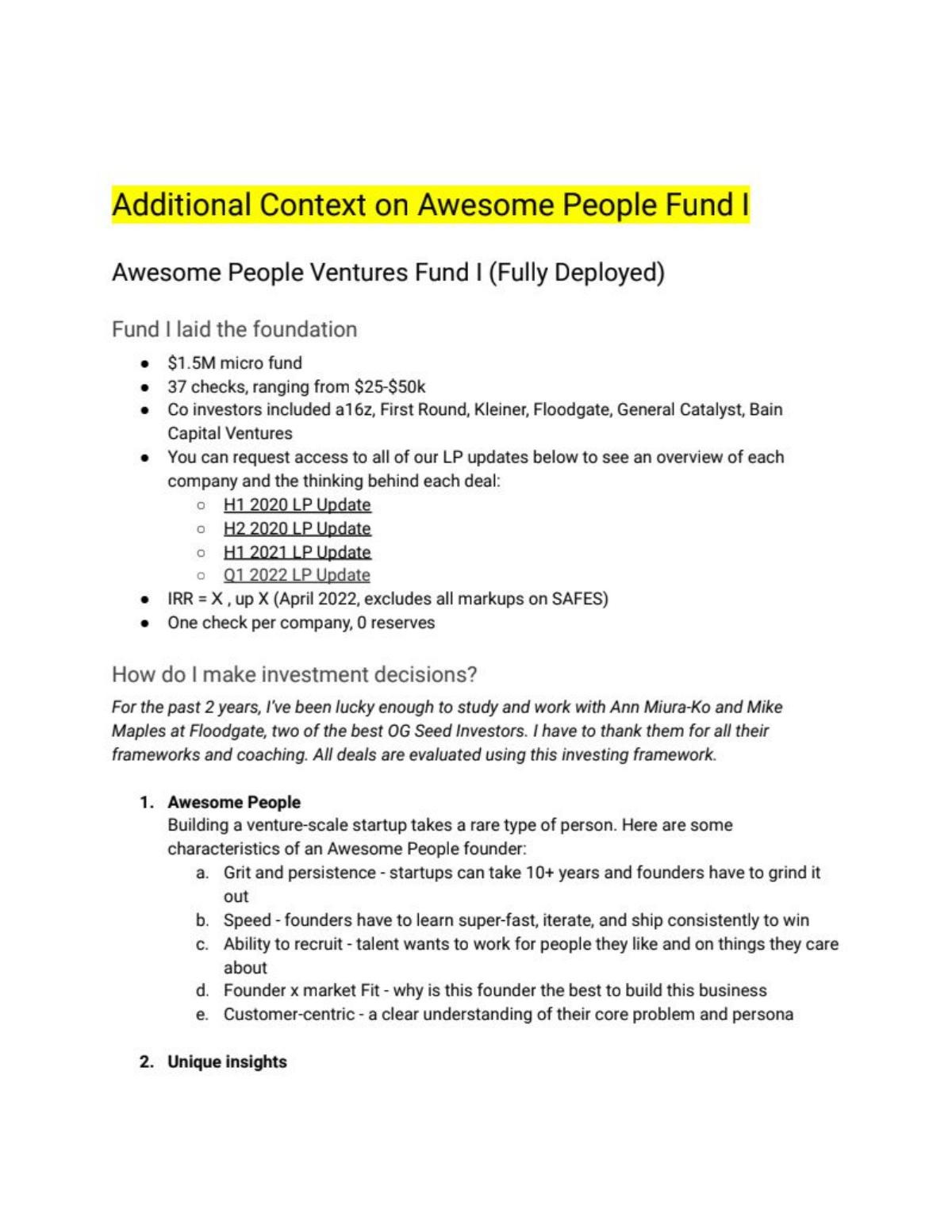
- Fund 1 was a $1.5M micro fund that made 37 checks ranging from $25k to $50k (Slide 6).
- The GP, Julia Lipton, previously ran growth and revenue at three startups, one of which was acquired by One Medical (Slide 2).
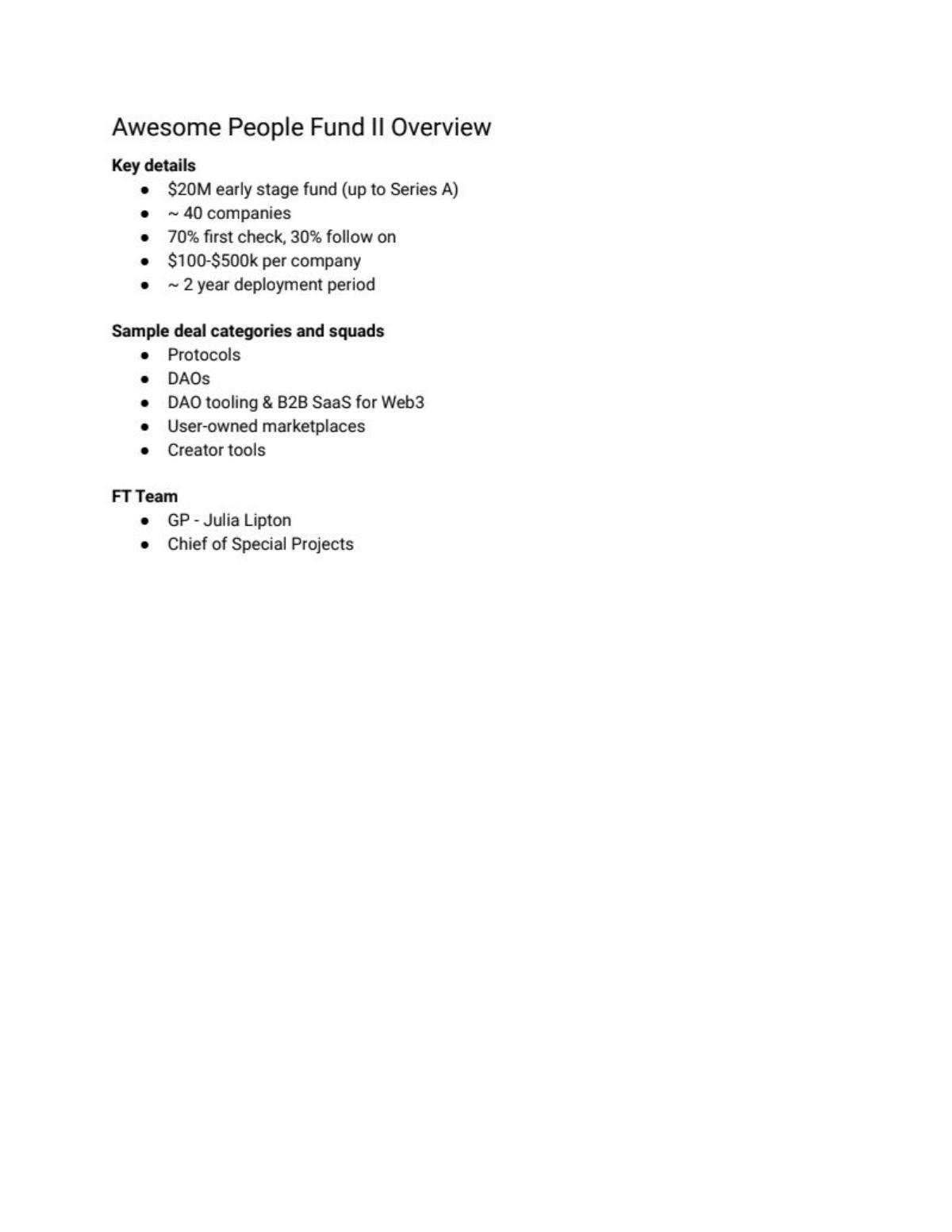
- Investment strategy for Fund 2 includes targeting ~40 companies with a $100k-$500k check size (Slide 5).
- The fund claims to have made approximately 1,500 intros in the previous year to support its 'value add' claim (Slide 3).
- Co-investors in Fund 1 included high-profile firms such as a16z, First Round, Kleiner Perkins, and General Catalyst (Slide 6).
- The fund uses a specific three-part investment framework: Awesome People, Unique Insights, and Unseen Inflection Points (Slides 6-7).
The Pitch Deck Teardown
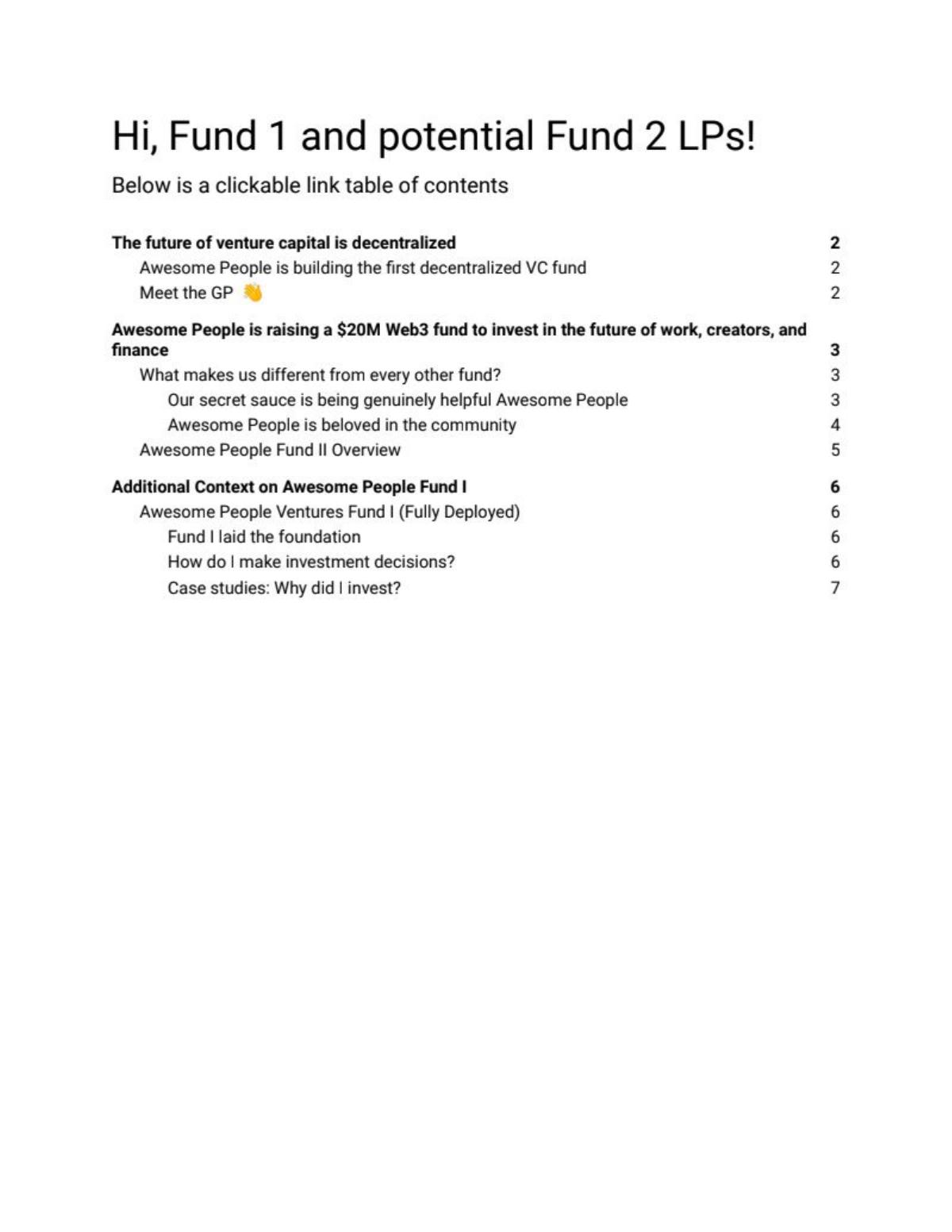
Slide 1: Table of Contents
The deck opens with a functional table of contents. It is styled as a clickable link list, which suggests this deck was designed to be read as a document rather than presented as a live slideshow. It outlines three main sections: the vision for decentralized VC, the specifics of Fund 2, and additional context/case studies regarding Fund 1.
Slide 2: The Vision and the GP
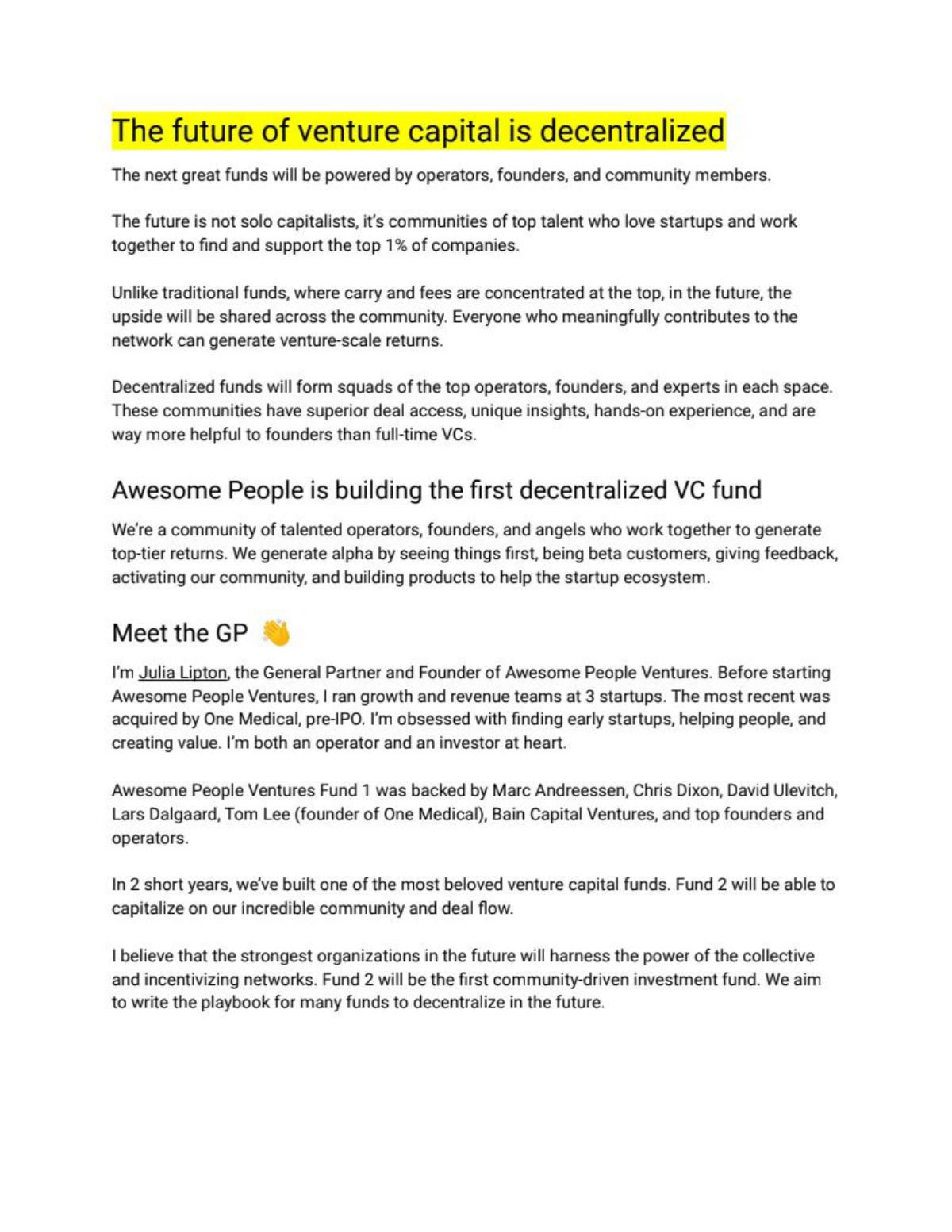
The future of venture capital is decentralized: This slide establishes the fund's thesis. It argues that the next generation of funds will be powered by communities of operators and founders rather than 'solo capitalists.' It explicitly states that decentralized funds will have superior deal access and unique insights due to their network structure.
Meet the GP: Julia Lipton is introduced as the General Partner. Her background includes running growth and revenue at three startups, including one acquired by One Medical. Crucially, she notes that Fund 1 was backed by industry titans including Marc Andreessen, Chris Dixon, and Bain Capital Ventures. This is a high-signal slide that uses social proof to validate a solo GP's ability to attract institutional-grade interest.
Slide 3: Fund 2 Mechanics and 'Secret Sauce'
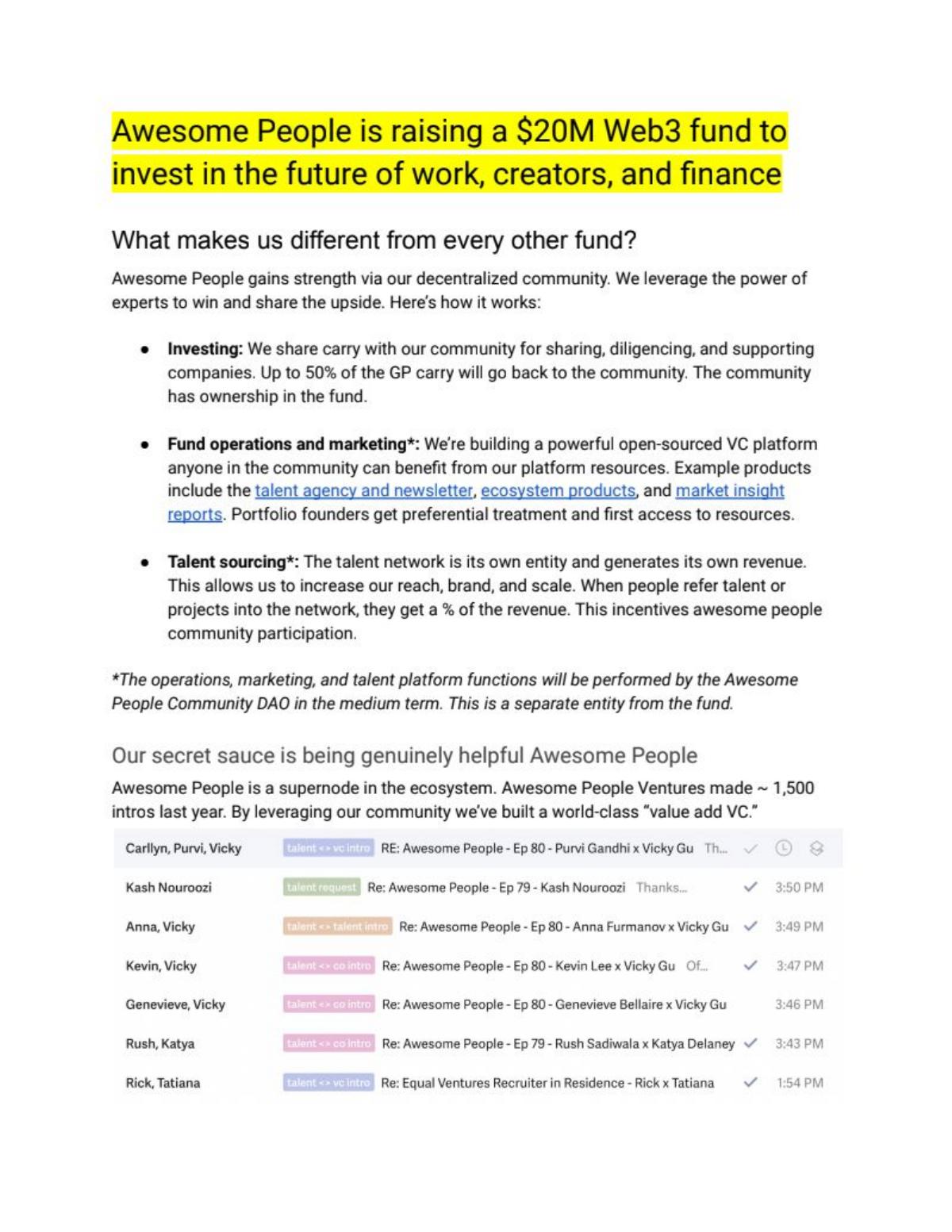
The Ask: The headline clearly states the goal: a $20M Web3 fund focused on work, creators, and finance. This slide introduces the 'decentralized' mechanism: sharing up to 50% of GP carry with the community. This is a bold structural choice designed to align incentives for deal sourcing and diligence.
The Secret Sauce: The deck claims Awesome People is a 'supernode' in the ecosystem. To back this up, it cites a metric: ~1,500 intros made in the last year. It includes a screenshot of an email inbox showing 'talent <> vc intro' and 'talent <> co intro' threads. This is a rare example of a fund providing 'proof of work' for their value-add claims.
Slide 4: Community Validation
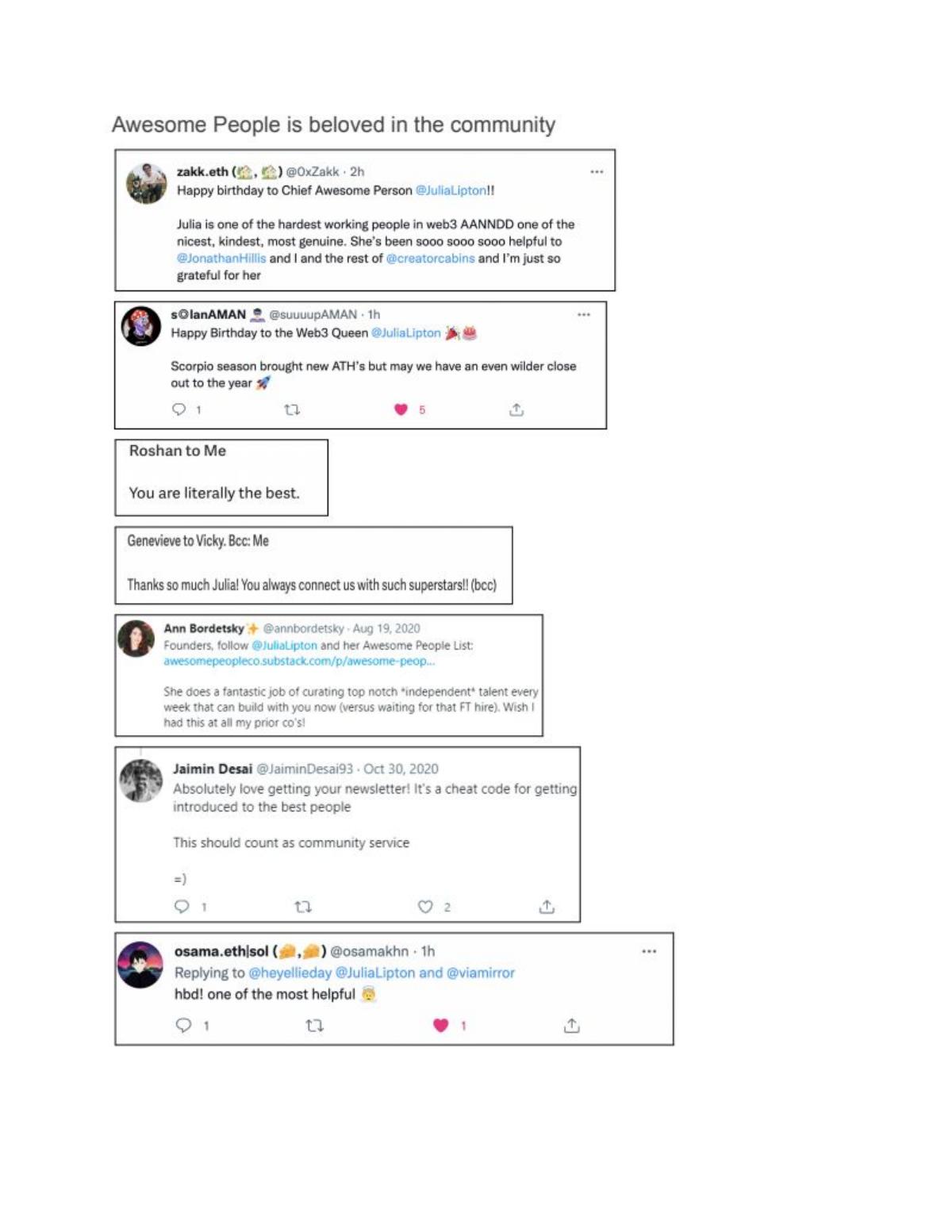
This slide is entirely dedicated to social proof. It features a collection of tweets and messages from community members and founders. Notable mentions include 'zakk.eth' and 'Ann Bordetsky.' The testimonials focus on the GP's work ethic, the value of her newsletter, and her ability to connect founders with talent. While anecdotal, it reinforces the 'Awesome People' branding and the idea that the GP is 'beloved in the community.'
Slide 5: Fund II Overview
This is the 'deal terms' slide. It provides a concise bulleted list of the fund's parameters:
$20M total size · ~40 companies · 70% first check / 30% follow on · $100k-$500k check size · ~2 year deployment period
It also lists target categories: Protocols, DAOs, DAO tooling, B2B SaaS for Web3, user-owned marketplaces, and creator tools. The team is listed as Julia Lipton (GP) and a 'Chief of Special Projects,' confirming this is a lean, GP-led operation.
Slide 6: Fund I Performance and Framework
Fund I Context: The deck provides transparency into the first vehicle. Fund 1 was a $1.5M micro fund that wrote 37 checks ($25k-$50k). It lists co-investors like a16z, First Round, and Kleiner Perkins. Notably, the IRR is listed as 'X,' which is likely a placeholder for a version of the deck where specific numbers were redacted or shared under NDA. It mentions the fund is 'up X' as of April 2022.
Investment Framework: Lipton credits Ann Miura-Ko and Mike Maples (Floodgate) for her investing frameworks. She looks for five characteristics in founders: Grit, Speed, Ability to recruit, Founder x Market Fit, and Customer-centricity. This section moves the deck from 'what' they invest in to 'how' they think.
Slide 7: Insights and Case Studies
This slide continues the framework, focusing on 'Unique insights' and 'Unseen inflection points.' It asks: 'What do you believe that the rest of the world doesn’t believe?'
Case Study - XMTP Protocol: Lipton explains her investment in XMTP, a communications protocol. She highlights her relationship with founder Shane Mac and her ability to connect him to 20+ founders via her talent network. This demonstrates the 'supernode' theory in practice.
Case Study - Mirror: She describes Mirror as a crypto-native publishing platform. Her entry point was a tweet about distributing a memoir as an NFT, which led to a relationship with the team. She co-invested alongside a16z.
Slide 8: Braintrust Case Study and Contact
Case Study - Braintrust: The final case study covers Braintrust, a user-owned talent network. Lipton notes she joined their referral network in 2020 and contributed talent before investing. She claims the investment is 'up over 10x in less than a year.' This is the strongest performance metric in the deck.
The deck concludes with a simple call to action: an email address for interested LPs.
What Works
Radical Transparency: The deck doesn't hide behind vague 'proprietary deal flow' claims. It shows screenshots of intros, names specific co-investors, and details the exact number of checks written in Fund 1. This builds significant trust with potential LPs.
The 'Supernode' Metric: Quantifying value-add (1,500 intros) is much more effective than simply saying 'we help founders.' It gives LPs a tangible way to measure the GP's activity level.
Alignment with Thesis: The fund's name (Awesome People), its focus (Web3/Work), and its structure (sharing carry with a community) are all perfectly aligned. It feels like a cohesive product rather than a generic investment vehicle.
What is Missing
Visual Design: The deck is essentially a series of text documents with a few screenshots. While this 'anti-design' can sometimes signal 'operator focus,' it lacks the professional polish typically expected for a $20M fundraise. There are no charts, maps of the ecosystem, or visual representations of the 'decentralized' structure.
Detailed Financials: While it mentions Fund 1 was 'up X,' the lack of specific TVPI (Total Value to Paid-In) or DPI (Distributed to Paid-In) figures on the slides makes it hard to evaluate the actual financial performance of the first vehicle without requesting the 'LP updates' mentioned on Slide 6.
Risk Factors: There is no discussion of the risks associated with a decentralized GP carry model or the regulatory hurdles of running a 'Community DAO' for fund operations.
What a Founder Should Copy
The 'Why I Invested' Section: The case studies on Slides 7 and 8 are excellent. They don't just describe the company; they describe the relationship and the value-add provided by the investor before the check was even signed. Founders raising for a fund should copy this narrative style to show they are 'winning' deals, not just buying into them.
Social Proof Integration: Instead of a 'Logo Slide' of portfolio companies, the deck uses a 'Beloved in the Community' slide with actual human testimonials. For an early-stage fund where the GP is the primary asset, this personal validation is often more valuable than a list of seed-stage logos that haven't exited yet.
Clear Investment Framework: Defining exactly what you look for (Grit, Speed, Recruitment, etc.) helps LPs understand your 'filter.' It makes the investment process feel repeatable and disciplined rather than opportunistic.
Frequently asked questions
- What is the primary investment focus of Awesome People Ventures Fund 2?
- The fund focuses on early-stage Web3 opportunities, specifically targeting the future of work, creators, and finance. Slide 5 lists specific categories including Protocols, DAOs, DAO tooling, B2B SaaS for Web3, user-owned marketplaces, and creator tools.
- How does the 'decentralized' VC model work in this context?
- According to Slide 3, the fund shares its upside with its community. Up to 50% of the GP carry is allocated to community members who help with sharing, diligencing, and supporting companies. Additionally, the operations and marketing functions are intended to be performed by a Community DAO in the medium term.
- What is the track record of the GP, Julia Lipton?
- Julia Lipton is the sole GP. She has a background in growth and revenue at three startups and has been mentored by Ann Miura-Ko and Mike Maples at Floodgate. Her first fund, a $1.5M vehicle, is fully deployed and includes investments alongside top-tier firms like a16z (Slide 2, 6).
- What are the specific terms and deployment plans for Fund 2?
- Fund 2 is a $20M early-stage fund aiming to invest in approximately 40 companies over a 2-year deployment period. The strategy involves 70% first checks and 30% reserves for follow-on investments, with check sizes between $100k and $500k (Slide 5).
- What evidence of 'value-add' does the deck provide?
- The deck cites making ~1,500 intros in a single year and provides a screenshot of an inbox showing various talent and VC introductions. It also includes several testimonials from founders and community members praising the GP's helpfulness and the quality of her newsletter (Slides 3, 4).