Awesome People presents a unique venture capital model that seeks to decentralize the investment process by sharing carry and operational tasks with its community. Raising a $20M Fund II, the firm targets early-stage Web3 startups across protocols, DAOs, and creator tools. The deck emphasizes a 'supernode' strategy, citing 1,500 introductions made in the previous year to demonstrate value-add. By offering up to 50% of GP carry back to the community, Awesome People attempts to align incentives between the fund, its experts, and its portfolio companies. The deck relies heavily on qualitative ca…
Key takeaways
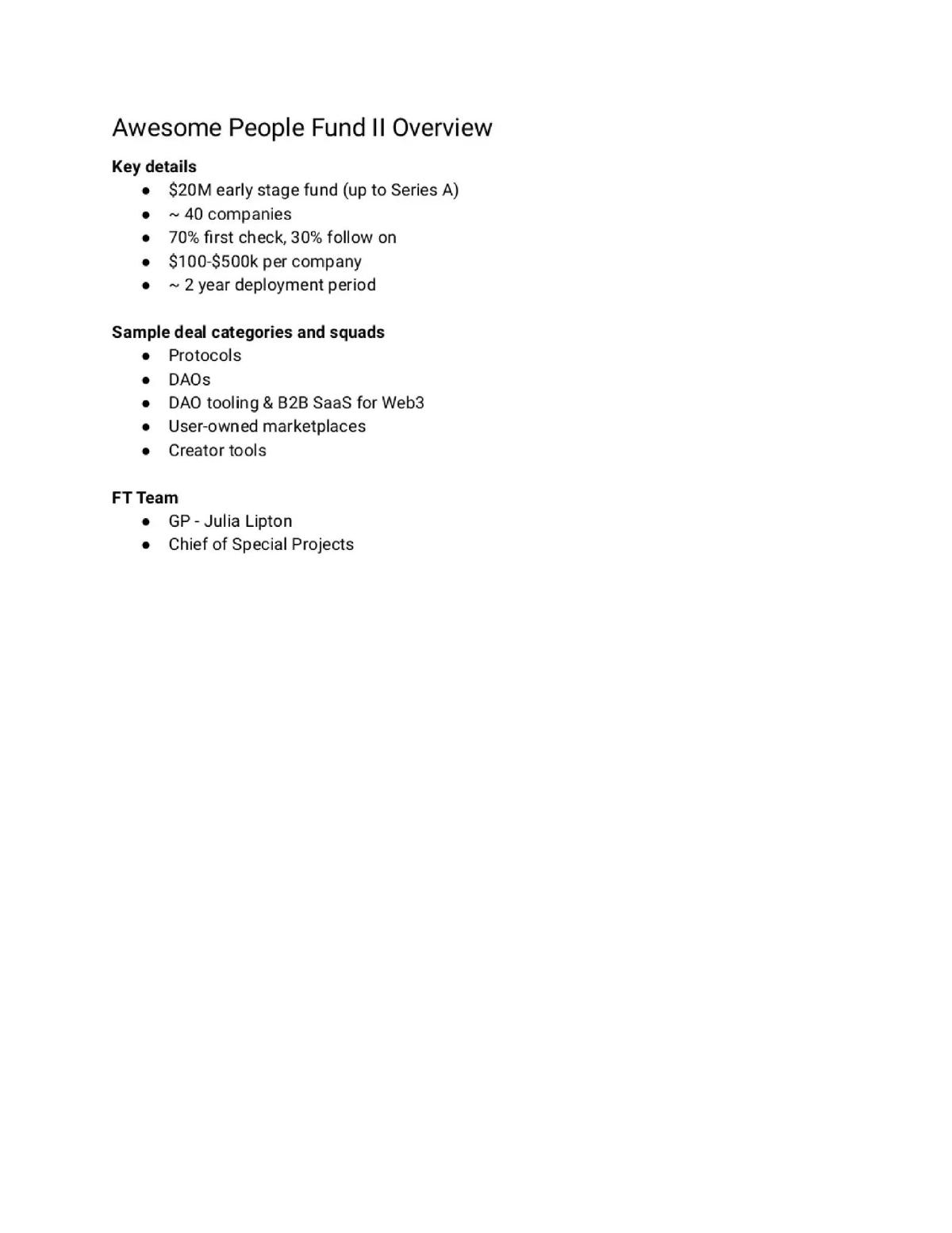
- The fund is seeking $20M for Fund II to invest in early-stage Web3 companies up to Series A (Slide 3).
- Awesome People proposes a decentralized model where up to 50% of GP carry is returned to the community (Slide 2).
- The fund claims to be a 'supernode' in the ecosystem, facilitating approximately 1,500 introductions in the prior year (Slide 2).
- Investment focus areas include Protocols, DAOs, DAO tooling, User-owned marketplaces, and Creator tools (Slide 3).
- The Fund II strategy involves investing in approximately 40 companies with checks ranging from $100k to $500k (Slide 3).
- The deployment period for Fund II is estimated at roughly 2 years (Slide 3).
- The team is led by GP Julia Lipton and a Chief of Special Projects (Slide 3).
- Case studies highlight co-investments with a16z in projects like XMTP Protocol and Mirror (Slide 4).
Introduction to the Awesome People Fund II Deck
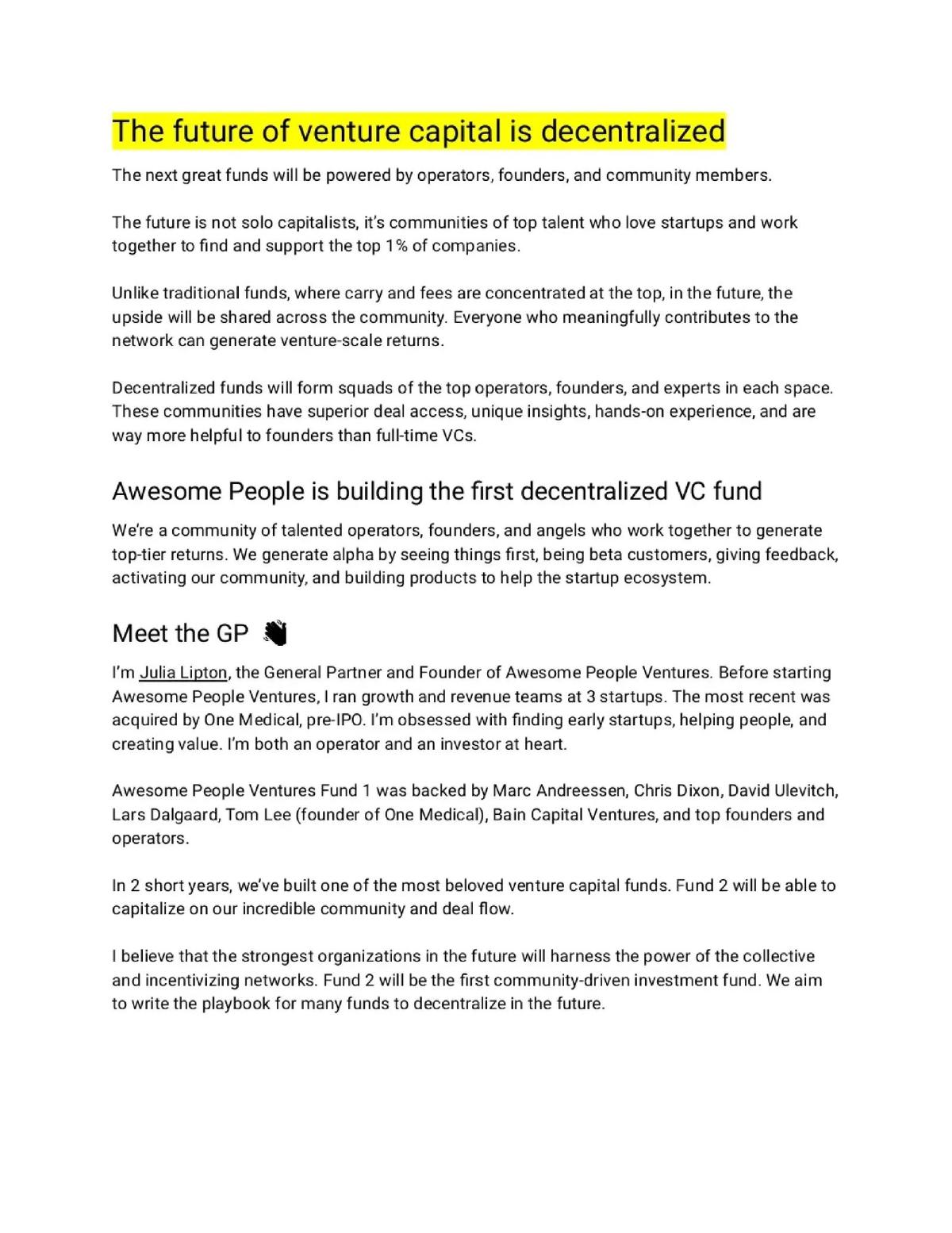
The Awesome People pitch deck is a specialized document aimed at Limited Partners (LPs) for a $20M Web3-focused venture fund. Unlike traditional venture decks that lead with financial returns and institutional pedigrees, this deck leads with community architecture and the concept of decentralized venture capital. The document is structured to bridge the gap between traditional fund management and the DAO (Decentralized Autonomous Organization) structures prevalent in the Web3 space.
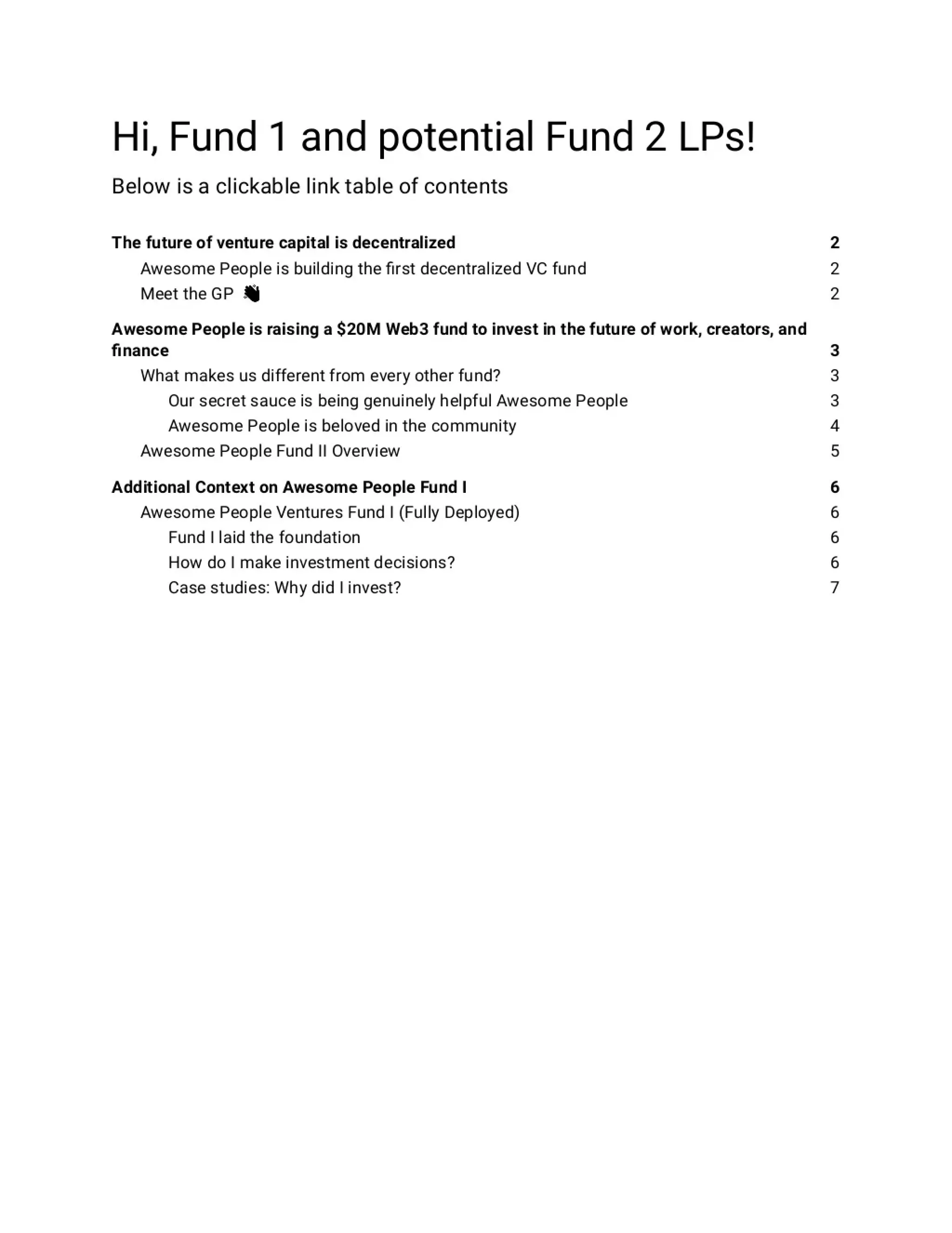
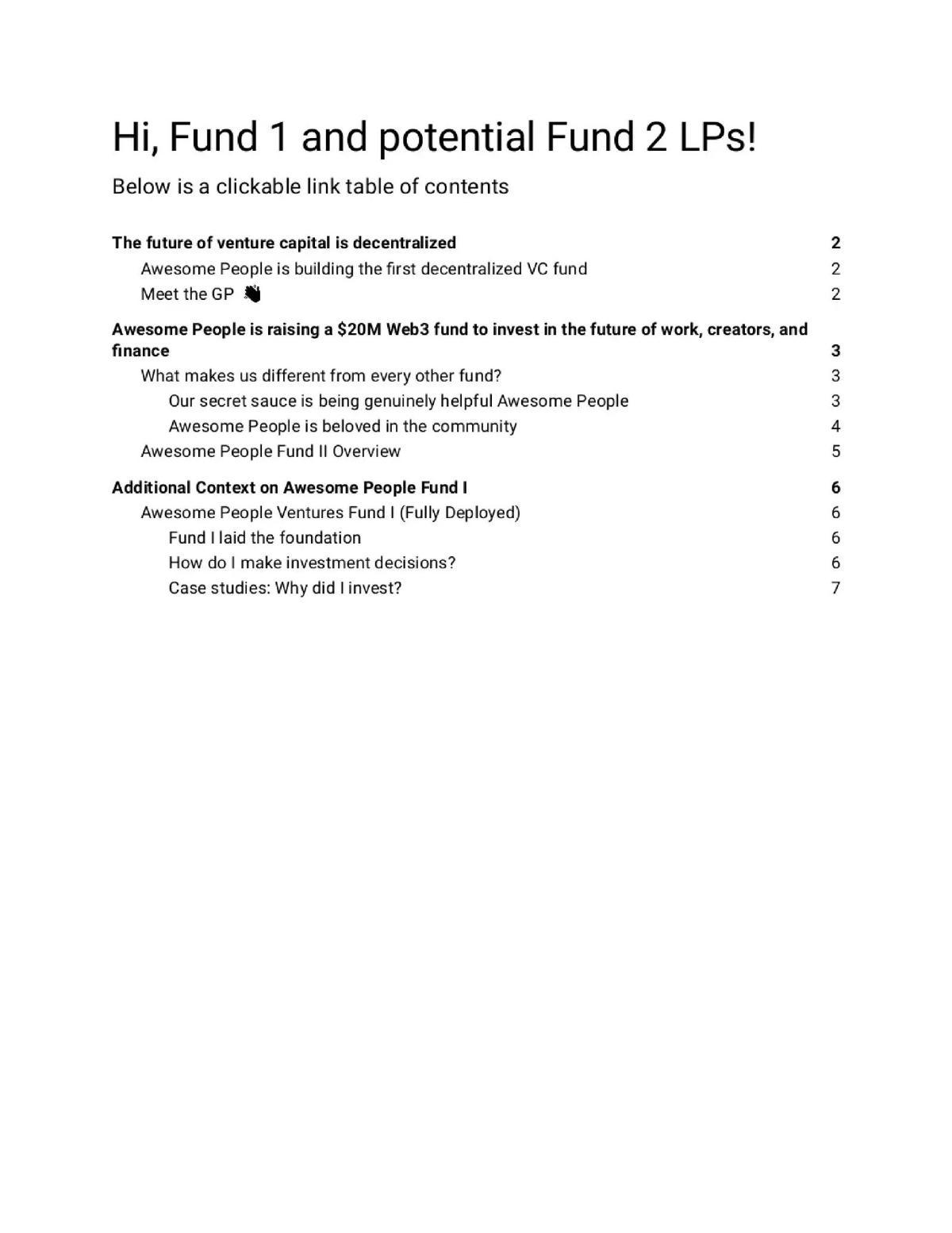
Slide 1: Table of Contents and LP Greeting
The deck opens with a direct address to 'Fund 1 and potential Fund 2 LPs.' This immediately establishes that the GP has a track record, even if the specific returns of Fund I are not the lead headline. The clickable table of contents is divided into three main sections: the future of decentralized VC, the specifics of the $20M Fund II, and additional context/case studies from Fund I. This structure suggests a narrative that moves from the 'Why' (decentralization) to the 'What' (Fund II details) to the 'Proof' (Case studies).
Slide 2: The Decentralized VC Model and 'Secret Sauce'
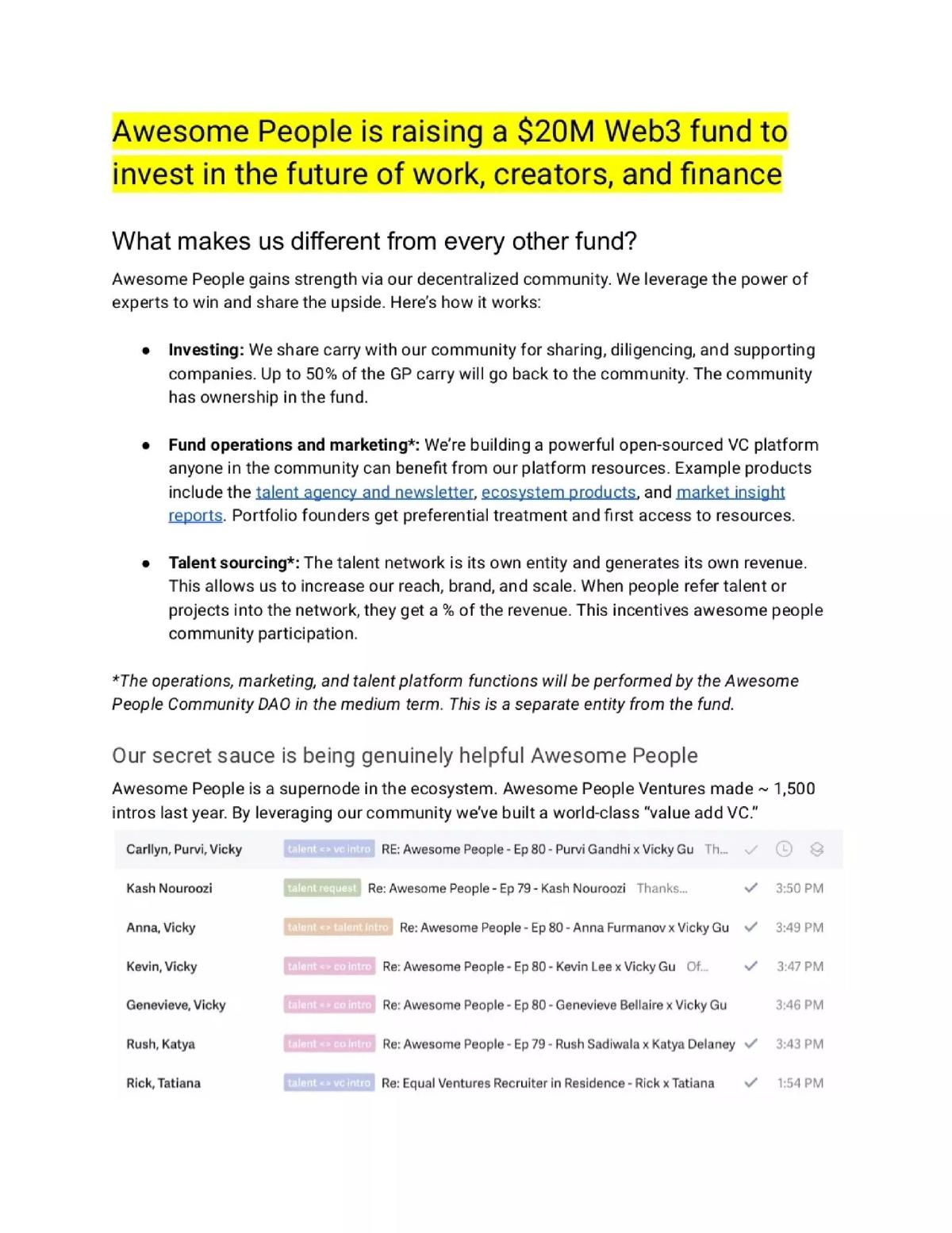
This slide serves as the core value proposition. It defines how Awesome People operates differently from a standard fund. The most notable claim is the sharing of carry: 'Up to 50% of the GP carry will go back to the community.' This is a significant departure from the standard 2/20 venture model and is intended to incentivize the community to perform high-value tasks like sourcing and diligence.
The slide also introduces the 'Awesome People Community DAO' as a separate entity that will eventually handle operations, marketing, and talent platform functions. To prove the efficacy of this network, the slide includes a screenshot of a communication log showing various introductions (e.g., 'talent <> vc intro', 'talent <> co intro'). The slide claims the fund made '~ 1,500 intros last year,' positioning the GP as a 'supernode' in the Web3 ecosystem. This metric is used as a proxy for 'value-add,' a common but often nebulous term in venture capital.
Slide 3: Fund II Overview and Team
Slide 3 transitions into the hard facts of the raise. The fund is targeting $20M for early-stage investments. The strategy is high-volume, aiming for ~40 companies over a ~2 year deployment period . The check sizes are relatively small for a $20M fund, ranging from $100k to $500k , which suggests a 'seed-plus' or 'co-investment' strategy rather than a lead-investor approach for every deal. This is supported by the '70% first check, 30% follow on' allocation strategy.
The 'Sample deal categories' list includes Protocols, DAOs, and Creator tools, which were the primary buzzwords of the Web3 era during which this deck was likely produced. The team section is notably lean, listing only Julia Lipton as GP and a 'Chief of Special Projects.' This reinforces the idea that the 'team' is actually the broader community, rather than a large headcount of full-time investment professionals.
Slide 4: Investment Philosophy and Case Studies
The final slide provided focuses on the qualitative side of the investment process. It asks three rhetorical questions about non-consensus insights and 10x improvements. The 'Unseen inflection points' section emphasizes market timing and tech shifts as the primary drivers for billion-dollar outcomes.
The case studies are the most concrete evidence of the GP's ability to access high-quality deals. The deck highlights XMTP Protocol , Mirror , and Braintrust . Crucially, the slide mentions co-investing 'alongside a16z' for both XMTP and Mirror. For an emerging manager, citing co-investments with top-tier firms like Andreessen Horowitz is a standard way to signal credibility and deal-flow quality. The narratives for these investments are personal, focusing on how the GP met the founders (e.g., 'early-days of Clubhouse in 2020') and how they added value before investing (e.g., connecting a founder to 20+ founders and VCs via the talent network).
What Awesome People Does Well
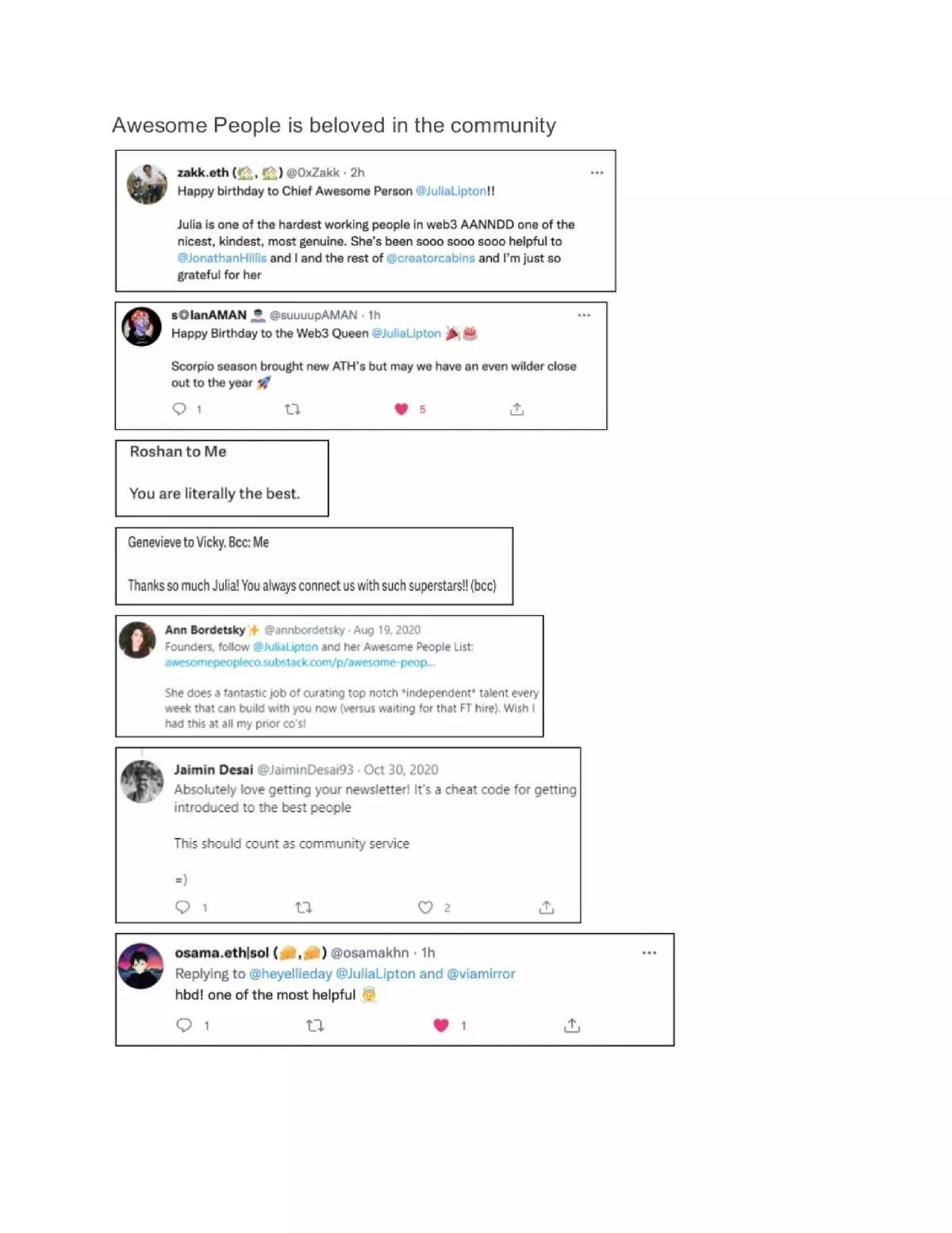
The deck excels at defining a specific 'vibe' and operational methodology. In a crowded market of emerging managers, Awesome People leans heavily into the 'community-as-a-service' model. By quantifying their network activity (1,500 intros) and showing actual screenshots of their workflow, they move beyond the generic claim of being 'founder-friendly.'
The transparency regarding carry sharing is also a bold and clear differentiator. It provides a logical reason why a community would help this fund over others: they have actual skin in the game. The alignment between the fund's Web3 investment thesis and its own decentralized internal structure creates a cohesive brand story.
What is Missing from the Deck
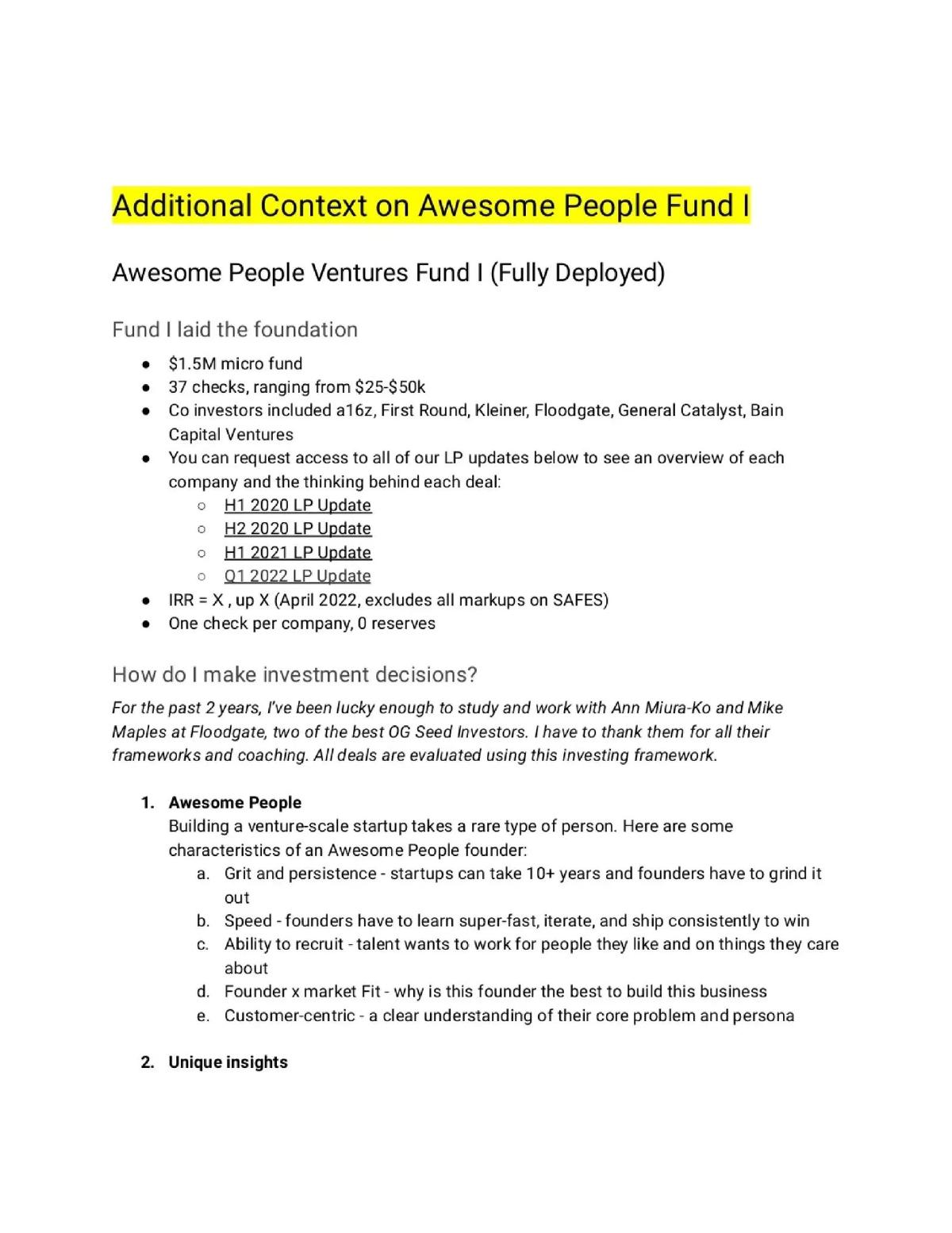
The most glaring omission in the provided slides is the financial performance of Fund I. While Slide 1 mentions that Fund I is 'Fully Deployed,' there are no metrics regarding TVPI (Total Value to Paid-In capital), DPI (Distributed to Paid-In capital), or IRR (Internal Rate of Return). For LPs, these are the primary metrics that matter. While the case studies mention successful companies, they do not disclose the fund's entry valuation, ownership percentage, or the current marked value of those positions.
Additionally, there is no mention of the fund's legal or regulatory structure, which is particularly important for a fund claiming to be 'decentralized' and sharing carry with a DAO. LPs typically require significant clarity on how a DAO-linked fund complies with securities laws and how the GP/LP relationship is protected legally.
Founder Takeaways: What to Copy
Quantify Your 'Value Add': Instead of saying you are helpful, show the number of introductions you made or the specific talent you placed. Awesome People's use of the '1,500 intros' figure is a strong way to turn a qualitative claim into a quantitative one. · Leverage Social Proof: If you are a solo or small-team GP, highlight your co-investors. Mentioning a16z multiple times serves as a powerful validation of the GP's ability to get into competitive rounds. · Define Your Sourcing Engine: Don't just say you have a network; explain the mechanics of it. The breakdown of how the talent network generates revenue and how community members are incentivized to refer deals provides a clear 'how' to the fund's 'what.' · Use Case Studies to Show Relationship Depth: The XMTP and Mirror examples aren't just about the companies; they are about the GP's relationship with the founders. Showing that you knew a founder before they started their current company demonstrates 'proprietary' access.
Frequently asked questions
- What is the primary differentiation of Awesome People compared to other VC funds?
- According to Slide 2, the primary difference is the decentralized community model. The fund shares up to 50% of the GP carry with its community for tasks like sourcing, diligencing, and supporting companies. It also operates an open-sourced platform where community members can access resources like talent agencies, newsletters, and market insight reports, creating a feedback loop of value between the fund and its network.
- What are the specific investment terms for Awesome People Fund II?
- Slide 3 outlines the key details for Fund II: a $20M target size focusing on early-stage deals (up to Series A). The fund intends to back approximately 40 companies with a 70% first check and 30% follow-on allocation. Individual check sizes are projected to be between $100,000 and $500,000, with a total deployment timeline of about two years.
- How does the fund handle talent sourcing and operations?
- As stated on Slide 2, talent sourcing is managed as its own entity that generates revenue. When community members refer talent or projects, they receive a percentage of that revenue. Additionally, the deck notes that operations, marketing, and talent platform functions will eventually be performed by the 'Awesome People Community DAO,' which is a separate entity from the investment fund itself.
- What sectors within Web3 does Awesome People target?
- Slide 3 lists five specific sample deal categories: Protocols, DAOs, DAO tooling & B2B SaaS for Web3, User-owned marketplaces, and Creator tools. The case studies on Slide 4 further illustrate this by highlighting investments in a communications protocol (XMTP), a crypto-native publishing platform (Mirror), and a talent-owned network (Braintrust).
- Who leads the fund and what is their investment philosophy?
- The fund is led by General Partner Julia Lipton (Slide 3). The investment philosophy, detailed on Slide 4, focuses on 'unseen inflection points' and 'non-consensus insights.' Lipton looks for market timing, tech shifts, or regulatory changes that could propel a business to a billion-dollar valuation, specifically betting on companies that solve problems in ways 10x better than existing alternatives.