AxCent is pitching a patented 'open loop' digital self-tuning system designed for both new and existing guitars. The deck outlines a $3.8B global market opportunity, with 6.4 million guitars sold annually. AxCent differentiates itself through mobile device integration and the ability to change tunings while playing—a feature they claim 'closed loop' competitors lack. The financial model is aggressive, projecting $100M in aggregate revenue over five years with a 50% EBITDA margin by year five. While the deck boasts an impressive roster of advisors and celebrity endorsements, it lacks a detaile…
Key takeaways
- The global guitar industry is valued at $3.8B, with 6.4 million units sold annually (Slide 2).
- AxCent utilizes patented 'open loop' technology, which allows for tuning changes during active play (Slide 9).
- The product has three pricing tiers: $695 retail, $495 wholesale, and $300 OEM (Slide 11).
- Production costs are stated at $100 per unit, yielding a margin of 45% to 67% (Slide 11).
- The company projects $50M in annual revenue and $25M in EBITDA by year five (Slide 12).
- The team includes high-profile advisors like Jim D'Addario and Peter Frampton (Slide 10).
- The fundraising ask is $2.5 million in exchange for up to 25% equity (Slide 13).
- The system is compatible with mobile devices (phones and tablets) via wireless integration (Slide 6).
Slide-by-Slide Analysis
Slide 1: Title Slide
The cover slide introduces AxCent as 'The New Digital Self-Tuning System.' It immediately leverages social proof by stating the product is 'Endorsed by Guitar Legends.' The branding is clear, focusing on the 'Self Tuning Guitars' tagline. The background image of a guitar neck reinforces the sector focus.
Slide 2: Total Addressable Market
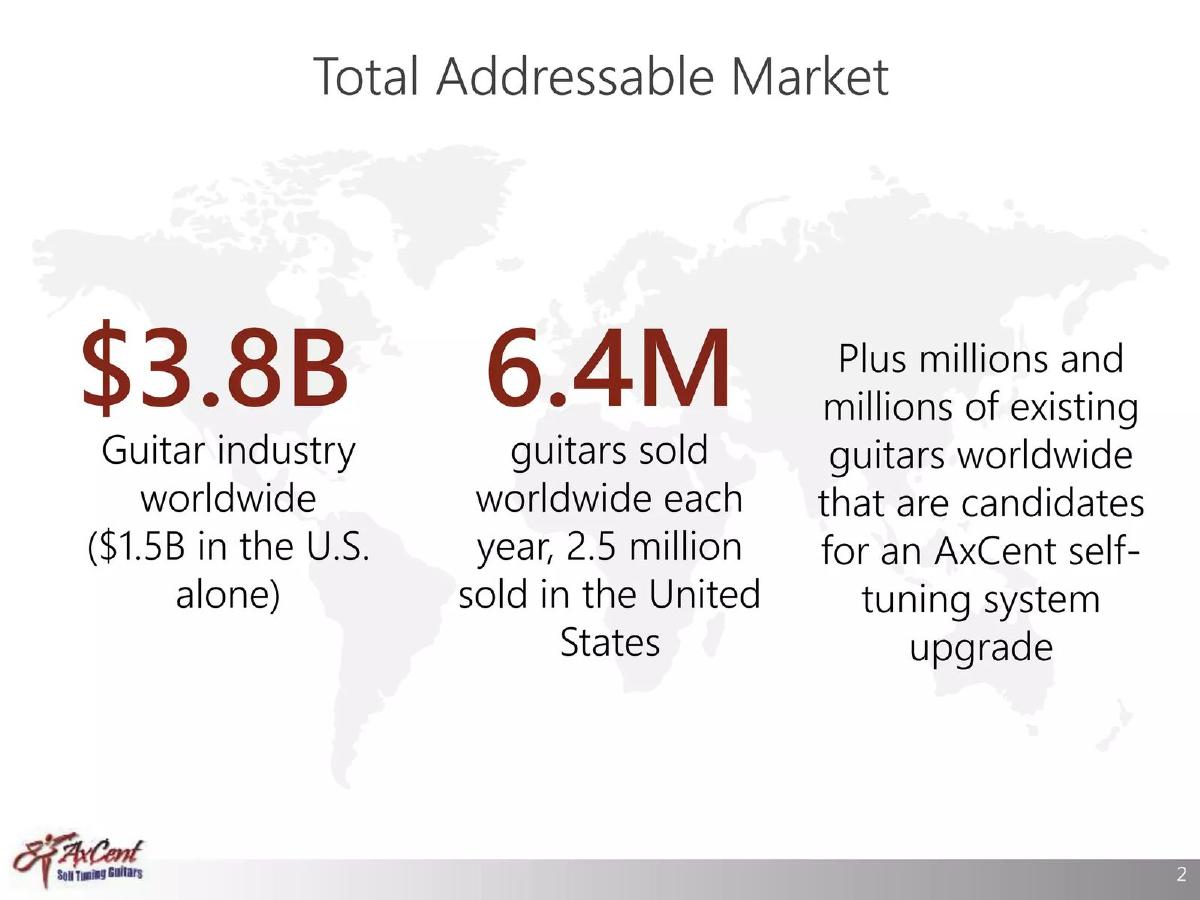
AxCent defines a large market opportunity. They cite a $3.8B worldwide guitar industry, with $1.5B in the U.S. alone. Volume metrics are provided: 6.4M guitars sold worldwide annually, with 2.5M in the U.S. Crucially, they identify a secondary market consisting of 'millions and millions' of existing guitars that could be candidates for an upgrade, suggesting a retrofit business model in addition to new sales.
Slide 3: The Problem
The deck identifies 'The Trouble with Guitars' as inherent instability. Factors like temperature changes, aging strings, and frequent use cause guitars to de-tune. The slide frames this as a waste of 'time and money' and a detriment to the player's sound. This is a classic 'pain point' slide that sets up the need for an automated solution.
Slide 4: The Solution
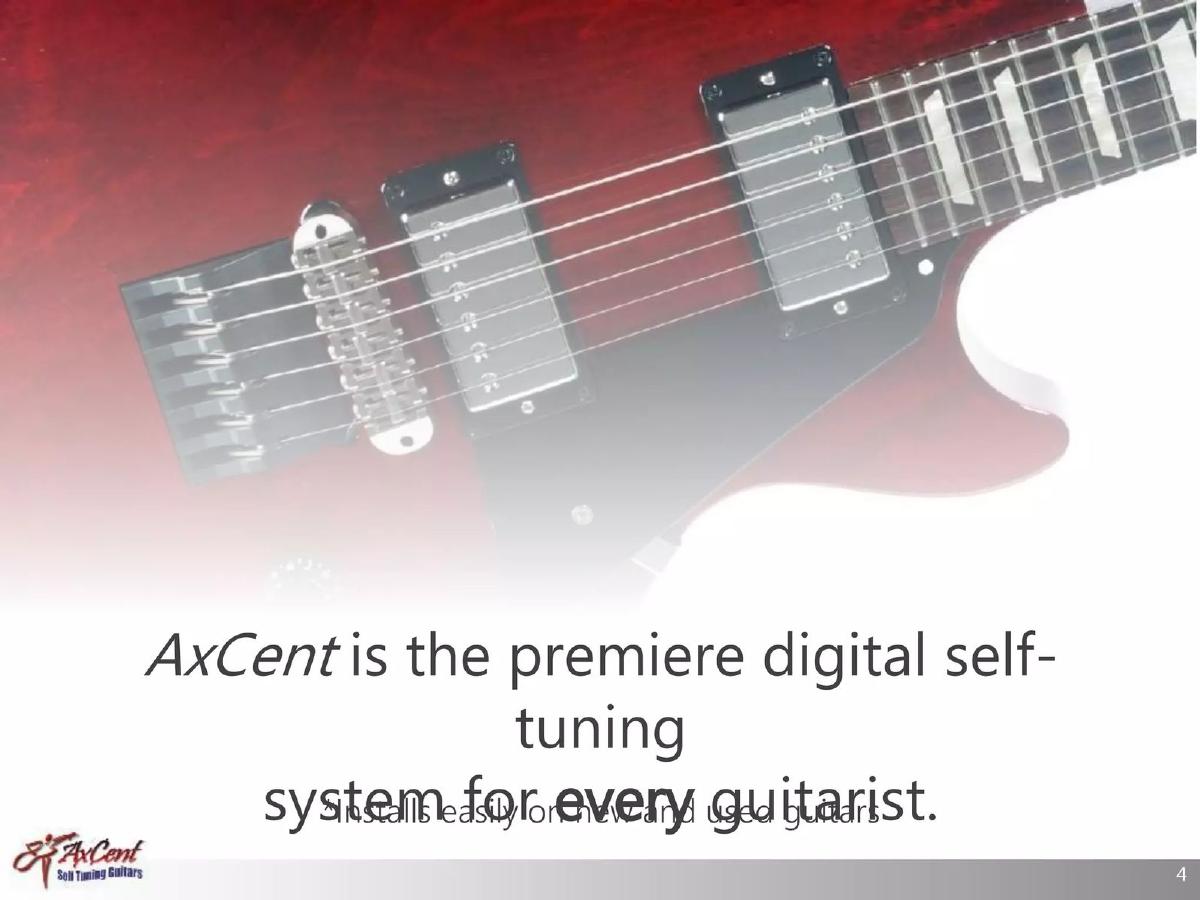
AxCent positions itself as the 'premiere digital self-tuning system for every guitarist.' A small sub-caption notes that it 'installs easily for new and used guitars,' addressing the retrofit market mentioned in the TAM slide. The visual shows the hardware installed on a red electric guitar body.
Slide 5: The AxCent System
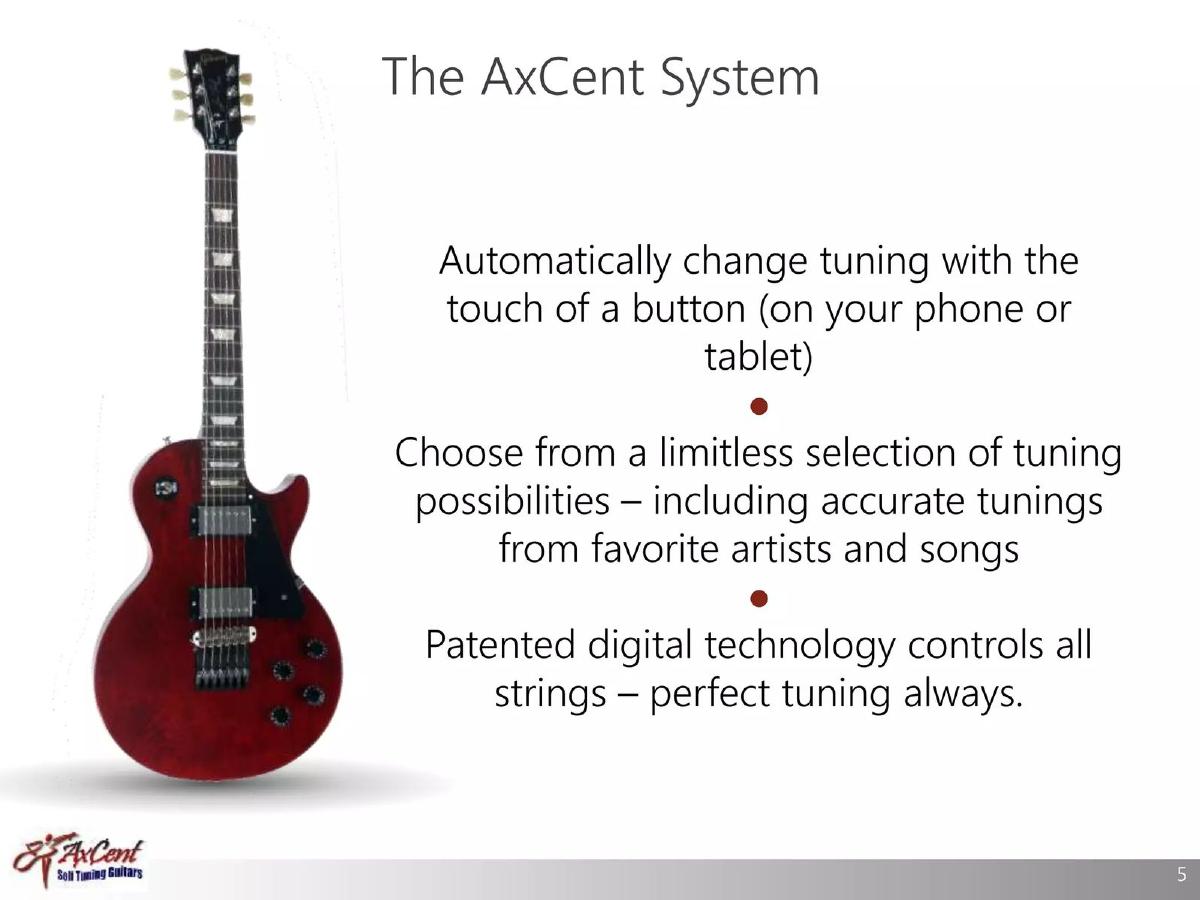
This slide details the product's capabilities. Key features include the ability to change tuning 'with the touch of a button' via a phone or tablet. It promises a 'limitless selection' of tunings, including presets from famous artists and songs. The slide mentions 'Patented digital technology' that controls all strings to ensure 'perfect tuning always.'
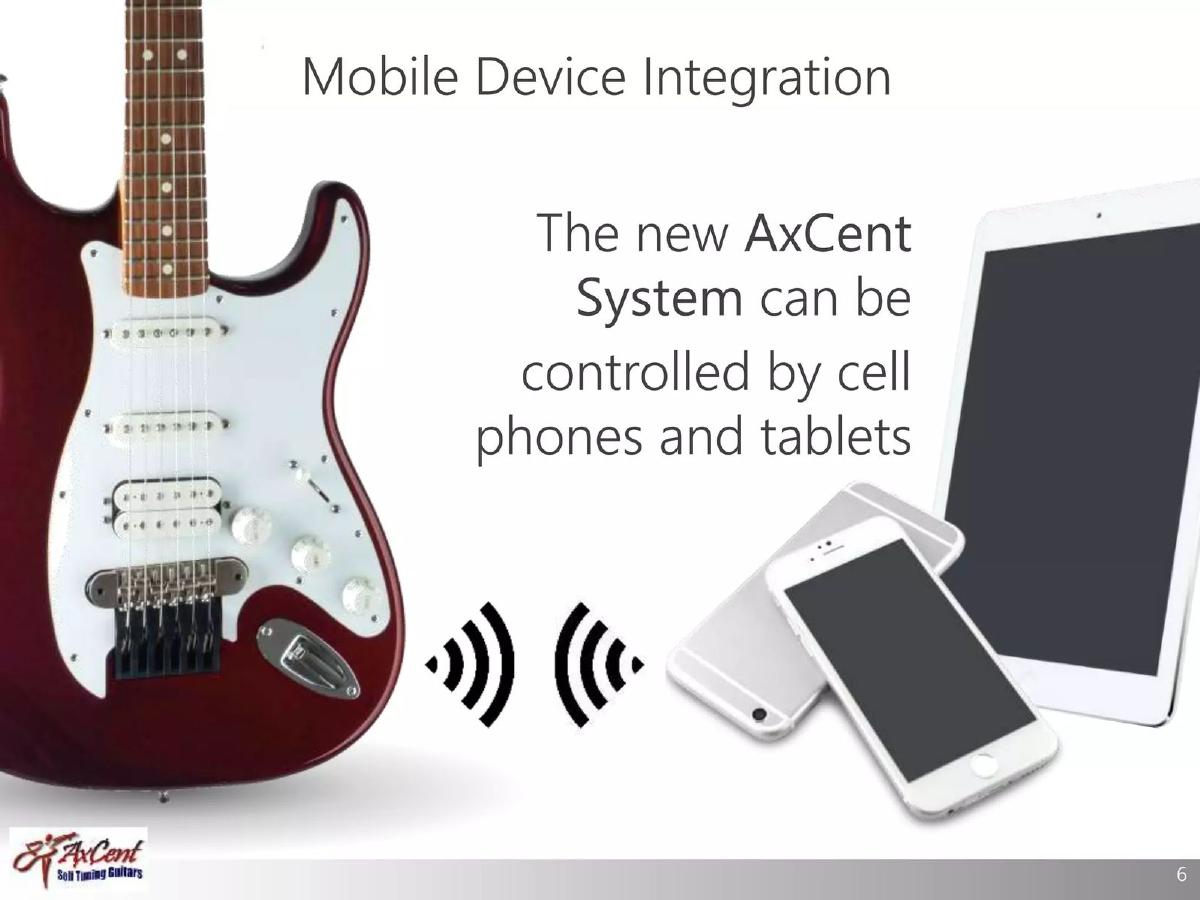
Slide 6: Mobile Device Integration
This slide emphasizes the modern interface of the product. It shows a guitar communicating wirelessly with a smartphone and tablet. This suggests a software component (an app) that acts as the controller for the physical tuning hardware, moving the user interface away from the guitar body itself.
Slide 7: Endorsements
This is a high-impact social proof slide. It features photos of Joe Perry , Peter Frampton , and Jimmy Page . It also lists Eddie Van Halen , Pat Metheny , Pete Townshend , and Peter Buck as users. A quote from Jimmy Page—'It has to be seen and heard to be believed'—is used to validate the technology's efficacy.
Slide 8: Target Audience
The deck segments its users into three categories: Beginners (helps instill perfect pitch and play songs as written), Intermediates (allows experimentation with alternative tunings faster), and Professional Players (saves time in studio/live settings and reduces the number of guitars needed for a set). This demonstrates a broad utility across all skill levels.
Slide 9: Competitive Differentiation
AxCent claims to be the only system using patented 'open loop' technology. They contrast this with 'less successful' 'closed loop' systems. The stated advantages of their open loop approach are compatibility with a wider range of guitars and the ability to change tunings while playing, which they claim competitors cannot do.
Slide 10: Team and Advisors
The management team includes Mark Bitter (CEO), Neil Skinn (CTO), and Peter Janssen . The advisor section is particularly strong for a niche hardware play, including Jim D'Addario (of the major string brand D'Addario) and musicians Peter Frampton , Graham Nash , and Mark Slaughter . This suggests deep industry connections.
Slide 11: Cost and Pricing
The unit economics are presented clearly. The cost to produce is $100 per unit , with the expectation that this will drop at higher volumes. They list three price points: $695 Retail , $495 Wholesale , and $300 OEM . The slide claims a margin of 45% to 67% per unit, which is healthy for consumer electronics/hardware.
Slide 12: Revenue Projections
The financial forecast is aggressive. They project $100M in aggregate revenue over the first five years, with $50M in revenue and $25M in EBITDA in year five alone. The slide notes that these projections require capturing only 1.8% of the domestic candidate market or 0.72% of the global market by the fifth year.
Slide 13: The Ask
The investment opportunity is a raise of up to $2.5 million in exchange for up to 25% of the company. The slide specifies that this is for 'Private, accredited investors only' and provides a contact email for the CEO, Mark Bitter.
Slide 14: Conclusion
A simple 'Thank you' slide with a blurred image of a guitar neck, maintaining the visual theme of the deck.
What AxCent Does Well
The AxCent deck excels at establishing industry credibility. By securing advisors like Jim D'Addario and endorsements from rock legends like Jimmy Page and Joe Perry, the company overcomes the initial skepticism often faced by 'gadget' hardware in the traditional music instrument space. The clear distinction between 'open loop' and 'closed loop' technology provides a technical moat that is easy for a non-technical investor to grasp as a competitive advantage. Furthermore, the pricing slide is transparent, showing a clear path to profitability through multiple sales channels (Retail, Wholesale, and OEM).
What is Missing from the AxCent Deck
While the deck is strong on vision and endorsements, it is light on execution details. There is no Go-to-Market (GTM) strategy explaining how they will reach the 6.4 million guitar buyers annually. There is also no Use of Funds breakdown; investors are asked for $2.5 million without knowing if that money goes toward R&D, manufacturing setup, or marketing. Additionally, the deck lacks a Product Roadmap . While it mentions mobile integration, it doesn't detail the software development status or future hardware iterations. Finally, there is no mention of Current Traction —it is unclear if these units are currently shipping or if the $100 production cost is a prototype estimate or a verified manufacturing quote.
What Other Founders Should Copy
Founders in the hardware space should emulate AxCent's multi-tiered pricing strategy (Slide 11). By showing Retail, Wholesale, and OEM prices, they demonstrate an understanding of the complex distribution networks in physical goods. The Market Share Context on the projections slide (Slide 12) is also a best practice; rather than just showing a large number, they explain that the $50M revenue target only requires a tiny fraction (0.72%) of the global market, which makes the goal feel more attainable to an investor. Lastly, the User Segmentation (Slide 8) is a great way to show that a product has a 'floor' (beginners) and a 'ceiling' (professionals), expanding the potential customer base.
Frequently asked questions
- What is the core technology behind AxCent?
- AxCent uses a patented 'open loop' digital technology. According to Slide 9, this distinguishes it from 'closed loop' systems because it can be installed on a wider range of new and used guitars and allows the player to change tunings while they are actively playing, rather than needing to stop.
- How does AxCent plan to make money?
- The company employs a multi-channel sales strategy. Slide 11 breaks down three price points: a $695 retail price for direct or consumer sales, a $495 wholesale price for retailers, and a $300 OEM price for guitar manufacturers to build the system directly into new instruments.
- Who is involved in the leadership and advisory of the company?
- The management team consists of Mark Bitter (CEO), Neil Skinn (CTO), and Peter Janssen. The advisory board is particularly strong for the industry, featuring Jim D'Addario of D'Addario Strings and legendary guitarists Peter Frampton, Graham Nash, and Mark Slaughter (Slide 10).
- What are the projected financial outcomes?
- Slide 12 projects an aggregate revenue of $100M over the first five years. By the fifth year, they anticipate $50M in annual revenue with $25M in EBITDA. These figures assume capturing 1.8% of the domestic candidate market or 0.72% of the global market.
- What is the specific investment ask?
- AxCent is seeking up to $2.5 million from private, accredited investors. In exchange, they are offering up to 25% of the company's equity, which implies a post-money valuation of $10 million (Slide 13).