AxCent Tuning Systems targets the musical instrument market with a digital self-tuning system designed to solve the inherent instability of guitars. The deck relies heavily on high-profile social proof, listing endorsements from rock legends like Jimmy Page and Joe Perry to validate the product's efficacy. Technically, the company differentiates itself through a patented "open loop" system, which it claims allows for tuning changes during live play—a feature supposedly missing from "closed loop" competitors. Financially, the deck outlines a clear margin structure, with a $100 production cost…
Key takeaways
- The product addresses guitar instability caused by temperature, aging strings, and use (Slide 3).
- AxCent claims to be the only system using patented 'open loop' technology, allowing for tuning changes while playing (Slide 9).
- Social proof is a core pillar, citing endorsements from Jimmy Page, Joe Perry, and Peter Frampton (Slide 7).
- The business model targets three tiers: Retail ($695), Wholesale ($495), and OEM ($300) (Slide 11).
- Unit economics are stated as a $100 production cost, yielding margins between 45% and 67% (Slide 11).
- The fundraising ask is $3 million in exchange for up to 30% of the company (Slide 13).
- The deck omits a team slide, failing to identify the founders' backgrounds beyond a contact email for Mark Bitter (Slide 13).
- There is no mention of current revenue, units sold to date, or specific market size figures.
AxCent Tuning Systems: A Technical and Social Proof Deep Dive
AxCent Tuning Systems presents a hardware-centric pitch focused on a specific pain point in the music industry: the mechanical instability of the guitar. The deck is structured to move quickly from the problem to a high-level technical solution, followed by significant social proof from industry icons. While the deck is visually sparse, it provides specific pricing and equity terms that are often missing from early-stage presentations.
Slide 1: Title Slide
The cover slide introduces the brand and its core value proposition: "The New Digital Self-Tuning System Endorsed by Guitar Legends." The logo features a stylized red figure that doubles as a guitar player, and the background image is a high-key, blurred shot of a guitar neck. The subtitle immediately establishes that the product's credibility is built on professional endorsement.
Slide 3: The Problem
Titled "The Trouble with Guitars...", this slide identifies the market pain point. It states that guitars are "inherently unstable" and that environmental factors like temperature and string age "constantly de-tune guitars." The slide frames the problem in economic and artistic terms, noting that out-of-tune instruments "waste your time and money, and hurt your sound." This is a classic "aspirational" problem slide, appealing to the professional musician's need for reliability.
Slide 5: The Solution
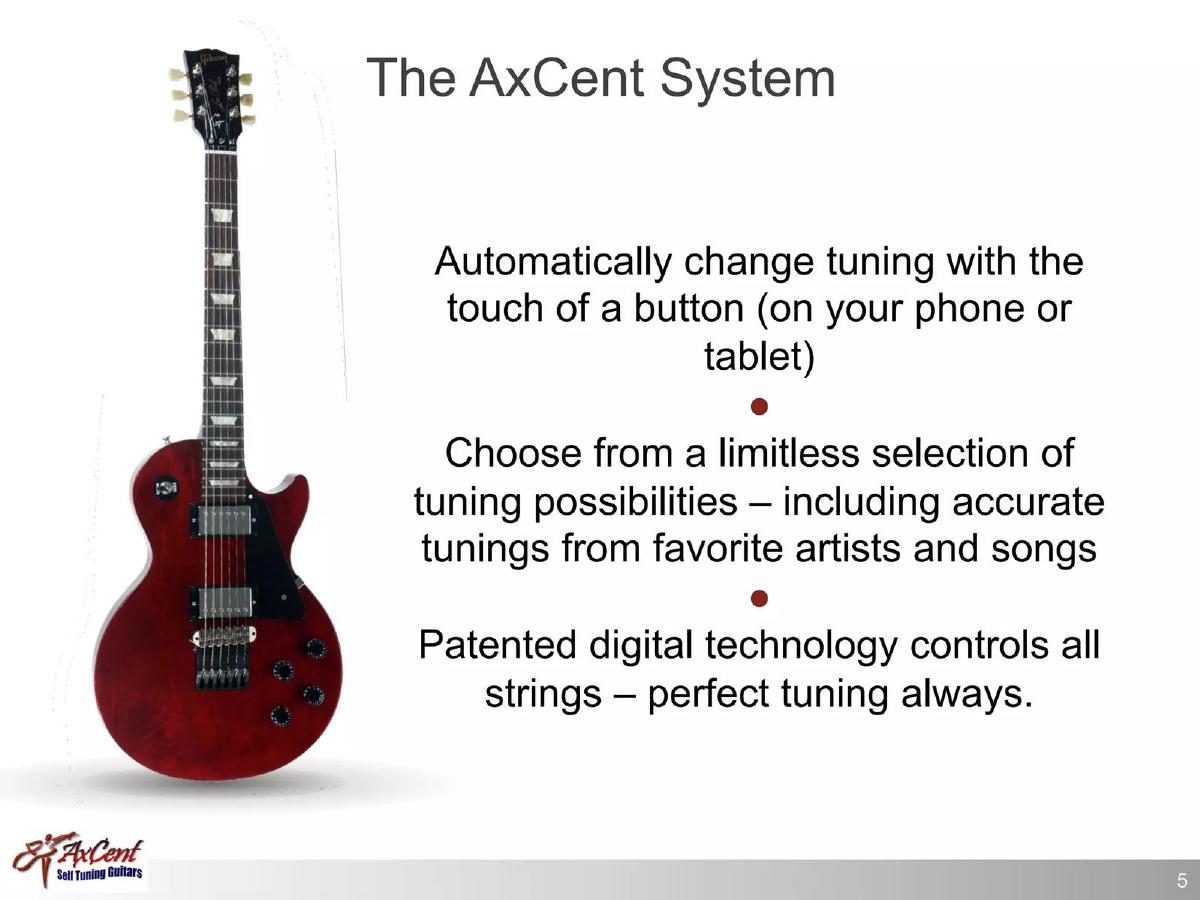
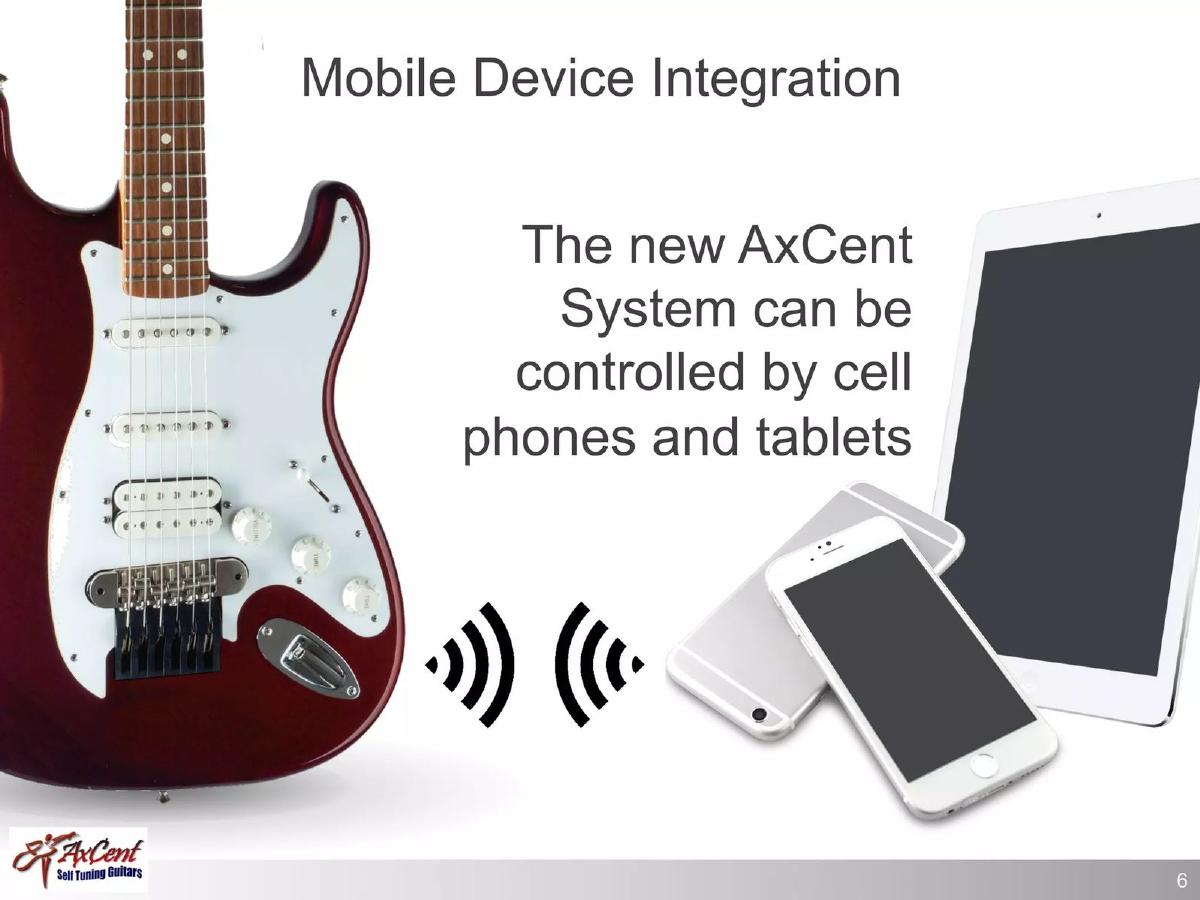
"The AxCent System" slide introduces the product functionality. It highlights three main features: the ability to change tuning via a phone or tablet, a "limitless selection" of tuning possibilities (including presets from famous songs), and patented digital technology that controls all strings. The visual shows a red Gibson-style electric guitar, implying that the system is either integrated into or compatible with high-end instruments.
Slide 7: Social Proof and Endorsements
This is arguably the strongest slide in the deck for a consumer hardware play. Titled "Endorsed by Legends," it features headshots of Joe Perry, Peter Frampton, and Jimmy Page. Below the primary photos, it lists other high-profile users including Eddie Van Halen and Pete Townshend. A testimonial quote from Jimmy Page—"It has to be seen and heard to be believed"—serves as the ultimate validation for the technology's performance in professional settings.
Slide 9: Competitive Differentiation
Slide 9, "Why AxCent is Different," moves into the technical moat. The company claims to be the only self-tuning system using patented "open loop" technology. It contrasts this with "less successful" closed-loop systems, which it claims are limited in their compatibility with older guitars and cannot change tunings mid-performance. This slide attempts to establish a technical barrier to entry and a functional advantage over existing market incumbents.
Slide 11: Business Model and Margins
The "AxCent Cost and Pricing" slide provides a transparent look at the unit economics. It lists a production cost of $100 per unit and breaks down three revenue streams: Retail ($695), Wholesale ($495), and OEM ($300). The slide explicitly calculates the margin per unit as being between 45% and 67%. This level of detail is helpful for investors to understand the scalability and profitability of the hardware, though it does not provide information on the current burn rate or overhead.
Slide 13: The Ask
The final slide in the provided set, "Investment Opportunity," states the fundraising goal: $3 million for up to 30% of the company. This implies a post-money valuation of approximately $10 million. The slide is restricted to "Accredited investors only" and provides a contact email for Mark Bitter. Notably, this slide lacks a breakdown of the "Use of Funds," which is a standard expectation for a $3 million round.
What Works in This Deck
Unparalleled Social Proof: For a niche hardware product, having names like Jimmy Page and Eddie Van Halen associated with the brand is a massive shortcut to credibility. It suggests that the product has already passed the most rigorous "stress test" possible: use by professional touring musicians.
Clear Unit Economics: The deck does not hide behind vague revenue projections. By stating the $100 production cost and the $695 retail price, the founders show they have a firm grasp of their gross margins and a clear strategy for different sales channels (Direct, Wholesale, and OEM).
Specific Technical Moat: By focusing on the "open loop" vs. "closed loop" distinction, the company gives investors a specific technical hook to investigate during due diligence. It moves the conversation from "we make a tuner" to "we have a patented method that solves a specific limitation of our competitors."
What is Missing from the Deck
Team Slide: The most glaring omission is a team slide. While Mark Bitter is mentioned as the contact person, there is no information regarding the engineering talent, the management's track record, or who holds the patents. In a $3 million raise, the "who" is often as important as the "what."
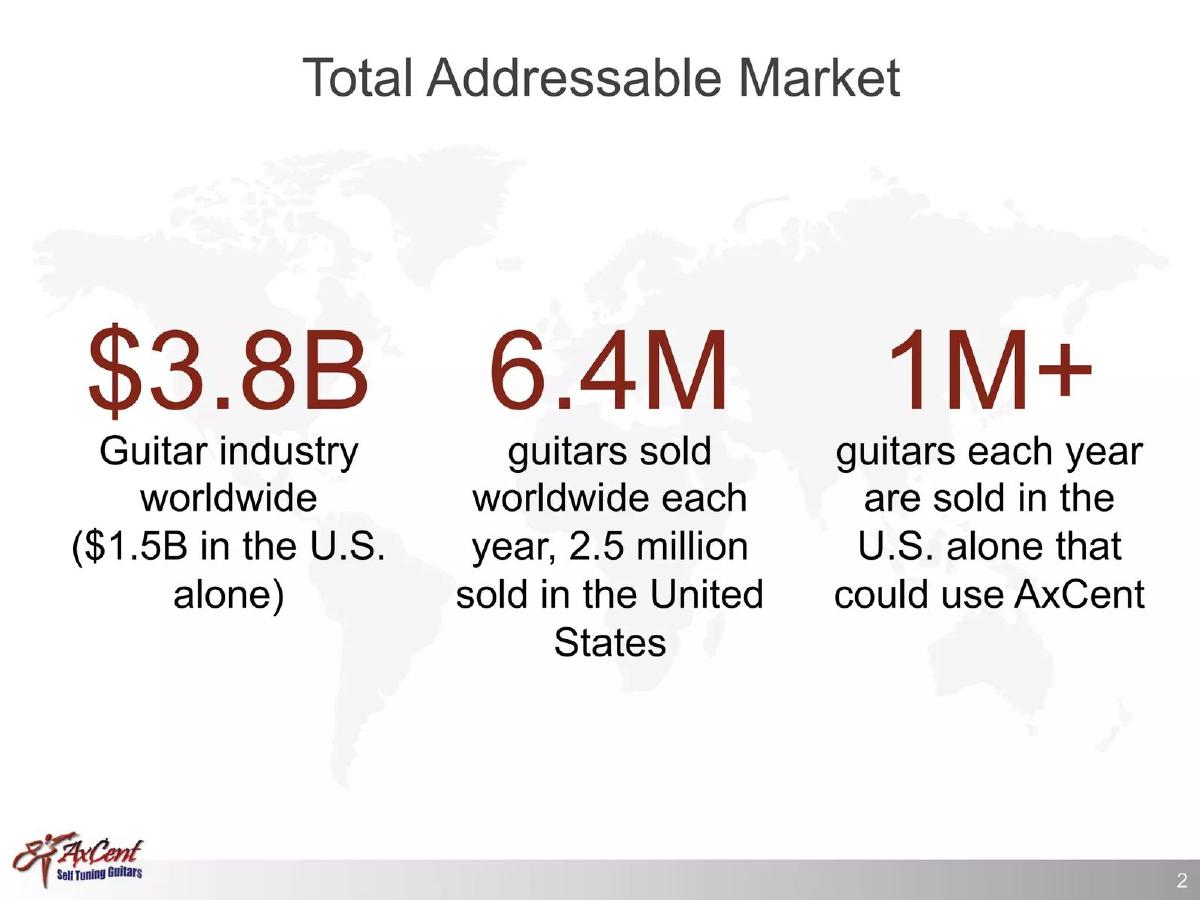
Market Size (TAM/SAM/SOM): The deck assumes the investor understands the size of the guitar market. It fails to quantify how many guitars are sold annually or what percentage of the market would realistically adopt a $695 add-on or integrated system. Without these numbers, the $3 million ask lacks context regarding the potential return on investment.
Traction and Roadmap: There is no mention of how many units have been sold to date, whether the product is currently in production, or what the $3 million will be used for (e.g., R&D, marketing, inventory). Investors need to know if they are funding a proven product's growth or a prototype's first production run.
What Founders Should Copy
Tiered Pricing Strategy: Founders should emulate the way AxCent breaks down its pricing by channel (Retail, Wholesale, OEM). This shows a sophisticated understanding of how hardware products actually reach the market and allows for different margin profiles across various segments.
Direct Problem/Solution Alignment: The deck does a good job of linking a physical problem (temperature affecting wood and strings) directly to a digital solution. It doesn't overcomplicate the narrative; it identifies a frustration every guitar player has felt and offers a button-press fix.
Leveraging Industry Validation: If your startup has early adopters who are leaders in their field, they should be front and center. AxCent uses its "Legends" slide to bypass the need for lengthy explanations of why the product is good—if Jimmy Page uses it, the product's quality is assumed.
Frequently asked questions
- What is the primary problem AxCent Tuning Systems is solving?
- According to Slide 3, the company addresses the fact that guitars are 'inherently unstable.' Factors such as temperature fluctuations, aging strings, and regular use cause instruments to de-tune constantly. The deck argues that out-of-tune guitars waste time and money while negatively impacting the musician's sound, positioning their digital system as the automated solution to this mechanical problem.
- How does AxCent differentiate itself from other self-tuning systems?
- Slide 9 specifies that AxCent uses a patented 'open loop' technology. The deck claims that competing 'closed loop' systems are less successful because they cannot be used on a wide range of both new and old guitars. Furthermore, AxCent asserts that its technology is unique in allowing musicians to change tunings while actively playing the instrument.
- What are the unit economics and pricing tiers for the product?
- Slide 11 outlines a production cost of $100 per unit, with the caveat that this will decrease at higher volumes. The company employs a multi-channel pricing strategy: a $695 retail price, a $495 wholesale price, and a $300 OEM price. This results in a stated margin per unit ranging from 45% to 67% depending on the sales channel.
- Who are the notable users or endorsers of the technology?
- The deck leans heavily on celebrity validation on Slide 7. It features photos and names of Joe Perry (Aerosmith), Peter Frampton, and Jimmy Page (Led Zeppelin). It also lists Eddie Van Halen, Pat Metheny, Pete Townshend, and Peter Buck as users, including a direct quote from Jimmy Page: 'It has to be seen and heard to be believed.'
- What are the terms of the investment being sought?
- On Slide 13, AxCent Tuning Systems states it is seeking to raise up to $3 million. In exchange for this capital, the company is offering up to 30% of its equity. The slide notes that the opportunity is for 'Accredited investors only' and directs inquiries to Mark Bitter, though it does not specify how the funds will be allocated.