Hourly’s 23-slide Series A deck focuses on the convergence of HR tech and Insurtech to solve the inefficiencies of the $50B U.S. workers' compensation market. By combining time-tracking, geo-fencing, and payroll into a single mobile-first platform, Hourly enables real-time premium calculations, moving away from the industry-standard annual audit model. The deck emphasizes a B2B2B go-to-market strategy, leveraging a network of insurance agents to reach small and medium-sized businesses. While the presentation provides a clear overview of the product's functional mechanics and shows significant…
Key takeaways
- Hourly identifies a $50B U.S. workers' compensation market as its primary target for disruption on Slide 4.
- The platform integrates time-tracking, geo-fencing, and payroll to automate insurance premium calculations in real-time as shown on Slide 10.
- The go-to-market strategy relies on a four-step partnership model involving insurers and a network of insurance agents according to Slide 13.
- Hourly operates as a licensed insurer leveraging agency distribution through a Managing General Agent (MGA) model noted on Slide 22.
- The company demonstrated significant growth in Gross Written Premiums sold across 2021 and 2022 as visualized on Slide 19.
- The product is positioned as 100% mobile and cloud-based, targeting the specific needs of businesses with hourly workers on Slide 10.
- The deck omits a dedicated team slide, only referencing 'best in class management' in the summary on Slide 22.
- There is no explicit 'Ask' slide detailing how the $27M Series A funds will be spent across specific departments.
The Convergence of Payroll and Insurtech
Hourly's Series A deck is a masterclass in vertical SaaS positioning. By the time they raised $27M in 2023 (as reported by Business Insider), the company had clearly moved past the 'idea' phase and into the 'scaling' phase. The deck focuses heavily on how their technology stack—comprising time tracking, payroll, and insurance—creates a moat that traditional insurers cannot easily replicate. The following teardown examines the 23-slide presentation, focusing on the strategic narrative and the data presented.
Slide 1-3: Introduction and Branding
The deck opens with a clean, professional aesthetic. Slide 1 establishes the context: a Series A presentation from Q1 2022. Slides 2 and 3 are minimalist branding slides featuring the 'H' logo. While these don't provide data, they set a tone of modern, tech-forward simplicity, which is a deliberate contrast to the often archaic and paperwork-heavy world of workers' compensation insurance.
Slide 4: The Market Opportunity
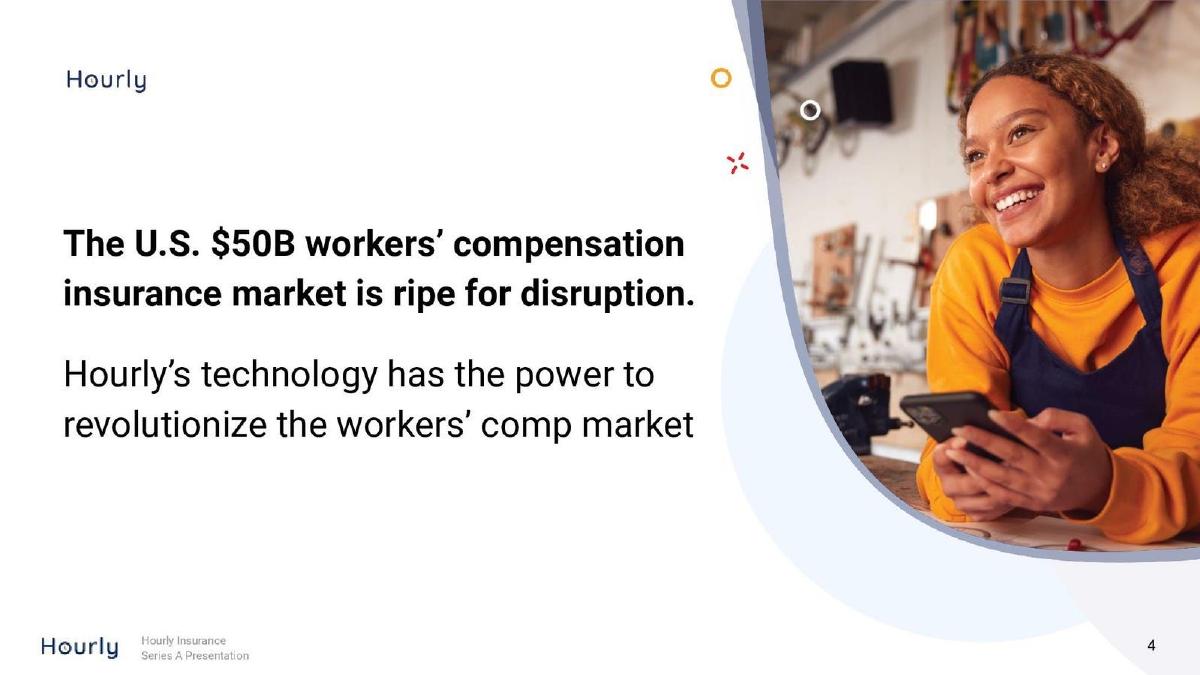
"The U.S. $50B workers’ compensation insurance market is ripe for disruption." This slide establishes the TAM (Total Addressable Market) immediately. By citing a $50B figure, Hourly signals to investors that even a small percentage of market capture represents a massive business. The slide also introduces the core thesis: that Hourly’s technology has the power to 'revolutionize' this specific niche. It’s a classic 'Big Problem' slide that justifies the need for a venture-scale solution.
Slide 7: The Differentiated Model
Slide 7 serves as a section header for 'Hourly’s Disruptive and Differentiated Model.' The use of high-quality lifestyle photography featuring a blue-collar worker (a carpenter or contractor) is a strategic choice. It grounds the abstract concept of 'fintech' in the reality of the people who actually use the product—small business owners and their hourly employees.
Slide 10: Product Mechanics and Value Proposition
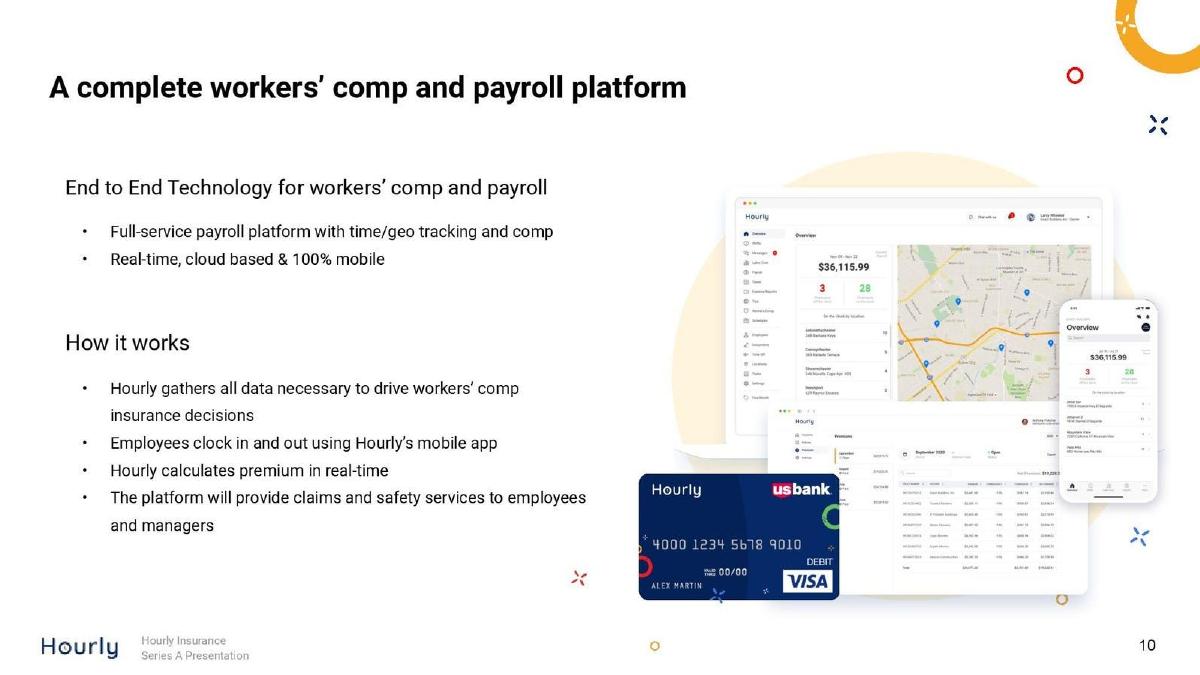
This is arguably the most important slide in the deck. Titled "A complete workers’ comp and payroll platform," it breaks down the 'How it works' into four distinct steps: data gathering, employee clock-in via mobile app, real-time premium calculation, and the provision of claims/safety services. The slide features a mockup of the mobile interface, showing a map for geo-tracking and a clear dashboard. The inclusion of a US Bank/Visa co-branded card image suggests a fintech layer involving direct payments or disbursements, further integrating the company into the customer's financial workflow.
Slide 13: Go-To-Market Strategy
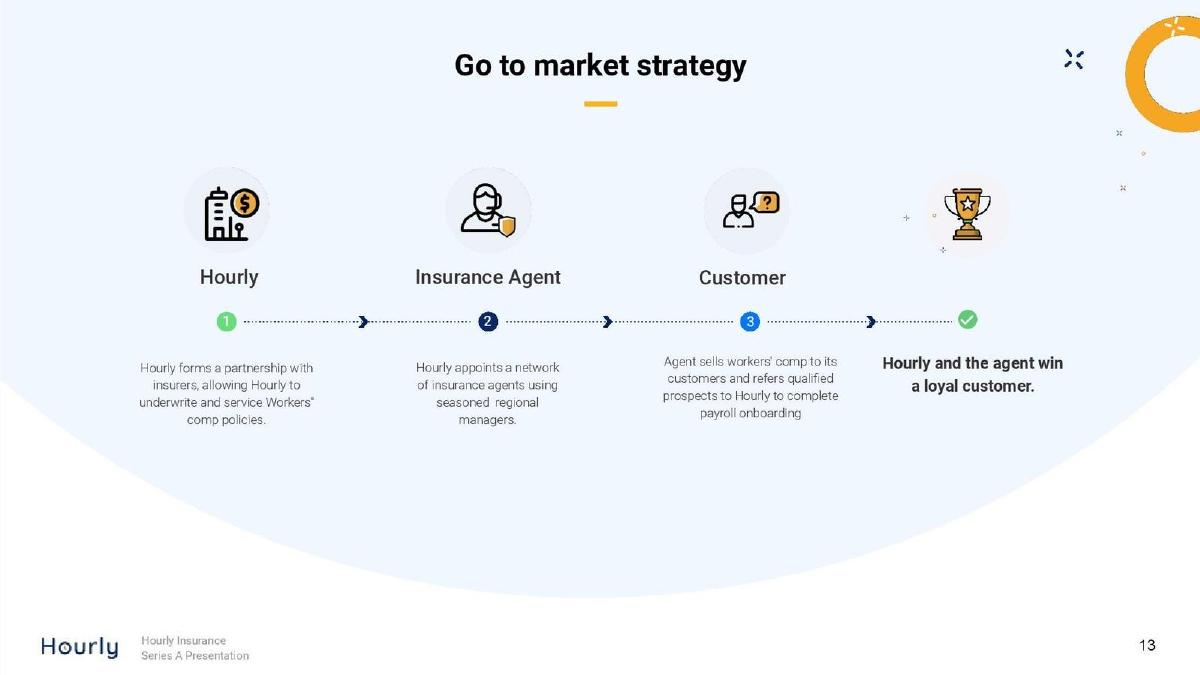
Hourly outlines a clear four-step distribution model on Slide 13. 1) Hourly forms partnerships with insurers to underwrite policies. 2) Hourly appoints a network of insurance agents. 3) Agents sell the workers' comp to their customers and refer them to Hourly for payroll. 4) Both Hourly and the agent win a loyal customer. This 'agent-first' strategy is a sophisticated way to bypass the high cost of direct customer acquisition in the insurance space, leveraging existing trust networks instead.
Slide 16: Insurance Strategy
Slide 16 acts as a transition into the deeper insurance mechanics. The imagery of a mobile phone inside a tool bag reinforces the 'mobile-first' and 'on-the-job' nature of the product. This section likely contained more detailed information about underwriting, risk pools, and the MGA (Managing General Agent) structure, though the summary slide later provides the high-level takeaway.
Slide 19: Growth and Traction
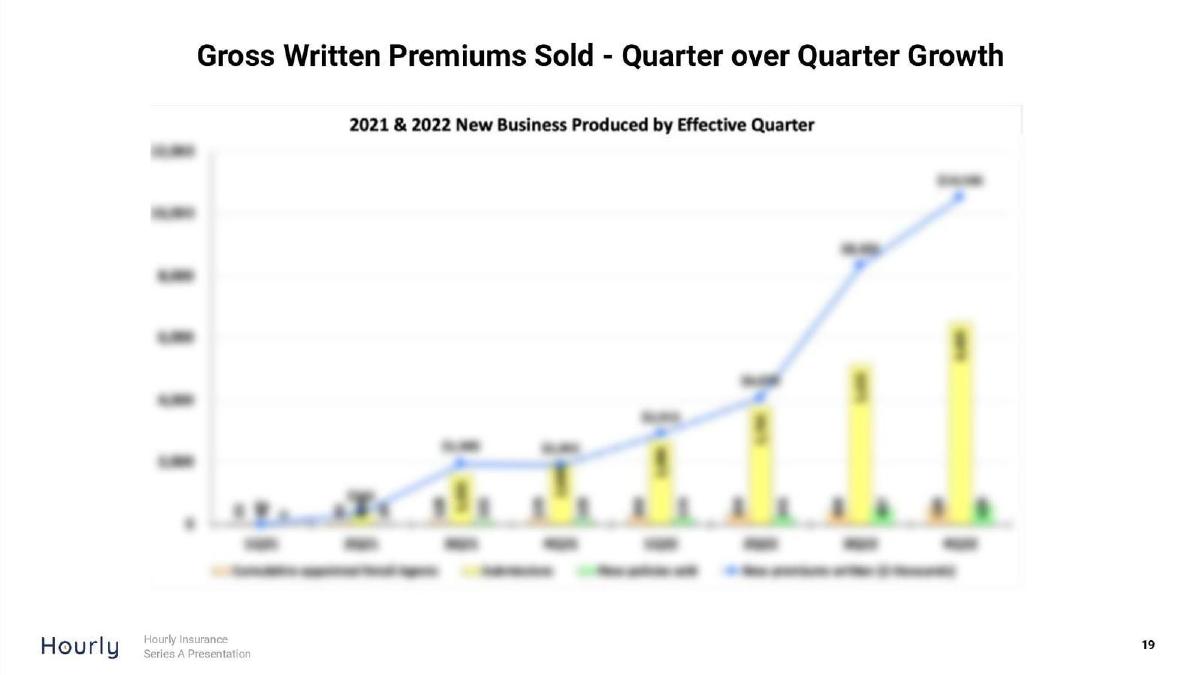
Slide 19 displays a chart for "Gross Written Premiums Sold - Quarter over Quarter Growth." The chart tracks 'New Business Produced by Effective Quarter' through 2021 and 2022. Although the specific Y-axis values are obscured in the public deck, the visual trend is one of exponential growth. The chart includes bars for 'Submissions' and 'New policies sold,' with a line representing 'New premiums written.' This slide is the 'proof of work' that justifies a Series A valuation, showing that the agent-based distribution model is functioning and accelerating.
Slide 22: The Summary
The deck concludes with a summary slide that hits five key pillars: the $50B opportunity, the unique end-to-end digital platform, the MGA-based go-to-market strategy, the 'best in class' team, and the financial momentum. This slide acts as a final pitch, consolidating the narrative into a single view for the investor to digest before the Q&A begins.
What Hourly's Deck Does Well
The primary strength of this deck is its clarity of purpose. Hourly does not try to be a general HR platform or a generic payroll provider. It focuses entirely on the synergy between payroll data and workers' compensation. By narrowing the focus, they make a compelling case for why they can win this specific $50B market.
The distribution strategy outlined on Slide 13 is also a highlight. Many startups fail because they underestimate the cost of customer acquisition (CAC). By positioning themselves as a tool for insurance agents rather than a competitor to them, Hourly creates a scalable engine for growth that aligns with existing industry incentives.
What is Missing from the Deck
The most glaring omission in the provided slides is a dedicated Team Slide . While Slide 22 mentions 'best in class management,' investors at the Series A stage typically want to see the specific pedigree of the founders—especially in a highly regulated industry like insurance. Experience at major carriers or successful fintech exits would be critical context here.
Additionally, there is no Unit Economics slide. While the GWP growth is impressive, investors would want to see the LTV (Lifetime Value) of a customer compared to the CAC, especially since they are sharing revenue with insurance agents. Finally, the Ask is missing. A standard pitch deck should explicitly state how much capital is being raised and how it will be allocated (e.g., 40% engineering, 30% sales, 30% operations).
Founder Takeaways: The Power of Vertical Integration
Founders should study how Hourly uses 'Step 2' of their product to solve 'Step 1' of their business model. By providing a free or low-cost time-tracking and payroll tool, they capture the data necessary to sell a high-margin insurance product. This is a classic 'Trojan Horse' strategy. If you are building in a crowded market like payroll, look for the adjacent, high-friction industry (like insurance or lending) where your data can provide an unfair advantage.
Another takeaway is the use of channel partners. If your product requires high trust to sell, don't try to build that trust from scratch. Find the people who already have it—in this case, insurance agents—and build a product that makes them look like heroes to their clients while increasing their own efficiency.
Frequently asked questions
- What is the core problem Hourly is solving?
- Hourly addresses the inefficiency and inaccuracy of the traditional workers' compensation insurance market. Typically, premiums are estimated and then adjusted through painful year-end audits. Hourly uses real-time payroll and time-tracking data to calculate premiums exactly as labor costs are incurred, providing better cash flow management for small businesses and more accurate risk assessment for insurers.
- How does Hourly acquire customers?
- Hourly utilizes a channel-partner strategy. Instead of selling directly to every small business, they appoint a network of insurance agents. These agents, who already have relationships with businesses needing workers' comp, refer qualified prospects to Hourly to complete their payroll onboarding. This B2B2B approach allows for faster scaling than a pure direct-to-consumer model.
- What makes Hourly's technology different from standard payroll software?
- Unlike generic payroll platforms, Hourly is built specifically to drive insurance decisions. It includes geo-tracking to verify where work is happening and links that data directly to workers' comp codes. This vertical integration allows the platform to provide claims and safety services to both employees and managers, creating a tighter feedback loop between labor and insurance risk.
- Is Hourly an insurance company or a software company?
- Hourly is a hybrid. It identifies as a 'Licensed Insurer leveraging agency distribution (through an MGA)' on Slide 22. While it provides a full-service payroll and time-tracking software suite, its primary revenue and value proposition are tied to the underwriting and servicing of workers' compensation policies.
- What metrics does the deck use to show success?
- The primary metric highlighted is Gross Written Premiums (GWP) Sold. Slide 19 shows a quarter-over-quarter growth chart for 2021 and 2022. While the specific dollar amounts are blurred in the public version, the trend line indicates accelerating momentum in new business production and agent submissions.