Horsehead Holding Corp.'s August 2012 presentation is a detailed industrial growth plan centered on the transition from high-cost electrothermic smelting to modern solvent extraction and electro-winning (SX-EW) technology. Operating across seven facilities, the company positioned itself as a leader in zinc recycling, specifically processing Electric Arc Furnace (EAF) dust. The core of the pitch is the construction of a new $375 million zinc plant in Rutherford County, NC, projected to lower manufacturing conversion costs from ~$0.38/lb to as low as $0.22/lb. While the deck provides robust ope…
Key takeaways
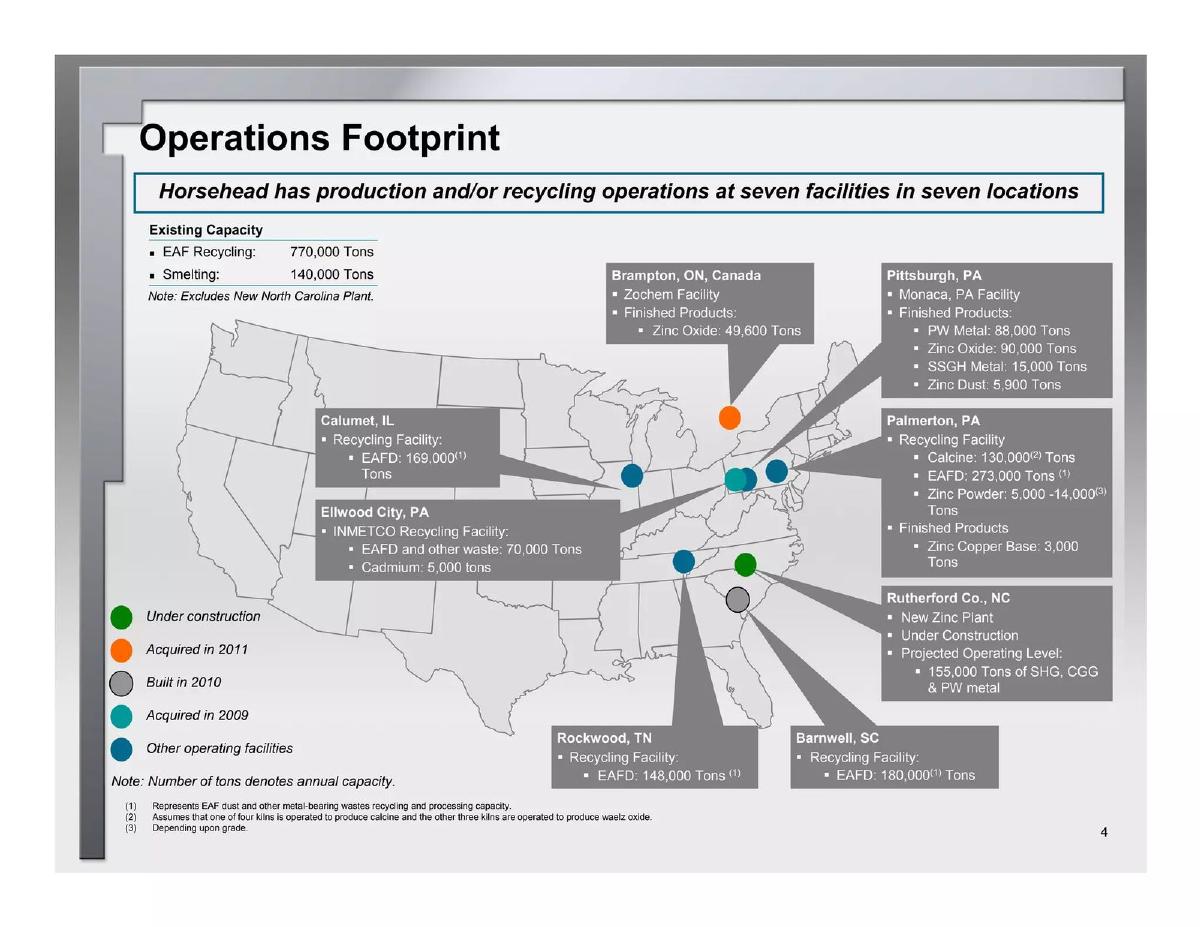
- The company operates seven facilities across the U.S. and Canada, with a total existing EAF recycling capacity of 770,000 tons (Slide 4).
- A new North Carolina facility is projected to expand EBITDA by $90 million to $110 million by 2014 (Slide 7).
- The transition to SX-EW technology aims to reduce manufacturing conversion costs from ~$0.38/lb to a range of $0.22 - $0.24/lb (Slide 7).
- Horsehead achieved a 47% increase in EAF dust recycling capacity between 2006 and 2010 (Slide 10).
- The anticipated capital cost for the new zinc plant is approximately $375 million (Slide 13).
- Technology for the new plant is licensed from industry leaders Tecnicas Reunidas and Asturiana de Zinc, a subsidiary of Xstrata (Slide 16).
- The new facility is designed to produce 155,000 tons per year of contained zinc, replacing a 140,000 tpy smelter (Slide 13).
- EBITDA sensitivity analysis shows the new SX-EW process maintains a significantly higher margin than the status quo across all LME zinc price points (Slide 22).
Horsehead Holding Corp. Investor Presentation: The Industrial Pivot to Efficiency
The August 2012 investor presentation for Horsehead Holding Corp. represents a classic industrial 'transformation' pitch. At the time, the company was a mature player in the zinc recycling space, but it was burdened by aging, high-cost infrastructure. The deck serves as a roadmap for a $375 million capital expenditure project intended to modernize their production and significantly widen their margins through technological innovation.
Slide 1: Title and Branding
The cover slide features a high-resolution image of a 'Cellhouse,' showcasing the industrial scale of the company's operations. It clearly identifies the parent company, Horsehead Holding Corp., along with its subsidiaries: Horsehead Corporation, INMETCO, and Zochem Inc. The tagline 'Leading the World in Zinc Recycling' establishes their market position immediately. The date, August 2012, provides the necessary temporal context for the financial projections that follow.
Slide 4: Operations Footprint
This slide provides a geographic and capacity overview of the company's North American assets. Horsehead lists seven facilities in seven locations. Key data points include an existing EAF Recycling capacity of 770,000 tons and Smelting capacity of 140,000 tons. The map distinguishes between facilities acquired in 2009 and 2011, those built in 2010, and the new plant under construction in Rutherford Co., NC. Specific output figures are provided for each site, such as 49,600 tons of Zinc Oxide at the Zochem facility in Brampton, ON, and 180,000 tons of EAF dust recycling at the Barnwell, SC facility. This slide effectively demonstrates the company's physical scale and market reach.
Slide 7: The Economic Case for the New Zinc Plant
Slide 7 is the core financial argument of the deck. It compares the 'Existing Smelter' to the 'New Zinc Facility' across several cost and revenue metrics. The manufacturing conversion cost is projected to drop from ~$0.38/lb to $0.22 - $0.24/lb. The slide also highlights a reduced feed cost ($0.35/lb vs $0.41/lb) and the introduction of higher-value products like SHG (Special High Grade) and CGG (Continuous Galvanizing Grade) zinc. The 'Total' row projects an incremental annual Adjusted EBITDA contribution of $90 million to $110 million. This is a powerful slide because it quantifies the 'why' behind the massive capital investment.
Slide 10: Historical Growth in Recycling Capacity
To build investor confidence, slide 10 looks backward at the company's execution track record. It shows a 47% increase in EAF dust recycling capacity between 2006 and 2010. A bar chart illustrates the growth from 500,000 tons in 2006 to 735,000 tons 'Current Capacity' (as of the presentation date). The slide credits this growth to a mix of facility expansions (Rockwood, Barnwell) and strategic acquisitions (INMETCO and Zochem). It also mentions a new 10-year agreement with Nucor in 2011, signaling long-term stability in raw material supply.
Slide 13: New Zinc Plant Overview
This slide provides the technical and logistical details of the North Carolina project. It reiterates that the new plant will replace the 80-year-old Monaca, PA smelter. Key technical terms like 'Solvent Extraction (SX)' and 'Electro-winning (EW)' are introduced as the 'green' alternatives to high-temperature smelting. The slide notes that the nominal operating level will be 155,000 tons per year (tpy), an increase over the 140,000 tpy at the old site. Crucially, it lists the anticipated project capital cost at approximately $375 million. The inclusion of construction photos and 3D renderings adds a sense of tangible progress to the project.
Slide 16: Technology Partnerships
Industrial projects of this scale carry significant execution risk. Slide 16 mitigates this by highlighting the 'Industry-Leading Technology Providers' involved. Horsehead identifies Tecnicas Reunidas (market cap $2.1 bn) as the provider for leaching and solvent extraction, and Asturiana de Zinc (a subsidiary of Xstrata, market cap $38.2 bn) for electrowinning. By aligning themselves with multi-billion dollar global leaders, Horsehead reassures investors that the technology is 'world-class' and 'proven,' rather than experimental.
Slide 21: Financial Overview Transition
Slide 21 is a simple divider slide titled 'Financial Overview.' In a 24-slide deck, this marks the transition from operational and strategic discussion to hard financial modeling and sensitivity analysis.
Slide 22: EBITDA Sensitivity Analysis
The final slide in this set addresses the volatility of commodity prices. It features a line graph comparing the 'Status Quo' EBITDA to the 'With SX-EW' EBITDA across a range of LME (London Metal Exchange) Zinc Prices. The 52-week price range of $0.79 - $1.13 is highlighted. The graph clearly shows that the new technology provides a significantly higher EBITDA floor and a steeper upward trajectory as zinc prices rise. This slide is essential for commodity-based businesses, as it demonstrates margin resilience even in a low-price environment.
What Horsehead Holding Corp. Does Well
The deck is exceptionally strong at quantifying the operational efficiency gains of their new technology. By providing side-by-side comparisons of per-pound manufacturing costs (Slide 7), they make a compelling mathematical case for their $375 million investment. The use of specific tonnage capacities for every facility (Slide 4) provides a level of transparency that is often missing in high-level investor decks.
Furthermore, the de-risking strategy on Slide 16 is excellent. Identifying Xstrata and Tecnicas Reunidas by their market caps and specific technological contributions shifts the 'burden of proof' for the technology's viability onto these established global giants. This is a smart move for a company attempting a major technological pivot.
What is Missing from the Deck
The most glaring omission in the provided slides is a Management Team slide . In a heavy industrial turnaround and construction project, the experience of the engineering and financial leadership is paramount. Investors need to know who is overseeing the $375 million spend.
Additionally, while the deck mentions the $375 million capital cost, it lacks a Sources and Uses of Funds slide within this selection. It is unclear how much of this capital was already raised, how much was debt-financed, and what the remaining funding gap was at the time of the presentation. A clear Balance Sheet summary showing current debt levels would also be necessary to evaluate the risk of such a large capital project.
Founder Takeaways: Lessons in Industrial Pitching
Quantify the 'Old vs. New': If you are replacing an existing process with a new one, follow the example on Slide 7. Don't just say it's 'better' or 'cheaper.' List the exact cost per unit (e.g., ~$0.38/lb vs $0.22/lb) and show how those pennies add up to millions in EBITDA.
Use Sensitivity Analysis: For any business tied to market fluctuations (commodities, ad rates, interest rates), a sensitivity chart like Slide 22 is mandatory. It shows investors that you understand the external risks to your business and have modeled how your new strategy performs under various market conditions.
Leverage Partner Credibility: If you are a smaller player using technology from a larger one, name-drop effectively. Horsehead didn't just mention their partners; they listed their market caps and specific track records (e.g., 'built over 1,000 industrial plants'). This transfers trust from the giant to the startup.
Show, Don't Just Tell, the Progress: The inclusion of construction photos on Slide 13 is a simple but effective way to prove that a project isn't just 'vaporware.' For physical products or infrastructure, real-world evidence of progress is worth more than any number of 3D renderings.
Frequently asked questions
- What is the primary business model of Horsehead Holding Corp.?
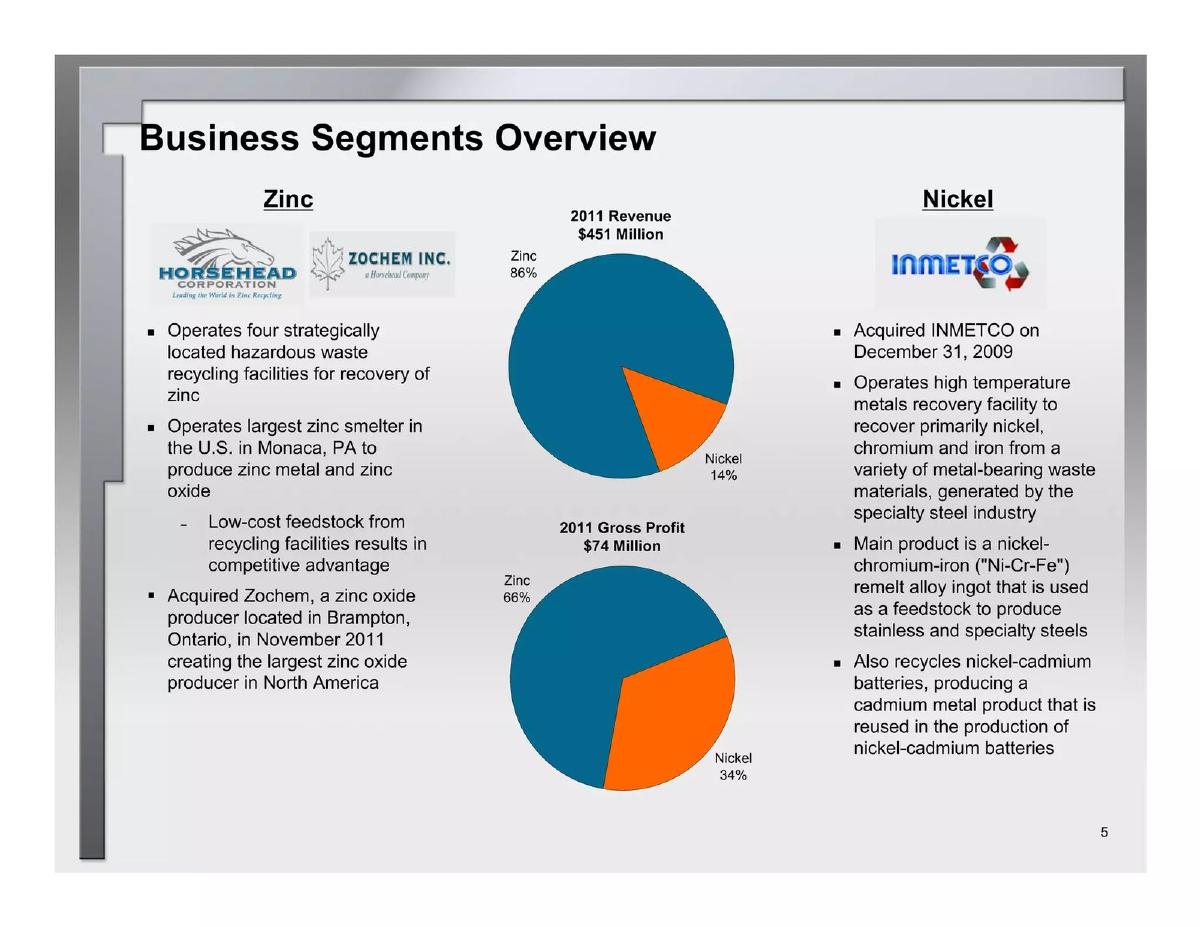
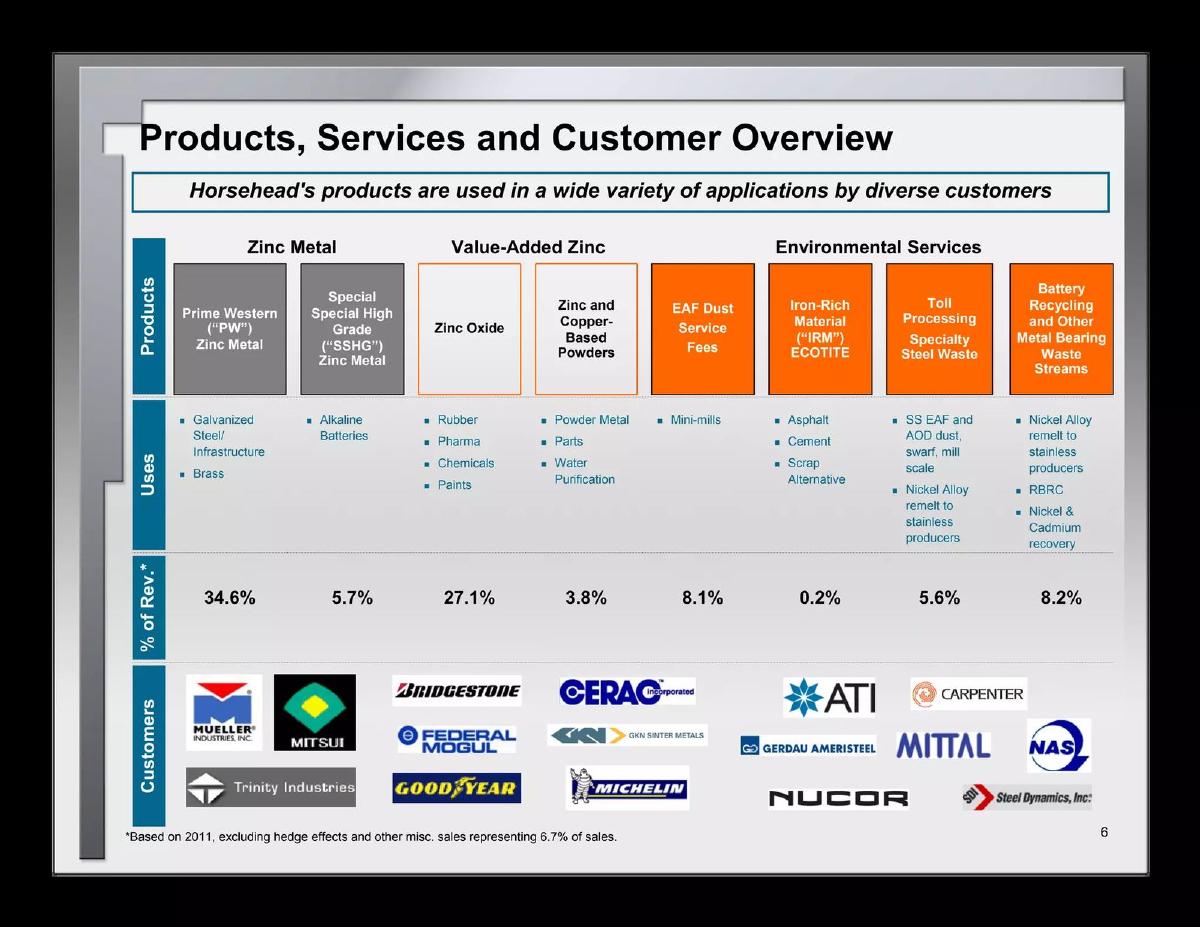
- Horsehead Holding Corp. focuses on zinc recycling and production. They primarily collect Electric Arc Furnace (EAF) dust—a hazardous waste byproduct of the steel-making process—and recycle it to recover zinc. They then process this recovered material into finished products like zinc oxide and various grades of zinc metal for industrial use.
- How does the new technology differ from the company's existing operations?
- The company is moving away from an 80-year-old high-cost electrothermic smelting process. The new technology utilizes solvent extraction (SX) and electro-winning (EW). According to slide 7, this 'green' technology offers lower energy usage, higher labor productivity, and the ability to produce higher-value Special High Grade (SHG) and Continuous Galvanizing Grade (CGG) zinc.
- What are the specific financial benefits of the North Carolina plant?
- The plant is expected to contribute an incremental $90 million to $110 million in annual Adjusted EBITDA. This is driven by a $46-$50 million reduction in manufacturing costs, a $16-$20 million reduction in feed costs, and $23-$35 million in increased revenue from higher-value co-products and premiums.
- Who are the key technology partners for this expansion?
- Horsehead partnered with Tecnicas Reunidas for leaching and solvent extraction technology (the ZINCEX process) and Asturiana de Zinc (a subsidiary of Xstrata) for electrowinning and melting casting technology. These partners are described as world-class providers with market caps of $2.1 billion and $38.2 billion respectively at the time.
- What is the scale of Horsehead's recycling operations?
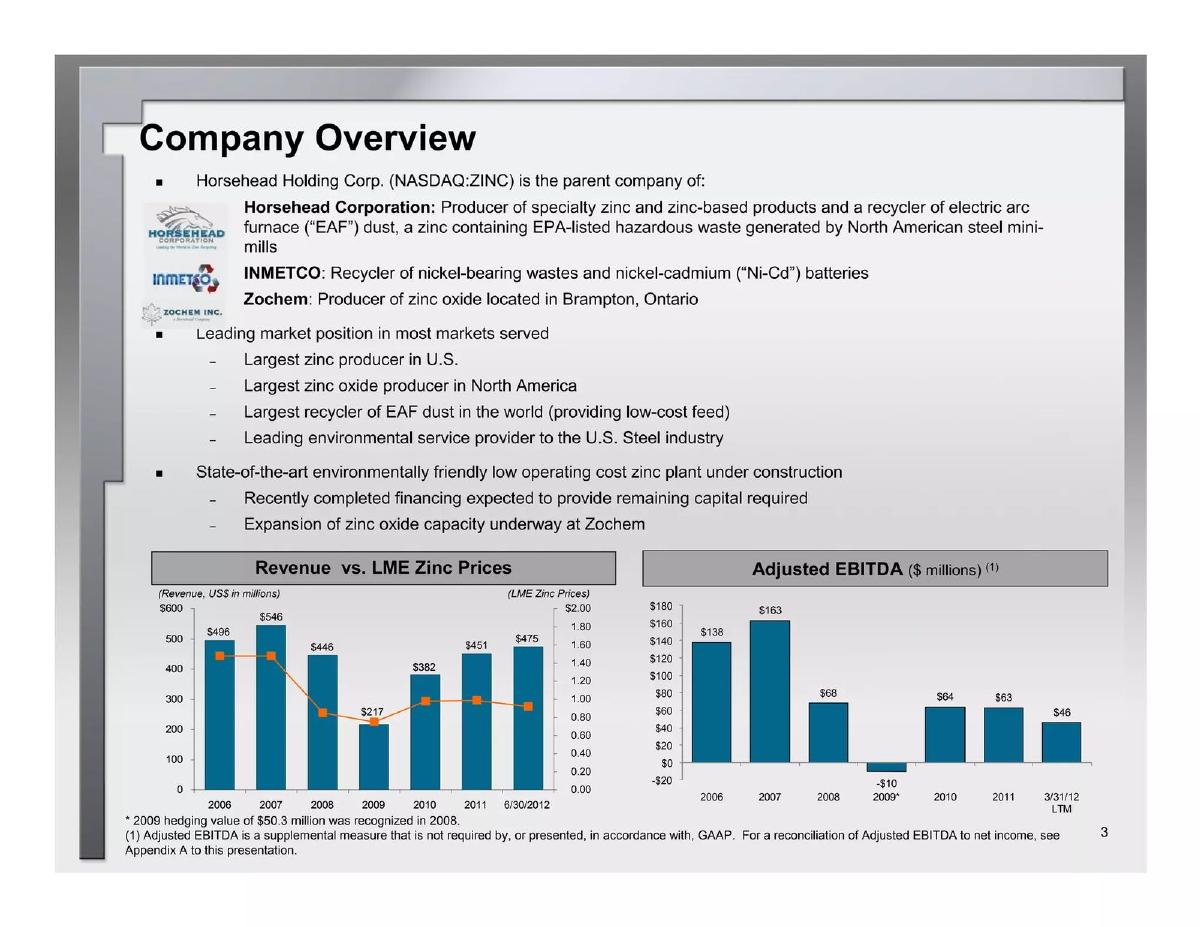
- As of the 2012 deck, the company had an EAF recycling capacity of 770,000 tons and a smelting capacity of 140,000 tons. Their footprint included facilities in Illinois, Pennsylvania, Tennessee, South Carolina, and Ontario, Canada, with a significant new plant under construction in North Carolina.