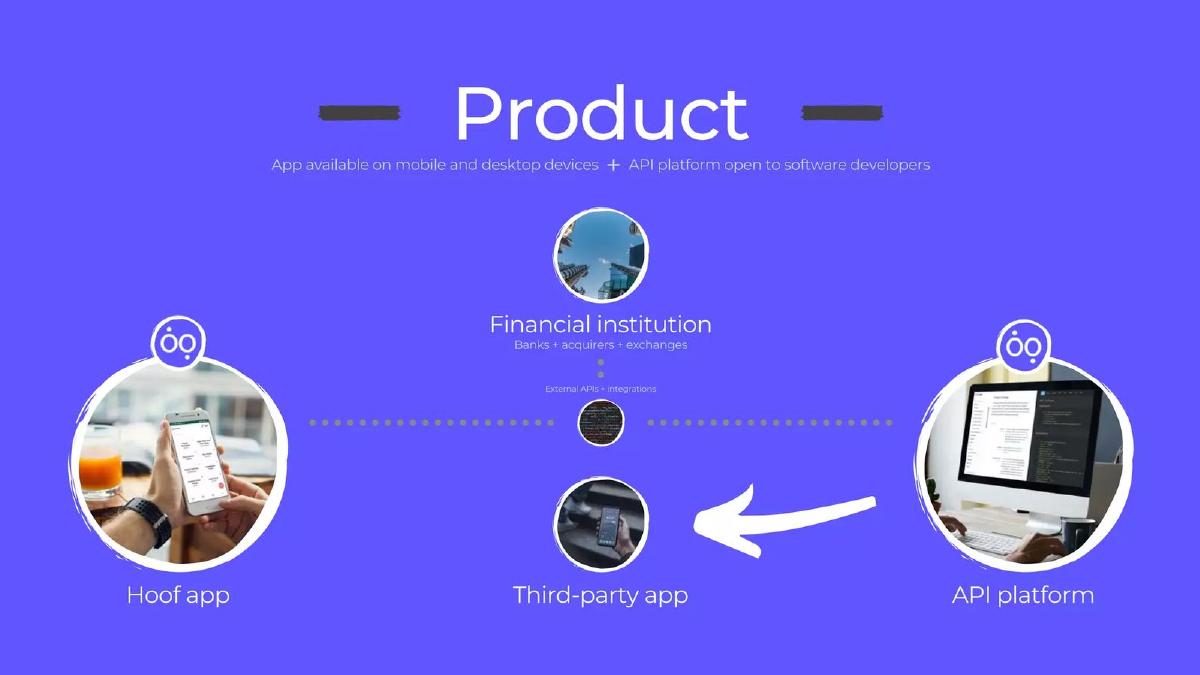
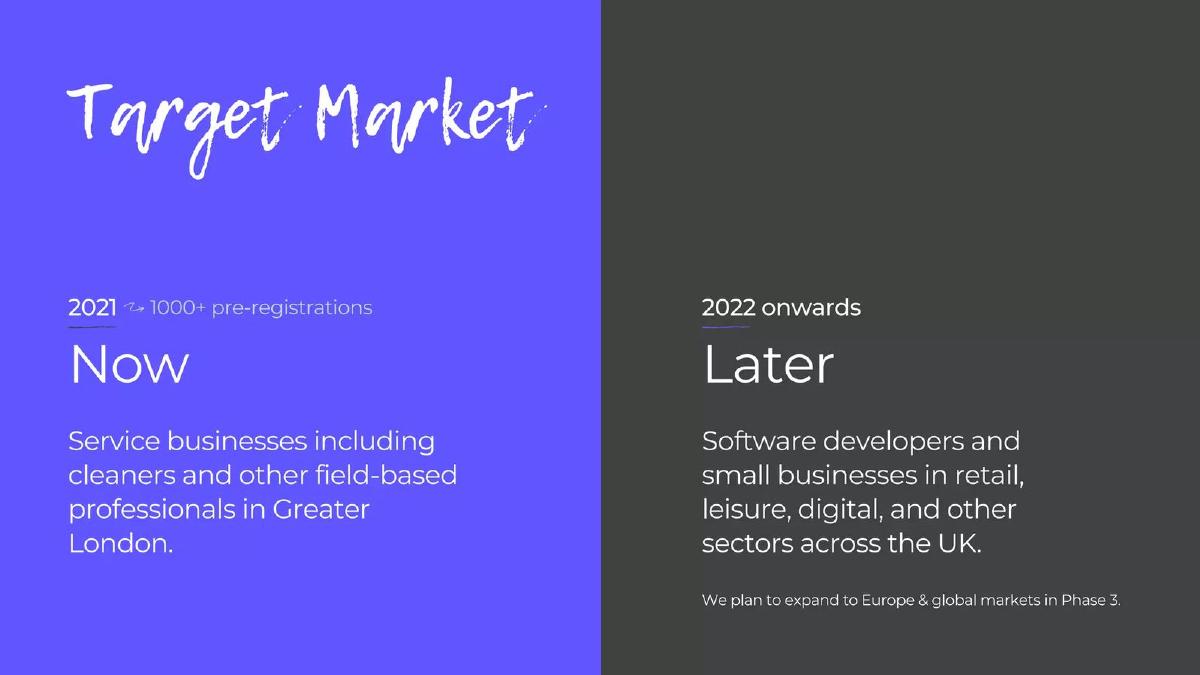
Hoof is a UK-based fintech aiming to provide an omni-channel payment solution for service businesses. The deck outlines a two-phase strategy: an immediate focus on card payments for service businesses, followed by a 'polymorphic' expansion into bank transfers and cryptocurrency. While the deck boasts a strong advisory board including a former Starling Bank director, it relies heavily on a pending FCA Payment Institution license to unlock its full value proposition. The financial ask is specific—£600k immediately—but the deck takes the unusual step of projecting a £149M valuation by year four…
Key takeaways
- The company is seeking an immediate investment of £600K with a projected follow-on requirement of £7.5M (Slide 8).
- Hoof projects a £149M valuation by year four, citing a greater than 8x EV/S multiple in the FinTech sector (Slide 8).
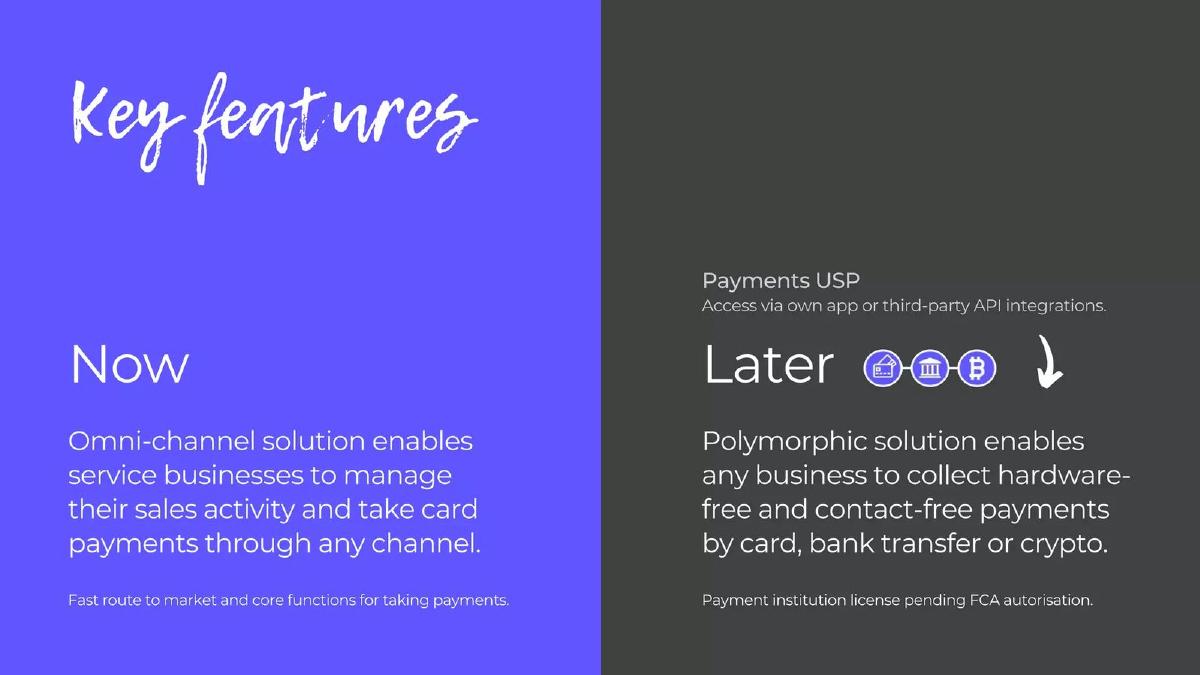
- The core product roadmap is split into 'Now' (omni-channel card payments) and 'Later' (card, bank transfer, and crypto) (Slide 3).
- A critical regulatory hurdle is noted: the Payment Institution license is currently pending FCA authorization (Slide 3).
- The market size analysis identifies a current UK SAM of £103M, scaling to a global TAM of £74B (Slide 4).
- The business model is a hybrid of recurring subscriptions for management tools and transaction fees for processing (Slide 5).
- The team includes a five-person advisory board featuring former executives from Starling Bank and FirstPlus UK (Slide 6).
- Strategic partnerships are already claimed with providers including Paysafe, Handpoint, and Authoripay (Slide 6).
Slide-by-Slide Analysis
Slide 1: Title Slide
The deck opens with a minimalist design featuring the Hoof logo on a solid purple background. The subtitle describes the company as 'A rapidly scalable FinTech investment opportunity.' It includes the URL hoofpay.com. This slide establishes the brand identity but offers no immediate data or specific value proposition beyond the sector classification.
Slide 2: Mission and Purpose
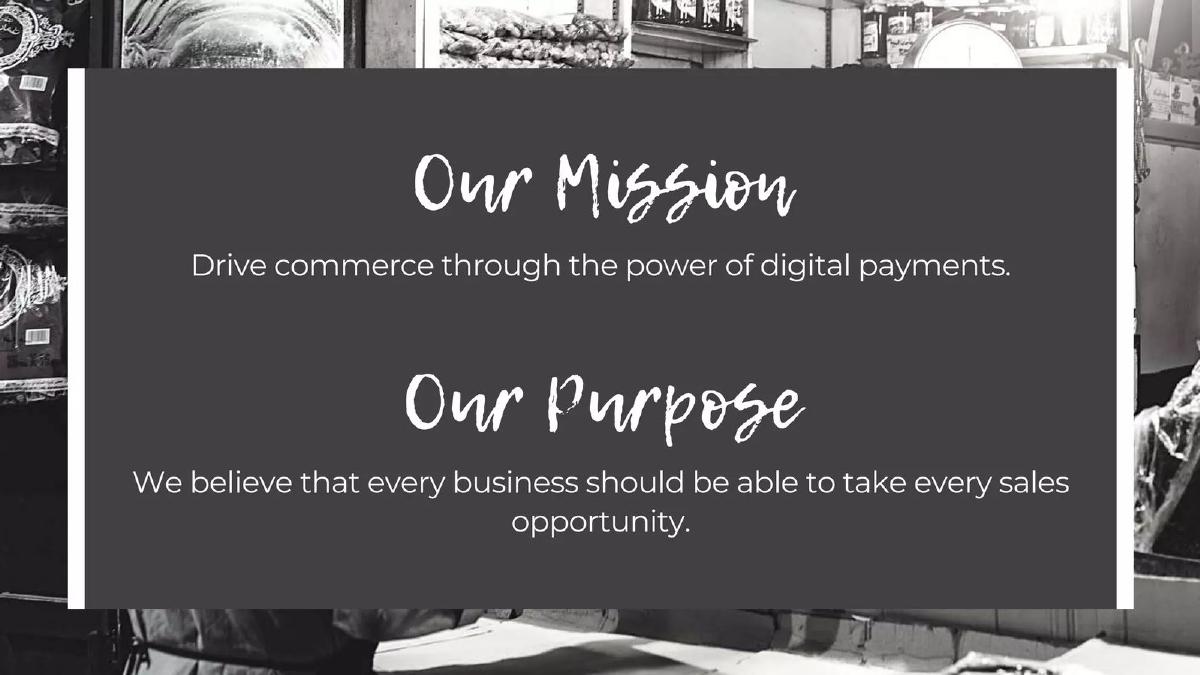
This slide defines the company's North Star. The mission is to 'Drive commerce through the power of digital payments,' while the purpose is stated as 'We believe that every business should be able to take every sales opportunity.' The background image shows a monochrome market stall, likely intended to represent the small businesses Hoof aims to serve. While emotive, it lacks specific technical or market differentiation.
Slide 3: Key Features
Hoof splits its product roadmap into two distinct phases: 'Now' and 'Later.' The 'Now' phase is an omni-channel solution for service businesses to manage sales and take card payments. The 'Later' phase introduces a 'Polymorphic solution' allowing any business to collect hardware-free payments via card, bank transfer, or crypto. A critical disclosure appears at the bottom: 'Payment institution license pending FCA authorisation.' This indicates that the company is currently in a pre-licensed or limited-license state, which restricts the 'Later' features from being deployed immediately.
Slide 4: Market Size
The market analysis uses the standard SAM/TAM framework but adds a temporal element. The 'Now' SAM is valued at £103M in the UK. The 'Later' SAM jumps to £7.1B in the UK, and the global TAM is cited at £74B. A footnote clarifies that 'Global' excludes China and other 'difficult to access' markets. Sources cited include parliament.uk, quora.com, and fsb.org.uk. The jump from £103M to £7.1B represents a massive expansion in target audience that coincides with the 'polymorphic' product launch.
Slide 5: Business Model
This slide explains the revenue streams: subscriptions and transaction fees. A flow diagram shows 'Transactions' entering the Hoof ecosystem, which then splits into 'Payment processing tools' (generating fees) and 'Business management tools' (generating subscriptions). Both feed back into 'Merchant Growth.' The slide includes a screenshot of a dashboard on a laptop, providing a glimpse of the user interface, though the details are too small to audit for specific functionality.
Slide 6: Our Team
The team slide is structured around Strategic Director George Johnson, who is credited with generating £1M revenue at WOWcruise. The 'Advisory Team' is robust, featuring five individuals with significant banking and fintech backgrounds, most notably Iain Cheshire (Starling Bank) and Neil Patrick (FirstPlus UK). The 'Support Team' consists of a Software Architect and a Growth Marketer. The slide also lists 'Strategic partnerships' with Paysafe, Handpoint, EM Bank, Authoripay, and Coax, suggesting a pre-existing infrastructure for payment routing.
Slide 7: The Time is Now
This is a market tailwinds slide. It cites the COVID-19 pandemic as a 'supercharger' for remote digital payment acceptance. It provides two specific growth metrics: a 27.9% CAGR in SaaS (2015-2022) and a 17.6% CAGR in digital payments (2018-2023). Sources are listed as ironpaper.com and ey.com. This slide aims to create urgency by showing that both business adoption and consumer demand are accelerating.
Slide 8: Investment
The final slide in this selection details the financial ask and exit potential. The 'Immediate' ask is £600K. It notes 'Additional rounds' of £7.5M will be required. Most notably, it projects a £149M valuation 'In year 4,' based on an 'EV/S >8x in FinTech.' Sources for these valuation multiples include preferredreturn.com and onstartupexits.com. This is a bold projection for a company still awaiting its primary regulatory license.
What Works
Clear Roadmap Segmentation: By dividing the product and market size into 'Now' and 'Later,' the founders demonstrate an understanding of their current limitations while painting a picture of future scale. This prevents the deck from feeling like it is over-promising on day one.
Strong Advisory Board: For a fintech startup, regulatory and institutional credibility is paramount. Having a former Starling Bank director on the advisory board provides a level of 'institutional comfort' that can help mitigate the risks associated with the pending FCA license.
Specific Revenue Mechanics: The business model slide clearly delineates between SaaS revenue (subscriptions) and FinTech revenue (transaction fees). This 'double-dip' model is highly attractive to investors because it balances stability with volume-based upside.
What is Missing
Unit Economics: While the deck mentions transaction fees and subscriptions, it does not provide the specific price points or the cost of customer acquisition (CAC). Without knowing the take-rate or the churn expectations, it is difficult to validate the £149M valuation projection.
Competitive Landscape: The payments space is incredibly crowded, with incumbents like Stripe, Square, and Adyen, as well as niche players. The deck does not explicitly state how Hoof wins against these giants, other than the mention of a 'polymorphic' solution.
Current Traction: The deck mentions a 'fast route to market' but does not provide current user counts, transaction volume (GTV), or monthly recurring revenue (MRR). It is unclear if the £103M SAM is currently being tapped or if the company is still in the pre-revenue stage.
Founder Takeaways
Be Transparent About Licensing: Hoof correctly identifies that their FCA license is pending. Founders in regulated industries should always be upfront about this, as it is a binary risk factor that will inevitably come out during due diligence.
Use Temporal Market Sizing: Instead of just showing a massive TAM that feels unrealistic, Hoof shows how their market grows as their product evolves. This makes the £74B figure feel like a destination rather than a day-one fantasy.
Leverage Advisory for Credibility: If your core team is small, surrounding yourself with industry veterans (and listing their specific former titles) is a proven way to signal that the 'grown-ups' are in the room, which is particularly important in the UK's strict financial regulatory environment.
Frequently asked questions
- What is the specific funding ask in the Hoof deck?
- Hoof is seeking an 'Immediate' investment of £600,000. The deck also signals a need for 'Additional rounds' totaling £7.5 million to reach its long-term goals. This staged approach suggests the initial capital is intended to bridge the company through its FCA licensing phase and initial UK market entry before scaling globally.
- How does Hoof plan to make money?
- The revenue model is two-fold. According to Slide 5, they generate income through 'subscriptions' for their business management tools and 'payment transaction fees' for their processing tools. This creates a mix of predictable recurring revenue and usage-based upside, a common structure for B2B payments platforms targeting small-to-medium service businesses.
- What is the 'polymorphic' solution mentioned in the deck?
- Hoof uses the term 'polymorphic' to describe their future-state product that enables businesses to collect payments via card, bank transfer, or cryptocurrency without specialized hardware. This is positioned as their 'Later' phase, intended to expand their reach from service businesses to 'any business' globally, significantly increasing their Total Available Market.
- Who are the key people involved in the project?
- The team is led by Strategic Director George Johnson, who previously founded WOWcruise. The deck emphasizes a heavy advisory presence, including Iain Cheshire (former Director at Starling Bank) and Neil Patrick (former COO at FirstPlus UK). The technical execution is led by Software Architect David Roberts and Growth Marketer Warren Coles.
- What are the primary risks identified in the slides?
- The most prominent risk is regulatory; Slide 3 explicitly states that their Payment Institution license is 'pending FCA authorisation.' Without this, the 'Later' phase of their product roadmap cannot be fully realized. Additionally, the deck relies on aggressive market growth assumptions, citing a 27.9% CAGR in SaaS and a 17.6% CAGR in digital payments.