Hometalk’s 21-slide Series A deck focuses heavily on traction and audience composition rather than complex financial modeling. The company positions itself as a community-driven marketplace for the $100B home improvement industry, addressing the 'daunting' nature of DIY projects. The deck is notable for its transparency regarding social media reach, citing 12 million Facebook followers and 52 million average monthly reach on Pinterest. While it lacks a specific financial 'ask' or detailed unit economics, it compensates with granular engagement data, including a user retention curve and detail…
Key takeaways
- The company identifies the home improvement industry as a $100B market where the home is the largest single investment for most people (Slide 2).
- Hometalk reports significant scale with 9M monthly uniques, 17M total members, and 2.5B annual project views (Slide 7).
- Social media is a primary driver of their ecosystem, boasting 12M Facebook followers and 1B total views (Slide 9).
- The platform's audience is highly concentrated, with 89% of users being female and 85.9% based in the USA (Slides 12 and 13).
- Engagement depth is strong, with an average of over 2 minutes and 30 seconds per visit and 2.8 page views per visit (Slide 17).
- The deck includes a rare look at a long-term retention curve, showing that roughly 15% of users remain active 9 months after signing up (Slide 19).
- Future monetization plans involve e-commerce for tools, interactive workshops, and a professional services marketplace (Slide 20).
- The deck omits a specific funding amount or 'ask' slide, focusing instead on the business's operational momentum.
Introduction: The Community-First Marketplace
Hometalk’s Series A pitch deck is a fascinating example of a company that has built a massive audience before fully turning on the monetization engine. In the world of marketplaces, the 'chicken and egg' problem is usually solved by spending heavily on performance marketing. Hometalk took a different route: building a content community that generates billions of views, then planning to layer commerce on top. This teardown examines the 21 slides that helped secure $15M in funding.
The Problem and Vision (Slides 1-5)
Slide 1: Title The deck opens with a clean, brand-forward cover. The tagline, "Empowering every person to create the home they love," sets a mission-driven tone. The visual of a paintbrush suggests the DIY nature of the platform immediately.
Slide 2: Market Opportunity Hometalk identifies the home improvement industry as a "$100B market." They use four bullet points to establish the emotional and financial stakes: the home is the largest investment, people spend most of their time there, and almost everyone has something they want to improve. This is a standard but effective way to establish a high Total Addressable Market (TAM).
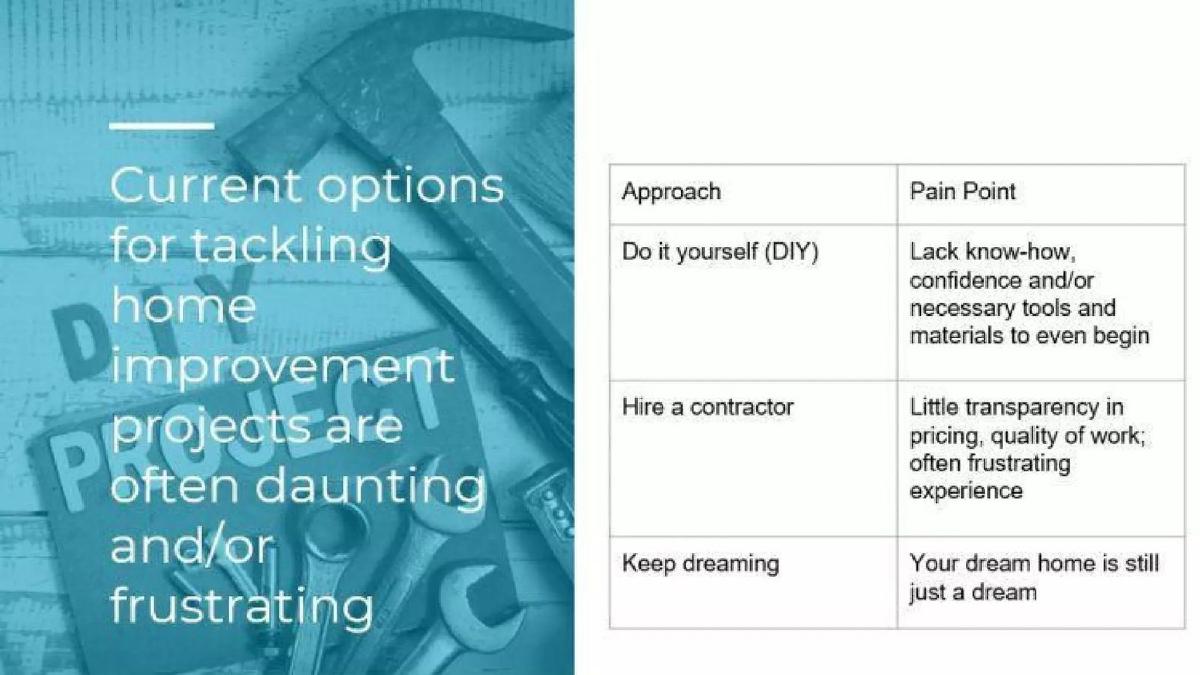
Slide 3: The Pain Points This slide uses a simple table to categorize the current options for homeowners. They list "Do it yourself (DIY)" with the pain point of lacking know-how, "Hire a contractor" with the pain point of pricing transparency, and "Keep dreaming" as the default failure state. It effectively frames the current market as "daunting and/or frustrating."
Slide 4: The Mission Statement A simple text slide defines Hometalk.com as a "community that strives to provide people with a marketplace of resources to tackle home improvement projects with confidence, clarity and excitement." It is a bridge between the problem and the solution.
Slide 5: Resources This slide breaks down what the platform actually offers: instructional digital content, discussion forums, and access to tools. It’s the first hint at the product’s multi-faceted nature—part media site, part social network, part utility.
The Traction: Massive Scale (Slides 6-11)
Slide 6: Key Stats Intro A transition slide that prepares the investor for a data dump. The use of a simple bar chart icon is consistent with the deck's minimalist aesthetic.
Slide 7: The Hometalk Community This is the 'wow' slide of the deck. Hometalk lists 9M Monthly Uniques, 17M Total Members, 140K Project Tutorials, 10M Social Media Followers, and 2.5B Annual Project Views. These numbers are massive for a Series A company and prove that the content is resonating at scale.
Slide 8: Site Analytics The deck goes deeper into the funnel here. 90M Monthly pageviews and 40K monthly new sign-ups show healthy organic growth. Interestingly, they highlight 2.4M Daily newsletter subscribers and 1.2M Messenger subscribers, indicating they have multiple direct-to-consumer channels that don't rely on third-party algorithms.
Slide 9: Facebook Stats Hometalk leans heavily into its social proof. They cite 12M Facebook followers and 1B total views. This confirms that they have mastered the art of viral video and social distribution, which is a key moat in the digital content space.
Slide 10: Pinterest Stats For a home improvement brand, Pinterest is arguably more important than Facebook. Hometalk shows 1.7M Page follows and a staggering 52M average monthly reach. They also mention "53 Active influencers," suggesting a nascent creator program.
Slide 11: Audience Intro Another transition slide, moving from 'how many' people are using the platform to 'who' they are.
Audience Demographics and Engagement (Slides 12-19)
Slide 12: Hometalk.com Audience (Gender & Age) The data here is striking: 89% of the audience is female. The age groups skew older, with 50% of the audience being over the age of 55. This is a critical insight—Hometalk has captured a demographic that has significant disposable income and time, but is often ignored by tech startups.
Slide 13: Hometalk.com Audience (Geo) The platform is highly concentrated in the USA (85.9%), followed by Canada (5.1%) and Australia (1.0%). This geographic focus is a positive for advertisers and potential marketplace partners looking for a specific regional footprint.
Slide 14 & 15: Social (Facebook) Audience These slides mirror the site analytics but for their Facebook following. The Facebook audience is slightly more male (24% vs 11%) and slightly younger, but still follows the core trend of being female-dominated and US-based (72%).
Slide 16: Engagement Intro A transition slide focusing on how the audience interacts with the platform.
Slide 17: Engagement on Hometalk The metrics here are strong: 2 min 30 sec per visit and 2.8 page views per visit. With 550K daily active users (DAU), the platform has significant daily utility, not just occasional 'search and leave' traffic.
Slide 18: Engagement on Facebook Per day, they see 23K post engagements and 1.1M video views. This slide reinforces the idea that Hometalk is a daily habit for a large portion of its social following.
Slide 19: User Retention This is one of the most important slides in the deck. It shows a retention curve over 9 months. While there is a steep drop-off after month 1 (common for content sites), the curve flattens out at around 15-18% from month 6 to month 9. A flat retention curve is the 'holy grail' for investors as it proves the product has a core group of power users.
Future Strategy and Team (Slides 20-21)
Slide 20: What's Next for the Business? This is the 'Marketplace' slide. Hometalk plans to leverage its position to sell tools and materials via e-commerce, launch interactive group workshops, and provide a services marketplace for professional contractors. They also mention international expansion through local languages. This slide explains how they will turn their 9M monthly uniques into a high-revenue business.
Slide 21: Our Team The deck concludes with a team slide featuring six individuals, including Co-Founder/CEO Yaron Ben Shaul and Co-Founder/CMO Miriam Illions. While the photos are clear, the slide lacks professional history, previous exits, or academic credentials. In a Series A deck, investors usually look for more 'pedigree' markers here.
What Works in This Deck
The Scale of Data: Hometalk doesn't just say they are big; they prove it across multiple platforms (Site, Facebook, Pinterest, Email). The 2.5B annual views is a number that is hard for an investor to ignore. · Demographic Clarity: By being honest about their 89% female audience, they carve out a clear niche. They aren't trying to be 'everything to everyone'; they are the leader for a specific, high-value segment. · Retention Transparency: Including a retention curve (Slide 19) is a bold move that builds trust. It shows the founders understand that 'uniques' are a vanity metric if they don't eventually turn into 'retained users.' · Visual Consistency: The deck uses a consistent color palette (teal and white) and high-quality background images that relate to the home improvement theme without being distracting.
What Is Missing from This Deck
The 'Ask': There is no slide stating how much money they are raising, what the valuation is, or what the specific milestones for the next 18 months are. · Financials: There is zero mention of current revenue. Even if they are pre-revenue in their marketplace model, they likely have ad revenue that should be disclosed. · Unit Economics: We don't see the cost to acquire a member (CAC) versus the value of that member. For a community-driven site, showing that organic growth keeps CAC low is a major selling point. · Competitive Landscape: There is no mention of Houzz, Pinterest (as a competitor), or traditional media players like HGTV. Investors want to know how Hometalk defends its territory. · Team Bios: The team slide is too thin. Investors at the Series A level are betting on the people as much as the numbers.
What a Founder Should Copy
Multi-Channel Traction: If your business relies on social media, don't just show 'followers.' Show 'reach,' 'views,' and 'engagement' across every platform you inhabit. · The Retention Curve: If you have a 'sticky' product, show the curve. It is the most effective way to prove product-market fit. · The 'Problem' Table: Slide 3 is a great way to simplify a complex competitive landscape into a few digestible pain points. · Demographic Deep-Dives: Showing exactly who your user is (age, gender, geo) makes your business feel 'real' and helps investors visualize the eventual monetization strategy.
Frequently asked questions
- What is Hometalk's primary business model according to the deck?
- While the deck focuses on community and content, Slide 20 outlines a transition toward a marketplace model. This includes e-commerce solutions for tools and materials, interactive group workshops, and a services marketplace to connect users with professional contractors. Currently, the platform appears to be a content-driven community that monetizes through its massive reach and engagement.
- How does Hometalk define its competitive advantage?
- Hometalk positions itself as the solution to the 'daunting and frustrating' nature of home improvement (Slide 3). By providing 140K project tutorials and a community for advice (Slide 7), they lower the barrier to entry for DIYers who lack know-how or confidence. Their advantage lies in their massive, proprietary audience and high-intent content library.
- What do the demographic slides reveal about their target market?
- The audience is overwhelmingly female (89%) and older, with the largest age cohorts being 55-64 (27%) and 65+ (23%) (Slide 12). This suggests a specific niche within the broader home improvement market that is often underserved by traditional, male-centric hardware marketing.
- Is there any information on revenue or unit economics?
- No. The deck is entirely focused on 'vanity' and engagement metrics like pageviews, followers, and sign-ups. There is no mention of Revenue, CAC (Customer Acquisition Cost), LTV (Lifetime Value), or burn rate. This is common for high-growth community platforms in early Series A rounds where the focus is on capturing the market first.
- What is the significance of the Pinterest data in this deck?
- Pinterest is a critical acquisition channel for Hometalk, with 52M average monthly reach and 2M monthly visits originating from the platform (Slide 10). This highlights Hometalk's ability to create 'viral' visual content that aligns perfectly with the demographics of Pinterest users.