HomeRoots positions itself as a 'B2B2C Selling Platform' for the home furnishings industry, aiming to solve the fragmentation manufacturers face when selling across multiple retail channels. The deck highlights a transition from a pure transaction-based model—where they take a 20% cut—to a SaaS model with MRR ranging from $25 to $1200. While the company boasts authorized vendor status with major retailers like Amazon, Walmart, and Wayfair, the deck relies heavily on future projections, including a leap from $9.2M in 2024 GMV to $80M by 2026. The narrative is anchored by a strategic partnershi…
Key takeaways
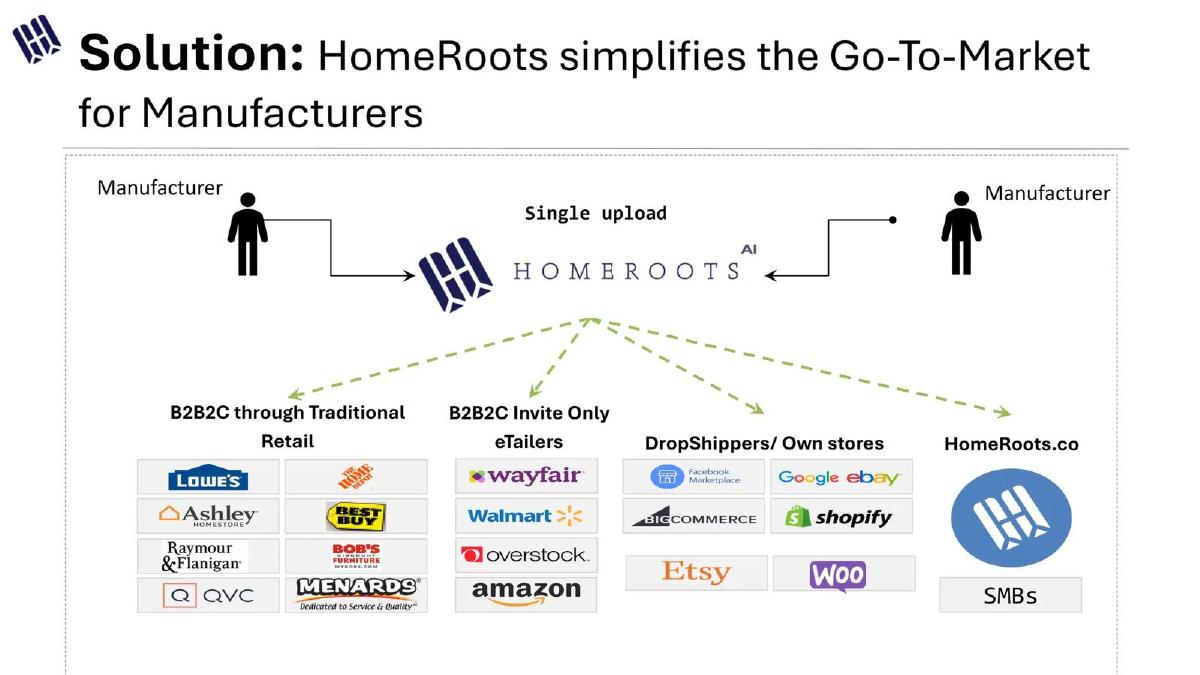
- The platform utilizes a 'single upload' AI-driven system to distribute manufacturer products across traditional retail, eTailers, and drop-shippers (Slide 2).
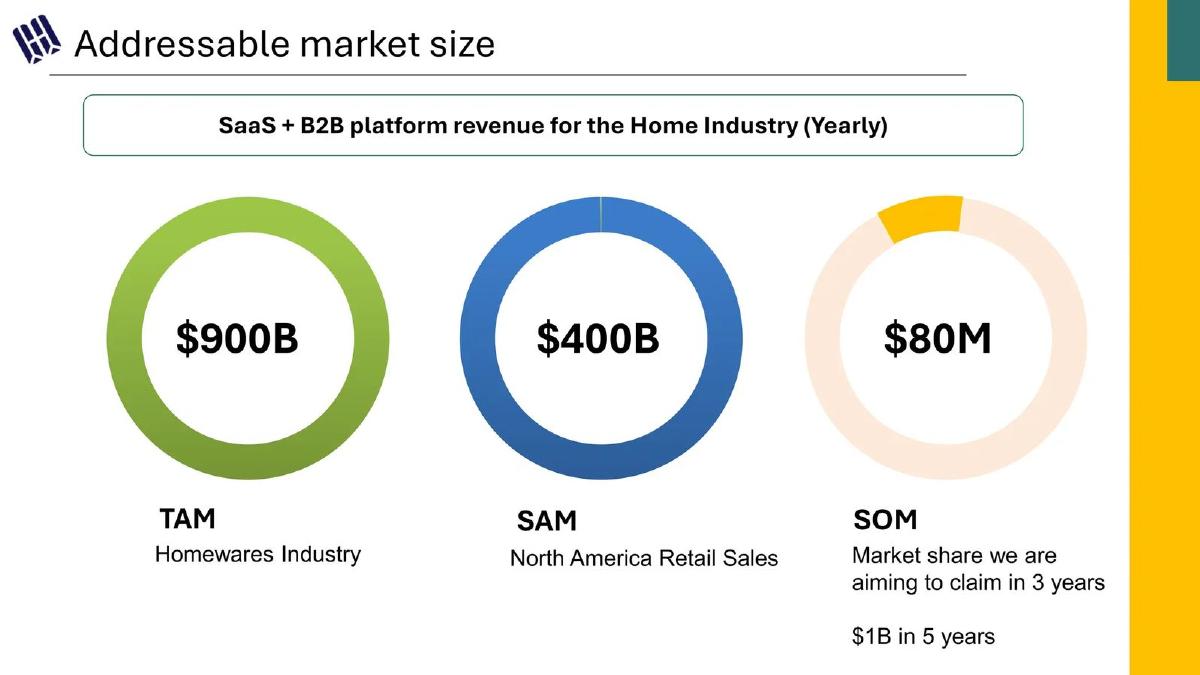
- HomeRoots defines its TAM as a $900B Homewares Industry, with a goal to claim $1B in market share within five years (Slide 3).
- The company is currently an authorized vendor for major players including Amazon, Walmart, Wayfair, and Lowe's (Slide 4).
- Revenue model is shifting from a 20% take rate on orders to a SaaS model with monthly recurring revenue between $25 and $1,200 (Slide 5).
- Financial projections show a transition from a $0.4M net loss in 2023 to a projected $17M net income by 2026 (Slide 5).
- A core growth pillar is becoming Wayfair's 'preferred Content Partner,' which they project will yield $400K per month in revenue (Slide 6).
- The deck is missing a dedicated team slide, detailed unit economics, a competitive landscape, and a specific investment ask (General Observation).
HomeRoots Pitch Deck Analysis
HomeRoots presents itself as a central nervous system for the home furnishings supply chain. The deck, dated June 2024, focuses on the transition from a service-heavy B2B2C marketplace to a scalable SaaS platform. While the visual presentation is clean, the content leans heavily on logo-dropping and ambitious financial forecasting without providing the underlying operational data to support those leaps.
Slide 1: Title Slide
The cover slide introduces HomeRoots as "The gateway to the market" and a "B2B2C Selling Platform for everything home." It identifies Gil Bar-Lev as the CEO and provides direct contact information. The branding is professional, using a minimalist aesthetic that fits the home furnishings sector. The subtitle immediately establishes the company's value proposition: acting as a bridge between manufacturers and the end consumer via various retail channels.
Slide 2: The Solution
Slide 2 illustrates the platform's mechanics. It shows a "Manufacturer" performing a "Single upload" into the HomeRoots AI platform. From there, the product data is distributed to four distinct categories: Traditional Retail (Lowe's, Home Depot, Best Buy), Invite Only eTailers (Wayfair, Walmart, Amazon), DropShippers/Own stores (Facebook, eBay, Shopify), and HomeRoots.co (serving SMBs). This slide effectively communicates the "hub and spoke" model, suggesting that HomeRoots handles the heavy lifting of channel-specific formatting and integration.
Slide 3: Addressable Market Size
The market slide uses the standard TAM/SAM/SOM framework. They cite a $900B TAM for the Homewares Industry and a $400B SAM for North America Retail Sales. The SOM is listed as $80M , which they aim to claim in 3 years, with a long-term goal of $1B in 5 years . While the $900B figure is a standard industry-wide stat, the jump from an $80M target to a $1B target in just two additional years (years 4 and 5) represents an extremely steep growth curve that usually requires significant capital or a viral network effect.
Slide 4: Traction and Integrations
This is a "logo slide" intended to build credibility. HomeRoots lists itself as an "Authorized Vendor" for heavyweights like Amazon, Walmart, Wayfair, Overstock, Lowe's, QVC, and Home Depot. Below this, they list companies they are currently integrating with, including Menards, Boscov's, and platforms like Shopify and WooCommerce. The distinction between "Authorized" and "In the middle of Integration" is an important piece of honesty that helps investors understand the current state of the product's reach.
Slide 5: Business Plan and Financials
Slide 5 details the revenue model and projections. The company currently takes a 20% take rate on every order. They are expanding into a SaaS model with $25-$1200 MRR . The bar chart shows Top line sales/GMV and Net Income from 2023 to 2026. In 2023, they report $5.2M GMV with a $0.4M loss. By 2026, they project $80M GMV and $17M Net Income . The jump in Net Income from $1.5M in 2025 to $17M in 2026 suggests they expect the SaaS revenue to have extremely high margins or that their operational costs will remain flat while volume triples.
Slide 6: Go-To-Market with Wayfair
This slide focuses on a specific strategic partnership. HomeRoots claims they are "about to be Wayfair’s preferred Content Partner." They attribute this to being among the fastest-growing suppliers and having "CEO visibility and endorsement." The slide sets a specific milestone: $400K a month in revenue by year-end . This slide is crucial because it provides a tangible near-term catalyst for the growth projected in the previous slide, though the phrase "about to be" indicates this is still a pending milestone.
Slide 7: Closing Slide
The deck ends with a "Thank you" slide featuring lifestyle imagery of home furnishings and repeating the CEO's contact information. It maintains the visual theme but lacks a final "Call to Action" or a summary of the investment opportunity.
What Works in This Deck
Clear Value Proposition: The "Single Upload" diagram on Slide 2 is the strongest part of the deck. It immediately explains what the software does and why a manufacturer would want it. · Strong Logo Traction: Being an authorized vendor for Amazon, Walmart, and Home Depot is a significant hurdle. Listing these logos provides immediate validation that the platform is functional and trusted by major retailers. · Specific Strategic Focus: Dedicating a slide to the Wayfair partnership (Slide 6) shows that the company has a clear path to its next revenue milestone rather than just "hoping" for general growth.
What Is Missing
The Team: Aside from the CEO, there is no mention of the founding team, advisors, or engineering talent. In early-stage investing, the team is often as important as the product. · The Ask: The deck never states how much money they are raising, the valuation, or what the funds will be used for (e.g., hiring, marketing, R&D). · Competitive Landscape: There are many feed management and B2B marketplace tools (e.g., ChannelAdvisor, CommerceHub). HomeRoots does not explain how they differ from these established players. · Unit Economics: While they mention a 20% take rate, they don't show Customer Acquisition Cost (CAC) or Lifetime Value (LTV), which are critical for evaluating a SaaS pivot. · Technology Depth: The word "AI" is used on Slide 2, but there is no explanation of what the AI actually does. Does it write product descriptions? Optimize pricing? Manage inventory?
Founder Takeaways
Focus on the Pivot: If you are moving from a transaction model to a SaaS model, you must explain why . HomeRoots does this implicitly by showing the MRR range, but they could have strengthened the case by showing how SaaS improves their margins and customer retention.
Be Wary of "Hockey Stick" Projections: Projecting a jump from $1.5M to $17M in net income in a single year (Slide 5) will trigger skepticism from seasoned analysts. If you show these numbers, you need a "bridge" slide that explains exactly which new revenue streams or cost savings make that leap possible.
Leverage Partnerships: The Wayfair slide is a great example of how to use a single high-profile partnership to anchor a growth story. It makes the abstract "market size" numbers feel more attainable.
Include the Basics: Never omit a team slide or a funding ask. Even if you are just "testing the waters," providing these details shows that you are ready for a professional transaction.
Frequently asked questions
- What is the primary problem HomeRoots is solving?
- HomeRoots addresses the complexity manufacturers face when trying to sell across diverse retail channels. According to Slide 2, they provide a 'single upload' gateway that connects manufacturers to traditional retail (Lowe's, Home Depot), eTailers (Wayfair, Amazon), and social/independent platforms (Facebook Marketplace, Shopify). This reduces the technical and operational friction of managing multiple integrations.
- How does HomeRoots generate revenue?
- The company uses a hybrid model. Slide 5 states they take a 20% commission on every order processed through the platform. Additionally, they are expanding into a SaaS model with subscriptions ranging from $25 to $1,200 MRR. This shift suggests a move toward more predictable, high-margin revenue compared to pure transaction fees.
- What is the current traction of the company?
- HomeRoots claims to be an authorized vendor for several Tier-1 retailers, including Amazon, Walmart, Wayfair, Overstock, Lowe's, and Home Depot. Slide 4 also notes they are in the 'middle of integration' with Raymour & Flanigan, Menards, Boscov's, Shopify, and WooCommerce, indicating an active expansion of their distribution network.
- Are the financial projections realistic based on the deck?
- The projections are highly aggressive. Slide 5 shows GMV growing from $9.2M in 2024 to $80M in 2026—a nearly 9x increase in two years. During that same period, they project moving from a $0.1M net income to $17M. Achieving a 21% net income margin on GMV while scaling that rapidly is a significant execution challenge that the deck does not fully explain.
- What information is missing from this pitch deck?
- The deck lacks several critical components for a professional fundraise: a team slide (only the CEO is named), a competitive analysis (who else provides multi-channel sync?), a clear breakdown of how the 'AI' works, and most importantly, a 'The Ask' slide detailing how much capital they are raising and how it will be spent.