Holly Health’s seed deck is a masterclass in balancing clinical credibility with consumer-friendly branding. Seeking £1.2 million to scale their AI coaching app, the company addresses the £50 billion annual cost of chronic disease in the UK. The deck highlights impressive early traction, including over 12,000 downloads and a 6-month retention rate of 13%, which they claim is significantly higher than market benchmarks. By positioning themselves as a low-cost (£1 per person/month for B2B) alternative to expensive, non-scalable human coaching, Holly Health targets a massive 'unhealthy' populati…
Key takeaways
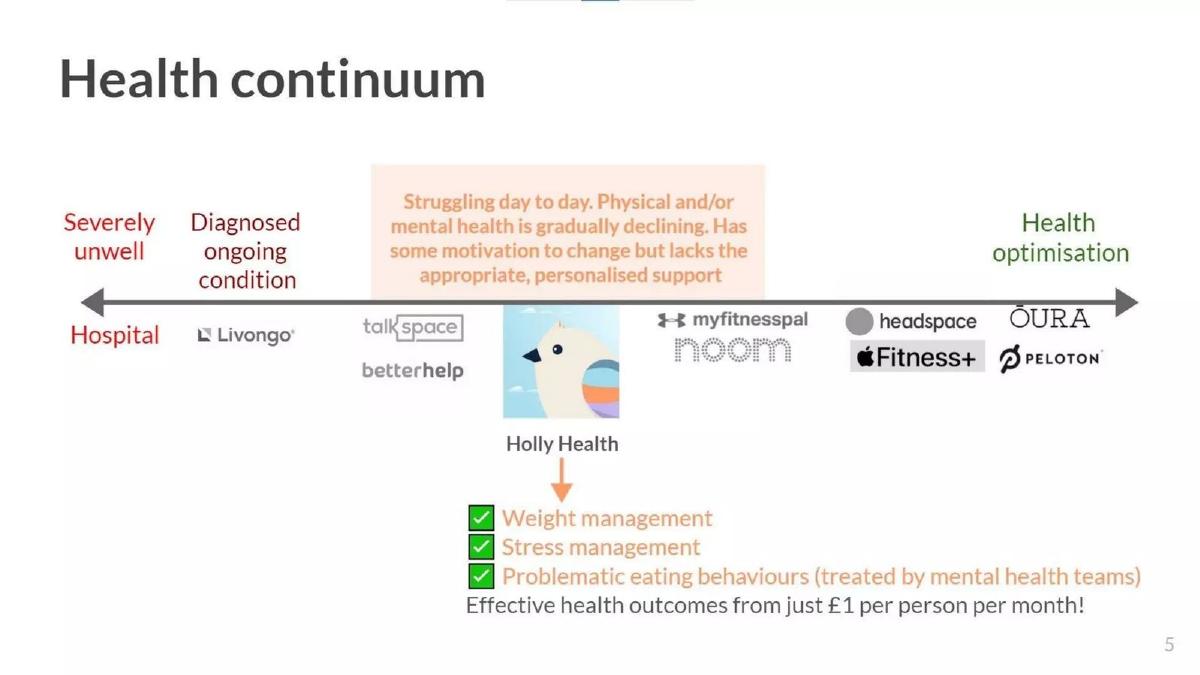
- The company identifies a massive gap in the 'health continuum' between fitness apps like Peloton and clinical solutions like Livongo (Slide 5).
- Holly Health reports a 6-month retention rate of 13%, which is noted as very high for a fully digital service (Slide 11).
- The business model focuses on B2B2C licensing, offering services from just £1 per person per month to healthcare providers (Slide 14).
- Traction includes 3 live NHS pilots with plans to scale to 20 by summer 2022 (Slide 14).
- The team is highly specialized, featuring a CEO with two startup exits and a CPO with a PhD in Neuroscience (Slide 7).
- Revenue targets are aggressive, aiming to grow from £300k in 2022 to £14 million ARR by 2025 (Slide 15).
- The funding ask of £1.2 million is supplemented by a £440,000 non-dilutive government grant (Slide 16).
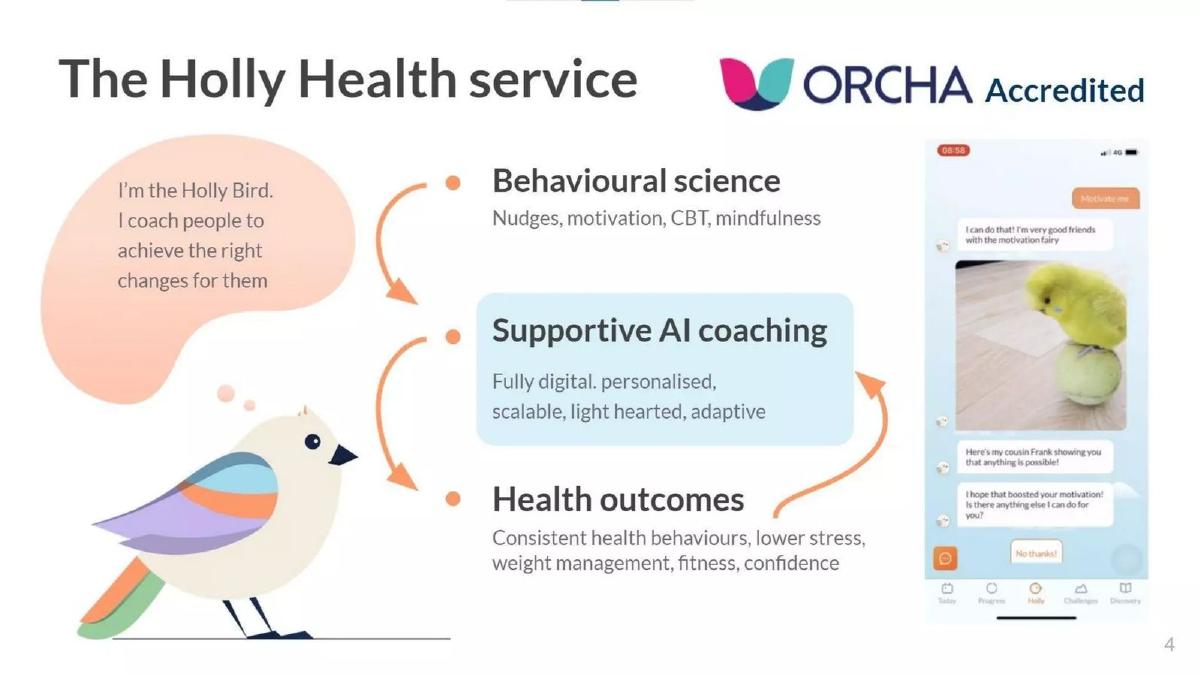
- The product is ORCHA accredited, providing a critical medical validation for digital health tools (Slide 4).
Executive Summary: The Habit Change Gap
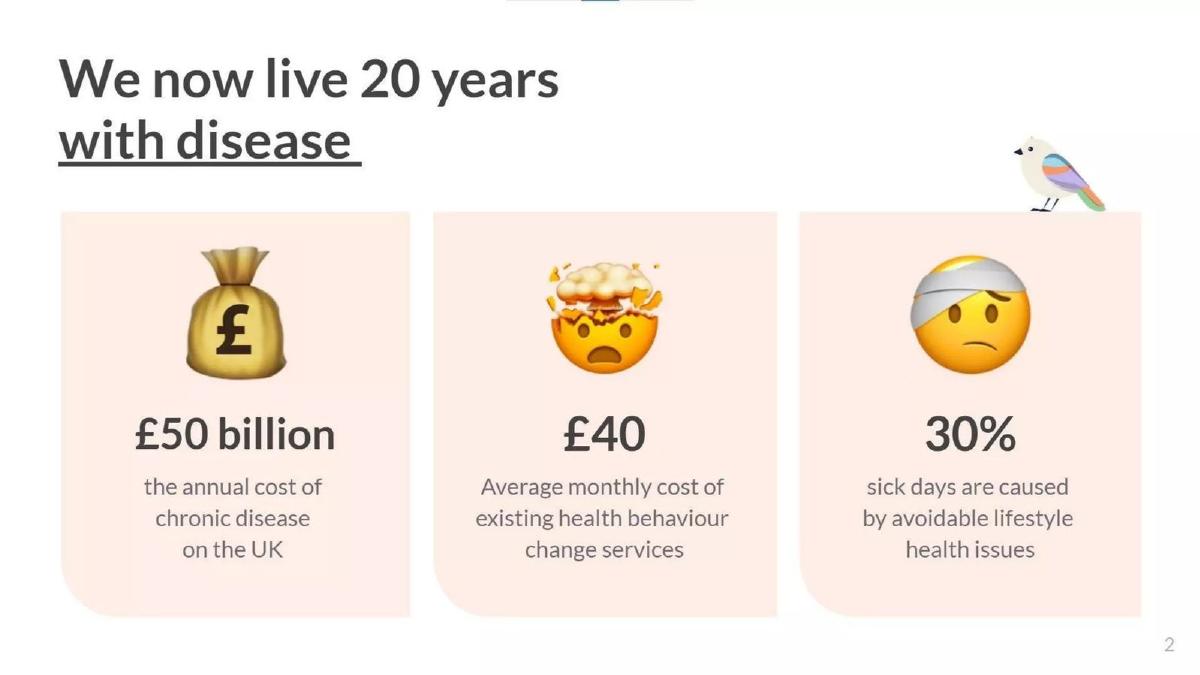
Holly Health addresses a fundamental failure in modern healthcare: the inability to scale behavioral change. While chronic diseases cost the UK £50 billion annually (Slide 2), existing solutions are either too expensive (£40/month for human coaching) or too generic. Holly Health positions itself as the 'missing middle,' providing AI-driven, personalized coaching that is 'infinitely scalable.' This teardown examines their 23-slide seed deck used to raise £1.2 million in 2020/2021.
Slides 1-3: The Problem and the 'Burnout' Context
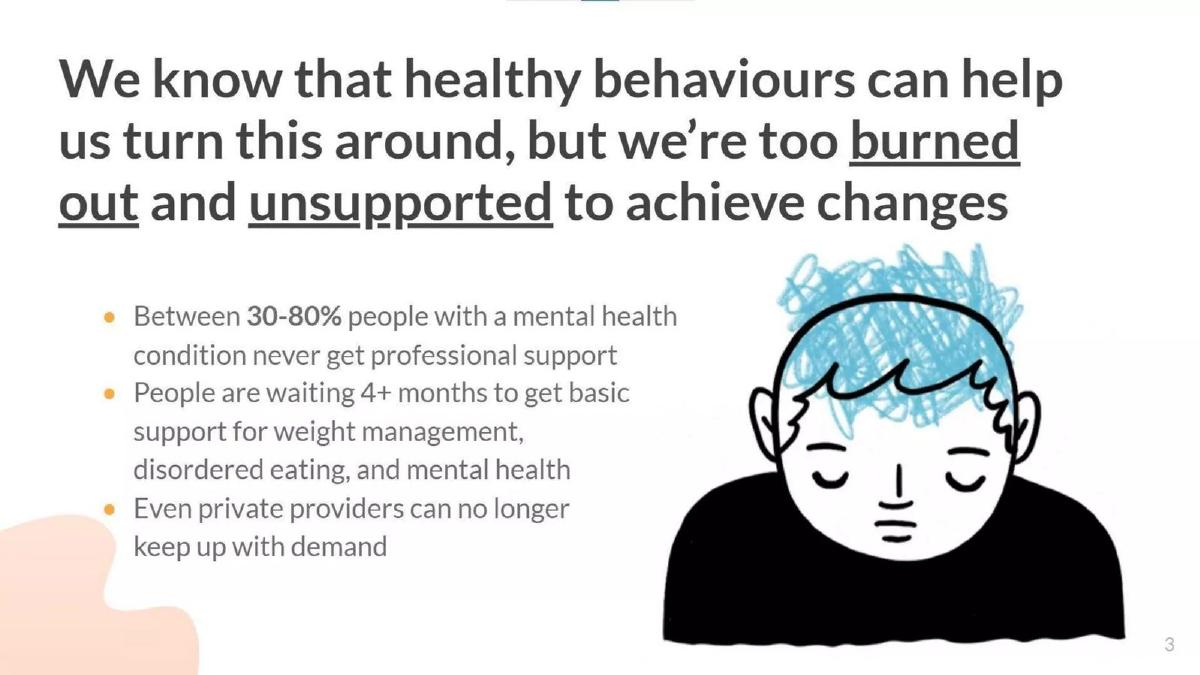
The deck opens with a clear value proposition: an intelligent coaching app to turn intentions into daily actions. Slide 2 uses stark figures to establish urgency, noting that people now live 20 years with disease and that 30% of sick days are caused by avoidable lifestyle issues. Slide 3 introduces a psychological layer to the problem—burnout. It notes that 30-80% of people with mental health conditions never receive professional support and wait times for weight management exceed 4 months. This framing moves the solution from 'nice-to-have fitness' to 'essential healthcare infrastructure.'
Slides 4-6: The Solution and Market Positioning
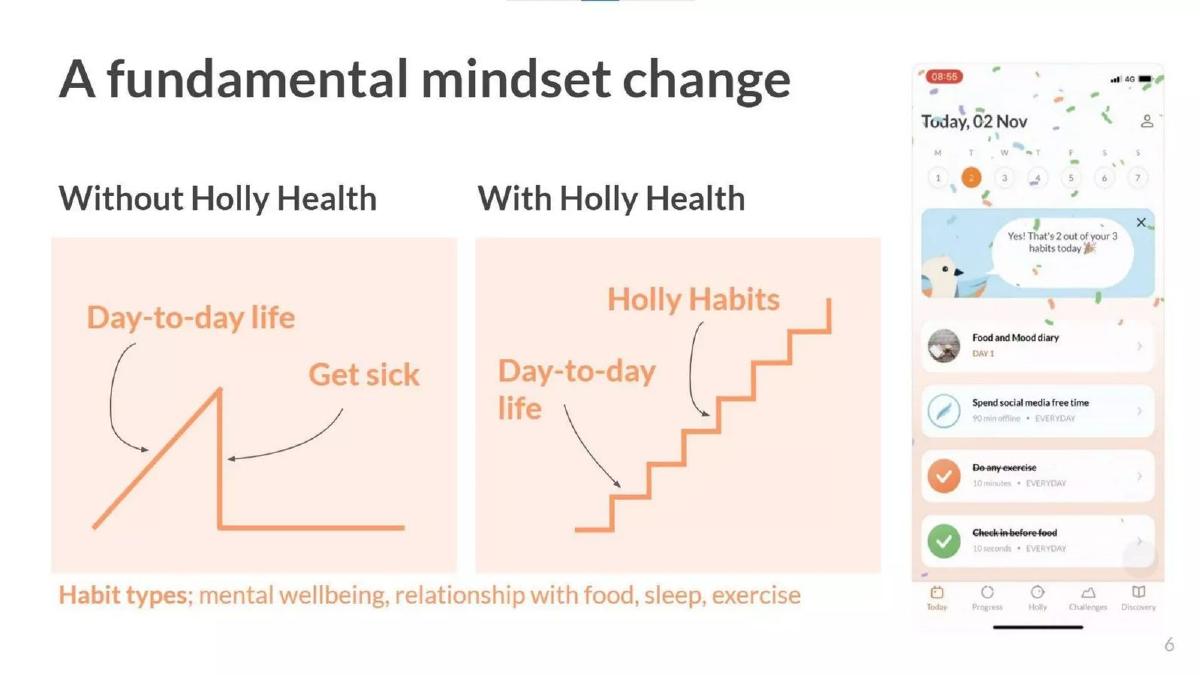
Slide 4 introduces the 'Holly Bird,' the personified AI coach. The service is built on four pillars: behavioral science (CBT, mindfulness), supportive AI coaching, and measurable health outcomes. Crucially, the slide displays the ORCHA Accreditation logo, which is the gold standard for health app safety and efficacy in the UK. Slide 5 is one of the most important in the deck, showing the 'Health Continuum.' It places Holly Health between clinical providers like Livongo and wellness apps like Headspace, targeting the 'struggling' population. They claim effective outcomes from just £1 per person per month, a price point designed for mass B2B adoption. Slide 6 illustrates the 'mindset change' from a cycle of getting sick to a 'staircase' of sustainable habits.
Slides 7-8: Team and Advisors
The team slide (Slide 7) emphasizes a mix of operational experience and clinical depth. CEO Grace Gimson is credited with two startup exits (Deliveroo and Scape Technologies), while CPO Dr. Claire Wu holds a PhD in Neuroscience. The inclusion of a Content & Research Manager with a PhD in Psychological Medicine reinforces the 'science-first' approach. Slide 8 showcases a 'Panel of Advisors' that includes former directors from Amazon and Deliveroo, alongside NHS leaders and professors from King's College London. This balance of 'Big Tech' growth expertise and 'Big Health' clinical authority is a strong signal to investors.
Slides 9-11: Traction and App Metrics
After a video placeholder (Slide 9), Slide 10 reveals the launch date of August 2021. In the first five months, the app achieved over 12,000 downloads and 2,000 MAU. The claim that Week 4 retention is '4x higher than market benchmarks' is a bold statement, though the specific benchmark is not cited. Slide 11 provides a deep dive into metrics. The user base is 75% UK-based and 70% women. Most impressively, 40% of users have a pre-existing medical condition. The retention data shows a 'smile curve' effect, where retention slightly increases between month 5 (12%) and month 6 (13%), suggesting the app successfully re-engages users after they take a break.
Slides 12-13: Differentiation and Market Scale
Slide 12 uses a standard 2x2 matrix to differentiate from competitors. Holly Health claims the top-right quadrant: 'Personalised adaptive coaching' that 'Can scale to whole population.' They explicitly contrast themselves with 'not scalable' human-centric services like Ginger or Lyra. Slide 13 quantifies the opportunity, starting with a £1.5 billion UK market and expanding to a £30 billion international market by 2023. The calculation is based on 65% of the population being 'unhealthy' and paying £24 per person.
Slides 14-17: Business Model and The Ask
Slide 14 details the B2B2C licensing model. The 'Holly app becomes an extension of your healthcare team,' targeting gyms, insurers, and the NHS. The mention of 3 live NHS pilots scaling to 20 is a key 'proof of concept' for the B2B strategy. Slide 15 projects a steep revenue climb, targeting £14 million ARR by 2025. Slide 16 contains the formal ask: £1.2 million. The pie chart shows a heavy lean toward team expansion (54%). A significant 'de-risker' is mentioned here: a £440,000 non-dilutive government grant already secured. The slide also lists existing backers, including the founder of Indeed.com and Kima Ventures.
Slides 18-23: Appendix and Technical Depth
The appendix provides the 'how' behind the 'what.' Slide 19 explains the technology, describing the 'Holly AI' as a recommender system combined with conversational AI. It lists the psychological models used, such as COM-B and Acceptance & Commitment Therapy (ACT). Slide 20 provides social proof via Trustpilot and Product Hunt (Top 10). Slide 21 offers a detailed 'User Journey' for a persona named Sarah, quantifying her 4-month progress (3% bodyweight loss, 122 additional portions of veg). Slide 22 shows actual in-app chat interfaces, demonstrating the 'light-hearted' tone mentioned earlier.
What Works Well in This Deck
1. Clinical Credibility: In the crowded 'wellness' space, Holly Health stands out by leading with ORCHA accreditation, PhD-level founders, and NHS pilots. They aren't just a fitness app; they are a clinical tool. 2. Clear Positioning: The 'Health Continuum' slide (Slide 5) perfectly explains why they need to exist. It identifies a specific segment of the population that is underserved by both Peloton and hospitals. 3. Transparency of Metrics: Slide 11 is exceptionally detailed for a seed-stage deck. Sharing DAU/MAU and 6-month retention rates shows a level of data maturity that investors value. 4. Non-Dilutive Funding: Mentioning the £440k grant (Slide 16) is a massive win. it shows government validation and extends the company's runway without further diluting equity.
What is Missing or Could Be Improved
1. Unit Economics: While the deck mentions a £1/month B2B price and a £24/year B2C price, it does not detail the Customer Acquisition Cost (CAC) or the Lifetime Value (LTV). For a B2B2C model, understanding the cost of the 'sales funnel' mentioned on Slide 16 is critical. 2. Competitive Pricing Detail: Slide 12 claims competitors are 'not scalable' or 'not personalised,' but it doesn't show a direct price comparison. If Holly Health is significantly cheaper, that should be a headline feature of the differentiation slide. 3. Technical Moat: Slide 19 describes the AI as a 'recommender system.' In the current AI climate, investors might look for more detail on what makes their proprietary data or algorithms difficult for a larger player (like Apple Health or Noom) to replicate.
What a Founder Should Copy
1. The 'Problem' Framing: Use the 'cost to the economy' and 'burnout' angles to make your problem feel systemic rather than just a personal inconvenience for users. 2. The Advisor Slide: Don't just list names. Use logos of the prestigious institutions your advisors come from (Slide 8). It creates an immediate 'halo effect' of institutional trust. 3. The User Journey: Slide 21 is a great way to make abstract data feel real. By following 'Sarah,' the investor can visualize exactly how the product changes a life over four months. 4. The 'Ask' Specificity: Don't just ask for money. List exactly what milestones that money will buy (e.g., 'Expand team to 18,' 'Achieve >£1.6M ARR'). It shows you have a concrete plan for the capital.
Frequently asked questions
- What is Holly Health's primary target market?
- Holly Health targets the 65% of the population classified as 'unhealthy' by government guidelines but not yet hospitalized. They focus on individuals struggling with weight management, stress, and problematic eating behaviors who lack personalized support. Geographically, they started in the UK and planned expansion into the USA in 2022, with a total addressable international market estimated at £30 billion.
- How does Holly Health differentiate itself from competitors like Noom or Headspace?
- The deck uses a 2x2 matrix to position Holly Health as both 'highly scalable' and providing 'personalized adaptive coaching.' Unlike human-led services (Talkspace) which are not scalable, or program-based apps (MyFitnessPal) which lack personalization, Holly Health uses an AI 'recommender system' to provide daily, low-cost coaching (£24/year vs. higher monthly costs for competitors).
- What are the key engagement metrics for the app?
- As of January 2022, the app had over 12,000 downloads and 2,000 Monthly Active Users (MAU). Key engagement ratios include a DAU/MAU of 32% and an average of 5 app opens per Daily Active User. They also report a 30-day retention rate of 40% after onboarding is completed.
- What is the clinical evidence for the product's effectiveness?
- The deck cites 8-week outcomes from survey respondents, showing a 35% improvement in problematic eating behaviors and a 10% improvement in self-confidence. They also highlight that 40% of their users have pre-existing medical conditions, suggesting the app is effective for higher-risk populations, supported by their ORCHA accreditation.
- How will the £1.2 million seed investment be spent?
- The majority of the funds (54%) are allocated to the team, with the goal of expanding to 18 employees across product, sales, and operations. Other allocations include marketing (15.7%), external development (4.6%), and cost of service (5.3%). The primary objective is to achieve >£1.6M ARR and develop clinical outcome evidence in primary care.