Holy Grail's pitch deck, likely produced in late 2015, focuses on the rapid expansion of a 'Hemp Lifestyle Company' across multiple product categories, including vapes, tinctures, and topicals. The deck highlights significant early traction, growing from $840,000 in 2014 to $2 million by September 2015. While the deck succeeds in demonstrating product variety and a clear upward revenue trajectory, it lacks specific unit economics, detailed competitor analysis, and a clear investment 'ask.' The presentation relies heavily on broad market growth statistics for the cannabis and e-commerce sector…
Key takeaways
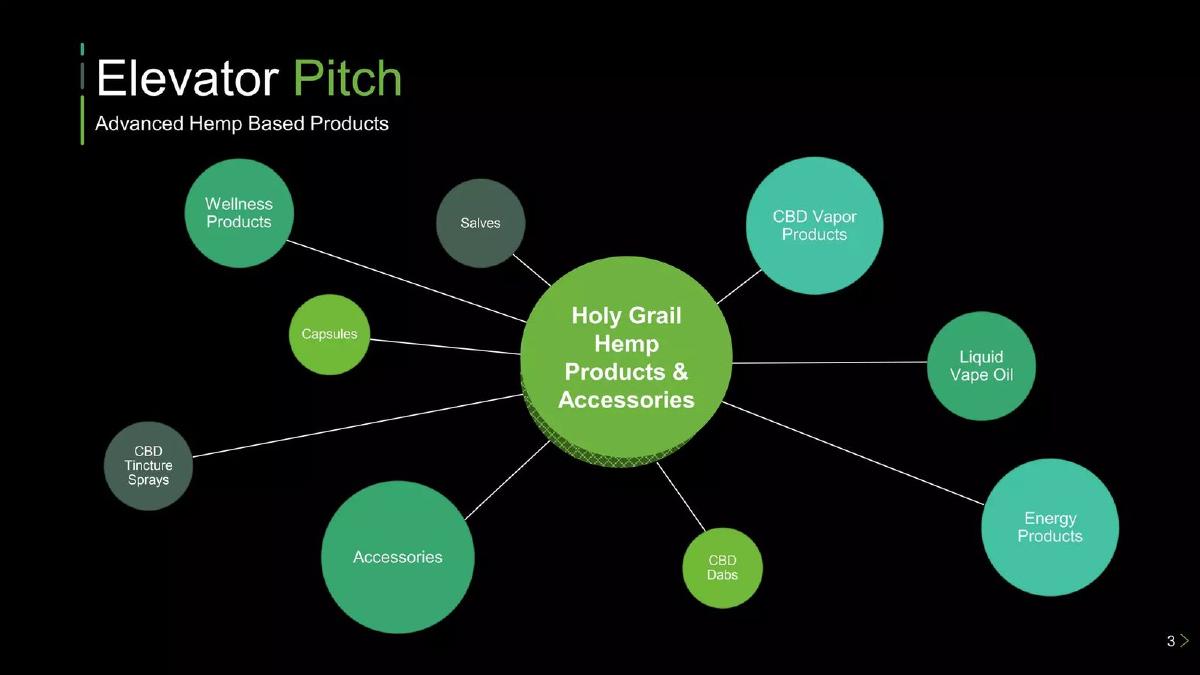
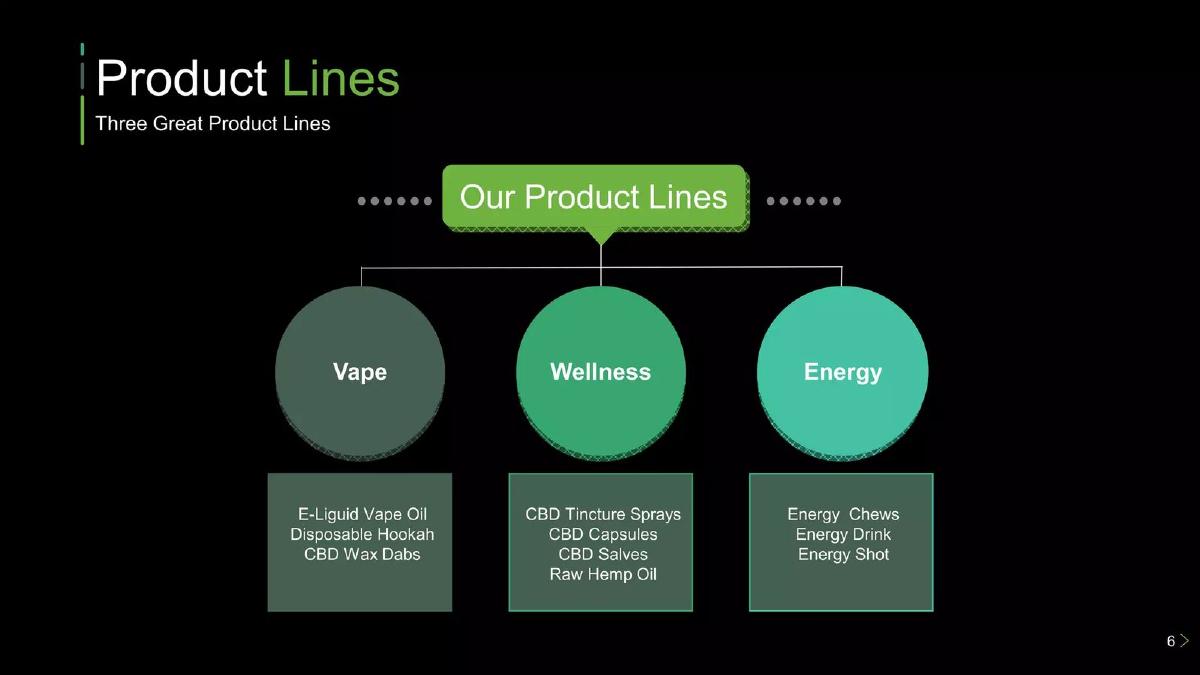
- The company positions itself as a 'Hemp Lifestyle Company' with a diverse product range including wellness, vapor, and energy products (Slide 3).
- Revenue grew from $840,000 in 2014 to $2 million by September 2015, demonstrating strong early-market product-market fit (Slide 17).
- The product strategy relies on high SKU counts, featuring 10 flavors of 30mg CBD e-liquids and 5 flavors of 100mg CBD e-liquids (Slide 7).
- The deck projects aggressive revenue growth, aiming for $35 million by 2019, though the specific drivers for this 17x increase are not detailed (Slide 17).
- Market validation is based on the legal hemp and cannabis sector being the 'fastest growing industry in the USA' as of the deck's creation (Slide 11).
- The leadership team consists of two Co-CEOs, Jason Golec and Edward Quiroz, both with backgrounds in finance and import/export (Slide 15).
- The deck omits a specific funding request, valuation, or breakdown of how new capital would be deployed.
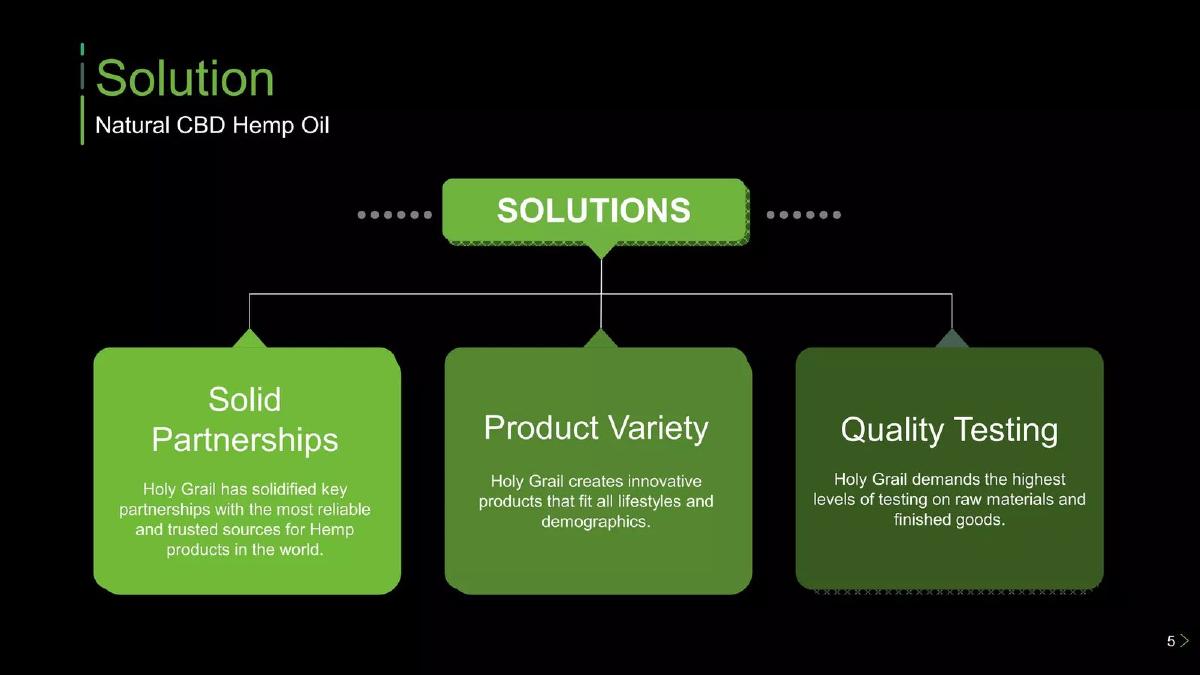
- Quality assurance is highlighted as a core pillar, with the company claiming to demand the highest levels of testing on raw materials (Slide 5).
Executive Summary: The Hemp Lifestyle Brand
Holy Grail presents a pitch for a diversified CBD product company during the mid-2010s hemp boom. The deck focuses on two primary pillars: a wide variety of high-quality products and a rapidly growing market. By positioning themselves as a 'lifestyle' company rather than just a supplement provider, they aim to capture a broad demographic of consumers. The deck is visually consistent, using a dark background with green accents that align with the hemp theme, though it lacks some of the deeper financial metrics that institutional investors typically require.
Slide 1: Title Slide
The cover slide introduces the brand as 'Holy Grail: The Hemp Lifestyle Company.' The subtitle 'Innovative Hemp Products' sets the stage for a product-focused presentation. The logo features a chalice with 'CBD' inscribed on it, reinforcing the brand name. The design is simple and professional, establishing the green-and-black color palette used throughout the deck.
Slide 3: Elevator Pitch
Slide 3 uses a hub-and-spoke diagram to visualize the company's product ecosystem. At the center is 'Holy Grail Hemp Products & Accessories,' surrounded by categories such as Wellness Products, Capsules, Salves, CBD Vapor Products, Liquid Vape Oil, Energy Products, CBD Dabs, Accessories, and CBD Tincture Sprays. This slide effectively communicates that Holy Grail is not a one-product wonder but a platform brand capable of occupying multiple shelves in a retail environment.
Slide 5: The Solution
The solution is framed around 'Natural CBD Hemp Oil.' The company breaks its value proposition into three categories: Solid Partnerships (sourcing from reliable hemp sources), Product Variety (fitting all lifestyles and demographics), and Quality Testing (testing raw materials and finished goods). By highlighting testing and partnerships, the company addresses common consumer and investor concerns regarding the safety and consistency of CBD products in an unregulated market.
Slide 7: Product Line 1 - Vape
This slide focuses on the vapor category, which was a major growth driver for the industry in 2015. It lists specific SKUs: 10 flavors with 30mg of CBD and 5 flavors with 100mg of CBD. It also introduces 'Gold CBD Wax Dabs' containing 24% CBD or 240mg per gram. The inclusion of product photography and specific dosage information provides a concrete sense of the company's manufacturing capabilities.
Slide 9: Product Line 2 - Wellness
The wellness slide covers Tincture Sprays, Capsules, and Salves. It specifies that tincture sprays come in two strengths and three flavors. The imagery shows professional packaging, which is crucial for a CPG brand trying to differentiate itself from 'basement' operations. This slide reinforces the 'lifestyle' messaging by showing products that look like standard health supplements.
Slide 11: Market Size & Opportunity
Holy Grail uses a bar chart to show the growth of 'US Legal Hemp & Cannabis Sales' from 2007 to 2018. The chart shows a steady climb, starting under $1 billion in 2007 and projecting toward $4.5 billion by 2018. The headline claims this is the 'fastest growing industry in the USA today.' While the data is broad, it serves to validate the macro-trend the company is riding.
Slide 13: E-commerce Growth
This slide attempts to show the synergy between the cannabis market and the digital retail market. It cites a $224 billion US e-commerce market growing at 19% annually and a $2.7 billion cannabis industry growing at 74% in 2014. The graphic on the right shows a shopping cart connected to various social and logistics icons (Facebook, eBay, FedEx, PayPal), suggesting a sophisticated digital distribution strategy, though it doesn't provide specific Holy Grail e-commerce metrics.
Slide 15: The Team
The leadership team consists of two Co-CEOs. Jason Golec brings an MBA and 17+ years of experience in sales, marketing, and brand development. Edward Quiroz has 18+ years in real estate finance and import/export. Both are mentioned as board members of CBDRA.org. The team appears to have the necessary business and finance background to scale a company, though the deck doesn't mention specific previous exits or industry-specific scientific expertise.
Slide 17: Revenue Projections
This is the most critical slide for investors. It shows historical growth: $840,000 in 2014 increasing to $2 million by September 2015 . The right-hand chart projects revenue reaching $35 million by 2019. However, there is a noticeable typo on the X-axis where '2018' is listed twice. Despite the typo, the message is clear: the company is currently generating significant revenue and expects that growth to accelerate.
Slide 19: Conclusion and Contact
The final slide provides contact information and a brief closing statement. It mentions that hemp has '50K+ uses' and encourages investors to research the benefits of CBD. It lists a physical address in Temecula, CA, and social media handles. Notably, it mentions contacting 'your broker,' which might suggest the deck was used for a private placement or a specific type of regulated offering.
What Holy Grail Does Well
The deck excels at demonstrating product-market fit through actual revenue numbers. Many startup decks rely entirely on projections; Holy Grail shows nearly $3 million in cumulative revenue over 21 months, which is a strong signal for a seed or Series A stage company. The clear categorization of products into 'Vape' and 'Wellness' shows a sophisticated understanding of retail segments.
The visual branding is also a strength. The packaging shown on slides 7 and 9 looks retail-ready and professional, which helps overcome the stigma often associated with hemp products in the early days of the industry. The 'lifestyle' positioning is a smart way to increase the Total Addressable Market (TAM) beyond just medical users.
What is Missing from the Deck
The most glaring omission is the Investment Ask . There is no mention of how much money the company is looking to raise, what the valuation is, or how the funds will be spent (e.g., marketing, inventory, R&D). Without this, the deck feels more like a company profile than a fundraising tool.
Furthermore, there is no Competitor Analysis . The CBD market in 2015 was becoming increasingly crowded, and investors would want to know how Holy Grail differentiates itself from other early movers like Charlotte's Web or CV Sciences. The deck also lacks Unit Economics . We see the top-line revenue, but we don't know the gross margins or the cost to acquire a customer (CAC), which are vital for determining if the $35 million revenue goal is actually achievable or profitable.
Founder Takeaways: What to Copy
Show, Don't Just Tell: Use actual product photography and specific SKU counts to make your business feel 'real' to investors. · Lead with Traction: If you have six-figure or seven-figure revenue, put it front and center. It is the most powerful validator you have. · Segment Your Market: Breaking your product line into logical categories (Wellness vs. Vape) helps investors understand your distribution strategy. · Professionalize the Team Slide: Including headshots and specific years of experience builds immediate credibility.
Frequently asked questions
- What is the primary business model for Holy Grail?
- Holy Grail operates as a multi-category consumer packaged goods (CPG) company within the hemp and CBD space. They utilize a 'lifestyle brand' approach, selling everything from CBD vape oils and dabs to wellness tinctures, capsules, and topical salves. Their strategy appears to be capturing market share through product variety and multi-channel distribution, including e-commerce and retail partnerships.
- How much revenue did Holy Grail generate before this pitch?
- According to slide 17, the company generated $840,000 in revenue in 2014. By September 2015, they had already reached $2 million for the year. This represents a significant year-over-year growth rate, which the deck uses to anchor its future projections of $35 million in annual revenue by 2019.
- Who are the founders and what is their background?
- The company is led by Co-CEOs Jason Golec and Edward Quiroz. Golec holds an MBA and has 17+ years of experience in sales, marketing, and brand development. Quiroz has 18+ years of experience in real estate finance and import/export. Both are noted as board members of CBDRA.org, an industry organization (Slide 15).
- What market opportunity does the deck highlight?
- The deck highlights the intersection of two high-growth sectors: legal cannabis/hemp and e-commerce. Slide 13 notes that the cannabis industry grew at 74% in 2014, while US e-commerce was a $224 billion market growing at 19% per year. They position hemp as having '50K+ uses,' framing it as a versatile and environmentally friendly commodity (Slide 19).
- What are the biggest weaknesses in this pitch deck?
- The most notable omissions are the lack of a specific financial 'ask' and a detailed breakdown of unit economics. While the deck shows top-line revenue growth, it does not explain margins, customer acquisition costs (CAC), or the competitive landscape. Additionally, the slide 17 chart contains a typo, listing '2018' twice on the X-axis, which can undermine professional credibility.