HomeRoots is positioning itself as a central hub for the $900B homewares industry, facilitating sales between manufacturers and retail giants like Amazon, Walmart, and Wayfair. The deck highlights a significant shift in business strategy, moving from a 20% transaction take rate to a SaaS model with MRR ranging from $25 to $1,200. While the company demonstrates strong traction with established retail partners and a projected jump to $80M in GMV by 2026, the deck lacks critical details regarding the founding team's background, specific unit economics, and a clear capital request. The narrative…
Key takeaways
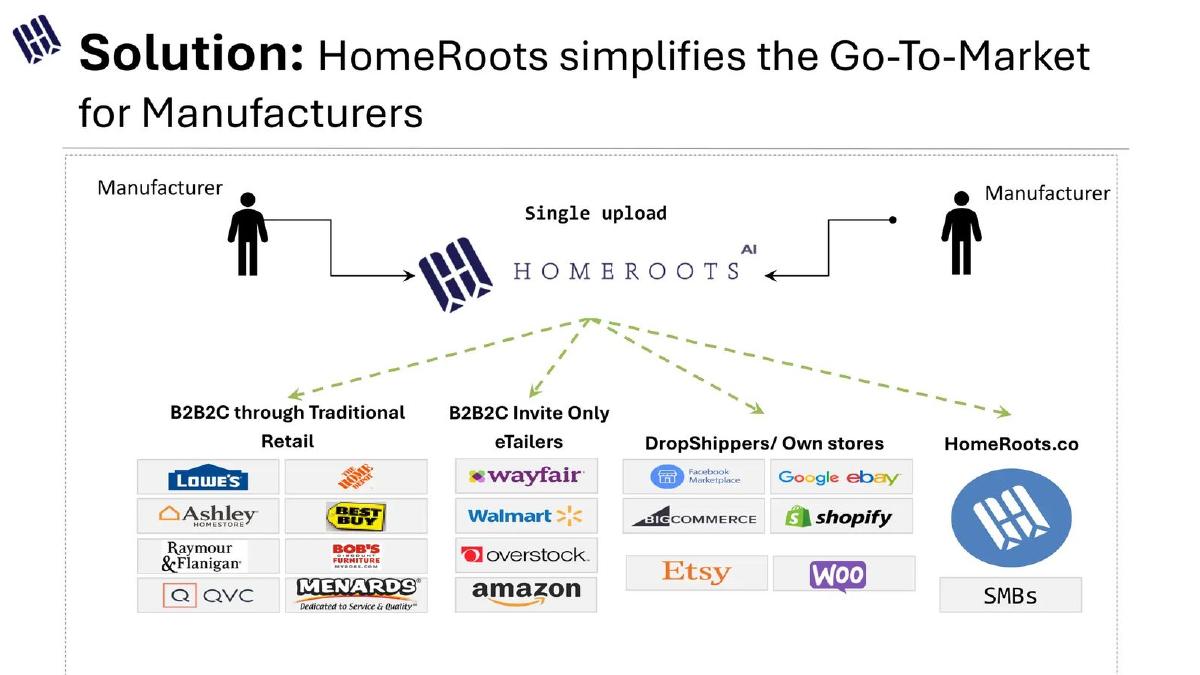
- The company operates a B2B2C platform that allows manufacturers to reach traditional retail, e-tailers, and drop-shippers through a single upload (Slide 2).
- HomeRoots claims authorized vendor status with major players including Amazon, Walmart, Wayfair, and Lowe's (Slide 4).
- The business model is evolving from a 20% transaction take rate to include a SaaS component with MRR between $25 and $1,200 (Slide 5).
- Financial projections show a steep growth curve, aiming for $80M in top-line sales/GMV and $17M in net income by 2026 (Slide 5).
- A newly released Shopify app subscription yielded $3.5K in MRR as of January 2024, alongside a sharp increase in monthly product sales revenue (Slide 9).
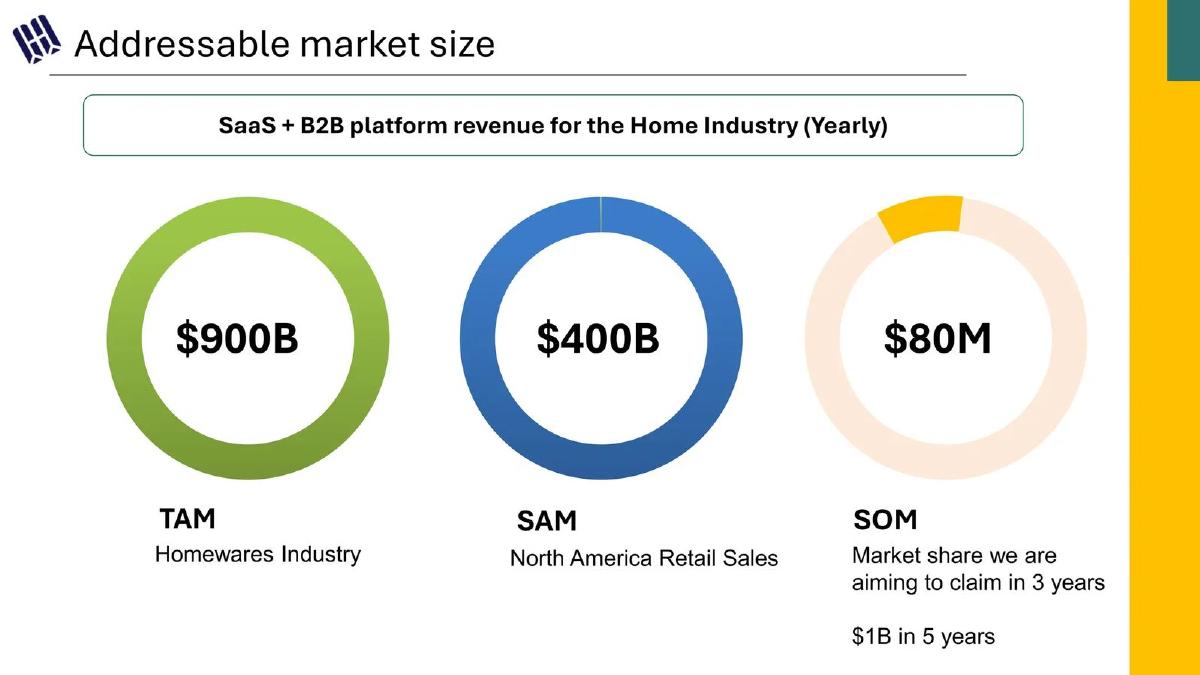
- The company identifies a $900B TAM for the homewares industry, with a specific SOM target of $80M within three years (Slide 3).
- A strategic partnership with Wayfair is central to their GTM, aiming for $400K in monthly revenue by year-end through content services (Slide 6).
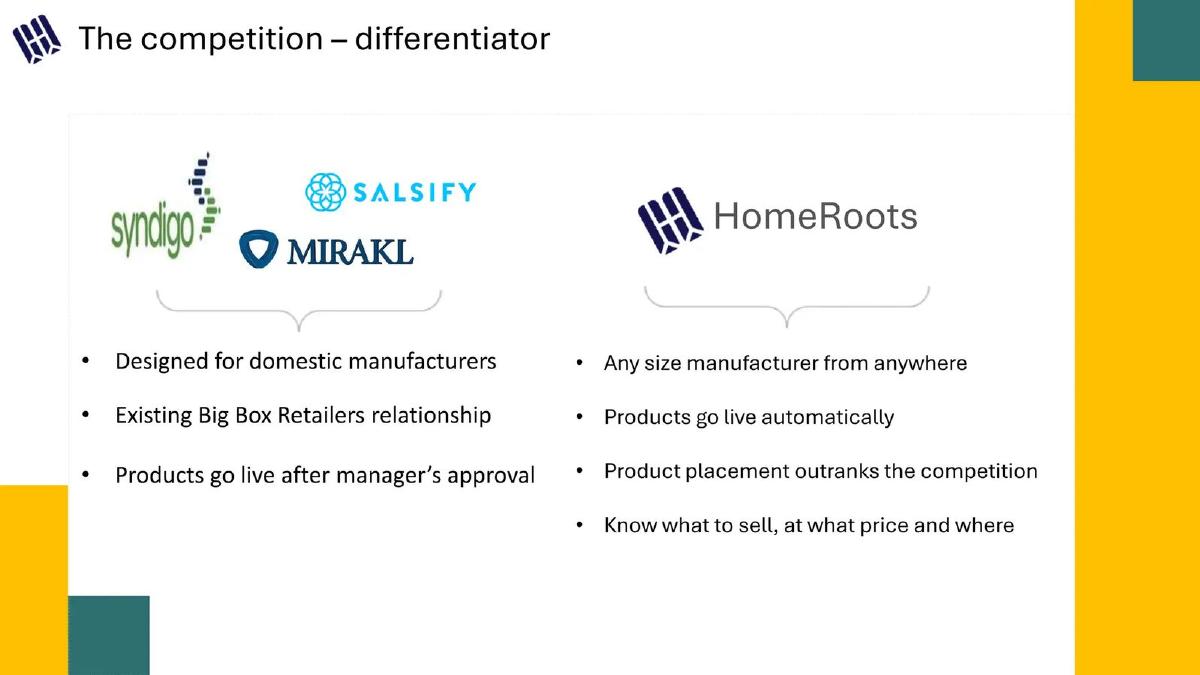
- The deck is missing a team slide, a competition analysis, and a specific funding 'ask' or use of funds.
Executive Summary: The Gateway for Everything Home
HomeRoots Insights presents itself as a B2B2C selling platform specifically tailored for the homewares industry. The deck, dated April 2024, outlines a transition from a pure-play marketplace/distributor model to a technology-enabled SaaS platform. By positioning itself between manufacturers and a massive network of retailers, HomeRoots seeks to solve the fragmented distribution problem in a $900 billion global market. The narrative is heavily focused on recent traction with major retailers and a pivot toward recurring revenue streams.
Slide 1: Title and Contact
The opening slide introduces HomeRoots as "The gateway to the market" and a "B2B2C Selling Platform for everything home." It features the CEO, Gil Bar-Lev, and provides direct contact information. The branding is clean, utilizing a minimalist home-decor aesthetic that aligns with the sector focus.
Slide 2: The Solution and Ecosystem
Slide 2 illustrates the platform's mechanics. It shows a "Single upload" process where manufacturers feed data into the HomeRoots AI-powered platform. From there, the platform distributes products across four main channels: Traditional Retail (Lowe's, Home Depot, Best Buy), Invite Only eTailers (Wayfair, Walmart, Amazon), DropShippers/Own stores (Shopify, eBay, Etsy), and HomeRoots.co directly to SMBs. This slide effectively communicates the 'hub-and-spoke' nature of their business model.
Slide 3: Addressable Market Size
The company defines its Total Addressable Market (TAM) as the $900B Homewares Industry. The Serviceable Addressable Market (SAM) is narrowed to $400B in North America Retail Sales. The Serviceable Obtainable Market (SOM) is set at $80M, which the company aims to claim within three years, with a further goal of reaching $1B in five years. While the TAM is large, the SOM aligns directly with their 2026 financial projections shown later in the deck.
Slide 4: Traction and Integrations
This slide serves as a credibility builder. HomeRoots lists itself as an "Authorized Vendor" for heavyweights like Amazon, Walmart, Wayfair, Lowe's, and The Home Depot. It also notes that they are "In the middle of Integration" with Raymour & Flanigan, Menards, Boscov's, Shopify, and WooCommerce. This demonstrates that the platform has already cleared the significant hurdle of being vetted by major corporate procurement departments.
Slide 5: Business Plan and Financial Projections
Slide 5 details the revenue mix. The company currently takes a 20% commission on orders but is expanding into SaaS with a monthly price point of $25 to $1,200. The bar chart shows a dramatic growth trajectory:
2023: $5.2M GMV / -$0.4M Net Income · 2024 (Projected): $9.2M GMV / $0.1M Net Income · 2025 (Projected): $24M GMV / $1.5M Net Income · 2026 (Projected): $80M GMV / $17M Net Income
The slide notes they have reached a "Breakeven - Cashflow Neutral" state, which is a significant milestone for a scaling B2B platform.
Slide 6: Go-To-Market and Wayfair Expansion
This slide focuses on a specific growth lever: becoming Wayfair's "preferred Content Partner." The company claims this status is imminent because they are among the fastest-growing suppliers and their technology impacts retailer performance. They project this specific initiative will drive $400K a month in revenue by year-end, serving as a template for other retail partnerships.
Slide 7: Wayfair Partnership Details
Expanding on the previous slide, Slide 7 breaks down the bilateral benefits. For Wayfair, HomeRoots shortens supplier onboarding from months to hours and reduces returns. For HomeRoots, it provides an introduction to 22,000 suppliers, an average of 640 products per supplier, and a new stream of SaaS revenue for content services. This slide highlights the potential for massive scale through a single strategic channel partner.
Slide 8: Shopify App Performance
To prove the viability of their SaaS pivot, Slide 8 highlights a Shopify app subscription released to existing customers. As of January 2024, this has yielded $3.5K in MRR. More impressively, the accompanying line chart shows "Monthly Revenue from products sales" spiking from near zero in early 2023 to approximately $60,000 by January 2024. This suggests that the software tools are successfully driving higher transaction volumes.
Slide 9: Closing Slide
The deck concludes with a "Thank you" slide, repeating the CEO's contact information and featuring high-quality imagery of furniture, reinforcing the company's focus on the home goods category.
What HomeRoots Does Well
The deck excels at demonstrating market validation . By listing logos like Walmart, Amazon, and Home Depot as authorized vendors, HomeRoots bypasses the need to explain if their platform works; the presence of these retailers proves it. The transition from a transaction-heavy model to a SaaS model is also well-articulated, showing that the company is thinking about margin expansion and revenue predictability. The specific focus on the Wayfair partnership provides a tangible, near-term catalyst that investors can track.
What is Missing from the Deck
Despite the strong traction, there are several glaring omissions that would be required for a formal investment round:
Team Slide: There is no information about the founders or key leadership. In early-stage investing, the 'who' is often as important as the 'what.' · Competitive Landscape: The deck does not mention competitors like Shopify Collective, Convictional, or traditional EDI providers. Investors need to know why HomeRoots is the superior choice for a manufacturer. · The Ask: There is no slide detailing how much money is being raised, the valuation, or the specific milestones the capital will fund. · Unit Economics: While they mention a 20% take rate, there is no data on Customer Acquisition Cost (CAC) or Lifetime Value (LTV), which are critical for evaluating the scalability of the SaaS pivot.
Founder Takeaways: Lessons from HomeRoots
Leverage 'Anchor' Partnerships: HomeRoots uses the Wayfair partnership as a proxy for their entire growth strategy. If you have one major customer or partner that validates your tech, dedicate significant space to explaining how that relationship scales. Show the Pivot: If you are moving from one business model (Marketplace) to another (SaaS), use charts like Slide 5 to show how the new model improves the bottom line. The jump from a $0.4M loss to a $17M profit projection is a powerful way to argue for a higher valuation. Visual Consistency: The deck uses high-quality, category-relevant imagery that makes the product feel premium. For a B2B company, looking like the industry you serve helps build immediate rapport with sector-specific investors.
Frequently asked questions
- What is the core value proposition of HomeRoots?
- HomeRoots acts as a 'gateway to the market' for home goods manufacturers. By providing a single point of upload, it automates the distribution of products across diverse channels, including big-box retailers like Home Depot, e-commerce giants like Amazon, and independent SMBs. This reduces the technical and administrative burden on manufacturers who would otherwise need to manage dozens of individual retail integrations manually.
- How does HomeRoots generate revenue?
- Historically, the company has relied on a 20% take rate on every order processed through its platform. However, the deck outlines a strategic shift toward a SaaS model. This includes a Shopify app subscription (currently at $3.5K MRR) and tiered SaaS pricing ranging from $25 to $1,200 per month, intended to provide more predictable, high-margin recurring revenue alongside transactional fees.
- What is the significance of the Wayfair partnership mentioned in the deck?
- The Wayfair partnership is presented as a cornerstone of their SaaS expansion. HomeRoots aims to become Wayfair's 'preferred Content Partner,' helping Wayfair's 22,000 suppliers onboard products faster (reducing time from months to hours). The company expects this single channel to generate $400K in monthly revenue by year-end, which they then plan to replicate across other major retailers.
- What are the projected financials for the company?
- The deck shows significant scaling ambitions. In 2023, the company recorded $5.2M in GMV with a $0.4M loss. By 2024, they project $9.2M in GMV and breakeven status. The long-term forecast is aggressive, targeting $80M in GMV and $17M in net income by 2026, representing a nearly 9x growth in top-line sales over two years.
- What critical information is missing from this pitch deck?
- The deck lacks several standard components essential for investor due diligence. Most notably, there is no team slide to establish founder-market fit, no competitive landscape analysis to show how they differ from other channel managers, and no 'Ask' slide detailing how much capital they are raising or how they intend to spend it to reach their 2026 targets.