HomeCooks (registered as Juno Food Ltd.) raised £3.2m in seed funding using a deck that positions the company as a two-sided marketplace for independent food creators. By handling the logistics—including pickup, freezing, and dispatch—HomeCooks allows chefs to sell pre-prepped meals with near-zero upfront costs. The deck emphasizes a 'creator-led' acquisition model where chefs bring their own audiences to the platform, significantly lowering customer acquisition costs compared to traditional meal-kit services like Gousto or HelloFresh. With a target of £150k monthly revenue by Q2 2024 and a f…
Key takeaways
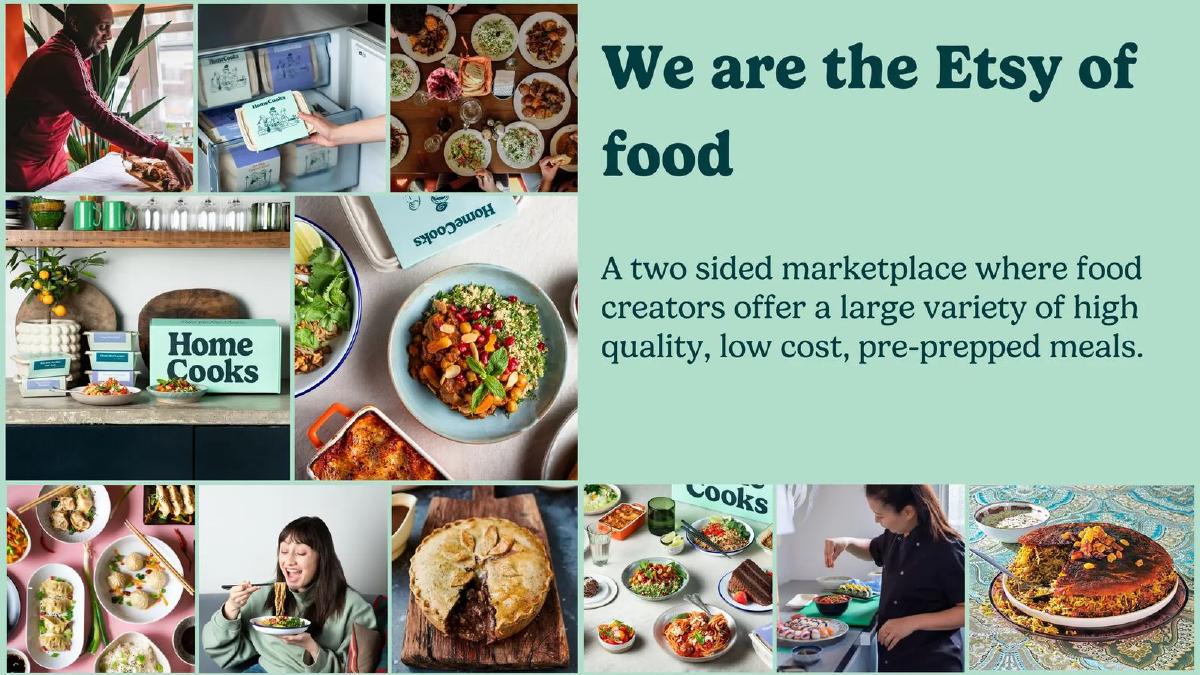
- The company uses a high-level anchor by describing itself as the 'Etsy of food' on slide 2.
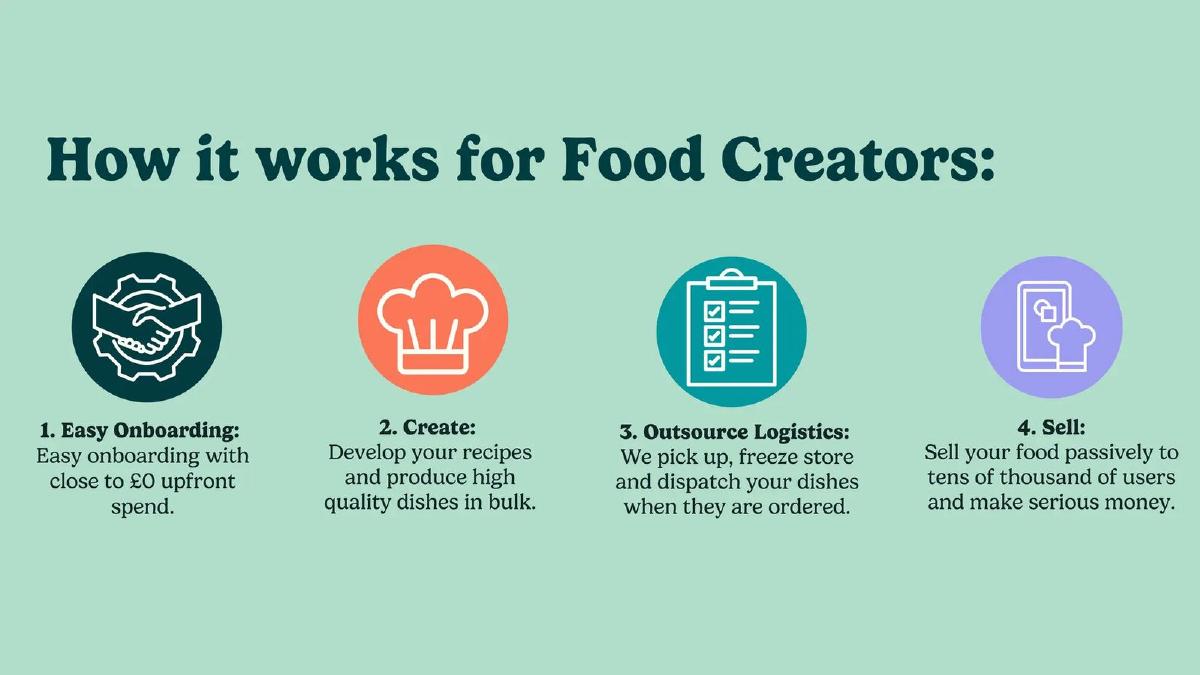
- HomeCooks handles the entire logistics chain for creators, including freezing, storage, and dispatch, as detailed on slide 3.
- The deck identifies a high failure rate in the food industry, noting that 60% of food brands fail in their first year (slide 5).
- The UK home food service market is valued at £18bn, with the global market reaching £250bn (slide 6).
- HomeCooks claims a competitive advantage in variety, offering 200+ dishes compared to HelloFresh's 50+ (slide 7).
- Creator segments are clearly defined: Micro Brands earn £6.5k-£8.5k per month, while Amateurs earn £0.6k-£0.8k (slide 8).
- Customer acquisition is highly diversified, with 33.3% coming from eater referrals and 14.3% from creator referrals (slide 10).
- The 12-month roadmap targets £150k monthly revenue and 500 active meals by late 2024 (slide 11).
The HomeCooks Pitch Deck: A Strategic Breakdown
HomeCooks, operating under the legal name Juno Food Ltd., utilized this 13-slide sequence to secure a £3.2m seed round. The deck is a masterclass in marketplace positioning, focusing heavily on the 'supply side' (the creators) as the primary engine for growth. By solving the logistics burden for independent chefs, HomeCooks creates a defensible moat that traditional meal-kit companies struggle to replicate due to their centralized, high-overhead models.
Slide 1: Title and Identity
The cover slide establishes the brand identity with the tagline 'Eat Well, Support Small.' It also includes the registered company name, Juno Food Ltd., at the bottom left. The hand-drawn illustration style suggests a grassroots, artisanal feel, which aligns with their mission to support independent creators rather than industrial food production.
Slide 2: The 'Etsy of Food' Vision
Slide 2 uses a powerful 'X for Y' analogy, calling HomeCooks the 'Etsy of food.' This immediately communicates the business model to investors: a decentralized marketplace for independent makers. The slide defines the product as a two-sided marketplace offering 'high quality, low cost, pre-prepped meals.' The imagery reinforces the variety of cuisines available, from Persian tahdig to classic beef lasagna.
Slide 3: The Creator Value Proposition
This slide outlines the four-step process for food creators. The most critical point is 'Easy Onboarding' with 'close to £0 upfront spend.' By handling the logistics—pickup, freezing, storage, and dispatch—HomeCooks removes the primary barrier to entry for small food businesses. This turns the platform into a passive income stream for chefs, which is a compelling reason for supply-side retention.
Slide 4 & 5: The Problem Statement
Slide 4 is a simple transition slide stating the industry is 'broken.' Slide 5 provides the data to back this up, noting that 60% of food brands fail in their first year and 80% within five years. The deck highlights rising energy prices, recessionary pressure, and increasing staff costs as external factors that make the traditional restaurant or food brand model 'borderline impossible.'
Slide 6: Market Opportunity and Validation
HomeCooks quantifies the UK home food service market at £18bn, showing significant growth from £10bn in 2015. They break this down into takeaway, ready meals, and meal kits. Crucially, they use 'social proof' by listing US-based competitors like Shef ($20m Series A), CookUnity ($47m Series B), and Goldbelly ($100m Series B) to prove that the 'food creator marketplace' category is venture-backable.
Slide 7: Competitive Comparison
Slide 7 directly compares HomeCooks to Gousto and HelloFresh. The primary vectors of competition are 'Prep Time' and 'Variety.' HomeCooks claims a 5-10 minute prep time, significantly lower than HelloFresh’s 20-45 minutes. They also highlight their 200+ dishes, asserting that their marketplace model allows for a much wider selection than the curated menus of traditional meal kits.
Slide 8: Creator Economics
This slide provides a granular look at how much money creators make. It segments the supply side into Amateurs, Professional Chefs, and Micro Brands. The data shows that Micro Brands can generate up to £8.5k per month. This slide is essential for proving that the platform is not just a hobbyist site but a viable commercial engine for professional food creators.
Slide 9: The Network Effect Flywheel
Slide 9 illustrates the company's growth engine. New food creators bring their own users to the platform, which leads to new dishes, increased engagement, and more orders. This increased volume then encourages existing chefs to develop even more dishes. The slide explicitly labels this as a 'powerful and robust network effect' that increases defensibility and scalability.
Slide 10: Acquisition Mix
The acquisition data on slide 10 is a highlight of the deck. It shows a healthy, diversified mix: 33.3% from eater referrals, 19% from paid online, and 14.3% from creator referrals. The key takeaway here is that the creators act as a low-cost acquisition channel, subsidizing the overall CAC and giving the company a competitive advantage over companies that must pay for every new user via Facebook or Google ads.
Slide 11: The 12-Month Roadmap
The 'Where do we go from here?' slide sets specific milestones. By Q2 2024, they aim for £150k monthly revenue and an app release. By Q4 2024, they target 500 active meals. They also mention hiring five key roles in growth, tech, and product to prepare for a Series A round. This gives investors a clear timeline for the next phase of growth.
Slide 12 & 13: Closing and Contact
Slide 12 uses the 'Feel Good Food' slogan with more hand-drawn illustrations. Slide 13 provides the final call to action with a contact email for 'Josh.' It is a standard closing that maintains the brand's visual consistency.
What Makes This Deck Effective?
The HomeCooks deck succeeds because it focuses on the supply-side advantage . In the crowded food delivery space, most companies die because of high customer acquisition costs. By showing that creators bring their own fans (Slide 10) and that the platform handles the 'hard' part of logistics (Slide 3), HomeCooks presents a model that feels more scalable than a traditional kitchen-based business. The use of US comparables (Slide 6) also helps de-risk the investment by showing that the model has already reached late-stage funding in other markets.
What Is Missing From the Deck?
While the deck is strong on vision and creator economics, there are several notable omissions in these 13 slides:
Unit Economics: There is no slide detailing the Contribution Margin per order. While they mention creator revenue, they don't explicitly show the platform's take rate or the net profit after delivery and packaging costs. · The 'Ask': The specific terms of the £3.2m round are not listed in these slides. Founders should usually include how much they are raising and how that capital will be allocated (e.g., 40% marketing, 30% engineering). · Retention Data: While they show acquisition channels, they don't show cohort retention. In food delivery, the 'leaky bucket' problem is common; showing that users come back month-after-month is vital for a seed-stage marketplace. · Detailed Team Bios: Slide 11 shows a group photo, but there are no individual bios highlighting the founders' specific expertise in food, logistics, or marketplace technology.
Founder Takeaways: What to Copy
Founders building marketplaces should take note of how HomeCooks uses creator tiers (Slide 8). By showing exactly how much a 'Micro Brand' vs. an 'Amateur' makes, they make the business feel tangible. Additionally, the Competitive Comparison (Slide 7) is excellent because it doesn't just list features; it uses visual icons to show a massive gap in 'Variety' (200+ vs 50+), which is a metric customers actually care about. Finally, the Network Effect diagram (Slide 9) is a great way to explain why the business gets easier to run as it gets bigger, which is exactly what venture investors want to see.
Frequently asked questions
- What is the core business model of HomeCooks?
- HomeCooks operates as a two-sided marketplace connecting independent food creators with consumers. Unlike traditional meal kits, the creators produce the food in bulk, and HomeCooks manages the logistics, including picking up the food, freezing it, and handling the final dispatch to the customer. This 'asset-light' approach for creators is intended to lower the barrier to entry for new food brands.
- How does HomeCooks acquire customers differently than HelloFresh?
- While traditional meal-kit companies rely heavily on expensive paid advertising, HomeCooks leverages its creators. According to slide 10, creator referrals account for 14.3% of acquisition, and the deck notes that chefs are incentivized to bring their existing customer bases to the platform to grow their brands nationally, effectively subsidizing the company's customer acquisition cost (CAC).
- What are the different tiers of creators on the platform?
- The platform categorizes creators into three main groups: Amateurs/Hobbyists (23% of the mix), Professional Chefs (29%), and Micro Brands (39%). Micro Brands are the highest earners, generating between £6.5k and £8.5k in monthly revenue by producing over 1,000 dishes, while Hobbyists typically produce 100 dishes for roughly £600-£800 in revenue.
- What market size is HomeCooks targeting?
- The deck focuses on the UK home food service market, which it values at £18bn as of 2021, up from £10bn in 2015. This includes takeaway delivery (£11bn), ready meals (£4bn), and meal kits (£2bn). They also cite a global 'eat at home' market opportunity worth £250bn to demonstrate long-term scalability.
- What are the company's short-term growth targets?
- As shown on slide 11, the company aims to reach £150k in monthly revenue by Q2 2024. Their product roadmap includes an app release in Q2 2024 and a social feed in Q3 2024. They also plan to scale their menu to over 500 active meals by the end of 2024 to maintain their variety advantage over competitors.