Vapi raised $20M in a Series A round led by Bessemer Venture Partners in 2024. The 19-slide deck is notable for its restraint; it contains zero traditional financial slides, no team bios, and no explicit 'ask' slide. Instead, it focuses entirely on the technical complexity of building voice agents and how Vapi abstracts that complexity. By framing the telephone as the 'universal business API' and highlighting the shift from rigid IVR to generative voice, Vapi positions itself as the essential middleware between LLMs and end-users. The deck relies on the strength of its developer-first value p…
Key takeaways
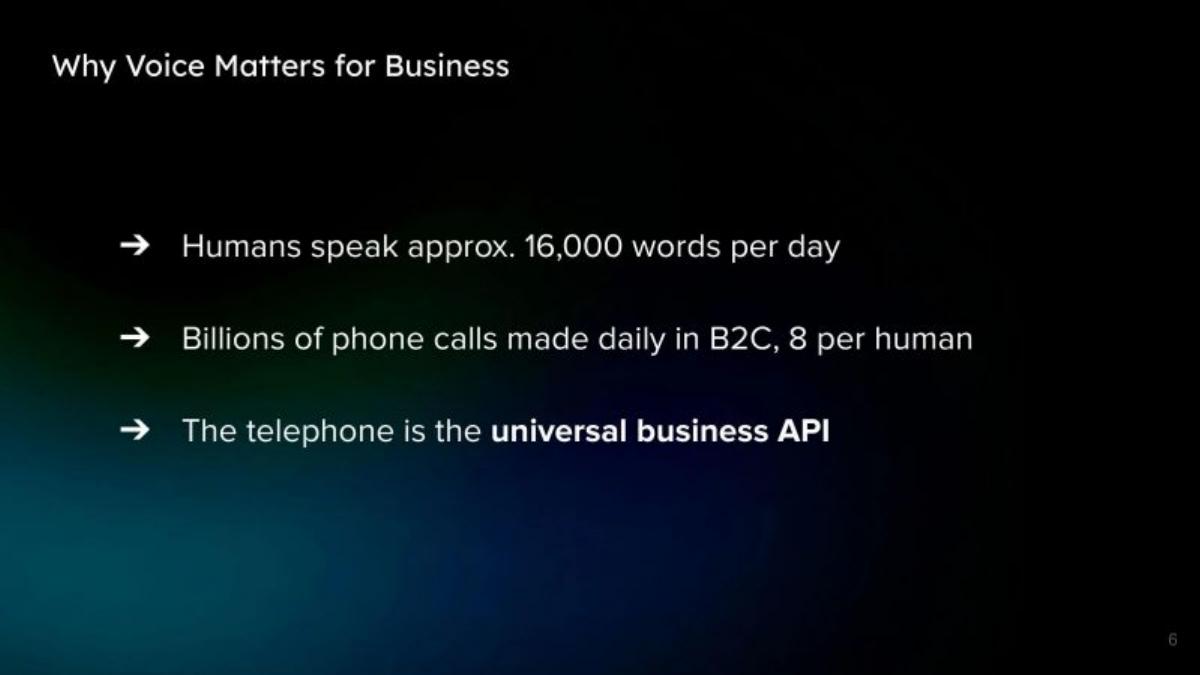
- The deck identifies the telephone as the 'universal business API' to justify the market size (Slide 6).
- It quantifies the current business voice problem with metrics like 62% unanswered SMB calls and 13-minute average hold times (Slide 7).
- Vapi positions its value as a middleware layer that replaces six complex engineering tiers including WebRTC and orchestration (Slide 12 and 13).
- The narrative focuses on reducing deployment time from 'months, if not years' to minutes (Slide 11).
- The deck segments the market into 'Existing Call Volume' like banking and 'New Call Volume' like AI companions (Slide 16).
- Technical differentiation is centered on three pillars: Scale (99.99% uptime), Determinism, and Deployment (Slide 17).
- Growth is framed as 100% organic, driven by a 'sprouting' startup ecosystem on the platform (Slide 19).
- The deck omits standard Series A components like a detailed team slide, competition matrix, and financial projections.
The Narrative of Abstraction
Vapi’s Series A deck is a study in minimalist persuasion. At 19 slides, it avoids the clutter of traditional pitch decks, opting instead for a high-level narrative that explains why voice AI is hard and why Vapi makes it easy. The deck was used to raise $20M in 2024, a period where AI infrastructure was at peak interest for VCs like Bessemer Venture Partners.
Slides 1-3: The Human Element
The deck opens with a simple title slide: "Voice AI Agents for Developers" (Slide 1). This immediately identifies the target user. Slides 2 and 3 establish a philosophical foundation: "Humans want to talk to the world" and "If you can talk to something like it’s a person, you will." This sets the stage for voice as the most natural interface, moving away from the technicalities of LLMs to the psychology of the user.
Slides 4-7: The Business Case for Voice
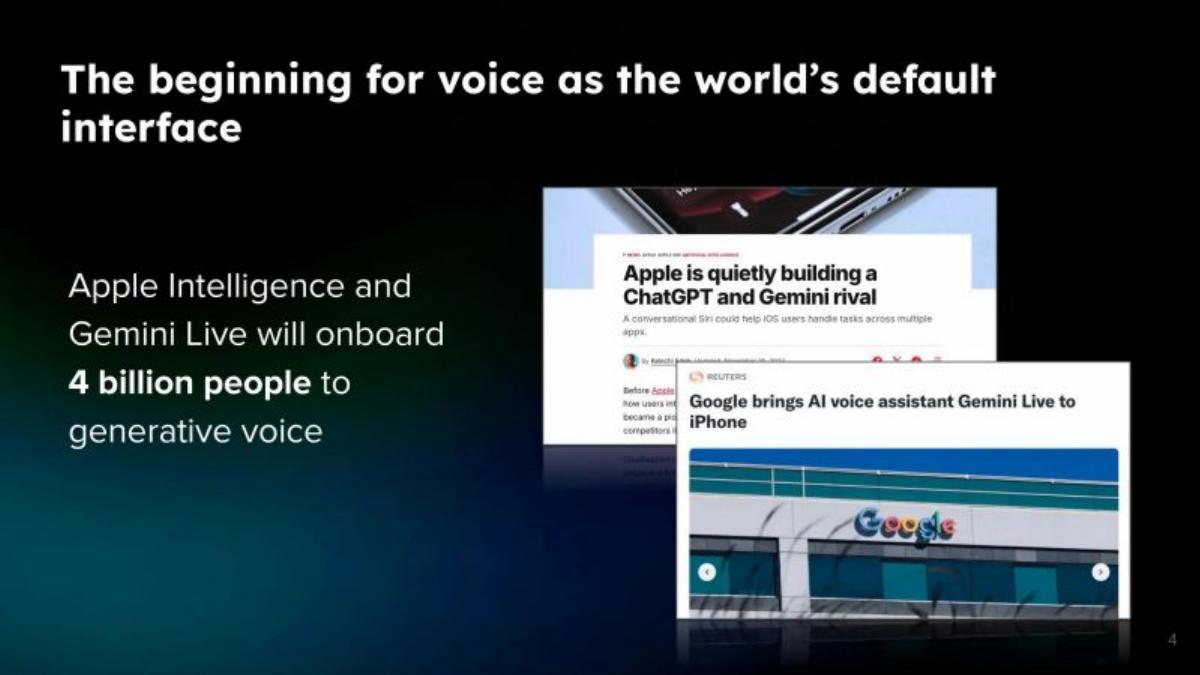
Slide 4 uses news clippings from Apple and Google to validate the market, claiming that Apple Intelligence and Gemini Live will onboard 4 billion people to generative voice. This is a classic 'rising tide' argument. Slide 6 introduces the concept of the telephone as the "universal business API," noting that humans speak approximately 16,000 words per day and make billions of B2C calls daily.
Slide 7 provides the 'pain' metrics: 62% unanswered SMB calls , 13-minute average hold times , and $400B in call center spend . By highlighting 40% agent attrition, Vapi frames the problem not just as a customer experience issue, but as a labor and cost crisis for businesses.
Slides 8-11: The Evolution of Technology
Slide 8 presents a timeline of automated voice systems. It categorizes the 1970s-2010s as the era of "Traditional IVR" (Press 1 for...), the 2010s-2022 as the era of "ASR / STT Systems" (Natural language but high latency), and 2023+ as the era of "Generative Voice AI" (Human-level conversation). The key takeaway here is the shift from "Humans adapting to technology" to "Technology adapting to humans."
Slide 9 and 10 act as a transition, debunking the idea that businesses can just use raw LLM models to fix these problems. Slide 11 delivers the punchline: "Deploying and scaling voice agents takes months, if not years, of specialized engineering." This creates the gap that Vapi intends to fill.
Slides 12-15: The Solution and Mission
Slide 12 is the most important technical slide in the deck. It visualizes the complexity of the voice stack, including Enterprise Telephony, WebRTC, Infrastructure, Knowledge Bases, Deterministic Call Workflows, and Conversational Model Orchestration, all sitting on top of models like Deepgram, Anthropic, OpenAI, and ElevenLabs. Slide 13 then shows Vapi as a single, unified layer that replaces all that complexity. This is the 'magic' moment of the deck.
Slide 14 states the mission: "Bend the arc of technology back to the human voice." Slide 15 reinforces the 'How': a developer platform that makes it easy to deploy voice agents.
Slides 16-19: Market Opportunity and Traction
Slide 16 segments the opportunity into "Existing Call Volume" (Restaurants, Banking, Healthcare) and "New Call Volume" (Language Tutors, AI Companions, Children's Toys). This is a sophisticated way to show that Vapi is both a replacement technology and an enablement technology. Slide 17 lists the technical challenges Vapi is solving: Scale (99.99% uptime) , Determinism , and Deployment .
Slide 18 visualizes the "Customer Adoption Journey," showing how users move from a single "Conversation Node" (after-hours coverage) to a full "Conversation Tree" (multi-agent workflows and multi-channel integration). This suggests a clear path to expansion revenue within their customer base.
The deck concludes on Slide 19 with a summary of their current status: closing enterprise customers weekly, a sprouting startup ecosystem, and 100% organic growth . Notably, there are no specific revenue numbers, no team slide, and no mention of the $20M they were seeking.
What Works
The 'Stack' Visualization: Slides 12 and 13 perfectly articulate the value proposition. By showing the six layers of engineering hell that Vapi replaces, they make the product feel like a necessity rather than a luxury. · Market Bifurcation: Slide 16 is excellent. It shows the investors that Vapi isn't just a better call center tool; it's a platform for entirely new categories of software. · Developer-First Framing: The deck consistently speaks to the developer experience. Phrases like "universal business API" and "deterministic call workflows" signal that this is a tool for builders, which is a highly defensible position in the AI race.
What is Missing
Team Slide: There is no mention of the founders' backgrounds or previous successes. In a Series A, the 'who' is usually as important as the 'what.' · Competition: The deck ignores other voice AI platforms or the threat of model providers (like OpenAI) building their own orchestration layers. · Financials: There are no charts showing MRR growth, burn rate, or unit economics. While the deck mentions "100% organic growth," it provides no data to back up the scale of that growth. · The Ask: The deck does not state how much money is being raised or what the milestones for the next 18-24 months will be.
Founder Takeaways
Sell the Abstraction: If your product makes a complex process simple, spend your slides showing the 'before' (the complex stack) and the 'after' (your single block). · Define the Era: Vapi successfully frames the current moment as a paradigm shift (Slide 8). If you can convince investors that a new era has begun, they will be more likely to believe that new infrastructure is required. · Use 'New' Market Categories: Don't just show how you replace old things. Show what new things your product enables that were previously impossible. This expands the perceived TAM.
Frequently asked questions
- Why does the deck lack a team slide?
- In high-profile Series A rounds where the founders are already known to the lead investors (in this case, Bessemer and Y Combinator), a team slide is often omitted from the external version of the deck. The focus is shifted entirely to the product's technical moat and the market opportunity. For Vapi, the developer-first traction likely spoke louder than individual resumes.
- How does Vapi define its market opportunity?
- Vapi uses Slide 16 to split the market into two distinct categories: replacing existing call volume in legacy industries (Banking, Healthcare, Insurance) and enabling entirely new categories of voice interaction that were previously impossible (AI Companions, Language Tutors, Roleplay Training). This suggests they are not just fighting for existing market share but expanding the total addressable market.
- What is the 'Universal Business API' mentioned in the deck?
- On Slide 6, Vapi refers to the telephone as the 'universal business API.' This is a strategic framing device. By calling a legacy technology an 'API,' they align the telephone with modern software development, making the case that voice should be as programmable and scalable as any other cloud service.
- How does Vapi address the technical difficulty of voice AI?
- Slide 12 and 13 are the core of the technical argument. Slide 12 shows the 'stack' a business would need to build manually: Enterprise Telephony, WebRTC, Infrastructure, Knowledge Bases, Deterministic Workflows, and Model Orchestration. Slide 13 shows Vapi as a single block replacing all of those layers, simplifying the developer experience.
- What metrics does Vapi use to show traction?
- Vapi is remarkably vague on hard numbers. Slide 19 claims they are 'closing enterprise customers every week' and growing '100% organically.' They do not list ARR, seat counts, or specific customer names. This suggests the deck was used to facilitate a process where the lead investor already had access to the data room.